by
Tom Gurney
Tom Gurney BSc (Hons) is an art history expert with over 20 years experience
Published on June 19, 2020 / Updated on October 22, 2026
Email:
tomgurney1@gmail.com
/ Phone:
+44 7429 011000
Bird in Three Views: Introduction
A bullfinch appears three times on this sheet: in profile above, from behind at the lower left, and facing the viewer at the lower right. Each view reveals a different part of its compact body. The red breast that dominates the profile almost disappears when the bird turns away; the long tail that anchors the rear view contracts behind the rounded frontal body. Bridgeman Images reproduces the sheet as Three Studies of a Bullfinch and locates it at the Real Monasterio de San Lorenzo de El Escorial, near Madrid. [1]
The familiar association with Albrecht Dürer needs qualification. In a notice dated 23 January 2025, the Royal Collections Gallery named a bird seen from the front, side and behind among six works by one of Dürer’s followers. This distinctive title corresponds closely to the Escorial study. The notice’s wording should accompany its traditional Dürer attribution; a precise date remains uncertain. The sheet’s appeal lies in an unusually direct invitation to look around a small animal, comparing its surfaces and discovering how much a change of viewpoint can conceal. [2]
The bird is a male bullfinch, rather than the parrot sometimes named in reproductions. Its pink-red breast and cheeks, grey back, black cap and tail, and white rump agree with the identifying features described by the RSPB. These markings are distributed across the sheet so that recognition develops through comparison. The profile supplies the clearest combination of face, breast and folded wing. The rear view exposes the pale rump. The frontal view brings the black head and red body into their most concentrated arrangement. [3]
At a Glance
- Subject Bullfinch shown in three views [1]
- Location El Escorial [1]
- Attribution qualification The Royal Collections’ 2025 notice identifies a closely corresponding study as a Dürer follower’s work [2]
- TypeDrawing [1]
This work across Albrecht Dürer’s career
Bird in Three Views (current article)
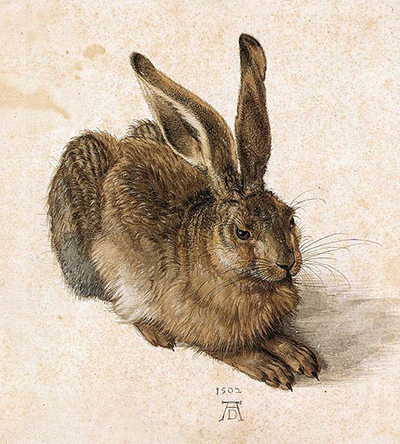
Date uncertainYoung Hare
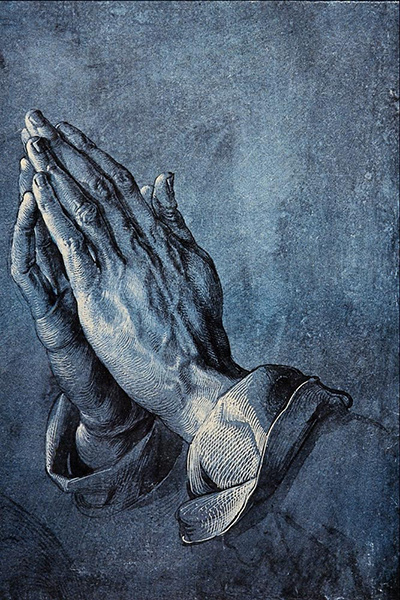
1502Praying Hands
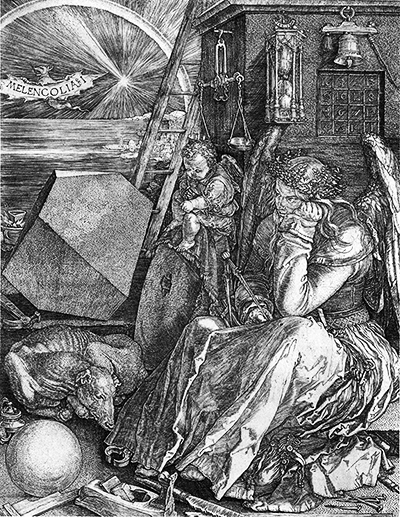
1508Melencolia I
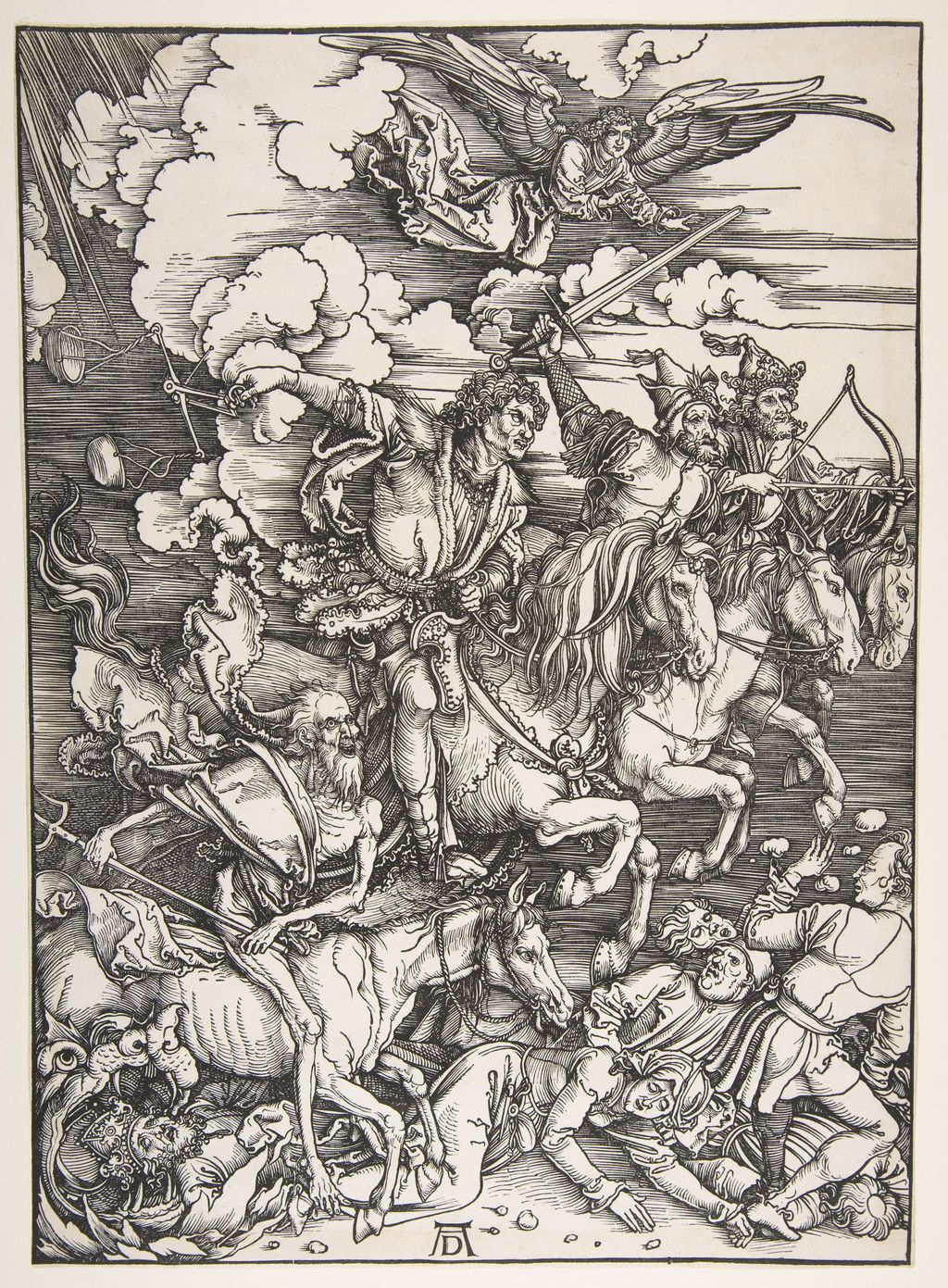
1514Four Apostles
1526Contents
- Turning the bird
- A recognisable Escorial study
- What three views can tell us
- Frequently Asked Questions
Turning the bird
At the top, the bullfinch faces left with its tail descending towards the right. The head is bowed slightly; its short dark bill forms a small projection below the forehead. A small bright point distinguishes the eye. Below it, the red cheek broadens into the breast, where fine pale strokes run through the colour. The body has weight: its broad curve settles above a cluster of toes and hooked claws, while a narrow shadow follows the underside towards the tail.
The folded wing crosses the side as a strong dark band. Pale patches interrupt it, and the grey-blue back rises above it in a gently sloping mass. Here the bird can be understood as a sequence of overlapping forms: head before shoulder, shoulder above wing, wing lying along the body. The white underside near the tail provides a lighter interval between the red breast and the black feathers extending behind it. Small changes in the direction of the strokes help distinguish these adjoining areas without outlining every feather separately.
The lower-left view reorganises those same colours. A rounded black cap sits above an oval back, with thin red strips remaining visible along its sides. The wings form dark borders around the grey centre, and the white rump makes a conspicuous patch immediately above the tail. This view explains an area that the profile largely compresses. It also makes the tail seem much longer, because the feathers extend towards the bottom of the sheet on an almost vertical axis, uninterrupted by the red body in front.
Looking at the rear view after the profile changes the way the upper bird is read. The white marks near its wing and tail cease to be isolated decorative touches: they belong to a pattern that continues around the animal. The painter has given the viewer enough overlapping information to connect one aspect with another. Yet the three silhouettes retain distinct characters. The upper bird is a long diagonal; the rear view is narrow and upright; the frontal one is broad and almost circular.
That frontal view produces the strongest sense of encounter. The black head tips towards us, with the bill and surrounding pale accents gathered into a small central area. Beneath it, the red breast spreads towards the edges, becoming lighter across its rounded middle. The grey shoulders appear as short patches on either side. A little row of claws emerges below, and the shadow falls away to the right. Almost all the tail has disappeared behind the body. The bird seems shorter without losing the impression of fullness established above.
The shadows are important to this transformation. They give each body a place against the pale ground, while the absence of branches, foliage or a distant setting keeps attention on the animal itself. Around the lower birds, the shadows occupy some of the space that a habitat might otherwise fill. They separate the bodies from their background and reinforce the different directions in which they are presented. Nothing on the sheet establishes a continuous scene in which three birds meet; the spaces between them encourage us to move from one view to the next.
A recognisable Escorial study
A particularly specific early account comes from Sebastian Killermann, who visited the Escorial at Easter 1909. In his 1910 book on Dürer’s plant and animal drawings, he described eleven studies assembled within a divided frame. His number 5 was a Gimpel or Dompfaff , the German names for the bullfinch, represented from the front, back and side. Later in the book he identified it as a male and described the red-purple breast, blue back, black head and tail, and white wing markings. His schematic plate places a profile bird in the corresponding compartment. [14]
Killermann’s description makes the study recognisable across more than a century. It also records the attraction of its colour relationships: precisely the features that remain legible when the bird changes direction. He tentatively favoured Dürer’s authorship, but acknowledged doubts about the attribution of the group and reported that he had been unable to find the familiar signature in the poor light. His account preserves both admiration and uncertainty. [14]
The surrounding collection had already received different names. Vicente Poleró y Toledo’s 1857 Escorial catalogue placed a collective entry for natural-history studies under Juan Holbein. It included birds, quadrupeds, fish, flowers and a landscape, describing work on paper and vellum attached to panels. Its measurements refer to the ensemble, so they cannot supply the size of this individual bullfinch sheet. That collective treatment helps explain why an animal study could be discussed through the identity of the larger display rather than through a separate, consistently catalogued object. [15]
Writing in 1923, José María Florit argued firmly for Dürer. He connected the natural-history group with sixteenth-century delivery records, reporting eight small panels in 1571–72 and nine in 1574. He also described the studies separated by mouldings within a common glazed frame. His discussion concerns the group, without identifying the three-view bullfinch separately. These accounts document changing interpretations of the collection; they do not fix this sheet’s maker or an exact year of execution. [16]
The Royal Collections’ 2025 rotation brought the front-side-back bird together with five other animal studies designated as the work of a follower. The notice explains the rotation of fragile works on paper for conservation, placing the drawings within an active programme of display and rest. Its announcement records that particular change of exhibits, rather than establishing where the bird will be on view during a future visit. [2]
What three views can tell us
The arrangement invites the term “model sheet”, because it gathers information that a single view cannot contain. A painter consulting the page could compare the placement of the wing, the shape of the back and the extent of the breast. That is a way of reading its usefulness, rather than proof of its original purpose. The sheet contains no visible sequence of instructions, measurements or labels. Its three finished-looking birds allow close comparison, but do not identify a later composition for which they were required.
Nor does the arrangement settle how the subject was observed. Three views are compatible with repeated looking, but cannot establish that one living bird posed for all of them. Killermann suggested the possibility of a trained cage bird; that remains his speculation. The visible evidence is the painter’s attention to changing appearances. Even the black plumage varies: it forms a curved cap, narrow folded wings and an extended tail, each with a different outline and relationship to the surrounding colour. [14]
Bridgeman describes the medium as watercolour and gouache on paper. In the reproduction, fine light strokes animate the breast and back, while denser dark passages hold the head, wings and tail together. The eye moves between these textures as readily as it moves between viewpoints. The result is informative without becoming a labelled diagram. We recognise the bullfinch through the combination of its parts, then return to each view with a fuller understanding of what lies beyond its silhouette. That exchange between recognition and renewed looking gives this small study its lasting interest. [1]
Frequently Asked Questions
Artworks directory
These 187 records include individual works, reverse sides, detail views, paired panels and reconstructed arrangements. Three additional catalogue images repeat works already listed. Related views are not counted as separate originals; qualified attributions and published dating are retained.
Discussion
Look again at the images and ideas explored in Bird in Three Views. These editorial prompts invite your observations.
Reader Insights
Which detail or idea in Bird in Three Views most changed your reading, and why?
How does the discussion of “Turning the bird” affect your understanding?
What comparison would you bring to the discussion of “What three views can tell us”?
Join the Conversation
Share a detail, comparison or question about Bird in Three Views below.
References
- Bridgeman Images , Three Studies of a Bullfinch , image XIR221442 (English record; German localisation also available). Photograph, collection credit and medium description. View source .
- Galería de las Colecciones Reales , “Rotación en la Galería. El Beato de Liébana se exhibe en el ámbito dedicado a El Escorial y Felipe II” (Spanish), 23 January 2025. View source .
- Royal Society for the Protection of Birds , “Bullfinch” (English), species identification. View source .
- ALBERTINA, Selbstbildnis als Dreizehnjähriger, inv. 4839 (German). View source.
- Metropolitan Museum, Four Horsemen from The Apocalypse, 19.73.209 (English). View source.
- Bayerische Staatsgemäldesammlungen, Selbstbildnis im Pelzrock, inv. 537 (German). View source.
- ALBERTINA, Feldhase, inv. 3073 (German). View source.
- ALBERTINA, Das große Rasenstück, inv. 3075 (German). View source.
- Metropolitan Museum, Adam and Eve, 19.73.1 (English). View source.
- ALBERTINA, Betende Hände, inv. 3113 (German). View source.
- Metropolitan Museum, Knight, Death, and the Devil, 43.106.2 (English). View source.
- Metropolitan Museum, Melencolia I, 43.106.1 (English). View source.
- Bayerische Staatsgemäldesammlungen, inventory 545: current collection record (German; descriptive citation). View source.
- Sebastian Killermann , A. Dürers Pflanzen- und Tierzeichnungen und ihre Bedeutung für die Naturgeschichte (German; Strassburg: J. H. Ed. Heitz, 1910), pp. 3–5, 66–67 and plate I. View source .
- Vicente Poleró y Toledo , Catálogo de los cuadros del Real Monasterio de San Lorenzo, llamado del Escorial (Spanish; Madrid, 1857), no. 260, p. 77, under the preceding Juan Holbein heading. View source .
- José María Florit , “Los aposentos de Felipe II en San Lorenzo del Escorial” (Spanish), Boletín de la Sociedad Española de Excursiones 31 (December 1923), pp. 296–300, especially p. 298. View source .
- Germanisches Nationalmuseum, Barbara Dürer (German and English). View source.
- Web Gallery of Art, Tucher–Rieter reverse (English). View source.
- National Gallery of Art, Portrait of a Clergyman (English). View source.
- Dürer Art, Portrait of a Man (English). View source.
- Hessen Kassel Heritage, Elsbeth Tucher (German). View source.
- Web Gallery of Art, Hans Tucher (English). View source.
- Germanisches Nationalmuseum, Emperor Maximilian I (German and English). View source.
- National Gallery of Art, Lot and His Daughters, reverse (English). View source.
- Bayerische Staatsgemäldesammlungen, Glim Lamentation (German). View source.
- Museo Nacional del Prado, Portrait of a Man (Spanish). View source.
- Bayerische Staatsgemäldesammlungen, Madonna of the Carnation (German). View source.
- Städel Museum, Job on the Dungheap (German). View source.
- Wallraf-Richartz-Museum, Piper and Drummer (German). View source.
- Italian Ministry of Culture / Uffizi, Head of Saint James (Italian). View source.
- Klassik Stiftung Weimar, Dresden Altarpiece (German). View source.
- Staatliche Museen zu Berlin, Girl with a Red Beret (German and English). View source.
- Dresden State Art Museums / Roland Enke, Bernhard von Reesen (German). View source.
- Royal Collection Trust, Burkhard von Speyer (English). View source.
- Dresden State Art Museums, Seven Sorrows of the Virgin (English). View source.
- Bayerische Staatsgemäldesammlungen, Mater Dolorosa (German). View source.
- Bayerische Staatsgemäldesammlungen, Lucretia (German). View source.
- Städel Museum, Young Woman with Her Hair Down (English). View source.
- ALBERTINA, Portrait of a Young Man (German). View source.