 by
Tom Gurney
Tom Gurney BSc (Hons) is an art history expert with over 20 years experience
Published on October 22, 2026 / Updated on October 22, 2026
Email:
tomgurney1@gmail.com
/ Phone:
+44 7429 011000
Dürer’s Techniques and Art Theory: Introduction
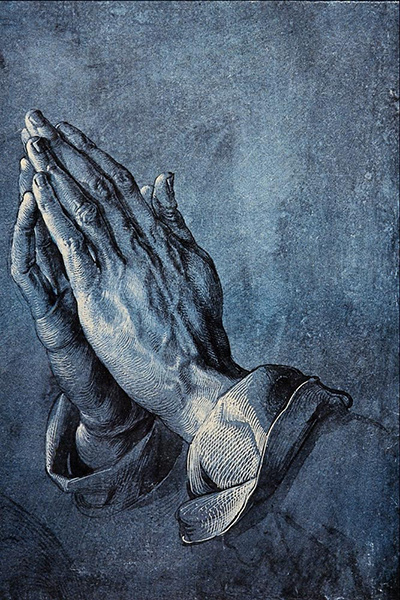
A white stroke catches a knuckle; dark hatching follows a tendon. In Dürer’s Praying Hands of 1508, blue-prepared paper supplies the middle tone between them. Brush, wash and white heightening give the fingers their rounded presence. The hands belonged to an apostle in the Heller Altarpiece and originally shared their sheet with his head. [1] [2] [3]
A material decision can become a way of thinking. Cutting a printable line, laying a coloured ground and plotting a viewpoint each require the maker to understand how an image will emerge. Dürer’s writings pursue that connection between making and understanding. His 1525 measurement book teaches through constructions that a reader can follow with tools, paper and attentive eyes. [4]
At a Glance
- Practice Materials, measurement and the construction of images [1] [4] [5] [6]
- Teaching subjects Perspective, proportion, letter design and fortification [4] [7] [8]
Contents
- Cutting and printing
- The drawing surface
- Painting as work
- Layers and later interventions
- A design and its impressions
- From a workshop to a book
- The position of the viewer
- Letters, tools and choice
- Bodies that can change
- Beauty and the trained hand
- Frequently Asked Questions
Cutting and printing
An engraving begins with an incision in metal. The copper plate receives the design, while the viewer sees ink transferred from it. The burin is pushed through the metal, its handle braced against the palm, leaving a channel that can retain ink. A scraper and burnisher can alter the surface again. The line is a physical incision before it becomes a black mark on a sheet. [5]
This process explains the importance of both cutting and printing. Ink is spread over the plate and wiped from its surface, remaining in the recesses. Damp paper is pressed firmly against it to take up that ink. The printer’s judgment determines how much stays and how it is distributed. The plate carries the design, but the appearance of an impression also depends upon the work of bringing that design onto its support. [5]
In a woodcut, the cutter clears the spaces around the design and preserves raised lines to receive ink. A fine printed stroke represents a slender ridge left standing. Design and cutting are different tasks; specialist cutters worked from Dürer’s designs, and the extent of his own carving remains debated. [9]
The British Museum’s Entombment block from the Small Passion , made around 1509–10, gives this process tangible dimensions: 129 by 99 millimetres across and 25 millimetres deep. Scientific examination identified pearwood cut along a tangential longitudinal section of its grain. The working face therefore runs along the wood, unlike later end-grain wood engraving. Thirty-five of the series’ thirty-seven blocks survive together in the museum. They could outlive their designer: the blocks were used again in Venice in 1612. [10]
Drypoint uses a pointed tool to scratch the metal. It can leave displaced metal, or burr, beside the groove; retained burr gives the printed mark a different character from a cleaned incision. Etching introduces another agent: acid attacks the metal where a needle has opened the protective ground. The needle draws through a coating while the acid makes the printable recess. These procedures change the relationship between the maker’s gesture and the finished line. [5]
Dürer’s Saint Jerome by a Pollard Willow (1512) uses drypoint’s soft darkness. The Agony in the Garden (1515) was etched on rust-prone iron. Similar-looking black marks can therefore record different processes. [9] [11]
Nor was every support paper. The Albertina’s Knight, Death and the Devil , DG1930/1550, is an impression on silk satin. The material belongs to this particular object; recognising the design alone does not tell us what was printed upon, or when. [12]
The drawing surface
Dürer’s 1484 Self-Portrait at Thirteen uses silverpoint on prepared paper. Adjustments in the cap, arm and finger reveal tentative laying out followed by firmer definition. [1] [2]
The support, its ground and the marks upon it are separate elements. Metalpoint needs a prepared surface to receive its trace. Pen and brush can work through lines and washes; watercolour, opaque colour and white heightening offer other ways of building a form. On a coloured ground, light can be added as a positive mark instead of supplied entirely by untouched white paper. Dürer’s Venetian carta azzurra was coloured during manufacture. His later Nuremberg sheets could receive an applied blue or green ground. The Albertina’s 2025 exhibition interprets the highly finished studies as workshop resources and showpieces as well as works related to paintings. [13]
The Three Drapery Studies of 1508 uses green over pink preparation. Its separate pieces concern the apostle of the Praying Hands . Comparison with Jobst Harrich’s surviving copy of the lost Heller centre cannot settle every original lighting effect. [1] [2]
Painting as work
Dürer’s letters to Jacob Heller bring drawing and painting into a setting of expense, negotiation and daily labour. In 1508 he distinguishes the progress of the wings from that of the centre. He has carefully outlined the middle panel and proposes repeated applications of expensive ultramarine. His promise that no one else will paint a stroke concerns that central part. It does not turn the entire altarpiece into a work carried out by one pair of hands. [6]
The disagreement over payment is also a disagreement over the degree of finish being purchased. Dürer insists that he has promised unusually careful work, yet resists the suggestion that this means the utmost care imaginable. At that rate, he argues, a face alone could occupy months. His impatient point about an altarpiece is practical: details must be seen. Time spent making something and the conditions in which someone will look at it are parts of the same calculation. [6]
His account makes materials inseparable from time. He describes the cost of colours, the work still needed in the upper part and the shortening winter days. A panel can contain passages at different stages while the artist continues to negotiate its completion. These letters give us a maker explaining his procedure to a patron, with pride, irritation and financial interest all affecting the explanation. They are especially vivid evidence because the technical claims are also arguments. [6]
Delivery did not end his concern. Dürer discussed packing and framing, rejected a roughly made frame and proposed fastening the replacement securely. He wanted the picture tilted forward slightly for good light. He also contemplated returning to varnish it after it was properly dry. His assurance that the colours could endure for five hundred years expresses confidence to a customer, rather than a measured forecast. The future of the object already occupied its maker. [6]
The often repeated complaint that engraving would have made him richer occurs in this bargaining correspondence. It shows how he weighed labour against income, without supplying an audited comparison of his activities. The exchange ends with the painting received, the payment settled and gifts acknowledged by his wife and brother. Technical achievement depended upon a household, intermediaries, transport and a patron’s eventual satisfaction as well as the painter’s control of a brush. [6]
Layers and later interventions
Infrared can reveal carbon-black underdrawing beneath some paint layers. X-rays respond to materials such as heavy-metal pigments and fastenings, and superimpose information from several layers. The National Gallery’s glossary explains why these images require interpretation: each records a different interaction with the object. [14] [15]
The Met’s Salvator Mundi , around 1504–05, retains pen hatching and curved brushstrokes visible in infrared. Ainsworth records its compromised condition: unfinished in 1573, later completed, then cleaned with damage and retouching. Linden and a calcium-carbonate ground favour Germany, though both were available in Venice. Examination in 2005 indicated the proposed Bremen wings most likely did not belong. Why Dürer stopped remains unknown. [15]
The Prado’s 1507 Adam and Eve demonstrates how later interventions change a painted surface. Conservator George Bisacca recalls Eve’s original porphyry-like reverse, while Adam had been thinned to less than half its thickness and fitted with a rigid cradle, causing about sixty splits. He and José de la Fuente removed it, repaired the fractures with 381 wooden inserts and installed a spring-supported structure. The repaired panel naturally assumed Eve’s curvature. The Prado’s restoration account also distinguishes treatment of the paint: dirt, varnish and repaint had obscured the colouring, while fine flesh glazes softened Dürer’s fluid brush underdrawing. The apparent continuity of a body depends upon the wood beneath its paint. [16] [17]
The current Pinakothek records identify fir wings and a linden centre in the Paumgartner Altarpiece . At the 2006 Dürer roundtable, Martin Schawe asked whether differing woods and preparations might indicate that the panels’ first intended arrangement differed from the surviving triptych. Later assembly by Dürer was a possibility, not an established reconstruction. The difference between identifying a material and explaining an object’s history remains essential. [18] [19]
After the 1988 acid attack, the Paumgartner paintings required years of restoration. The Doerner Institut records the development of treatments based on ion exchangers. These belong to the paintings’ modern material history; they do not describe the methods by which Dürer painted them. [20]
A design and its impressions
A design, a printing surface and a printed impression have different histories. The design is the image being repeated; the plate or block is the object from which it is taken; an impression is one result of printing. A state identifies an alteration to that printing surface, such as an added or removed line or inscription. An edition concerns a publishing event or group of impressions. A later impression need not be a new state: the surface might have worn without receiving a deliberate alteration. [5]
Lippmann’s historical handbook, revised by Max Lehrs and translated by Martin Hardie in 1906, draws attention to trial proofs as evidence of work in progress. A maker can examine a printed result while still changing the plate. It also explains the effects of wear: delicate lines can weaken and tonal relationships change. A bold black passage alone therefore cannot tell a viewer the whole story. Printing, wear and subsequent work on the matrix must be considered together. [5]
Dürer himself offers a memorable observation in the proportion treatise, translated in Conway’s 1889 edition. Even two impressions from one copper plate, he says, reveal differences. He uses this example while distinguishing the unavoidable variation in making things from changes an artist deliberately intends. Repetition is already an instance of difference. His theory looks back towards the practical experience of producing multiples, where a repeated design does not make every surviving object interchangeable. [6]
The National Gallery of Victoria records the mould’s close laid lines, wider chain lines and wire watermark, using measurements and beta-radiographs. Paired moulds produced related twins; wire profiles could change through damage or repair. Trimming can leave partial marks or separate countermarks. An absent mark alone cannot establish an early impression. [21]
The Germanisches Nationalmuseum distinguishes identical marks, similar marks and a shared motif. A crown or catalogue group supplies no exact year. Dating combines paper, state, condition and provenance. Stains and repairs must be distinguished from printed marks. [22] [21]
From a workshop to a book
Three publications set out different parts of Dürer’s teaching: measurement in 1525, fortification in 1527 and human proportion in 1528, the last published posthumously by Hieronymus Formschneyder for Agnes Dürer and dedicated to Pirckheimer. [7]
The 1525 German title names compass and straightedge, lines, planes and solid bodies. The dedication addresses goldsmiths, sculptors, stoneworkers and joiners as well as painters. Dürer presents geometry to people whose work already involves tools and measurement. His printed teaching gives such procedures a form that a learner can revisit, working through a construction at a pace that a finished painting cannot disclose. [4]
One diagram, numbered 40 in the Munich copy, spreads squares and triangles into a large flat arrangement. A central square anchors branches of connected faces. Its outline is irregular on the page, yet the reader is invited to understand those pieces as the surfaces of a solid before assembly. Following the shared edges requires a change of attention: a neighbour on the paper may become a face turning away in space. The diagram lets the learner move between a visible pattern and an imagined object. [4]
This exercise unites eye and hand. A drawn edge supplies both a boundary to look at and a potential line of folding. The flat sheet can become a means of testing a spatial relationship. Geometry enters making at precisely that point, where the reader must understand how separately presented parts will join. The usefulness of the construction reaches beyond the illusion of depth in a picture towards objects that can occupy space. [4]
The position of the viewer
The woodcut of two men plotting a lute turns a spatial problem into a scene of work. The instrument lies on a table. One man brings a cord to points on it; the cord passes through a frame towards its fixed attachment on the opposite wall. The other man attends to the frame and its hinged drawing surface. Object, cord, frame and fixed point make the relationships of projection available for inspection. [4]
The position represented by the attachment must stay consistent while points on the lute change. Each new contact produces another line through the frame. Instead of guessing the foreshortened instrument as a whole, the workers can locate successive points on a plane. The procedure breaks a difficult act of seeing into actions that can be repeated. Move the fixed point, however, and the projected relationships change. [4]
The woodcut also presents perspective as cooperation. One person handles the object’s points while the other attends to their registration. The table supports both the instrument and the apparatus; the room supplies the fixed attachment. The demonstration depends upon an arranged environment as much as upon an abstract line. This makes the lesson unusually concrete, without establishing that every finished composition was plotted mechanically or that Dürer invented perspective. [4]
Letters, tools and choice
Letter construction enters the third book. In R. T. Nichol’s English version, translated from the Latin edition of 1535, Roman A begins within a square; circles help shape its curved terminals. Alternatives change its top and crossbar. The text or quadrate alphabet instead builds repeated upright units from squares and diagonals. The instructions also allow finishing by hand. These visibly different alphabets connect a repeatable construction with a maker’s choice. Nichol’s wording belongs to the later Latin route into the teaching, distinct from the German book of 1525. [8]
Bodies that can change
Dürer recalled one stimulus to his study in an autobiographical passage translated by Conway. Jacopo de’ Barbari had shown him a man and woman constructed according to proportion, but, Dürer felt, withheld the underlying principles. Dürer described turning to Vitruvius and continuing the enquiry himself. This is his account of a beginning, not a surviving explanation of de’ Barbari’s supposed secret. The recollection joins frustrated curiosity with the desire to make knowledge available. [6]
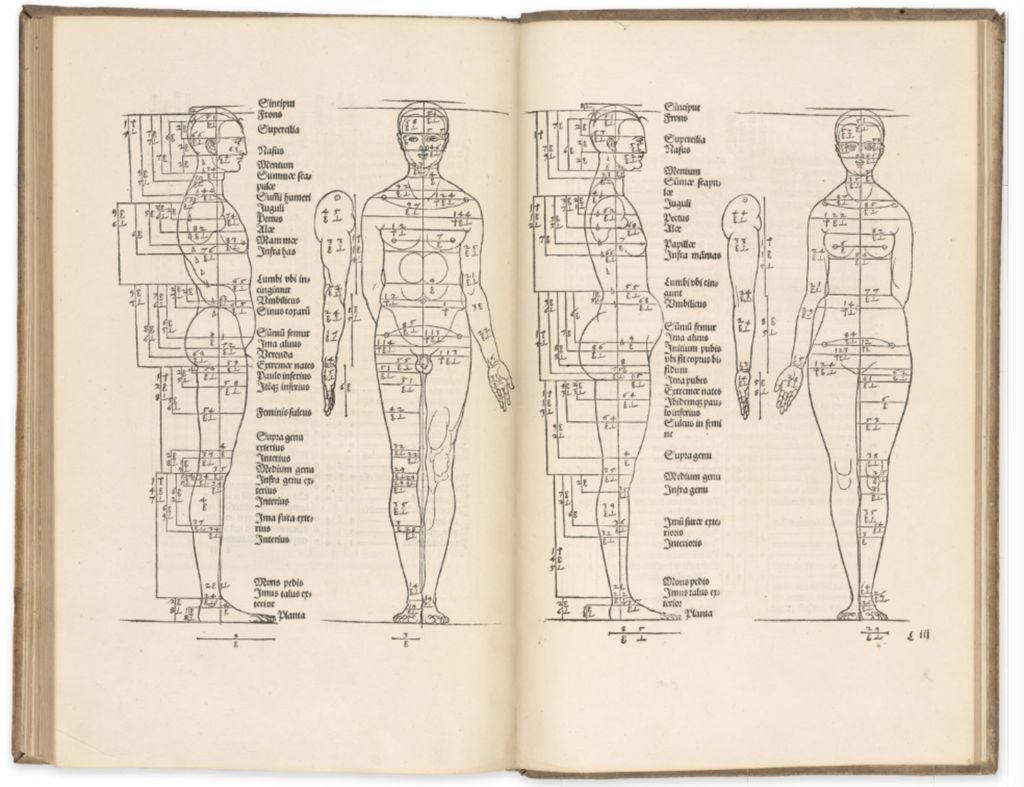
The four books on human proportion move through bodily systems, mathematical alteration and movement. Their illustrations give the reader forms to compare. An early diagram places a male figure in frontal and profile views, accompanied by a separate arm. Heights and widths cross the body at different points. The profile supplies depth that the front cannot; neither view alone describes the whole. The page makes comparison part of understanding a figure. [23] [24]
A later page sets out six profiles within ruled compartments. Shifted reference lines alter the relationship of forehead, nose, mouth and chin. The heads remain recognisably related as diagrams while their characters change. Another sheet presents a long, slender woman from the front and side, with further views of the head. It is possible to follow a level across the page and ask where it falls in each presentation. The body becomes an object of transformation as well as measurement. [24]
In the movement illustration, paired female figures turn so that one shows more of the front, the other more of the back. Numerous lines connect corresponding levels. The curved boundaries of the bodies work against the straightness of those links: shoulders, breasts, waist and hips must remain related through the change of view. A figure capable of turning cannot be understood only as a single frontal outline. The teaching asks the learner to coordinate several aspects of one body. [24]
These pages resist the idea of one formula that explains every Dürer nude. They offer different bodies and ways to alter their forms. Even when dimensions are explicit, the reader must translate a set of relations into a contour. A proportion can indicate where a feature belongs without supplying every subtle change in its shape. The illustrations and the written reflections meet around this demand for a practised hand. [6] [24]
Beauty and the trained hand
In the extract from the third book translated in William Martin Conway’s Literary Remains of 1889, Dürer acknowledges that he cannot give beauty’s final measure. Two people can both be beautiful and differ throughout their proportions, while the viewer remains unable to rank them with certainty. This doubt does not end the enquiry. It gives a reason to keep looking and learning rather than to treat a familiar type as the only possible achievement. [6]
His practical advice begins with coherence. The parts of a figure should agree in age and bodily character. A young head, an old chest and hands of another age do not automatically produce a convincing whole. He urges the artist to examine many people, but to choose appropriately for each figure. A canon supplies relationships; the ability to draw determines how those relationships become a body. The instruction links construction to discriminating observation. [6]
The surrounding text also ranks bodies through racial and physical prejudices. Its claims about desirable forms belong to a historical value system, and cannot serve as neutral measurements of human worth. This matters when reading the apparent precision of the diagrams. A measured relation and a judgment of beauty are different kinds of statement, even when the author brings them together. His own admissions of uncertainty keep that relationship open to examination. [6]
Nature, memory and invention
“For Art standeth firmly fixed in Nature,” Dürer writes in Conway’s translation on page 247. The passage continues through geometry, experience and the forms stored in the artist’s mind. He regards nature as a source of beauty beyond what any maker can exhaust. Study accumulates resources that can later appear in a new work. The familiar sentence belongs to an account of learning and invention, rather than a demand to copy every figure directly from life. [6]
An experienced artist, he argues, can draw upon what has been gathered over time. The forms imagined in the mind have a history outside it, in things studied and skills acquired. Further observation can still improve the work. This allows construction, memory and renewed looking to support one another. A figure assembled with the help of measured relations remains dependent upon experience, while an image made from memory can contain the results of long attention. [6]
Dürer also allows the skilled maker to reveal great power in a small, quickly made work. Careful finish and prolonged labour do not alone measure artistic understanding. That thought adds another dimension to the Heller letters’ concern with time and expenditure: knowledge changes what a hand can accomplish. His theory repeatedly brings the reader back to practice, where an instruction is useful only when someone has learned how to act upon it. [6]
Measurement could itself become a troubling subject. In the 1525 Victoria , a seated peasant with a sword projecting from his back tops a stack of objects, including agricultural tools and a sheaf. Elizabeth J. Petcu’s study, published online in 2026, connects this monument with disputes over measures and obligations during the Commoners’ Revolt. She reads its distribution of burdens, and the precarious weight of the proportioned figure in Nemesis , as explorations of uncertainty. Her interpretation questions measurement’s social and artistic authority; it does not establish Dürer’s recorded intention or a party allegiance. The nearby drunkard’s monument further complicates the book’s mood. [4] [25]
Geometry at the scale of a city
The 1527 fortification book applies plans, sections and elevations to defences for cities, castles and smaller settlements. Its proposals combine ditches, moats, earthworks and artillery positions. The opening exhibited by Bridwell Library cuts across a broad structure, exposing its substantial interior supports. Such a drawing lets the reader relate an exterior to what lies within. These are printed models for considering construction, rather than proof that the schemes were built or that they describe Nuremberg’s existing walls. [7]
From a folded solid to a turning body, Dürer’s diagrams ask the learner to relate one view to another. His writings also acknowledge what rules leave unresolved: the work of drawing, the variety of nature and the uncertainty of judgment. Teaching makes a procedure available without doing all its work for the reader. A compass construction can be repeated; understanding grows when a practised eye and hand put it to use. [4] [6] [24]
Frequently Asked Questions
Further reading
A historical edition for following the primary texts. Its translation and editorial commentary belong to the nineteenth century.
Literary Remains of Albrecht Dürer. William Martin Conway; manuscript transcripts and notes by Lina Eckenstein. Cambridge: Cambridge University Press, 1889.
Read the selections from Dürer’s theoretical writings alongside this article. Read the digitised edition.
Artworks directory
These 187 records include individual works, reverse sides, detail views, paired panels and reconstructed arrangements. Three additional catalogue images repeat works already listed. Related views are not counted as separate originals; qualified attributions and published dating are retained.
Discussion
Look again at the images and ideas explored in Dürer’s Techniques and Art Theory. These editorial prompts invite your observations.
Reader Insights
Which detail or idea in Dürer’s Techniques and Art Theory most changed your reading, and why?
How does the discussion of “Cutting and printing” affect your understanding?
What comparison would you bring to the discussion of “Geometry at the scale of a city”?
Join the Conversation
Share a detail, comparison or question about Dürer’s Techniques and Art Theory below.
References
- ALBERTINA: Praying Hands , 3113; Self-Portrait at Thirteen , 4839; Three Drapery Studies , 3115. German records and Heinz Widauer essays, 2003/2008; English introductions. View source 1 . View source 2 . View source 3 .
- Charles Ephrussi, Albert Dürer et ses dessins (Paris: A. Quantin, 1882), selected pp.2,14–16,20,78–80,107,109,120,153,178,188,298,302; index pp.399,403,405–406,409–410; additional selected pp. 86, 111–112, 152, 158 (footnote 1) and 202. Original French edition. View source.
- Moriz Thausing, Albert Dürer: His Life and Works, translated from German, edited by Fred. A. Eaton, vol. II (London: John Murray, 1882), pp. 16–18. Original English edition. View source.
- Albrecht Dürer , Underweysung der Messung (1525), bsb00095496, digital images 7–8, 160, 203; bsb00084858, images 94–95. German primary text and diagrams. View source 1 . View source 2 .
- Friedrich Lippmann , Engraving and Etching: A Handbook for the Use of Students and Print Collectors , revised Max Lehrs, translated Martin Hardie (New York: Charles Scribner’s Sons, 1906), pp. 1–5, 10–15. Historical English edition. View source .
- Albrecht Dürer, Heller letters, de’ Barbari recollection and proportion extract, in William Martin Conway, Literary Remains of Albrecht Dürer (Cambridge: University Press, 1889), pp. 65–71, 165, 243–248, quotation p. 247; additional inherited selected family chronicle pp. 34–35, 37, 40–41, 47, 51–52, 93, 97, 122–123. Historical English translation from German; manuscript transcripts and notes by Lina Eckenstein. View source.
- Bridwell Library , Books and Prints by Albrecht Dürer: Underweysung der Messung (1525), Etliche Underricht zu Befestigung der Stett, Schloss, und Flecken (1527), Vier Bücher von menschlicher Proportion (1528). English entries; German originals. View source 1 . View source 2 . View source 3 .
- Albrecht Dürer , Of the Just Shaping of Letters , R. T. Nichol’s English translation from the 1535 Latin edition, Roman A and quadrate-letter instructions; Project Gutenberg (2011), Dover electronic text. View source .
- Suzanne Boorsch and Nadine M. Orenstein , The Print in the North: The Age of Albrecht Dürer and Lucas van Leyden , Metropolitan Museum of Art Bulletin 54:4 (1997), pp. 3–8, 25, 35. English. View source .
- British Museum , Entombment woodblock, 1839,0608.3.44, scientific identification and Bartrum catalogue commentary. English. View source .
- NGV , Agony in the Garden , 3436-4. English; etching on iron, 1515. View source .
- ALBERTINA , Knight, Death and the Devil , DG1930/1550. German; silk-satin impression record and 2012 catalogue text. View source .
- Achim Gnann and Christof Metzger , curators, Leonardo–Dürer: Renaissance Master Drawings on Colored Ground , ALBERTINA exhibition dossier (2025), pp. 6–10. English. View source .
- National Gallery , London, technical glossary: “Infrared” and “X-rays”. English. View source 1 . View source 2 .
- Maryan W. Ainsworth , “Salvator Mundi,” in Stijn Alsteens and Freyda Spira, eds., Dürer and Beyond: Central European Drawings in the Metropolitan Museum of Art, 1400–1700 (Metropolitan Museum, 2012), cat. 8, pp. 19–22, including notes and infrared illustration. English. View source .
- George Bisacca , “Adam and Eve by Dürer. A wonderful experience”, Prado, recorded 7 October 2020. English interview-segment transcript. View source .
- Pilar Silva Maroto , Maite Dávila and José de la Fuente, “Special Display: Adam and Eve, by Dürer, following their restoration”, Prado (2010–11), “Restoration details.” English. View source .
- Bayerische Staatsgemäldesammlungen , Paumgartner panels: 701, 702, 706. German; current support metadata. View source 1 . View source 2 . View source 3 .
- Germanisches Nationalmuseum , Dürer roundtable proceedings (2006), p. 20, Martin Schawe. German. View source .
- Doerner Institut , “Geschichte”, “1977 bis heute.” German. View source .
- NGV , “Watermarks in the NGV’s collection of prints by Albrecht Dürer”, introduction and glossary. English. View source .
- Germanisches Nationalmuseum/BAM , “Wasserzeichenanalyse”, methods and limitations. German. View source .
- National Library of Medicine , Dürer: author and title description, four-book structure. English. View source .
- Albrecht Dürer , Vier Bücher von menschlicher Proportion (1528), title and facsimile pp. [11], [175], [194], [230]. German primary illustrations. View source .
- Elizabeth J. Petcu , “Dürer’s Victoria: Contending with the Uncertainty of Measurement”, The Art Bulletin 107:4 (2025), pp. 36–66; online 27 February 2026. Introduction and selected Nemesis discussion. English. View source .
- S. R. Koehler, A Chronological Catalogue of the Engravings, Dry-Points and Etchings of Albert Dürer, as Exhibited at the Grolier Club (New York: Grolier Club, 1897), selected entries: 5 (p. 5), 14 (p. 14), 16–17 (pp. 17–18), 32–33 (pp. 32–35), 34 (pp. 37–38), 35 (p. 42), 38 (p. 44), 55 (p. 51), 65 (p. 55), 69–70 (pp. 58–61), 71 (p. 63), 89 (p. 77), 95 (p. 81). English. View source.
- T. Sturge Moore, Albert Dürer (London: Duckworth and Co.; New York: Charles Scribner’s Sons, 1905), part III, portrait discussion and caption of the 1500 Munich self-portrait; additional selected Part III, II Portraits, subsection III, Hans Tucher paragraph. Original English edition. View source.
- National Gallery of Art, Annual Report 1974 (Washington: National Gallery of Art, 1975), p. 23; title and copyright pages. English. View source.
- Campbell Dodgson, Catalogue of Early German and Flemish Woodcuts Preserved in the Department of Prints and Drawings in the British Museum, vol. 1 (London: British Museum, 1903). Original English edition Selected pp. 246, 260, 262, 272, 274, 288, 290, 294–296, 299–300, 302, 307. Additional selected introduction p. 3. View source.
- Maud Cruttwell, Andrea Mantegna, London: George Bell and Sons, 1901, pp. 110–112. View source.
- Albrecht Dürer and Benedictus Chelidonius, Epitome in Divae Parthenices Mariae Historiam ab Alberto Durero Norico per figuras digestam cum versibus annexis Chelidonii (Nuremberg: Albrecht Dürer, 1511); Vatican Library, Cicognara.IX.2022, scans 7–46, including all twenty designs, facing texts and final imprint. Latin. View source.
- Hermann Knackfuß, Dürer, 12th edition (Bielefeld and Leipzig: Velhagen & Klasing, 1921), printed pp. 19–20, 24–26, 45–46, 58–60 and 138; plates 22, 30, 36 and 61. Original German edition. View source.
- Heinrich Wölfflin, Die Kunst Albrecht Dürers, second enlarged edition (Munich: F. Bruckmann, 1908), pp. 110, 298. Original German edition. View source.
- Joachim von Sandrart, L’Academia Todesca della Architectura, Scultura & Pittura: oder Teutsche Academie der Edlen Bau- Bild- und Mahlerey-Künste (Nuremberg, 1675), II, book 3, p. 224; facsimile and transcription. View source 1. View source 2.
- Moriz Thausing, Dürer: Geschichte seines Lebens und seiner Kunst (Leipzig: E. A. Seemann, 1876). Original German edition Selected pp.303, 306, 308–309. View source.
- S. R. Koehler, A Chronological Catalogue of the Engravings, Dry-Points and Etchings of Albert Dürer, as Exhibited at the Grolier Club (New York: Grolier Club, 1897), p. 5, cat. 5. English. View source.
- Burlington Fine Arts Club, Exhibition of Early German Art (London: Burlington Fine Arts Club, 1906). Original English catalogue P.24, no.38. View source.
- Albrecht Dürer, Records of Journeys to Venice and the Low Countries, edited by Roger Fry, translated by Rudolph Tombo (Boston: Merrymount Press, 1913), pp. 62–65. English translation from German. View source.
- Germanisches Nationalmuseum, Katalog der im Germanischen Museum befindlichen Gemälde (Nürnberg: Verlag des Germanischen Museums, 1893), pp.34–35, nos.206–209. Original German catalogue. View source.
- Moriz Thausing, Albert Dürer: His Life and Works, translated from German, English edition edited by Fred. A. Eaton, vol. I (London: John Murray, 1882), pp. 119–120. Historical English edition. View source.
- Heinrich Weizsäcker, Catalog der Gemälde-Gallerie des Städelschen Kunstinstituts in Frankfurt am Main, Erste Abtheilung: Die Werke der älteren Meister vom vierzehnten bis zum achtzehnten Jahrhundert (Frankfurt am Main: Druckerei von August Osterrieth, 1900), nos. 83 and 85, pp. 91–98. Original German edition. View source.
- Joseph Heller, Das Leben und die Werke Albrecht Dürer's, vol. II, part 1 (Bamberg: C. F. Kunz, 1827), p. 118, no. 138; pp. 160–162, Florence entry 13; pp. 196–197, Munich entry 17; additional selected pp. 230–231, no. 6 and p. 260, entry e. Original German edition. View source.
- Hans W. Singer, Drawings of Albrecht Dürer (London: G. Newnes; New York: C. Scribner’s Sons, 1906), p. 8; Little Owl (Schönbrunner and Meder no. 829). Original English edition. View source.
- “Ein wiederaufgefundenes Gemälde von Albrecht Dürer”, Hamburgischer Correspondent, no. 473, Abend-Ausgabe (9 October 1900), p. 5, centre column (German). View source.
- Johann Carl Sigmund Kiefhaber, ed., Nachrichten zur ältern und neuern Geschichte der freyen Reichsstadt Nürnberg: ein Beytrag zur Geschichte der Reichsstädte in Teutschland, vol.1 (Nuremberg: Lechner, 1803), first quarter, pp.6–9,14–16. Original German historical edition of correspondence and inventory. View source.
- Friedrich Winkler, Die Zeichnungen Albrecht Dürers, II (Berlin: Deutscher Verein für Kunstwissenschaft, 1937), no. 357, pp. 73–74. German. View source.
- The Metropolitan Museum of Art, Handbook of the Benjamin Altman Collection, with painting descriptions by Bryson Burroughs, other object descriptions by Durr Friedley and William M. Milliken, and introduction by Edward Robinson (New York: The Metropolitan Museum of Art; printed by The Gilliss Press, November 1914), no. 32, pp. 50–52; staff credits, pp. xiv–xv. Original English edition. View source.
- Germanisches Nationalmuseum, Barbara Dürer (German and English). View source.
- Web Gallery of Art, Tucher–Rieter reverse (English). View source.
- National Gallery of Art, Portrait of a Clergyman (English). View source.
- Dürer Art, Portrait of a Man (English). View source.
- Hessen Kassel Heritage, Elsbeth Tucher (German). View source.
- Web Gallery of Art, Hans Tucher (English). View source.
- Germanisches Nationalmuseum, Emperor Maximilian I (German and English). View source.
- National Gallery of Art, Lot and His Daughters, reverse (English). View source.
- Bayerische Staatsgemäldesammlungen, Glim Lamentation (German). View source.
- Museo Nacional del Prado, Portrait of a Man (Spanish). View source.
- Bayerische Staatsgemäldesammlungen, Madonna of the Carnation (German). View source.
- Städel Museum, Job on the Dungheap (German). View source.
- Wallraf-Richartz-Museum, Piper and Drummer (German). View source.
- Italian Ministry of Culture / Uffizi, Head of Saint James (Italian). View source.
- Klassik Stiftung Weimar, Dresden Altarpiece (German). View source.
- Staatliche Museen zu Berlin, (entry description) collection record for painting 557I (1507), object 870760 (German and English). View source.
- Dresden State Art Museums / Roland Enke, Bernhard von Reesen (German). View source.
- Royal Collection Trust, Burkhard von Speyer (English). View source.
- Dresden State Art Museums, Seven Sorrows of the Virgin (English). View source.
- Bayerische Staatsgemäldesammlungen, Mater Dolorosa (German). View source.
- Bayerische Staatsgemäldesammlungen, Lucretia (German). View source.
- Städel Museum, Young Woman with Her Hair Down (English). View source.
- ALBERTINA, Portrait of a Young Man (German). View source.
- Albrecht Dürer, De symmetria partium in rectis formis humanorum corporum, libri in Latinum conversi, translated by Joachim Camerarius (Nuremberg: in aedibus viduae Durerianae, 1532), book II, sig. L2v–L3r (Internet Archive image leaves 127–128), Clark Art Institute Library copy. Original Latin edition; selected original title leaf and illustrated opening inspected. View source.