


 by
Tom Gurney
Tom Gurney BSc (Hons) is an art history expert with over 20 years experience
Published on October 22, 2026 / Updated on October 22, 2026
Email:
tomgurney1@gmail.com
/ Phone:
+44 7429 011000
Dürer’s Large Passion: Introduction
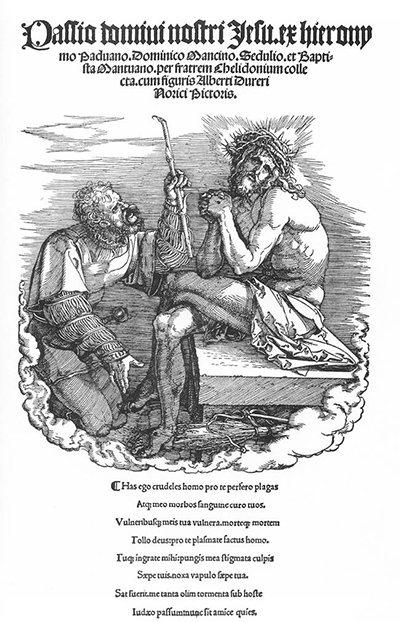
Christ first appears seated, his hands together and his body exposed, while a kneeling soldier raises a reed towards him. Eleven pictures later he stands above the tomb, carrying a banner, with soldiers scattered beneath him. Between those two appearances, Dürer’s Large Passion leads through a meal, a garden, arrest, punishment, execution and mourning. Its changing rooms and landscapes give each encounter a particular atmosphere. The violence is immediate, but the book also makes room for exhaustion, prayer, companionship and release. [10]
Published at Nuremberg in 1511, the Large Passion contains twelve woodcut designs: the title image followed by eleven narratives. The complete book survives alongside its pictures’ separate lives as individual prints. The digitised copy in Munich’s Bayerische Staatsbibliothek allows us to follow the illustrations from beginning to end, see the Latin pages between them and reach the publication statement after the final image. Looking through that whole object changes the experience of pictures now often reproduced individually. [10]
At a Glance
- Book publication Nuremberg, 1511 [10]
- Designs Title image and eleven narrative scenes [10]
- Main campaigns About 1497–1500 and 1510–1511 [7]
Contents
- Making the pictures, reading the story
- A large page and a divided authorship
- The title’s encounter
- Around the table, beyond the garden wall
- Punishment, display and the crowded road
- Beneath the cross
- Out of confinement
- Publication, exchange and survival
- Frequently Asked Questions
Making the pictures, reading the story
Seven narratives were designed around 1497–1500: Christ on the Mount of Olives , The Flagellation , Ecce Homo , The Bearing of the Cross , The Crucifixion , The Lamentation and The Entombment . Four followed in 1510: The Last Supper , The Betrayal , Christ in Limbo and The Resurrection . The title was added around 1511. Early-sheet dates remain approximate; institutions sometimes assign narrower ranges. This chronology, summarised by Cleveland, separates the making campaigns from the order in which the finished book is read. [7] [9] [10]
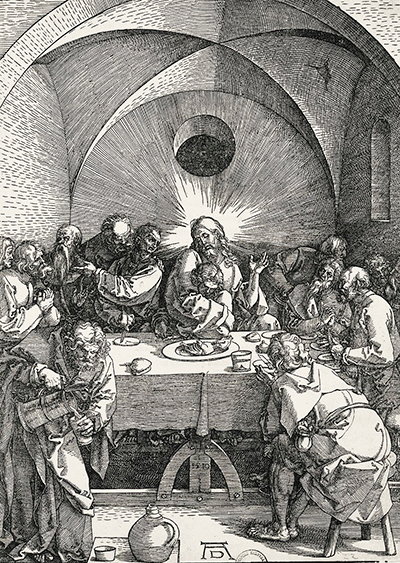
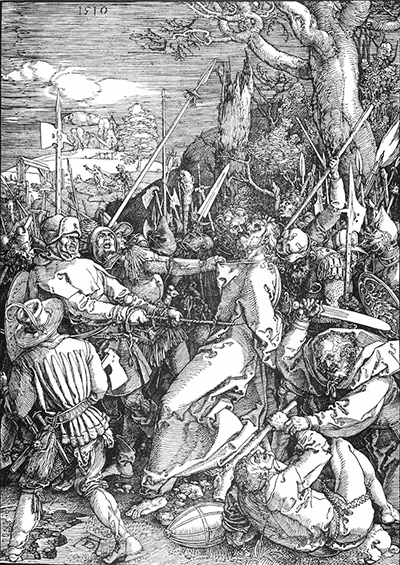
The woodcuts themselves provide a useful check on that distinction. The dates 1510 appear within the Supper, arrest, Limbo and Resurrection images: on the table support, high in the sky, on masonry and on the tomb. They belong to scenes distributed across the story. Each date becomes part of a different depicted surface; in the Supper it is particularly easy to overlook among the table’s practical fittings. [10]
Follow the pictures in the Munich volume and the order is clear: Last Supper , Mount of Olives , Betrayal , Flagellation , Ecce Homo , Bearing of the Cross , Crucifixion , Lamentation , Entombment , Christ in Limbo , Resurrection . The movement is from a company gathered around food to a body alone above the earth. Within that progression, people repeatedly assemble around Christ, but the reason for gathering changes: disciples eat, soldiers capture, a crowd demands, friends mourn and captives await rescue. [10]
Some early designs had already circulated separately before the book: the Städel’s chronology records individual Great Passion sheets published in 1498. A surviving impression can therefore belong to a different moment from the completed volume. [8]
Selected sheets from the Large Passion
A large page and a divided authorship
The 1511 publication is a folio. Hieronymus Höltzel was its printer; Dürer supplied the designs and published the book. The Large Passion , Life of the Virgin and reissued Apocalypse are his three large books, alongside the separate Small Passion . [11] [10]
Measurements make the scale tangible. Princeton’s Lamentation , x1957-144, has a block size of 39.2 × 28.2 centimetres and a sheet size of 40.3 × 29 centimetres. The block and its surrounding paper are distinct measurements. [12]
The Metropolitan Museum’s bound three-book volume, 41.1.229, measures 44 × 30.5 centimetres overall. Its dimensions describe the book, including its margins and binding, rather than a single printing block. [13]
In the Munich facsimile, broad margins surround both pictures and type. The illustrated pages occupy the right side of an opening, with Latin on the left; turning an illustrated leaf brings its printed reverse into view. The alternation has a bodily simplicity. A reader can linger before a picture, then turn it away and encounter another. The tightly packed procession on one page gives way to the conspicuous cross on the next, while the lower, reclining body in the Lamentation demands another adjustment of the gaze. [10]
The written narrative has its own divisions. Before the Flagellation picture, the facing page runs through Christ’s interrogation by Annas and Caiaphas; the heading introducing his scourging in Pilate’s house appears near the foot. Elsewhere in this digitised copy, the heading for Christ laid before his mother stands on the text page immediately preceding the Resurrection image. The physical alternation of words and pictures should therefore be distinguished from an assumption that every facing page describes only its neighbouring illustration. [10]
The title names Hieronymus Paduanus, Dominicus Mancinus, Sedulius and Baptista Mantuanus as the writers from whom Brother Chelidonius compiled the Passion. It then credits the pictures to Albrecht Dürer of Nuremberg. On the first verso, abbreviated author names beside the verse make that compilation visible: Chelidonius, Baptista and Sedulius alternate before the reader has passed the Supper. Chelidonius’s work as poet and compiler joins together several literary voices; the book does not present every line as newly written by him. [10]
Jeffrey Hamburger describes its poetry as epic verse. Latin and pictures offered complementary approaches to the story, requiring different kinds of reading. [14]
The title’s encounter
The National Gallery of Art calls the opening design The Man of Sorrows Mocked by a Soldier , dating it probably to 1511. The kneeling man performs a cruel parody of homage. [15]
In the Munich impression, the soldier’s raised reed and Christ’s inclined head form the upper points of a compact group. The soldier’s richly worked sleeve occupies the left, while Christ’s bare shoulder, flank and knee remain exposed at the right. Scourges lie below the seat. Around them, a low, curling boundary separates the scene from the paper, without giving it the developed setting of a narrative room. The soldier opens his mouth towards Christ; Christ looks out of the encounter towards us. [10]
The arrangement invites a different pace from the arrest or procession. There are only two participants to study, with little opportunity to escape into distant architecture. Kneeling, ordinarily a gesture of reverence, becomes an insult. Christ’s constrained posture has an inward concentration, while his outward gaze lets the confrontation extend beyond the soldier. The first image places the reader close to suffering before the story begins at the table. [10]
Below it, the Latin poem addresses a human reader directly. Christ speaks of wounds borne for that reader and of renewed injury through the reader’s sins. The poem’s final couplet also contains an anti-Jewish accusation, part of the book’s historical religious hostility. Its devotional appeal and its polemic occupy the same page. They should both remain visible when considering the kind of response this opening sought. [10] [15]
Around the table, beyond the garden wall
The Supper’s room fills almost the entire upper half of its picture. Vaults spring across the ceiling; a round opening punctuates the back wall. Christ sits beneath it, his halo spreading into the room’s hatching. Below, the table presents a long, pale horizontal surface interrupted by plates, bread and a cup. The architecture frames the company, but the meal is full of movements: heads incline, arms reach and figures turn towards their neighbours. [10]
Two foreground figures bring us close to everyday arrangements. At the left, a man pours from a large vessel into a smaller one. At the right, a seated diner turns away from us on a plain stool. His cloak and purse overlap the table’s corner. A bottle and drinking cup rest near the bottom border, beside the monogram. The picture supplies both the elevated view of the whole gathering and the obstructed view of somebody standing just outside it. [10]
The room holds these incidents together through its repeating curves. The vaults stretch overhead; below them shoulders, heads and bent elbows form smaller arcs. Under the table the trestle remains visible, an ordinary support beneath a charged human encounter. That conspicuous piece of furniture gives the space depth and makes the dinner feel furnished for use. The picture’s order can be grasped quickly, yet the actions around the table reward a much slower examination. [10]
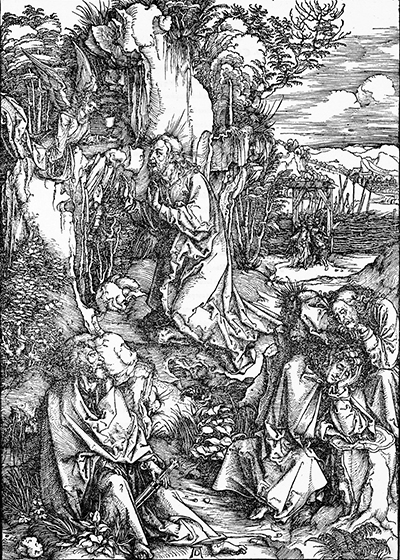
At the Mount of Olives, the ground rises and breaks apart. Three sleepers occupy the foreground in different positions: one sits heavily at the left, another curls under his clothing at the right, and a third rests above him. Christ kneels farther back against a great rock. His upturned face and joined hands answer the angel with a chalice at the upper left. The surrounding stone keeps him near his companions in the picture while making his prayer feel solitary. [10]
At the right a small procession approaches a gate in the fence. Above it the land continues towards buildings and distant hills. These little figures are easy to miss after looking at the large sleepers. Their approach makes the garden a place with an entrance, and gives a direction to the next page’s danger. Dürer makes the reader more alert than the disciples: the eye can travel past their slumped bodies and discover what they cannot see. [10]
The Betrayal fills that available space with armed men. Christ’s robe makes a pale, bending shape among helmets and breastplates. Judas leans towards his face; from the left, one soldier reaches across towards the group while another pulls a rope. Peter’s raised sword at the lower right threatens the fallen Malchus, whose lantern lies on its side nearby. Behind, shafts cut across the sky beside the tree. [10]
Compare the equipment at the bottom of these two pictures. In the Supper, the bottle and cup stand upright near the pouring figure. At the arrest, the lantern has fallen beside a man sprawling on the ground, close to a soldier’s planted boot. Objects once arranged for use become objects displaced by a struggle. Their low placement rewards a second look after the principal encounter has been recognised, and gives the change from company to conflict an everyday material vocabulary. [10]
Punishment, display and the crowded road
In the Flagellation , the column rises behind Christ almost to the top edge. A curtain is swept aside at the right, and the surrounding men close around his exposed torso. The foreground contains preparations as well as blows: at the lower left a kneeling figure works on a bundle of rods. Broken twigs litter the ground. A little dog stands near the monogram, between that working figure and a seated man whose arm extends across the scene. [10]
The height of the column and curtain makes the enclosure oppressive. Christ’s narrow upright body is surrounded by people whose bent knees, raised elbows and twisting trunks give them more room to act. The dog and scattered branches keep the lowest part of the print busy. Looking down offers no release from the episode; it reveals more of the arrangements that sustain the violence. The scene includes an almost practical attention to equipment, labour and spectatorship. [10]
The two interiors reward comparison. In the Supper, the table stretches across a broad room beneath expansive vaults. In the earlier Flagellation , the tall column and hanging curtain divide the space above the heads, while bodies fill the room below. Dürer gives a shared meal and a captive body different kinds of enclosure. [10] [7]
The following Ecce Homo , or “Behold the man,” changes the arrangement again. Christ stands at the left on raised steps, displayed to people below. A decorated pier divides the architecture from the forest of weapons at the right. The crowd’s nearest figures show their backs or turn sideways, making us look past them towards the small, exposed figure on the platform. At the lower left, a child carrying a curved stick occupies the steps beneath the adults. [10]
By the road to Calvary, the crowd has begun moving out through a gateway. Its portcullis and heavy masonry fill the upper left. Horses push their heads into the packed middle distance, while a bare tree, birds and a distant town occupy the comparatively open sky. Christ has fallen in the foreground beneath the crossing timbers. The route out of the city is visible, but the company surrounding him makes it difficult to imagine a clear way through. [10]
The Pushkin Museum dates this Bearing of the Cross around 1498–99 and identifies its Г-2386 impression with the Latin-text edition of 1511. [9]
The pale clothing of the man at the right brings a long upright shape down almost to the bottom edge; Christ’s robe spreads in another pale shape beside him. Between and behind them, faces and weapons accumulate in much darker passages. Small stones, plants and two dogs occupy the nearest ground. The breadth of the sheet permits these changes of scale: an individual stone below, a human face at the centre, a town far away. The procession contains a landscape even while it seems to leave Christ no room. [10]
The black strokes in these woodcuts were printed from raised lines left on a block after the surrounding surface was cut away. Ink transferred those lines to paper; the spaces between them remained light. [17] [16]
Shira Brisman relates bodily contact to printing. Her study chiefly concerns the Small Passion , but includes this unusually straight supporting arm: hand against ground and face towards Veronica’s cloth link suffering with the transfer and multiplication of images. She also distinguishes designing from cutting. This material analogy is her interpretation; it establishes neither that Dürer personally carved every block nor that he documented such a theological programme. [16]
Beneath the cross
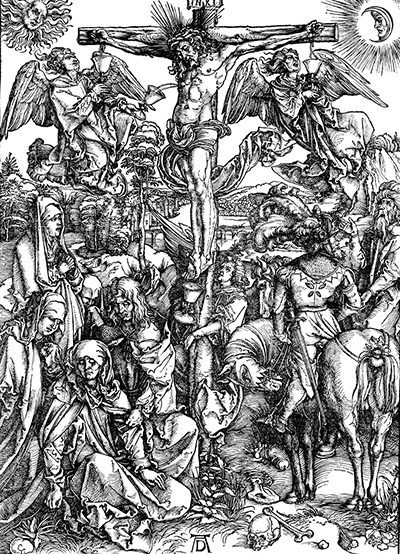
At the Crucifixion, Christ’s arms reach nearly across the upper part of the picture. The sun and moon have faces, and angels bring vessels towards his wounds. Below, a horse’s hindquarters occupy much of the right side; at the left the Virgin sinks among her companions. A skull, jaw and scattered bones lie along the lower edge. Distance remains visible between these dense groups, leading towards trees, water and buildings beyond the cross. [10]
The picture brings different scales of response into one field. The angels approach the suspended body, the mourners bend towards Mary, and the mounted group remains high and conspicuous. The central cross makes these directions readable without stilling them. Its vertical descends to a ground full of bones and grasses; its horizontal passes between the two heavenly faces. Execution, grief and sacred significance are given places within the same landscape. [10]
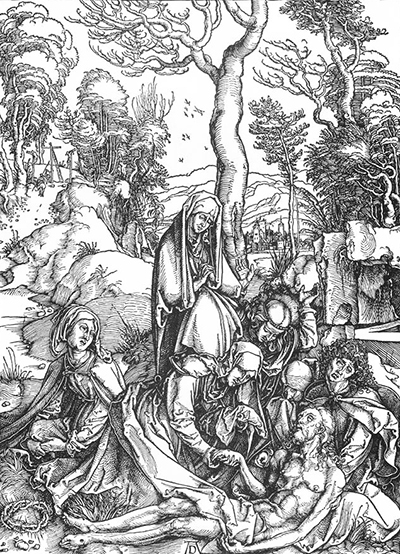
In the Lamentation , the dead body lies along the lowest part of the composition, its feet pointing left and its head supported at the right. Above it, the Virgin’s hooded figure rises beside a tall tree. Other faces gather nearer to Christ’s face, while a seated woman at the left opens one hand. A crown of thorns lies on the ground. Far up the hill, a ladder leans against the now empty central cross. [10]
Princeton’s interpretation links the sinuous branches and swooping birds to the mourners’ grief. Their restless shapes make the open landscape emotionally active, even where the human figures have become still. [12]
Looking at the two pictures together, it is striking how much the empty cross has diminished. The large body that occupied its centre now occupies the foreground below a different upright, the tree. A city appears through the interval behind the Virgin, and birds cross the light area of sky. The site of execution remains within sight, but it is far enough away for the mourners to command our attention. This is a pause with its own terrain, rather than a hurried passage to burial. [10] [12]
In the Entombment , Christ’s body hangs diagonally within the cloth his followers carry. The Morgan’s commentary emphasises their mourning, with the tomb itself pushed to the right. Their shared task gives the scene an atmosphere of responsibility after violence: the dead must be supported and buried. Golgotha remains distant at the upper left. [14]
Out of confinement
The last two pictures make departure visible in different ways. In Christ in Limbo , the entrance is a great arch over broken barriers. A group waits at the left, where an old, bearded man stands beside a woman and a small child. Christ bends down towards a figure emerging at the lower right. Above him, demons crowd the upper structure; one carries a weapon while another spreads ragged wings across the dark masonry. [10]
The apocryphal Gospel of Nicodemus offers a literary parallel. In its account of the descent to the dead, gates shatter, prisoners emerge into the light and Christ raises Adam before leading the others out. The account gives words to the movement from captivity to release so emphatic in Dürer’s picture. [18]
The heading in the 1511 book names Christ’s descent explicitly. Dürer gives it an architecture that can be broken open, with timbers and metalwork scattered at the front. The people awaiting release occupy a comparatively clear space, while the creatures that resist it are lodged in corners and cavities. After the tightly guarded passages through the city, a barrier has finally failed to keep its captives in place. [10]
The Resurrection sets Christ upright above the tomb. The banner rises at the right, balancing his raised hand at the left. The long curve of his mantle catches the light as it swings away from his legs. Angels cluster in the upper corners, while clouds and radiance separate him from the soldiers below. Armour, a sword, a shield, a helmet and bodies fill the foreground in overlapping fragments. [10]
The central body has space around it again. Beneath, the guards cannot organise themselves into the threatening company seen at the arrest. Some slump; another turns towards the apparition. The picture directs the eye upwards through their confusion, along the banner’s staff and the luminous body. The title’s seated and exposed Christ remains a powerful memory at this point. The volume has led from an intimate act of humiliation to a manifestation the surrounding soldiers cannot control. [10]
Publication, exchange and survival
After the final picture, the Munich copy ends with its 1511 Nuremberg publication statement and a warning to imitators. The Latin notice invokes Maximilian’s authority against printing the images from substitute blocks or selling such impressions within the empire, and threatens confiscation. Dürer presents the work as something whose making and circulation require protection. The book that asks readers to contemplate suffering also closes by asserting the publisher’s interest in his images. [10]
The Morgan exhibited the New York Public Library’s Spencer Collection copy, Ger. 1511, bound in Nuremberg and formerly owned by Munich’s St Pütrich Franciscan laywomen. Its provenance is separate from the Met volume’s. [14]
Dürer’s Netherlands diary gives another view of circulation. In Conway’s 1889 English translation, Sebald Fischer’s Antwerp purchase includes thirty-two Large Books for eight florins, beside sixteen Small Passions and six engraved Passions. “Large Books” does not specify thirty-two Large Passions : Conway’s note identifies the category with the Apocalypse , Life of the Virgin and Great Passion . The different publications share a transaction without losing their distinct names. [19]
A nearby entry makes the Great Passion explicit. Dürer records giving the Portuguese factor a substantial group of works that includes the three large books, followed by the Little Passion and the engraved Passion. He then says he gave the same quantity to Rodrigo. Prints could move as gifts alongside sales; the book formed part of an artist’s stock and of his exchanges with people he met. These entries record particular transactions, rather than a complete account of who read the books or what every copy cost. [19]
The Pushkin catalogue reports later series publications at Augsburg in 1675 and Ulm in 1690. It also distinguishes its 1511 Entombment impressions, Г-2390 and Г-2389, from a textless impression, Г-2391, assigned to the 1570s. A blank reverse therefore cannot by itself establish an early proof: the design, the edition and the particular sheet need separate histories. [9]
Those histories can return a familiar picture to the scale of an actual page. Through the complete volume we encounter the spare title group, the furnished meal, the dangerous garden and the broken entrance to Limbo in succession. Each scene reorganises the space around Christ. Following them allows the reader to experience changes in company, distance and movement, from people who crowd around a vulnerable body to the radiant figure who rises beyond their reach. [10]
Frequently Asked Questions
Artworks directory
These 187 records include individual works, reverse sides, detail views, paired panels and reconstructed arrangements. Three additional catalogue images repeat works already listed. Related views are not counted as separate originals; qualified attributions and published dating are retained.
Discussion
Look again at the images and ideas explored in Dürer’s Large Passion. These editorial prompts invite your observations.
Reader Insights
Which detail or idea in Dürer’s Large Passion most changed your reading, and why?
How does the discussion of “Making the pictures, reading the story” affect your understanding?
What comparison would you bring to the discussion of “Publication, exchange and survival”?
Join the Conversation
Share a detail, comparison or question about Dürer’s Large Passion below.
References
- Charles Ephrussi, Albert Dürer et ses dessins (Paris: A. Quantin,1882), pp.118–120; selected catalogue entries pp.2,14–16,20,78–80,107,109,120,153,178,188,298,302; index pp.399,403,405–406,409–410. Original French edition. View source.
- S. R. Koehler, A Chronological Catalogue of the Engravings, Dry-Points and Etchings of Albert Dürer (New York: Grolier Club, 1897). Original English edition Selected pp. 5, 14, 17–18, 32, 37, 42, 44, 51, 58, 60, 63, 81. View source.
- Heinrich Wölfflin, Die Kunst Albrecht Dürers, second enlarged edition (Munich: F. Bruckmann, 1908), pp. 110, 298. Original German edition. View source.
- Campbell Dodgson, Catalogue of Early German and Flemish Woodcuts Preserved in the Department of Prints and Drawings in the British Museum, vol. 1 (London: British Museum, 1903). Original English edition Selected pp. 246, 260, 262, 272, 274, 288, 290, 294–296, 299–300, 302, 307. View source.
- Johann Carl Sigmund Kiefhaber, ed., Nachrichten zur ältern und neuern Geschichte der freyen Reichsstadt Nürnberg: ein Beytrag zur Geschichte der Reichsstädte in Teutschland, vol.1 (Nuremberg: Lechner, 1803), first quarter, pp.6–9,14–16. Original German historical edition of correspondence and inventory. View source.
- T. Sturge Moore, Albert Dürer (London: Duckworth and Co.; New York: Charles Scribner’s Sons, 1905), part III, portrait discussion and caption of the 1500 Munich self-portrait. Original English edition. View source.
- Cleveland Museum of Art , The Large Passion: The Crucifixion , c. 1497–1500, 1926.118. English. View source .
- Städel Museum , “Albrecht Dürer,” biography. English. View source .
- Pushkin State Museum of Fine Arts , The Large Passion ; The Bearing of the Cross , Г-2386; The Entombment , Г-2390 and related impressions. English. View source 1 . View source 2 . View source 3 .
- Benedictus Chelidonius , compiler, and Albrecht Dürer, Passio domini nostri Jesu , Nuremberg, 1511. Latin. Bayerische Staatsbibliothek, Rar. 49; digitised images 4–27, title, illustrations, verse pages and colophon. Catalogue and manifest. View source 1 . View source 2 .
- Universitätsbibliothek Regensburg , “Die drei großen Bücher Dürers”. German. View source .
- Princeton University Art Museum , The Lamentation , x1957-144. English. View source .
- Metropolitan Museum of Art , The Life of the Virgin, Great Passion, and Apocalypse , 1511, 41.1.229. English. View source .
- Morgan Library & Museum , “073. Albrecht Dürer, The Large Passion,” Imperial Splendor , label and Jeffrey Hamburger’s transcript. English. View source .
- National Gallery of Art , The Man of Sorrows Mocked by a Soldier , probably 1511, 1941.1.22. English; Latin inscription. View source .
- Shira Brisman , “A Touching Compassion: Dürer’s Haptic Theology”, Open Arts Journal 4 (Winter 2014–15), pp. 9–27, especially 20–26. English. DOI: 10.5456/issn.2050-3679/2015w01. View source 1 . View source 2 .
- Suzanne Boorsch and Nadine M. Orenstein (1997), study of northern Renaissance printmaking (article description), The Metropolitan Museum of Art Bulletin 54, no. 4, pp. 3–4. English. View source.
- The Gospel of Nicodemus , Part II, Greek form, chapters 5–8, in Alexander Roberts and James Donaldson, eds., revised by A. Cleveland Coxe, The Ante-Nicene Fathers , VIII, Buffalo: Christian Literature Company, 1886, pp. 436–437. English translation. View source .
- William Martin Conway, with transcripts and notes by Lina Eckenstein, Literary Remains of Albrecht Dürer (Cambridge: Cambridge University Press, 1889), pp.34–35,37,40–41,97,100. English historical translation of Dürer’s German diary and family chronicle. View source.
- Burlington Fine Arts Club, Exhibition of Early German Art (London: Burlington Fine Arts Club, 1906). Original English catalogue P.24, no.38. View source.
- Moriz Thausing, Albert Dürer: His Life and Works, translated from German, edited by Fred. A. Eaton, vol. II (London: John Murray, 1882), pp. 16–18. Original English edition. View source.
- Joseph Heller, Das Leben und die Werke Albrecht Dürer's, vol. II, part 1 (Bamberg: C. F. Kunz, 1827), p. 118, no. 138; pp. 160–162, Florence entry 13; pp. 196–197, Munich entry 17. Original German edition. View source.
- Maud Cruttwell, Andrea Mantegna, London: George Bell and Sons, 1901, pp. 110–112. View source.
- Moriz Thausing, Dürer: Geschichte seines Lebens und seiner Kunst (Leipzig: E. A. Seemann, 1876). Original German edition Selected pp.303, 306, 308–309. View source.
- Hans W. Singer, Drawings of Albrecht Dürer (London: G. Newnes; New York: C. Scribner’s Sons, 1906), p. 8; Little Owl (Schönbrunner and Meder no. 829). Original English edition. View source.
- Germanisches Nationalmuseum, Katalog der im Germanischen Museum befindlichen Gemälde (Nürnberg: Verlag des Germanischen Museums, 1893), pp.34–35, nos.206–209. Original German catalogue. View source.
- Germanisches Nationalmuseum, Barbara Dürer (German and English). View source.
- Web Gallery of Art, Tucher–Rieter reverse (English). View source.
- National Gallery of Art, Portrait of a Clergyman (English). Associated catalogue: John Oliver Hand and Sally E. Mansfield, German Paintings of the Fifteenth through Seventeenth Centuries (Washington, DC: National Gallery of Art, 1993). View source.
- Dürer Art, Portrait of a Man (English). View source.
- Hessen Kassel Heritage, Elsbeth Tucher (German). View source.
- Web Gallery of Art, Hans Tucher (English). View source.
- Germanisches Nationalmuseum, Emperor Maximilian I (German and English). View source.
- National Gallery of Art, Lot and His Daughters, reverse (English). View source.
- Bayerische Staatsgemäldesammlungen, Glim Lamentation (German). View source.
- Museo Nacional del Prado, Portrait of a Man (Spanish). View source.
- Bayerische Staatsgemäldesammlungen, Madonna of the Carnation (German). View source.
- Städel Museum, Job on the Dungheap (German). View source.
- Wallraf-Richartz-Museum, Piper and Drummer (German). View source.
- Italian Ministry of Culture / Uffizi, Head of Saint James (Italian). View source.
- Klassik Stiftung Weimar, Dresden Altarpiece (German). View source.
- Staatliche Museen zu Berlin, Girl with a Red Beret (German and English). View source.
- Dresden State Art Museums / Roland Enke, Bernhard von Reesen (German). View source.
- Royal Collection Trust, Burkhard von Speyer (English). View source.
- Dresden State Art Museums, Seven Sorrows of the Virgin (English). View source.
- Bayerische Staatsgemäldesammlungen, Mater Dolorosa (German). View source.
- Bayerische Staatsgemäldesammlungen, Lucretia (German). View source.
- Städel Museum, Young Woman with Her Hair Down (English). View source.
- ALBERTINA, Portrait of a Young Man, inv.3122 (German). Eva Michel, cat.48, p.98, fig.48, in Dürer, Cranach, Holbein: Die Entdeckung des Menschen: Das deutsche Porträt um 1500, edited Sabine Haag, Christiane Lange, Christof Metzger and Karl Schütz (Munich: Hirmer, 2011). View source.







