by
Tom Gurney
Tom Gurney BSc (Hons) is an art history expert with over 20 years experience
Published on June 19, 2020 / Updated on October 22, 2026
Email:
tomgurney1@gmail.com
/ Phone:
+44 7429 011000
Parrot by Albrecht Dürer: Introduction
Albrecht Dürer's Parrot gives a single bird the presence of a substantial, alert body. Its head turns towards the right, its claws clasp a narrow branch, and its long feathers spread the composition towards the lower left. Around it, the paper is largely empty. This drawing belongs to the Biblioteca Ambrosiana in Milan, where it is catalogued as a work by Dürer, in pen, grey-black ink and watercolour on yellowed white paper, measuring 193 × 213 millimetres. The catalogue connects it with the parrot in the 1504 engraving Adam and Eve and with drawings of the Virgin surrounded by animals. [1]
Look first at the bird's eye. A dark pupil sits within a small, sharply defined oval, with short strokes radiating around it. This tiny concentration of marks establishes a direction of attention. Beside it, the enormous upper beak curves down to a dark point, overlapping the smaller lower part. Its pale upper surface has far fewer marks than the neighbouring feathers. That abrupt change makes the beak seem hard and smooth, while the cheek beside it looks soft enough to yield to touch. Dürer differentiates surfaces through the density and movement of his lines.
At a Glance
- Materials Pen, grey-black ink and watercolour on paper [1]
- Collection Biblioteca Ambrosiana, Milan [1]
- Date qualification The inscription 1513 does not establish the drawing’s execution date [1]
This work across Albrecht Dürer’s career
Parrot (current article)
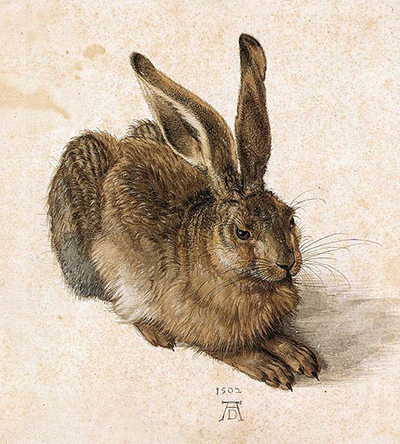
Execution date not establishedYoung Hare
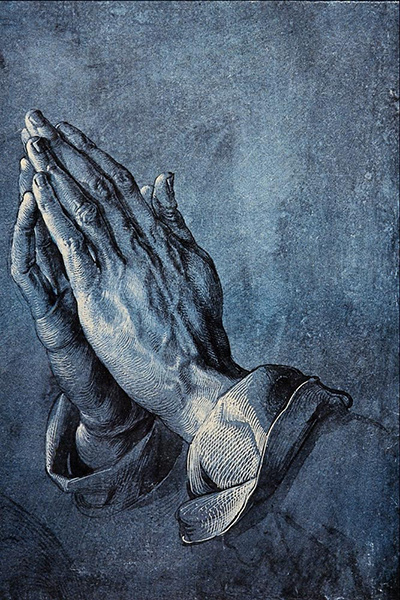
1502Praying Hands
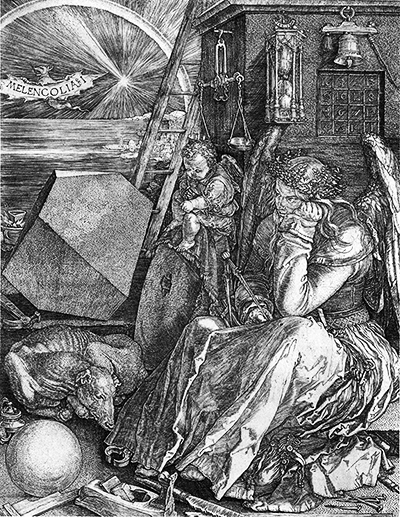
1508Melencolia I
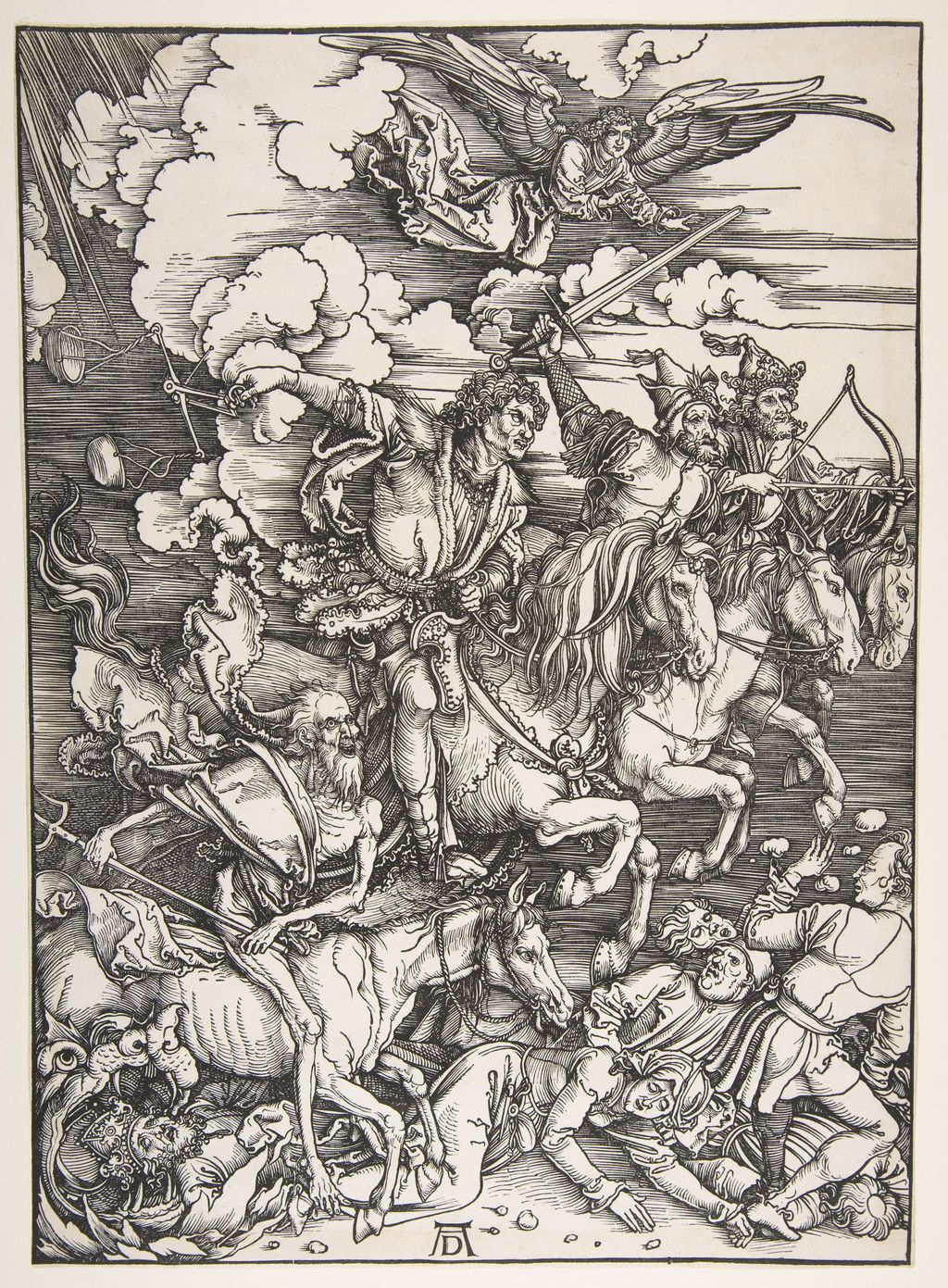
1514Four Apostles
1526Contents
A closer look
The head also controls the drawing's silhouette. Its crown rises in a rounded mass, then breaks into small irregularities along the back of the neck. Beneath the cheek, short curved strokes form a fringe. Farther down, the same kind of mark lengthens and gathers into overlapping groups across the breast. These are economical distinctions: the body does not depend on an equally detailed description of every feather. A few changes in length, curvature and spacing allow the eye to pass from the compact plumage of the head to the looser, fuller covering of the chest.
This treatment becomes especially expressive where the breast meets the feet. Closely packed dark lines form a shadow along the underside, giving the bird weight above its perch. Higher on the breast, open strips of paper remain between the groups of strokes. The succession of pale bulges and darker recesses suggests plumage settling over a rounded body. The effect is quite different from the wing, whose long, overlapping shapes lie closer together and direct the eye downwards.
The folded wing is the broadest relatively quiet area. Its outer edge runs from the shoulder into a set of elongated feathers, with lighter internal lines following their length. Across the upper wing, several smaller scalloped shapes interrupt that downward sweep. Near the lower left, the feather tips separate and extend beyond the body. Their narrow outlines remain unusually clear against the bare paper. Following these edges reveals how much of the bird's apparent complexity comes from a few coherent groups, each with its own direction.
Below them, the longer tail feathers make a second descent. The drawing opens into a fan of narrow forms, some extending almost to the edge of the reproduction. This gives the composition an asymmetry that a simple oval body could never supply. The head gathers attention at the upper right; the feathers release it towards the lower left. Between those two ends, the claws provide a small but forceful point of attachment. The bird feels poised because these different directions meet at a convincing grip.
Each visible foot bends around the branch in articulated segments. Short transverse marks distinguish the scaly surface from the flowing feather strokes above. The curved claws extend beyond the toes, so that gripping becomes an action one can understand, even in this motionless pose. The branch rises diagonally to the right and carries a few quick marks of its own. Dürer gives it enough solidity to support the bird, while leaving its continuation largely to the imagination. There is no need for a complete tree, cage or surrounding room to make the perch intelligible.
The space around the figure matters just as much. Without competing foliage or a distant setting, the viewer can follow the outer contour all the way from the beak to the feather tips. The branch gives a local explanation of support; the empty paper allows the body to retain its independence. The result has the concentrated attention of an individual study, while preserving a pose that could be fitted into a larger scene. Its usefulness as an artistic resource and its visual completeness are easy to appreciate together.
The familiar monochrome reproduction makes the penwork especially accessible, but the recorded medium includes watercolour. It should therefore be approached as a reproduction of a mixed-media sheet, with the colour information incomplete. The distinction also helps explain why the bird can look almost like an engraving at first glance. Its dense shadow, sharp beak and disciplined feather lines produce strong contrasts without requiring a surrounding dark ground. On paper, those contrasts remain contained within a freely placed figure.
The date requires equal care. The Ambrosiana inventory-catalogue records an inscription of 1513 and Dürer's monogram above the bird, but assigns the writing, with a question mark, to Hans Süss von Kulmbach. It does not establish 1513 as the year Dürer drew the parrot. The separation of drawing and added inscription becomes particularly consequential when the sheet is related to an engraving dated nine years earlier. A later written date cannot by itself settle the chronology of the image beneath it. Friedrich Winkler published the drawing in 1927; the catalogue’s provenance names Federico Fagnani in 1841. The bird's place in Dürer's work is best explored through the particular compositions with which it has been associated. [1]
In the Albertina's Virgin with a Multitude of Animals , the parrot appears on the diagonal wooden barrier immediately to the left of Mary. Its head, beak and trailing feathers give it a recognisable profile even though it occupies only a small part of the composition. The current museum record dates this drawing to around 1506. Its account describes the setting through the tradition of the enclosed garden associated with Mary's virginity, expanded here into a world inhabited by many creatures. The relationship to the Ambrosiana study is consequently more than a resemblance between two bird shapes: it shows what happens when a carefully isolated animal enters a devotional environment. [12]
On the study sheet, the perch and claws establish physical security. In the Virgin drawing, the bird's position on the barrier helps articulate the space beside Mary. Its long feathers follow the sloping wood, carrying the viewer's attention towards the foreground. The small head sits close to the area where Mary's hand and open book draw the eye. The parrot joins an arrangement in which plants, birds and other animals surround the central figures at different distances. The study's concentrated scrutiny becomes one strand in a much more extensive act of composition.
The Louvre preserves another version of this subject, dated 1503 in its present record. Here Mary sits in a landscape whose animals and incidents are arranged differently, with a tree stump immediately beside her. The Louvre's commentary treats the Paris sheet as the earliest version and cites a 2019 interpretation dating the Vienna composition to 1508. The Albertina's current label of around 1506 shows that the chronology has not been expressed consistently across the related records. These differences leave the visual relationship worth examining without turning the drawings into a securely dated sequence of successive steps. [13]
The shifting arrangement of the two Virgin drawings demonstrates how adaptable an animal-filled setting can be. In Vienna, the parrot’s body and feathers stand out against the diagonal rail, close to the central figure. That setting gives the isolated study a particularly clear point of comparison. A persuasive head, folded wing and gripping feet can survive a change of support and setting, while the surrounding composition supplies a new role. The connection recorded for the Ambrosiana drawing should be understood at that level of preparation and reuse; it does not require every visible line to have been transferred unchanged.
The 1504 Adam and Eve offers a particularly vivid transformation. Above Adam's raised hand, a parrot faces left on a leafy branch, close to the tablet bearing Dürer's name and the date. Its direction reverses that of the Ambrosiana bird, but its compact upper body, emphatic beak and descending feathers preserve the same kind of visual balance. The branch now belongs to the larger forest, and the bird's light shape is set against dark foliage. A form surrounded by open paper in the study has become a bright, readable accent within a densely worked engraving. [14]
That placement also opens the parrot to interpretation. In his Albertina catalogue essay on Adam and Eve , Berthold Hinz connects the bird's traditional capacity to imitate human speech with its conspicuous position beside the artist's Latin signature. He reads the conjunction as a statement about the maker of the image. This is a specific interpretation of the finished composition. It adds a dimension to the parrot's later pictorial life without requiring the isolated Ambrosiana study to declare that meaning on its own. The drawing provides a credible creature; the engraving brings creature, inscription, human figure and biblical narrative into a charged relationship. [14]
The Ambrosiana sheet rewards returning from those larger scenes to the bird itself. The eye's small dark centre, the almost unmarked surface of the beak and the tiny divisions of the feet each invite a different pace of looking. Long feathers link these concentrated details across the page. Even with its related compositions in mind, the parrot retains an individual presence: a body held together by overlapping surfaces, directed strokes and a few decisive points of contact. The drawing makes that structure available for reuse while keeping the pleasure of examining it close at hand.
Frequently Asked Questions
Artworks directory
These 187 records include individual works, reverse sides, detail views, paired panels and reconstructed arrangements. Three additional catalogue images repeat works already listed. Related views are not counted as separate originals; qualified attributions and published dating are retained.
Discussion
Look again at the images and ideas explored in Parrot by Albrecht Dürer. These editorial prompts invite your observations.
Reader Insights
Which detail or idea in Parrot by Albrecht Dürer most changed your reading, and why?
How does the discussion of “A closer look” affect your understanding?
What comparison would you bring to the discussion of “A closer look”?
Join the Conversation
Share a detail, comparison or question about Parrot by Albrecht Dürer below.
References
- Robert Randolf Coleman , in cooperation with the Biblioteca Ambrosiana, Inventory-Catalog of the Drawings in the Biblioteca Ambrosiana , “Parrot,” ND 815, F 264 inf. n. 12, record updated 12 January 2022. View source .
- ALBERTINA, Selbstbildnis als Dreizehnjähriger, inv. 4839 (German). View source.
- Metropolitan Museum, Four Horsemen from The Apocalypse, 19.73.209 (English). View source.
- Bayerische Staatsgemäldesammlungen, Selbstbildnis im Pelzrock, inv. 537 (German). View source.
- ALBERTINA, Feldhase, inv. 3073 (German). View source.
- ALBERTINA, Das große Rasenstück, inv. 3075 (German). View source.
- Metropolitan Museum, Adam and Eve, 19.73.1 (English). View source.
- ALBERTINA, Betende Hände, inv. 3113 (German). View source.
- Metropolitan Museum, Knight, Death, and the Devil, 43.106.2 (English). View source.
- Metropolitan Museum, Melencolia I, 43.106.1 (English). View source.
- Bayerische Staatsgemäldesammlungen, inventory 545: current collection record (German; descriptive citation). View source.
- ALBERTINA , Maria mit den vielen Tieren , inventory 3066, current object record, including Heinz Widauer's catalogue essay (2008, no. 7) and Anna Scherbaum's catalogue essay (2003, no. 75, p. 280). German and English; extended essays in German. View source .
- Musée du Louvre , Département des Arts graphiques, Vierge à l'Enfant dans un paysage avec une multitude d'animaux et, dans le fond, l'Annonce aux bergers , INV 18603, recto, record updated 10 April 2025. French. View source .
- ALBERTINA , Adam und Eva , inventory DG1930/1451, current object record and Berthold Hinz's catalogue essay, Albrecht Dürer (2003), no. 65, pp. 254–256. German and English; extended essay in German. View source .
- Germanisches Nationalmuseum, Barbara Dürer (German and English). View source.
- Web Gallery of Art, Tucher–Rieter reverse (English). View source.
- National Gallery of Art, Portrait of a Clergyman (English). View source.
- Dürer Art, Portrait of a Man (English). View source.
- Hessen Kassel Heritage, Elsbeth Tucher (German). View source.
- Web Gallery of Art, Hans Tucher (English). View source.
- Germanisches Nationalmuseum, Emperor Maximilian I (German and English). View source.
- National Gallery of Art, Lot and His Daughters, reverse (English). View source.
- Bayerische Staatsgemäldesammlungen, Glim Lamentation (German). View source.
- Museo Nacional del Prado, Portrait of a Man (Spanish). View source.
- Bayerische Staatsgemäldesammlungen, Madonna of the Carnation (German). View source.
- Städel Museum, Job on the Dungheap (German). View source.
- Wallraf-Richartz-Museum, Piper and Drummer (German). View source.
- Italian Ministry of Culture / Uffizi, Head of Saint James (Italian). View source.
- Klassik Stiftung Weimar, Dresden Altarpiece (German). View source.
- Staatliche Museen zu Berlin, Girl with a Red Beret (German and English). View source.
- Dresden State Art Museums / Roland Enke, Bernhard von Reesen (German). View source.
- Royal Collection Trust, Burkhard von Speyer (English). View source.
- Dresden State Art Museums, Seven Sorrows of the Virgin (English). View source.
- Bayerische Staatsgemäldesammlungen, Mater Dolorosa (German). View source.
- Bayerische Staatsgemäldesammlungen, Lucretia (German). View source.
- Städel Museum, Young Woman with Her Hair Down (English). View source.
- ALBERTINA, Portrait of a Young Man (German). View source.