


 by
Tom Gurney
Tom Gurney BSc (Hons) is an art history expert with over 20 years experience
Published on June 19, 2020 / Updated on October 22, 2026
Email:
tomgurney1@gmail.com
/ Phone:
+44 7429 011000
Christ Shown to the People (Small Passion): Introduction
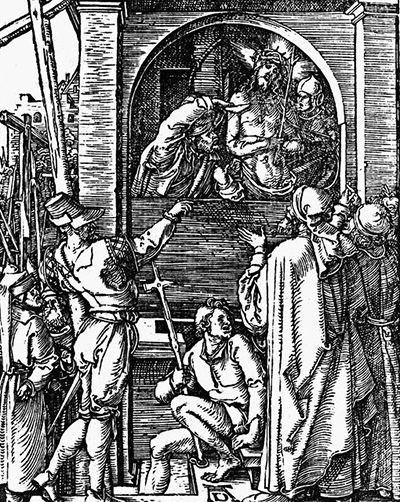
Albrecht Dürer makes the presentation of Christ an encounter across a barrier. Above, a crowned, nearly naked man stands within a dark arch; below, a crowd presses towards him with raised arms. A broad wall separates the two groups, while a flight of steps opens a narrow passage between them. The architecture gives Christ a prominent position but also makes his exposure painfully public. This woodcut, usually called Ecce Homo or Christ Shown to the People , was designed around 1509 for the Small Passion , the cycle subsequently published as a book in 1511. The design is dated to about 1509 in the Metropolitan Museum of Art’s catalogue. [1]
The scene belongs to Christ's trial before the Crucifixion. In John's Gospel, Pilate has Jesus scourged; soldiers place a crown of thorns on his head and dress him in a purple robe. Pilate then brings him out and announces, in the King James translation, “Behold the man!” The demand for crucifixion follows, and Pilate eventually delivers Jesus to be executed. The Latin expression Ecce homo supplies the familiar title. This sequence explains why Dürer's Christ already wears the crown while the cross remains an instrument of impending death. [2]
Dürer concentrates on the difficult interval between displaying the prisoner and passing sentence. John's account repeatedly moves between Pilate's interior questioning and his appearances before the accusers. The print gives that movement a powerful physical setting: Christ is visible through the opening of a building, held above people who can see him but cannot readily reach him. His stillness and their agitation occupy the same small rectangle.
At a Glance
This work across Albrecht Dürer’s career
Young Hare
1502Praying Hands
1508Melencolia I
1514Four Apostles
1526Contents
- Looking up at Christ
- A small image made for a book
- From a Passion book to a collector's album
- Frequently Asked Questions
Looking up at Christ
The arch dominates the upper half of the design. Its curved rim encloses Christ and his attendants tightly, leaving little free space around their heads. Dense intersecting strokes darken the recess behind them. Christ's pale chest, bent arms and illuminated head consequently emerge with unusual clarity. The crown and the rays around his head occupy almost the same place, bringing the sign of his humiliation close to the sign of his sacred identity. His exposed body offers little resistance to the clothing, armour and stonework surrounding it.
Beside him, a man bends deeply over the parapet. The fall of his garment and the downward angle of his head make him a restless counterpart to Christ. An arm reaches across towards the prisoner, directing attention to the body being exhibited. On the other side, an armoured figure crowds close behind Christ's shoulder. The three heads fit within the arch, but their different inclinations prevent them from becoming a static row. Presentation, suffering and armed supervision are compressed into a single opening.
Below them, the wall is drawn with ranks of short horizontal strokes. It creates a broad, relatively uninterrupted middle zone between the upper bodies and the crowd. The spectator's eye has to cross this surface to move from the gesticulating hands to Christ. At the left, one foreground figure stretches an arm upwards while standing beside the tall wooden cross. On the right, men in long garments turn their backs towards us, their heads tipped up towards the opening. These backs bring us close to the gathering: we look past shoulders and raised hands, with no spacious foreground from which to survey the event comfortably.
A seated young man interrupts this upward movement. Low in the centre, he turns his face towards the standing men to his right. One leg bends across the other, making a compact knot of knees and fabric above the steps. The upright object beside him has a crosspiece, repeating in miniature the cross rising at the left. His position is especially noticeable because he occupies the passage that might otherwise lead the eye straight up to Christ. Looking through the scene involves looking around him.
Sabine Siemer interprets the seated man as a possible point of identification for the viewer: he watches the accusers instead of Christ. She reads the crossed fingers at the right as a demand for crucifixion. Her larger interpretation joins two kinds of religious image: the public presentation before the palace and the frontal display of Christ as the Man of Sorrows. In this reading, a concentrated devotional image sits within the larger narrative. [13]
The contrast between hands helps sustain that reading. Those below project themselves outwards, making claims on the elevated figure. Christ's arms stay close to his body. Even before individual gestures are decoded, this difference is legible: the crowd acts upon the space, while the prisoner is exposed within it. These are figures within a Christian Passion narrative, whose hostile accusers must not be treated as evidence of collective guilt among Jewish people. The print places the beholder uncomfortably close to those demanding death.
A small image made for a book
The narrow format rewards close inspection. A woodcut prints the inked, raised portions of a carved block onto paper; the spaces cut away remain unprinted. Dürer's design uses that contrast to make several distinct surfaces. Fine strokes bend around the seated man's legs; longer lines follow the great hanging cloak at the right; short marks articulate the stone. The deep shadow inside the arch is made from the accumulation of printable lines, while exposed paper supplies the brightest passages. [14]
Scale changes the experience of these details. The Met's sheet measures only 12.7 × 9.8 centimetres. Enlarged on a screen, the image can resemble a large architectural drama. On paper, the crowd and the distant prisoner must coexist within an area smaller than a modern postcard. The large foreground bodies help establish this compact space quickly. Their difference in size from the figures above conveys depth and the spectator's low position, even as the wall and tightly cropped building make that depth feel constricted. [1]
The Small Passion appeared in 1511 as a devotional book with a title image, thirty-six narrative woodcuts and a final colophon, making thirty-eight leaves. Benedictus Chelidonius supplied its Latin poems. This setting gave the presentation a place within an unfolding sequence. The crown has already been forced upon Christ; Pilate's hand washing will follow. Bridwell Library's account of this particular scene draws attention to the appearance of the wooden cross, which gives the coming execution a physical presence before Christ begins carrying it. [14]
Chelidonius's accompanying poem also makes looking an urgent activity. As Siemer observes, it repeats the Latin interjection en , calling attention successively to the innocent prisoner and the marks of his suffering. Siemer also notes the poem's anti-Jewish invective: its urgent devotional appeal belongs to a text containing hostile religious polemic. [13]
A surviving uncut sheet in the Rijksmuseum provides a different view of the images' material organisation. Four designs remain together on one piece of paper: the Flagellation and Crowning with Thorns above, the presentation of Christ and Pilate's hand washing below. The museum records individual images of 127 × 97 millimetres on a sheet measuring 354 × 252 millimetres. Such an object preserves a stage before separation into small leaves. It also distinguishes the physical sheet on which several images were printed from the individual composition normally reproduced by itself. [15]
From a Passion book to a collector's album
Different impressions preserve different encounters with the same design. The Museumsquartier Osnabrück records this subject in a bound Small Passion with the Latin text of the 1511 book edition on the backs of the leaves. Its later calf binding dates from the eighteenth century. Here the presentation remains part of a sequence that can be handled and turned through, although even this volume carries a collecting history beyond its first publication. [16]
The Louvre's impression has a particularly revealing afterlife. It is catalogued as a printing made after the 1511 edition, without text on the reverse. Trimmed to 12.7 × 9.5 centimetres, it is mounted on the recto of folio 26 in the first of two albums of Dürer's woodcuts associated with Abraham Ortelius. The album contains one hundred folios and received a Russia-leather binding in the early nineteenth century for Count Moritz von Fries. Its listed ownership history passes through Pierre-Jean Mariette and Henry Huth before Edmond de Rothschild; the Louvre acquired it by gift in 1935. [17]
The album measures 66.2 × 50 centimetres, far larger than this small print. Placed within such a collection, the scene could be encountered as one example of Dürer's work as well as an episode of the Passion. That change of surroundings matters. The book connects the image with adjacent events and Latin poetry; the album connects a particular impression with other collected woodcuts. The composition survives both uses, while its physical setting changes what lies beside it. [17]
A slim border of paper surrounds the Louvre impression. Within it, the seated figure’s twisting pose remains legible among the heavier standing bodies, with Dürer’s monogram in the narrow space below him.
The design also continued to circulate through later editions. A 1612 edition published by Daniel Bissuccio in Venice paired the woodcuts with Italian text. The British Museum holds thirty-five of the cycle's thirty-seven original blocks. In 1844 an English publication reproduced the series using stereotype copies made from those thirty-five blocks, with the two missing designs supplied through new cutting by Charles Thurston Thompson. A nineteenth-century reproduction thus belongs to a different stage of transmission from an impression printed from Dürer’s original block, even when it carries the same composition. [18] [19]
Through these different settings, the design retains its tension between Christ's stillness and the restless people below. The bright body within the dark arch remains the point towards which gestures and glances converge.
Frequently Asked Questions
Artworks directory
These 187 records include individual works, reverse sides, detail views, paired panels and reconstructed arrangements. Three additional catalogue images repeat works already listed. Related views are not counted as separate originals; qualified attributions and published dating are retained.
Discussion
Look again at the images and ideas explored in Christ Shown to the People (Small Passion). These editorial prompts invite your observations.
Reader Insights
Which detail or idea in Christ Shown to the People (Small Passion) most changed your reading, and why?
How does the discussion of “Looking up at Christ” affect your understanding?
What comparison would you bring to the discussion of “From a Passion book to a collector's album”?
Join the Conversation
Share a detail, comparison or question about Christ Shown to the People (Small Passion) below.
References
- The Metropolitan Museum of Art. *Ecce Homo , from “The Small Passion”*, 19.73.189. Undated collection record; consulted 19 October 2026. View source .
- Gospel according to John , 19:1–16, King James Version. 1611 English translation, electronic transcription. View source .
- ALBERTINA, Selbstbildnis als Dreizehnjähriger, inv. 4839 (German). View source.
- Metropolitan Museum, Four Horsemen from The Apocalypse, 19.73.209 (English). View source.
- Bayerische Staatsgemäldesammlungen, Selbstbildnis im Pelzrock, inv. 537 (German). View source.
- ALBERTINA, Feldhase, inv. 3073 (German). View source.
- ALBERTINA, Das große Rasenstück, inv. 3075 (German). View source.
- Metropolitan Museum, Adam and Eve, 19.73.1 (English). View source.
- ALBERTINA, Betende Hände, inv. 3113 (German). View source.
- Metropolitan Museum, Knight, Death, and the Devil, 43.106.2 (English). View source.
- Metropolitan Museum, Melencolia I, 43.106.1 (English). View source.
- Bayerische Staatsgemäldesammlungen, inventory 545: current collection record (German; descriptive citation). View source.
- Sabine Siemer. Die Passionsdarstellungen von Albrecht Dürer: Theologie und Rezeptionsästhetik . Heidelberg: arthistoricum.net , 2023, pp. 99–102, 107–108, 152–153. German . View source .
- Bridwell Library , Southern Methodist University. “The Small Passion”, “Christ Shown to the People”, and “Introduction to Woodcuts”, Books and Prints by Albrecht Dürer . Undated exhibition entries; consulted 19 October 2026. View source 1 . View source 2 . View source 3 .
- Rijksmuseum. *Geseling , Doornenkroning, Christus aan het volk getoond (Ecce homo), Pilatus wast zijn handen in onschuld*, RP-P-OB-1361. Undated collection record; consulted 19 October 2026. Dutch . View source .
- Museumsquartier Osnabrück. Die Schaustellung Christi , L 153/16-20. Undated Dürer database record; consulted 19 October 2026. German . View source .
- Musée du Louvre , Département des Arts graphiques. Ecce homo , L 36 LR/81 Recto. Collection record updated 10 March 2023; consulted 19 October 2026. French . View source .
- British Museum. Small Passion , 1896,0125.2.2. Collection record and curator's comments on the 1612 edition; consulted 19 October 2026. View source .
- OCLC WorldCat. The Passion of Our Lord Jesus Christ , edited by Henry Cole, 1844, OCLC 40722177. Library catalogue record; consulted 19 October 2026. English catalogue description; Czech interface . View source .
- Germanisches Nationalmuseum, Barbara Dürer (German and English). View source.
- Web Gallery of Art, Tucher–Rieter reverse (English). View source.
- National Gallery of Art, Portrait of a Clergyman (English). View source.
- Dürer Art, Portrait of a Man (English). View source.
- Hessen Kassel Heritage, Elsbeth Tucher (German). View source.
- Web Gallery of Art, Hans Tucher (English). View source.
- Germanisches Nationalmuseum, Emperor Maximilian I (German and English). View source.
- National Gallery of Art, Lot and His Daughters, reverse (English). View source.
- Bayerische Staatsgemäldesammlungen, Glim Lamentation (German). View source.
- Museo Nacional del Prado, Portrait of a Man (Spanish). View source.
- Bayerische Staatsgemäldesammlungen, Madonna of the Carnation (German). View source.
- Städel Museum, Job on the Dungheap (German). View source.
- Wallraf-Richartz-Museum, Piper and Drummer (German). View source.
- Italian Ministry of Culture / Uffizi, Head of Saint James (Italian). View source.
- Klassik Stiftung Weimar, Dresden Altarpiece (German). View source.
- Staatliche Museen zu Berlin, Girl with a Red Beret (German and English). View source.
- Dresden State Art Museums / Roland Enke, Bernhard von Reesen (German). View source.
- Royal Collection Trust, Burkhard von Speyer (English). View source.
- Dresden State Art Museums, Seven Sorrows of the Virgin (English). View source.
- Bayerische Staatsgemäldesammlungen, Mater Dolorosa (German). View source.
- Bayerische Staatsgemäldesammlungen, Lucretia (German). View source.
- Städel Museum, Young Woman with Her Hair Down (English). View source.
- ALBERTINA, Portrait of a Young Man (German). View source.







