by
Tom Gurney
Tom Gurney BSc (Hons) is an art history expert with over 20 years experience
Published on June 19, 2020 / Updated on October 22, 2026
Email:
tomgurney1@gmail.com
/ Phone:
+44 7429 011000
Albrecht Dürer Paintings: Introduction
A hand can do very different work in an Albrecht Dürer painting. It holds a prickly plant in the self-portrait of 1493, rests inside a glove five years later, and rises against a fur collar in the frontal portrait of 1500. Elsewhere hands pray, argue, distribute garlands or point to a skull. Their precision matters, but so does the encounter they create: someone stands before the painted person and is invited to look, recognise, remember or respond.
These encounters give Dürer's paintings their extraordinary range. A small devotional picture can make a face insistently present; an altarpiece can organise a whole community. Their surfaces also carry different histories. The paint may cover a dense drawing, preserve an unfinished stage or record a restorer's intervention. Some compositions survive in copies of lost originals. Drawings, watercolours and prints offer comparisons, with their different materials kept visible. Looking across them means attending to what each object asks of us, as well as to the care with which it was made.
Watch: Paintings
A career overview, including Dürer’s portraits.
TheHistoryOfArt. Watch on YouTube.
At a Glance
Contents
- Faces, clothes and the painter’s standing
- A family enters sacred history
- Venice: gathering a community and crowding a face
- Drawing, paint and the practised hand
- Painted bodies and the life of wood
- Labour, light and the commissioned picture
- A chapel, a frame and a gathering
- Gifts, warnings and pictures opened to view
- Frequently Asked Questions
Faces, clothes and the painter’s standing
Dürer's painted portraits of his parents take us back to 1490. His father is in the Uffizi; the panel identified as his mother Barbara is in Nuremberg's Germanisches Nationalmuseum. The latter museum explains how inventory evidence and technical investigation recovered their relationship after separation. On the father's panel, the reverse bears the families' arms and an original date; the familiar date and monogram on the front were added later, probably by Dürer. The faces belong to family objects whose history has had to be pieced together. [1] [2]
In the Louvre's 1493 self-portrait, soft skin, gathered cloth and pointed leaves demand different marks from the brush. Red edging travels down the dark garment, answering the loose red strands of the cap. Hair curls against the neck; the white shirt folds tightly across the chest. The shoulders turn away while the eyes return towards us. Even before we consider an inscription or identify the plant, that combination gives the small figure a sustained, alert presence.
The Louvre identifies the plant as thistle or eryngium and proposes that the picture could have marked an engagement, with the plant signifying marital fidelity. A prospective marriage partner is therefore a possible viewer, not an established recipient. The inscription places the artist's affairs under what is ordained above. The object itself is fragile: the current record describes parchment attached to canvas and reports damage during a nineteenth-century transfer. [3]
The Prado's self-portrait of 1498 places gloved hands below a window, presenting the painter in carefully chosen clothes. [4]
The museum reads the costume as asserting social standing and painting's intellectual dignity. The panel passed from Charles I's collection into Spain's royal collection. [5]
The Munich portrait closes the window and brings the face almost squarely towards us. Hair spreads to either side; the hand rises below the chin. These light shapes are separated by broad expanses of dark fur and clothing. The curls never repeat mechanically, and the face's two sides are not perfectly symmetrical. The overall arrangement is severe, while its countless small variations keep the person particular.
This is the original self-portrait of 1500 on limewood, inventory 537. The museum relates its frontality to images of Christ as Salvator and interprets the eye and hand as an exploration of seeing and making. Dürer's individual features acquire the gravity of a devotional form: the painter presents himself through a visual language already charged with authority. [6]
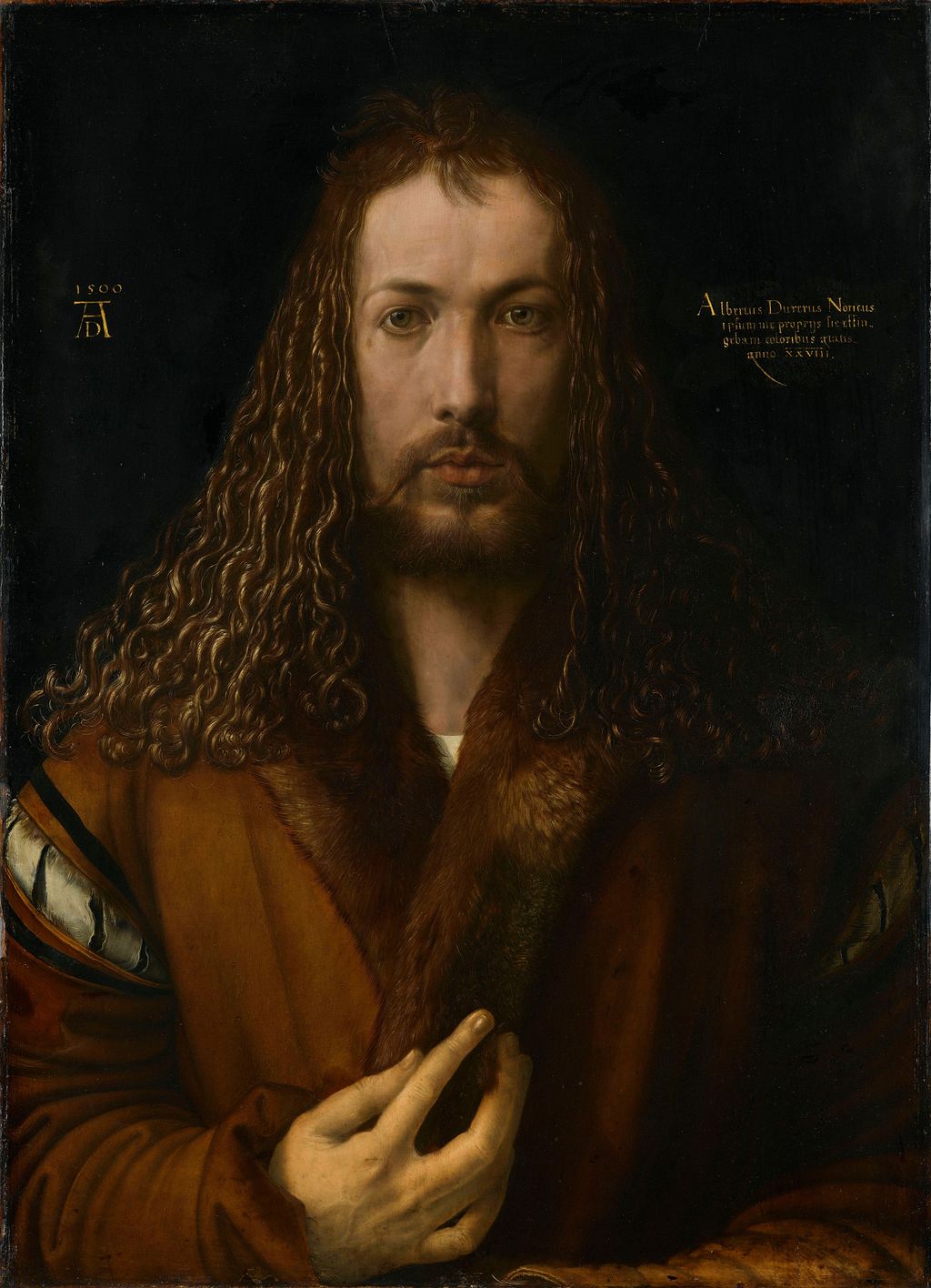
The 1500 self-portrait concentrates attention on face, hair and hand.
Explore the paintings and associated works


Tucher and Rieter coats of arms, reverse of Hans Tucher




Portrait of a Clergyman (Johann Dorsch?)

Portrait of a Man, Kisters collection

Portrait of a Venetian Woman

Saint Jerome in His Study, Lisbon painting

Virgin and Child with Saint Anne

Portrait of Elsbeth Tucher

Portrait of Hans Tucher
 Albrecht Durer.jpg)
Emperor Maximilian I, Nuremberg canvas

Lot and His Daughters, reverse of the Haller Madonna

Glim Lamentation

Portrait of a Man with Beret and Scroll

Madonna of the Carnation

Jabach Altarpiece, paired outer wings

Apostles Philip and James, paired paintings

Dresden Altarpiece, with qualified wing attribution

Portrait of a Girl with a Red Beret

Portrait of Bernhard von Reesen

Portrait of Burkhard von Speyer

Seven Sorrows of the Virgin, reconstructed arrangement

The Suicide of Lucretia

Portrait of a Young Woman with Her Hair Down
A family enters sacred history
Portraiture enters sacred history in the Paumgartner Altarpiece . The Nativity centre, around 1500, is limewood, 155 × 126.1 centimetres. Small family donors kneel below the sacred figures; on the fir wings Stephan becomes Saint George and Lukas Saint Eustace. The current dates differ: after 1497 for Stephan, around 1500 for Lukas. This family can appear both at the margin and as imposing Christian knights. [9] [10] [11]
The ensemble's construction remains a question. Martin Schawe asked in the 2006 Dürer roundtable whether the differently built centre and wings were originally intended together, or assembled later by Dürer. The proposal does not establish a later assembly. [12]
A memorial foundation for the parents has also been proposed. After Bavaria acquired the panels in 1613, additions and overpainting changed them; removal in 1902–03 helped shape today's appearance. The acid attack of 1988 required years of restoration, with treatment concepts based on ion exchangers developed at the Doerner Institut. [13] [14]
Within the painted centre, a diagonal roof crosses a tall arch. Blue sky shows through the ruins; smaller openings frame approaching figures. Mary's blue clothing and Joseph's orange robe bend around the bright Child and angels. The space is both shelter and passage: our eye settles on the foreground or travels through it.
Venice: gathering a community and crowding a face
The Feast of the Rose Garlands gathers a wider community. German merchants commissioned the 1506 painting for San Bartolomeo in Venice. Now in Prague, it is poplar, 162 × 192 centimetres. The Virgin and Child, Saint Dominic and angels distribute garlands among religious and secular figures. The pope kneels on the viewer's left, Maximilian on the right; the pope's substantially repainted face makes its proposed identification especially uncertain. Other sitters remain disputed. [15]
Mary's blue clothing forms a deep central pool around the pale Child. Red garments carry attention across the kneeling figures, and the lute-playing angel sits between them at the very front. Trees hold the sides of the gathering; distant mountains extend its space beyond the tightly assembled bodies. At the right, a standing figure with an inscribed sheet looks towards us. The painting moves between the ritual of giving and receiving and the individual faces which make the gathering particular.
Olga Kotková relates Johann Gruss the Elder's restoration of 1839–41 to Nazarene religious painting, including Joseph Führich's influence on Mary's reconstructed face. Václav Mánes's earlier drawing records a fly on the Virgin's drapery, now lost. Kotková leaves open whether original paint had disappeared or Gruss omitted it; the absence proves no certain tale of prudery. [16]
At the end of August 2026, National Gallery Prague began another conservation project, estimated to take up to five years. Its published programme includes investigation, panel and paint treatment, and an eventual scholarly monograph. These are plans for recovering knowledge, not findings already available to explain every visible passage. [17]
Dürer's own Venetian letters add a livelier voice to these public objects. Writing to Willibald Pirckheimer on 7 February 1506, he describes a world of friendship and rivalry. He reports Giovanni Bellini's praise and request for a painting, alongside complaints about other painters copying and criticising his work. The letter is full of confidence, irritation and affectionate teasing. It lets us hear the painter making a case for himself to a friend; it cannot stand as a disinterested survey of Venetian opinion. [18]
On 23 September he announces the completion of his principal picture and another, unusually new kind of painting. That second work is unnamed. In the same letter he boasts of praise for his Madonna, says he must still paint promised portraits and claims to have refused very profitable commissions to hasten his return. Painting appears here within a stream of obligations, opportunities and personal news. The exuberance is part of the evidence, rather than a reason to accept every reported sum or compliment literally. [18]
The Christ among the Doctors presses its figures into a much shallower field. Books form a barrier at the bottom, heads crowd towards Christ, and the meeting of hands becomes almost a second conversation beneath the faces. Christ's youthful, pale face sits above the darkest central opening. To the right, a heavily distorted profile approaches him; at the opposite side, another face turns quietly towards the exchange. The compression leaves us little distance from the argument.
The 1506 painting is now at Madrid's Thyssen-Bornemisza. Its patron is unknown. Mar Borobia discusses its possible identification with the unnamed second picture in the Venetian letter; that connection remains scholarly identification. The inscription's claim to execution in five days need not include the preparatory studies. Speed of painting and time spent preparing are different questions. [19]
The caricature also carries religious hostility. Caroline Kaye argues that attention to the composition's artistic sources has often displaced scrutiny of its anti-Jewish implications. The contrast between Christ and the distorted elders is a Christian representation of Jewish people, not evidence about their appearance or character. Admiration for the handling of hands and faces must leave room for that judgement. [20]
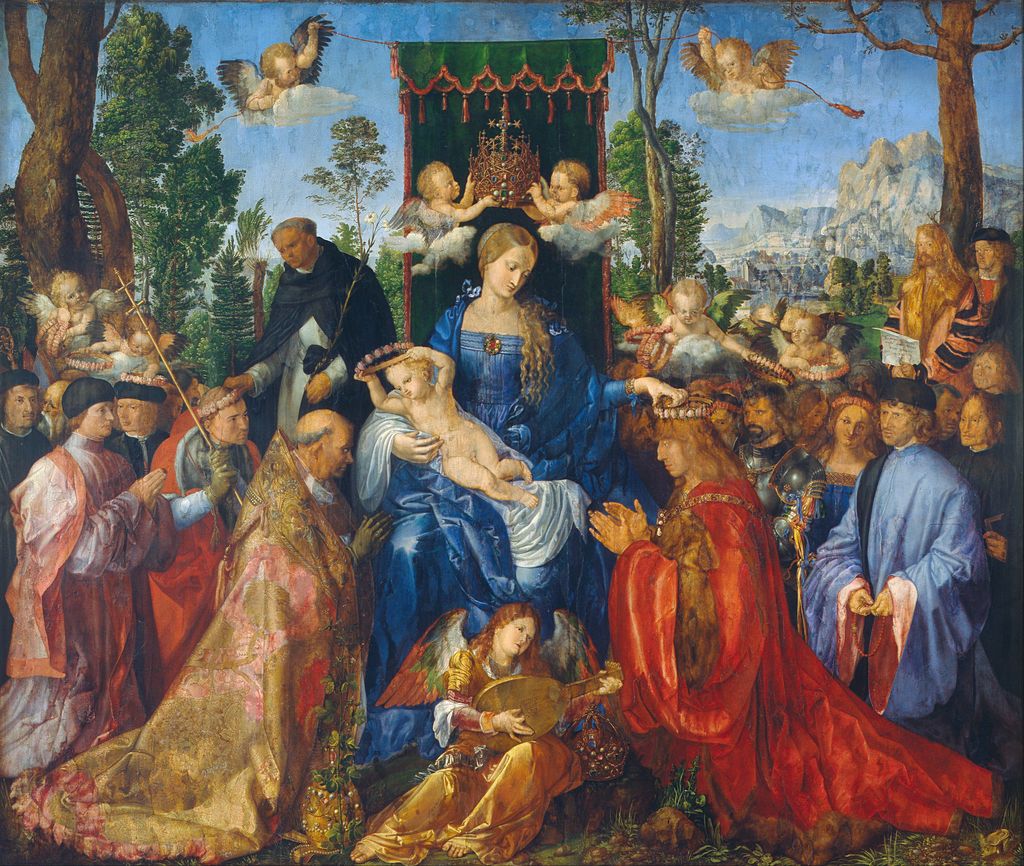
The Feast of the Rose Garlands gathers richly clothed figures around the Virgin.
Drawing, paint and the practised hand
The Metropolitan Museum's unfinished Salvator Mundi , around 1505 on limewood, exposes drawing beside coloured drapery. Pen and brush underdrawing appear in the technical account; infrared reflectography reveals strokes under paint, while microscopy identifies thin original paint in flesh, beard and orb. Pale areas are therefore more than bare drawing. [21]
The picture was already listed as incomplete in 1573. The Burlington Fine Arts Club's catalogue of 1906 records the later application and removal of finishing paint: its apparently unfinished state had attracted investigation long before modern imaging. [8]
Cleaning also damaged original material. Ainsworth proposes a possible workshop demonstration, but why Dürer stopped remains unknown. Joint examination in 2005 argued against the supposed Bremen wings. The object's alterations remain part of what we see. [21] [22]
The blue robe looks continuous beside the broken network of strokes in the pale face; the infrared image extends that network into the drapery.
Dürer's later writing helps explain why preparation need not dictate every finished mark. In the discussion of proportion translated by William Martin Conway in 1889, he insists that drawing must be learnt through repeated practice. A student should take a little at a time and proceed only after acquiring the skill. Understanding and the trained hand must develop together. A written rule cannot supply the power to carry it out. [18]
He also answers an objection that sounds practical rather than mathematical: who could continually measure out figures when twenty or thirty different ones might be required quickly? His answer is that knowledge acquired through measurement can become judgement by eye. The experienced hand need not reconstruct the lesson at every stroke. Elsewhere he argues that sustained study supplies the imagination with material, so that a practised artist need not copy each figure directly from a model. Observation can be stored and transformed. [18]
These are arguments for acquired freedom, with limits. Dürer's account of beauty admits uncertainty and disagreement, yet its categories also contain explicit racial prejudice and contempt for bodily disability. His appeal to nature does not make those judgements neutral truths. What remains especially useful for looking at the paintings is his insistence that knowledge, practice and choice work together. A carefully drawn outline may be a stage in deciding what a picture should become, rather than a mechanical instruction which paint merely fills. [18]
Workshop drawings complicate authorship. London's Madonna with the Iris is currently attributed to Dürer's workshop with Hans Baldung Grien, possibly 1503–08. The Gallery connects its plants with available studies; familiar motifs cannot establish Dürer's hand. [23]
Technical examination records changes to the arch, a rose omitted after drawing, and plants added in different phases. The AD monogram lies over much later repaint. The Gallery's 2000 study makes attribution a question about the object's sequence of making as well as its resemblance to Dürer's work. No single familiar motif settles who painted it. [24]
The red robe spreads across the grassy seat towards the plants. Above, the broken arch opens onto a pale sea. The Child lies across the Virgin's bent arms; broad folds shelter that close encounter, while stems and sharp leaves lead our attention outwards.
Painted bodies and the life of wood
The Prado's Adam and Eve of 1507 are nearly life-size paintings, distinct from the 1504 engraving. Pale figures stand apart against darkness. [4]
Their commission is unknown; a civic origin is hypothetical. Brush underdrawing lies beneath flesh glazes. Eve retains an original porphyry-like painted reverse; Adam was thinned, cradled and split. George Bisacca describes the spring support that allowed movement and the panels' matching natural curvatures afterwards. Later constraints on wood had distorted the painted forms. [25] [26]
Measured bodies did not mean a single unalterable template to Dürer. In the same later treatise, he describes changing the proportions of a figure, lengthening or shortening its parts until it becomes different from the starting form. He distinguishes deliberate variation from the small differences which inevitably enter handwork. Even two impressions from one copperplate, he observes, can be distinguished. The search for order thus coexists with an acute awareness that making produces differences. [18]
Labour, light and the commissioned picture
The Heller Altarpiece , completed in 1509 for Frankfurt's Dominican church, survives unevenly. Dürer's centre was replaced by Jobst Harrich's copy when the original went to Bavaria in 1614; the original burned in 1729. Workshop donor portraits on the wings and Grünewald's later grisaille additions belong to separate parts of the ensemble's making. [27] [28]
Harrich's copy preserves the broad movement of the composition. Apostles cluster around the Virgin's empty tomb below, while her coronation fills the upper field. Kneeling, bending and upright bodies turn their heads in different directions, connecting the two levels. We can follow that organisation without recovering the touch of Dürer's lost painted surface.
The letters to Jakob Heller preserve a different kind of proximity. In August 1508 Dürer describes the state of the wings and centre, promises that no one else will paint a stroke on the latter, and asks for more money to realise his intended work. He also worries that shortening winter days will limit what he can accomplish. Materials, daylight, payment and the artist's time are inseparable in his account. [18]
The correspondence resists the easy idea that Dürer always wanted the greatest possible finish. In November 1508 he rejects Heller's suggestion that he had promised the utmost care he could conceivably bestow. At that level, he argues, a single face could occupy half a year; an altarpiece with many faces could scarcely be completed. More pointedly, no one would be able to see such minute work in its intended position. He defends exceptional effort, but distinguishes it from an unlimited labour with no practical end. [18]
By August 1509 his assurances extend to the picture's life after delivery. He describes repeated colour applications and costly ultramarine, asks that the painting be kept clean and protected from holy water, and reports replacing a roughly made frame at his own expense. He advises allowing the picture to lean slightly forward so that it can be seen in good light. Packing and installation are part of finishing the commission: the painter is still thinking about its appearance beyond the workshop. [18]
His proposal to return and varnish it again is conditional on sufficient drying, not a record that the return happened. The promises of extraordinary durability and claims that engraving would have made him richer belong to a painter negotiating the value of his labour. The October letter brings thanks for payment and for gifts to his wife and younger brother. An acrimonious negotiation could end in continuing social ties. Nor did his frustrated promise to concentrate on engraving end his career as a painter. [18]
Drawings associated with Heller make another form of labour visible. Dark strokes and white heightening against blue or green turn folds, hands and heads into studies of light. The ALBERTINA's 2025 exhibition account distinguishes Venetian paper coloured during manufacture from the prepared grounds used in Nuremberg, and proposes an additional life for highly finished sheets as workshop records and showpieces. Their relationship to a painted passage need not exhaust their purpose. [29]
A chapel, a frame and a gathering
The All Saints' Picture , or Landauer Altarpiece , gathers heavenly and earthly believers around the Trinity. The Father supports the crucified Christ, with the dove above. Around them figures occupy widening bands of cloud. Below, a narrow landscape opens towards a distant horizon; Dürer stands apart with his inscription tablet. The painter is present, yet separated from the company he has made visible. The chapel's congregation could look towards an assembly far larger than its own. [4]
Matthäus Landauer commissioned the 1511 limewood panel for the chapel of his charitable home for elderly, impoverished craftsmen. The original is now in Vienna's Kunsthistorisches Museum. [30]
Looking can alternate between crowded clouds and almost empty earth, between individual figures and an uninterrupted view towards the horizon. The breadth of the landscape gives the gathered bodies a second scale: an immense distance beneath their close company. [4]
Dürer's design of 1508 included a frame, carved by an unidentified Nuremberg master. The original frame survives in the Germanisches Nationalmuseum with a copy of the painting; the painted original is in Vienna. Its carved Last Judgement and the painted adoration formed a coordinated object. Their separation leaves two collections preserving different parts of the chapel encounter. [31] [32]
Gifts, warnings and pictures opened to view
A commission was only one way to give a painting a destination. Dürer's Saint Jerome of 1521 was a gift to Rui Fernandes de Almada, secretary of the Portuguese trading establishment in Antwerp. Now in Lisbon's Museu Nacional de Arte Antiga, it is oil on oak, 59.5 × 48.5 centimetres, inventory 828 Pint. The Academy of Fine Arts bought it from the Almada family in 1880. [33] [34]
Jerome supports his head and points to a skull; books and crucifix recede. His painted gaze brings the 1514 engraving's spacious meditation close. [34]
The ALBERTINA preserves head 3167, hand 3168, skull 3175 and lectern 3176. Painting raises the gaze, omitting the round box. [35] [36]
The inscription on the head study identifies a healthy ninety-three-year-old man in Antwerp in 1521. Charles Ephrussi's 1882 catalogue records that statement, then describes the separate arm and hand, skull and desk with books and a metal box. The preparatory objects already existed as a group to compare, without requiring us to imagine that every drawn object was copied unchanged into paint. [7]
Wölfflin's 1908 discussion notices another distinction: the hand for Jerome is conceived in broader light and dark areas than the hands studied for Heller. That comparison directs attention to the work of the brush, as well as to the objects it describes. Preparation can refine the manner of seeing while also supplying a set of parts to choose and rearrange. [4]
The Four Apostles of 1526 addresses a public world. On two tall limewood panels, John and Peter stand at the left, Mark and Paul at the right. The customary title includes the evangelist Mark alongside three apostles. John's red robe and Paul's pale mantle dominate; the figures behind them deepen the narrow spaces. [37]
Dürer gave the pair to Nuremberg's council. Martin Schawe relates its warnings against false teaching, drawn from Luther's New Testament, to the city's adoption of the Reformation in 1525. An old theory that the panels were converted from cancelled altarpiece wings has been rejected on technical grounds. The inscriptions were cut away after the transfer to Bavaria in 1627 and reunited with the paintings in 1922. Reading restores part of their civic address. [38]
The downward turn towards John's open book differs from Paul's outward vigilance. Large folds carry the bodies' weight; small exposed hands and feet locate them inside the cloth. We register the red and white masses before approaching the faces and writing. Distance and close attention have different work to do here.
Berlin's Hieronymus Holzschuher belongs to 1526, the same year as Jakob Muffel . [4]
The sliding cover bears joined family arms; the museum links its protection with preservation. Brilliance made Sulpiz Boisserée suspect forgery around 1812, despite earlier records. Opening could control access to the likeness. [39]
Wölfflin compares the two portraits through their handling of a head. Holzschuher's white locks sweep across the forehead in emphatic curves; in Muffel the modelling of brow and eye socket has a different weight. Such a comparison lets us see how exactness can be carried by very different decisions about line and mass. Minute attention need not mean that every hair receives the same kind of mark. [4]
Dark fur anchors the face; eye reflections and the upper-left inscription reveal its minute construction. [39]
Dürer's paintings reward that movement between the whole and the particular. Cloth can first read as a broad area of colour, then as a succession of folds and edges. A hand can carry a gesture across a crowded scene, then reveal the joints and shadows that make it convincing. Patient looking discovers decisions at both scales. The painter's skill becomes most absorbing when we ask what those decisions enable a picture to do.
Frequently Asked Questions
Artworks directory
These 187 records include individual works, reverse sides, detail views, paired panels and reconstructed arrangements. Three additional catalogue images repeat works already listed. Related views are not counted as separate originals; qualified attributions and published dating are retained.
Discussion
Look again at the images and ideas explored in Albrecht Dürer Paintings. These editorial prompts invite your observations.
Reader Insights
Which detail or idea in Albrecht Dürer Paintings most changed your reading, and why?
How does the discussion of “Faces, clothes and the painter’s standing” affect your understanding?
What comparison would you bring to the discussion of “Gifts, warnings and pictures opened to view”?
Join the Conversation
Share a detail, comparison or question about Albrecht Dürer Paintings below.
References
- Germanisches Nationalmuseum , Bildnis der Barbara Dürer , Gm1160. German. View source .
- Catalogo Generale dei Beni Culturali , Ritratto del padre di Dürer , Uffizi, inv. 1890 no. 1086. Italian. View source .
- Musée du Louvre , Portrait de l'artiste tenant un chardon , RF 2382. French. View source .
- Heinrich Wölfflin , Die Kunst Albrecht Dürers , second enlarged edition (Munich: F. Bruckmann, 1908), pp. 30–31, 169, 178, 191–194, 296–298, 321–322 and illustration index, pp. 375–379. German. View source .
- Museo Nacional del Prado , Self-portrait , P002179. English; text by Pilar Silva Maroto, adapted from El retrato del Renacimiento (2008). View source .
- Bayerische Staatsgemäldesammlungen , Selbstbildnis im Pelzrock , 537. German. View source .
- Charles Ephrussi , Albert Dürer et ses dessins (Paris: A. Quantin, 1882), pp. 2–3, 14–16, 78–80, 107, 153–154, 178, 188, 298, 302, 312–313 and subject indexes, pp. 397–410. French. View source .
- Burlington Fine Arts Club , Exhibition of Early German Art (London, 1906), no. 38, “Salvator Mundi,” p. 24. English. View source .
- Bayerische Staatsgemäldesammlungen , Paumgartner-Altar: Geburt Christi , 706. German. View source .
- Bayerische Staatsgemäldesammlungen , Stephan Paumgartner als hl. Georg , 701. German. View source .
- Bayerische Staatsgemäldesammlungen , Lukas Paumgartner als hl. Eustachius , 702. German. View source .
- Germanisches Nationalmuseum , Dürer roundtable proceedings (2006), p. 20, Martin Schawe's contribution. German. View source .
- Haus der Bayerischen Geschichte , Paumgartner-Altar . German. View source .
- Doerner Institut , History , “From 1977 to the present day.” English. View source .
- Olga Kotková , Růžencová slavnost , O 1552, National Gallery Prague catalogue entry (2007). Czech. View source .
- Olga Kotková , “The Role of Nazarenism in the Renewal of Late Medieval Works: Johann Gruss the Elder's Restoration of The Feast of the Rose Garlands by Albrecht Dürer”, Forum Historiae 11, no. 2 (2017), pp. 26–35. English. View source .
- National Gallery Prague , The Feast of the Rose Garlands through Five Centuries . English. View source .
- Albrecht Dürer , letters and proportion treatise, in William Martin Conway, Literary Remains of Albrecht Dürer , with transcripts and notes by Lina Eckenstein (Cambridge, 1889), pp. 48–49, 56–58, 65–71, 241–249. English translation. View source .
- Mar Borobia , Jesús entre los doctores , 134, Museo Nacional Thyssen-Bornemisza. Spanish. View source .
- Caroline Kaye , The Disputation: The Enduring Representations in William Holman Hunt's “The Finding of the Saviour in the Temple,” 1860 , chapter 5, especially pp. 131–135. English. View source .
- Metropolitan Museum of Art , Salvator Mundi , 32.100.64, Catalogue Entry and Technical Notes. English. View source .
- Maryan W. Ainsworth , “Salvator Mundi,” in Dürer and Beyond: Central European Drawings, 1400–1700 (2012), pp. 19–22. English. View source .
- National Gallery , The Virgin and Child (“The Madonna with the Iris”) , NG5592. English. View source .
- Paul Ackroyd , Susan Foister, Marika Spring, Raymond White and Rachel Billinge, “A Virgin and Child from the Workshop of Albrecht Dürer?”, National Gallery Technical Bulletin 21 (2000), pp. 28–42. English. View source .
- Pilar Silva Maroto , Maite Dávila and José de la Fuente, Special Display: Adam and Eve, by Dürer, following their restoration , Museo Nacional del Prado, 2010–11. English. View source .
- George Bisacca , Adam and Eve by Dürer. A wonderful experience , Voces del Prado , interview segment (2020). English transcript. View source .
- Vanessa Tron , “Der ‘Heller-Altar’ von Albrecht Dürer”, Städel Stories, 18 November 2013. German. View source .
- ALBERTINA , Albrecht Dürer exhibition press dossier (2019), “Der Heller-Altar”; Historisches Museum Frankfurt, Museum Guide , donor-portrait caption, B267 and B269; and Staatliche Kunsthalle Karlsruhe, Heilige Märtyrerin , 2605. German and English. View source 1 . View source 2 . View source 3 .
- ALBERTINA , Leonardo–Dürer: Renaissance Master Drawings on Colored Ground , exhibition press dossier (2025), exhibition texts, especially printed pp. 6 and 9–10; curators Achim Gnann and Christof Metzger. English. View source .
- Kunsthistorisches Museum , All Saints' Picture (Landauer Altar) , GG 838. English. View source .
- Germanisches Nationalmuseum , Altarretabel aus der Kapelle des Nürnberger Zwölfbruderhauses , Pl.O.211. German and English. View source .
- Christina Posselt , Entwurf des Allerheiligenbildes mit Rahmen , Sandrart.net, annotation dated 26 January 2009. German, with English interface. View source .
- Museu Nacional de Arte Antiga , São Jerónimo , 828 Pint, Google Arts & Culture. Portuguese. View source .
- Museu Nacional de Arte Antiga , S. Jerónimo , “Uma Peça | Um Museu,” e-cultura. Portuguese. View source .
- Heinz Widauer , Bildnis eines 93-jährigen Mannes , 3167, ALBERTINA, Die großen Meister der Albertina (2008), no. 13. German and English. View source .
- Matthias Mende , ALBERTINA: Arm- und Handstudie , 3168; Totenschädel , 3175; Lesepult mit Büchern , 3176. Albrecht Dürer catalogue (2003), pp. 503–510. German. View source 1 . View source 2 . View source 3 .
- Bayerische Staatsgemäldesammlungen , Vier Apostel: Hll. Johannes Ev. und Petrus , 545, and Hll. Markus und Paulus , 540. German. View source 1 . View source 2 .
- Martin Schawe , “Dürer, Albrecht: Vier Apostel”, Historisches Lexikon Bayerns , 13 April 2010. German. View source .
- Staatliche Museen zu Berlin , Hieronymus Holzschuher mit Deckel , 557E, including the 2019 Gemäldegalerie essay. German and English. View source .
- Campbell Dodgson, Catalogue of Early German and Flemish Woodcuts Preserved in the Department of Prints and Drawings in the British Museum , vol. I (London: printed by order of the Trustees, 1903), pp. 299–300, no. 103 (B. 7; H. 1120). English. View source.
- Web Gallery of Art, Tucher–Rieter reverse (English). View source.
- National Gallery of Art, Portrait of a Clergyman (English). View source.
- Dürer Art, Portrait of a Man (English). View source.
- Hessen Kassel Heritage, Elsbeth Tucher (German). View source.
- Web Gallery of Art, Hans Tucher (English). View source.
- Germanisches Nationalmuseum, Emperor Maximilian I (German and English). View source.
- National Gallery of Art, Lot and His Daughters, reverse (English). View source.
- Bayerische Staatsgemäldesammlungen, Glim Lamentation (German). View source.
- Museo Nacional del Prado, Portrait of a Man (Spanish). View source.
- Bayerische Staatsgemäldesammlungen, Madonna of the Carnation (German). View source.
- Städel Museum, Job on the Dungheap (German). View source.
- Wallraf-Richartz-Museum, Piper and Drummer (German). View source.
- Italian Ministry of Culture / Uffizi, Head of Saint James (Italian). View source.
- Klassik Stiftung Weimar, Dresden Altarpiece (German). View source.
- Staatliche Museen zu Berlin, Girl with a Red Beret (German and English). View source.
- Dresden State Art Museums / Roland Enke, Bernhard von Reesen (German). View source.
- Royal Collection Trust, Burkhard von Speyer (English). View source.
- Dresden State Art Museums, Seven Sorrows of the Virgin (English). View source.
- Bayerische Staatsgemäldesammlungen, Mater Dolorosa (German). View source.
- Bayerische Staatsgemäldesammlungen, Lucretia (German). View source.
- Städel Museum, Young Woman with Her Hair Down (English). View source.
- ALBERTINA, Portrait of a Young Man (German). View source.