by
Tom Gurney
Tom Gurney BSc (Hons) is an art history expert with over 20 years experience
Published on June 19, 2020 / Updated on October 22, 2026
Email:
tomgurney1@gmail.com
/ Phone:
+44 7429 011000
Rhinoceros (Pen and Ink) by Albrecht Dürer: Introduction
Albrecht Dürer’s Rhinoceros of 1515 has the patient detail of an animal studied at close quarters. The head hangs heavily, the small eye looks out from a succession of wrinkles, and each foot has convincing weight. Yet Dürer never saw the rhinoceros. This British Museum drawing brings a distant animal into view through information that had travelled ahead of it. Executed in pen and brown ink on paper, the sheet measures 274 × 420 millimetres and bears the museum number SL,5218.161. [1]
The drawing and Dürer’s better-known woodcut are easy to distinguish. Here the animal faces left, with a long handwritten account beneath its feet. The title RHINOCERON and the date 1515 stand in the open space above its back. The drawing has room to breathe: paper surrounds the horn, ears and tail, while the inscription occupies a narrow strip along the lower edge. Before this creature became a densely printed public image, it existed as this combination of an elaborate body and a closely written report.
At a Glance
- Date 1515 [1]
- Materials Pen and brown ink on paper [1]
- Collection British Museum, London; SL,5218.161 [1]
This work across Albrecht Dürer’s career
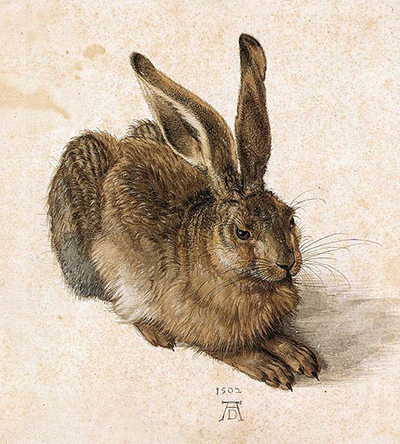
Young Hare
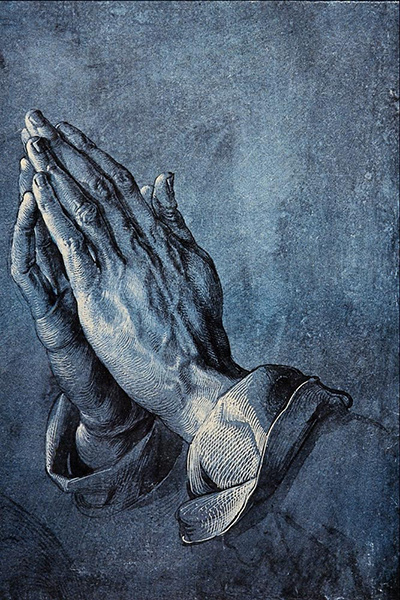
1502Praying Hands
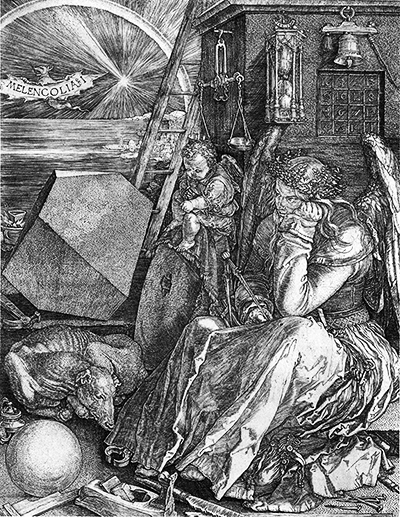
1508Melencolia I
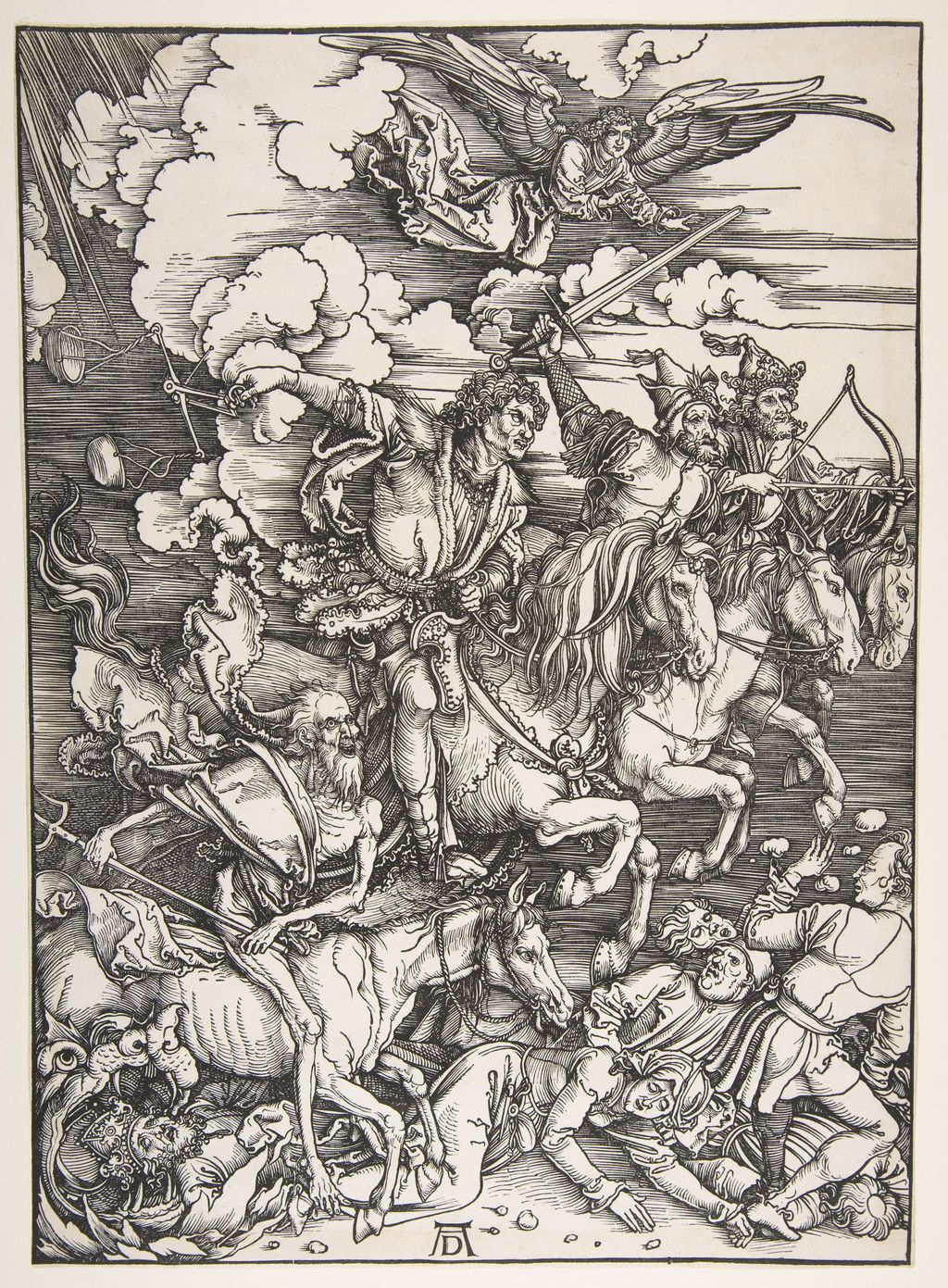
1514Four Apostles
1526Contents
- Building the animal in ink
- The report beneath the feet
- How Lisbon reached Nuremberg
- What the paper reveals
- From the sheet to the woodcut
- Frequently Asked Questions
Building the animal in ink
Dürer makes the rhinoceros understandable by dividing it into strongly defined parts. A large covering over the shoulder overlaps the foreleg. Another curls around the haunch, and the broad middle of the body rises between them like a ribbed shell. Their edges turn outward in narrow rims, suggesting thickness as well as shape. Across these surfaces, small circles, irregular loops and rows of scallops create different kinds of skin. The texture changes as the eye travels: rings scatter over the shoulder, longer marks follow the belly, and close scales descend the legs.
The variety matters. An evenly patterned body would look flat. Instead, Dürer lets each family of marks follow the part it describes. Curved hatching rounds the haunch; tight dark strokes gather where one part overlaps another. Along the underside, several nearly horizontal lines make the belly seem to project beyond the feet. The broad, lightly marked upper flank remains relatively pale. Its openness allows the darker bands around it to describe a substantial volume without filling the whole animal with ink.
The head is especially intricate. A rounded swelling above the eye leads into the long slope of the nose, while folds beneath the cheek turn toward the mouth. The nasal horn rises from a knobbly base. Behind the ears, the neck develops a succession of projecting ridges, and a smaller pointed growth appears farther back along its upper contour. These details have the same meticulous treatment as the plausible feet and heavy muzzle. The drawing offers no visual label to separate a reliable reported feature from an uncertain one.
Under the animal, quick strokes establish a patch of ground. They are enough to carry its weight, although they supply almost no location. There is no harbour, enclosure, attendant or European spectator. Dürer concentrates attention on the body itself, presenting a creature that can be examined from horn to tail. Its monumental appearance comes partly from this isolation: nothing nearby provides a competing scale or a distracting event.
The report beneath the feet
The inscription gives the still animal an extraordinary life. Dürer writes of its arrival from India, its colour, size, protective covering and hostility toward the elephant. He describes a sharp horn that the animal supposedly whets against stones before attacking its opponent’s vulnerable underside. The final words move between Greek, Latin and an Indian name, written as gomda . Friedrich Winkler’s catalogue reproduces the long German inscription, including its opening date, and identifies the separate title and date above. [12]
Particularly revealing is the expression unserm küng van portigall : “our king of Portugal.” The voice belongs naturally to someone reporting from Portugal. Another sentence addresses a recipient and explains that the creature’s marvellous appearance has prompted the sending of its likeness. Read as words copied into Dürer’s sheet, these phrases preserve the relationship between a sender and a reader. They need not mean that Dürer himself sent this particular drawing, or that the king was his own ruler. The sheet carries traces of a communication as well as a representation. [12]
Its dating also needs careful reading. The large date above the animal is 1515. The lower text begins with the faulty form “153,” conventionally understood as 1513, and gives 1 May for the arrival. The rhinoceros actually reached Lisbon on 20 May 1515. The discrepancy belongs to the transmitted description; it does not move the drawing back two years. Two dates on one sheet therefore perform different jobs: one dates the image, while the other repeats a piece of news whose details were imperfect. [12] [13]
Even the colour statement depends on words. The German compares the animal’s colour to a toad, although the brown ink drawing supplies no painted colour sample. Dürer gives the reader a richly differentiated surface and leaves the comparison to complete an aspect the medium does not specify. The text is consequently more than a caption naming what is already visible. It extends the picture into colour, behaviour, language and distant events. [12]
How Lisbon reached Nuremberg
The animal had passed from Sultan Muzafar II of Gujarat to the Portuguese governor Afonso de Albuquerque, who sent it to King Manuel I. The British Museum proposes a likely route for news reaching Dürer: a newsletter sent to Nuremberg merchants by Valentin Ferdinand, also known as Valentim Fernandes, a Moravian printer working in Lisbon. An Italian transcript of Ferdinand’s report survives in Florence. Sketches may also have accompanied information sent north, but the presumed visual source has not survived. [1]
The missing links should remain visible. In his historical study of captive rhinoceroses, L. C. Rookmaaker questioned whether the letter associated with a lost sketch was actually Ferdinand’s surviving report. He also rejected an older suggestion that the British Museum sheet was itself the original Portuguese drawing. Those distinctions prevent a plausible transmission route from hardening into a fully documented sequence. We have Dürer’s drawing and its text; we cannot put an identifiable eyewitness sketch beside them and measure exactly what he copied or changed. [13]
The inscription’s elephant story also had a long written history. Pliny’s Natural History describes the rhinoceros sharpening its horn on rocks and attacking the elephant’s softer belly. It compares the animals’ length while giving the rhinoceros shorter legs. The correspondence with Dürer’s text shows how readily fresh news could carry ancient natural history with it. This was a newly arrived living creature described through expectations already available in books. [14]
Such expectations affected events too. Manuel arranged an encounter between the rhinoceros and an elephant on 3 June 1515; the elephant fled. The elaborate killing described beneath Dürer’s animal should therefore be understood as an account of its supposed fighting method, not a literal record of what happened at that encounter. The sheet joins reported appearance to a story of formidable power. Its layered covering and lowered horn make that story easy to imagine, even though the animal stands quietly before us. [13]
What the paper reveals
The sheet also belongs to a material network. The British Museum records a trident-and-ball watermark associated with the Fugger trading family. In 2022 Angela Campbell, C. Richard Johnson Jr. and William Sethares included this exact rhinoceros drawing in a comparison of seventeen watermarks. Their analysis separated the papers into two groups, probably originating from two moulds, possibly a working pair. The rhinoceros falls in their Group A, alongside several other Dürer drawings. [1] [15]
This is more specific than recognizing a similar emblem. The researchers compared the relative positions of points within each mark and checked aligned images. Their findings suggest that Dürer kept using a related stock of fine drawing paper over many years. They leave the precise origin and supply arrangements open; the proposed Augsburg manufacturer remains a hypothesis. The watermark thus connects the rhinoceros to workshop materials without proving a commission from Fugger or a purchase made for this particular animal. [15]
The distinction is useful when looking at the finished sheet. Its minute textures and sustained outlines required a support on which repeated pen strokes could remain legible. The physical paper belongs to the making of this convincing body just as the report belongs to its conception. Neither the material evidence nor the inscription, however, restores the missing moment when Dürer first encountered the news.
From the sheet to the woodcut
Comparison with the National Gallery of Art’s woodcut and letterpress impression makes the next transformation clear. The printed rhinoceros faces right. The report has moved above a rectangular frame, and the title and AD monogram occupy the upper right of the image. The drawing’s more spacious presentation has become a compact arrangement in which the horn nearly touches the border and the great body presses into the available field. [16]
There are changes within the animal too. In the print, the covering over the shoulder reads as a more emphatic patterned panel. Dark hatching under the belly gives the body a stronger downward pressure, and the little horn behind the neck has a conspicuous twist. The print adds a rougher patch of ground, with tufts and stones, while deepening the contrast between illuminated surfaces and shadowed overlaps. Comparing the two works makes it possible to follow an image becoming firmer and more insistent without pretending that every alteration can be assigned to a lost intermediate drawing.
The technique demanded a different physical operation. In a woodcut, the surrounding wood is removed so that the lines receiving ink stand in relief. Pen marks on this sheet could be made directly; printable marks had to survive as part of a cut block. The resulting impression preserves a reversed animal and a more forceful play of black and white. The drawing nevertheless remains rewarding on its own: its quieter intervals, small changes of touch and close-packed handwriting retain the encounter between a report and an artist trying to give it visible form. [17]
Frequently Asked Questions
Artworks directory
These 187 records include individual works, reverse sides, detail views, paired panels and reconstructed arrangements. Three additional catalogue images repeat works already listed. Related views are not counted as separate originals; qualified attributions and published dating are retained.
Discussion
Look again at the images and ideas explored in Rhinoceros (Pen and Ink) by Albrecht Dürer. These editorial prompts invite your observations.
Reader Insights
Which detail or idea in Rhinoceros (Pen and Ink) by Albrecht Dürer most changed your reading, and why?
How does the discussion of “Building the animal in ink” affect your understanding?
What comparison would you bring to the discussion of “From the sheet to the woodcut”?
Join the Conversation
Share a detail, comparison or question about Rhinoceros (Pen and Ink) by Albrecht Dürer below.
References
- British Museum , Rhinoceros in profile to left , SL,5218.161, 1515. Object record, inscription and curator’s commentary. View source .
- ALBERTINA, Selbstbildnis als Dreizehnjähriger, inv. 4839 (German). View source.
- Metropolitan Museum, Four Horsemen from The Apocalypse, 19.73.209 (English). View source.
- Bayerische Staatsgemäldesammlungen, Selbstbildnis im Pelzrock, inv. 537 (German). View source.
- ALBERTINA, Feldhase, inv. 3073 (German). View source.
- ALBERTINA, Das große Rasenstück, inv. 3075 (German). View source.
- Metropolitan Museum, Adam and Eve, 19.73.1 (English). View source.
- ALBERTINA, Betende Hände, inv. 3113 (German). View source.
- Metropolitan Museum, Knight, Death, and the Devil, 43.106.2 (English). View source.
- Metropolitan Museum, Melencolia I, 43.106.1 (English). View source.
- Bayerische Staatsgemäldesammlungen, inventory 545: current collection record (German; descriptive citation). View source.
- Friedrich Winkler , Die Zeichnungen Albrecht Dürers , vol. III: 1510–1520, Berlin, 1938, pp. 64–65, no. 625 (German). View source .
- L. C. Rookmaaker , “Captive Rhinoceroses in Europe from 1500 until 1810”, Bijdragen tot de Dierkunde 43, no. 1, 1973, pp. 39–63, especially pp. 39–44. View source .
- Pliny the Elder , Natural History , book VIII, chapter 29 (20), translated by John Bostock and H. T. Riley, 1855. View source .
- Angela Campbell , C. Richard Johnson Jr. and William Sethares, “From Rags to Riches: Pursuing the Connection between Albrecht Durer’s Linen Papers and the Fugger Family’s Mercantile Trademark”, The Quarterly: Journal of the British Association of Paper Historians 124, October 2022, pp. 1–10, especially pp. 6–9. View source .
- National Gallery of Art , The Rhinoceros , 1964.8.697, 1515, woodcut and letterpress on laid paper. View source .
- Suzanne Boorsch and Nadine M. Orenstein , The Print in the North: The Age of Albrecht Dürer and Lucas van Leyden , The Metropolitan Museum of Art Bulletin 54, no. 4, Spring 1997, pp. 3–4. View source .
- Germanisches Nationalmuseum, Barbara Dürer (German and English). View source.
- Web Gallery of Art, Tucher–Rieter reverse (English). View source.
- National Gallery of Art, Portrait of a Clergyman (English). View source.
- Dürer Art, Portrait of a Man (English). View source.
- Hessen Kassel Heritage, Elsbeth Tucher (German). View source.
- Web Gallery of Art, Hans Tucher (English). View source.
- Germanisches Nationalmuseum, Emperor Maximilian I (German and English). View source.
- National Gallery of Art, Lot and His Daughters, reverse (English). View source.
- Bayerische Staatsgemäldesammlungen, Glim Lamentation (German). View source.
- Museo Nacional del Prado, Portrait of a Man (Spanish). View source.
- Bayerische Staatsgemäldesammlungen, Madonna of the Carnation (German). View source.
- Städel Museum, Job on the Dungheap (German). View source.
- Wallraf-Richartz-Museum, Piper and Drummer (German). View source.
- Italian Ministry of Culture / Uffizi, Head of Saint James (Italian). View source.
- Klassik Stiftung Weimar, Dresden Altarpiece (German). View source.
- Staatliche Museen zu Berlin, Girl with a Red Beret (German and English). View source.
- Dresden State Art Museums / Roland Enke, Bernhard von Reesen (German). View source.
- Royal Collection Trust, Burkhard von Speyer (English). View source.
- Dresden State Art Museums, Seven Sorrows of the Virgin (English). View source.
- Bayerische Staatsgemäldesammlungen, Mater Dolorosa (German). View source.
- Bayerische Staatsgemäldesammlungen, Lucretia (German). View source.
- Städel Museum, Young Woman with Her Hair Down (English). View source.
- ALBERTINA, Portrait of a Young Man (German). View source.