by
Tom Gurney
Tom Gurney BSc (Hons) is an art history expert with over 20 years experience
Published on June 19, 2020 / Updated on October 22, 2026
Email:
tomgurney1@gmail.com
/ Phone:
+44 7429 011000
Small Horse by Albrecht Dürer: Introduction
A horse lifts one foreleg beneath a massive stone vault. Its mouth is open, its neck taut, and its pale body catches the light against the darkness of the passage. Behind it stands an armed man wearing an extraordinary winged helmet. Above them, smoke streams from a shallow vessel into a small patch of sky. In Small Horse , dated 1505, Albrecht Dürer gives a beautifully legible animal an intriguingly ambiguous setting. The engraving is small enough to hold comfortably in the hand: the plate represented by the National Gallery of Art’s Washington impression measures 16.4 × 10.7 centimetres. [1]
The horse’s profile offers an immediate pleasure in shape. Its chest swells forward, the belly draws inward, and the line of the back carries the eye towards the rounded hindquarters. Yet that apparent simplicity is surrounded by complications. The building recedes steeply, the attendant is partly hidden, and the smoke suggests an action whose purpose remains unexplained. Dürer makes the animal accessible while leaving the event elusive.
At a Glance
This work across Albrecht Dürer’s career
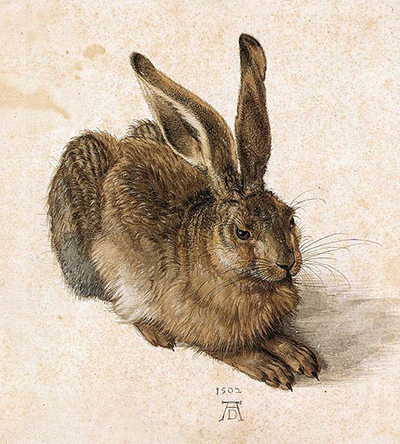
Young Hare
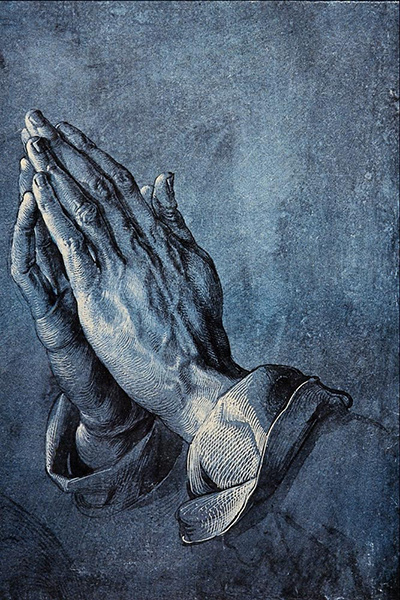
1502Praying Hands
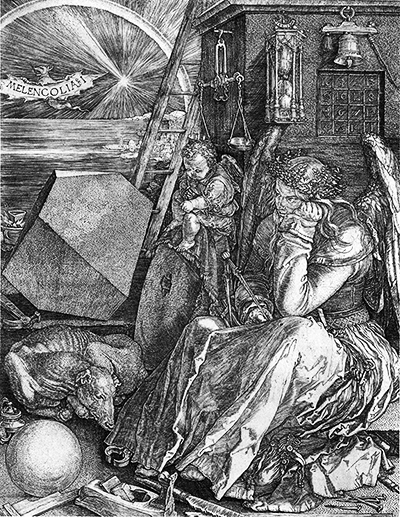
1508Melencolia I
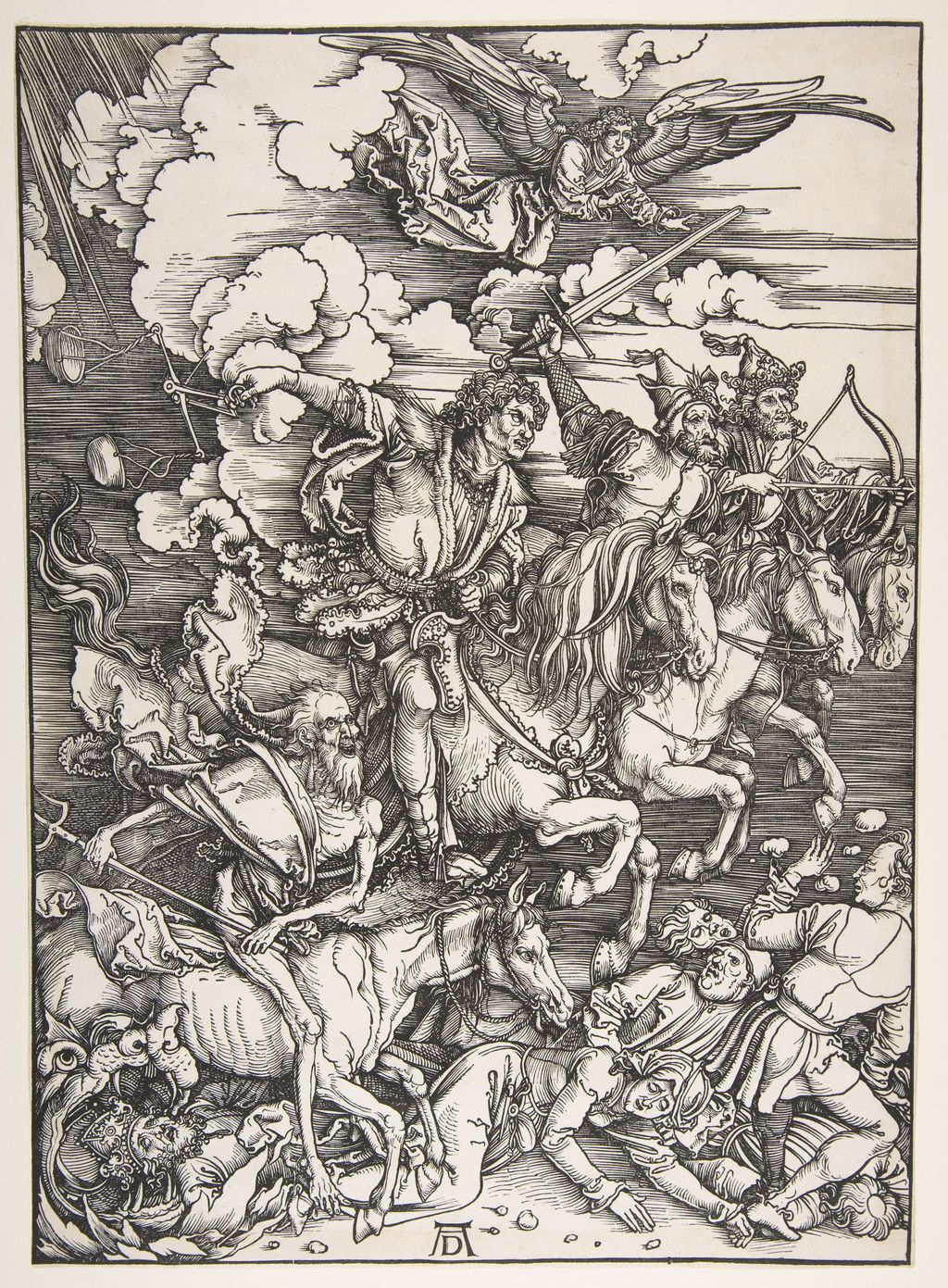
1514Four Apostles
1526Contents
- A body poised between stillness and movement
- The weight of the arch
- Constructing an ideal horse
- The warrior and the smoking vessel
- An image carried into other settings
- Frequently Asked Questions
A body poised between stillness and movement
The raised foreleg gives the composition its liveliest accent. Bent at the knee, with the hoof drawn back, it interrupts the firm verticals of the supporting legs. The horse occupies almost the whole width of the image, so there is little room for the movement its pose seems to promise. Its head approaches the left edge; its tail descends close to the right. The result is a sensation of contained energy, intensified by the stonework overhead.
Look closely at the meeting of neck and chest. Fine lines describe the changing direction of the coat, while darker bands turn the smooth surface into muscle. Around the shoulder, the strokes gather into a deep hollow; along the upper neck they become lighter and more widely spaced. The bright areas are particularly effective because Dürer leaves them open enough for the paper to carry the light. The horse has weight without losing its polished, almost sculptural clarity.
Other details resist an entirely smooth ideal. The mane curls unevenly along the crest. Long hair gathers around the lower legs, and the tail is tied into a conspicuous knot before its strands hang towards the ground. The open mouth exposes an irregular, restless outline beneath the muzzle. At the flank, changes in the direction of the hair animate a surface that might otherwise appear too regular. These small disturbances help the animal feel alive within its carefully organised silhouette.
The attendant stands behind the horse, with his legs visible beneath its belly. Much of his torso disappears behind the neck and back, while his elaborate helmet rises above them. A long halberd crosses diagonally from the lower left towards the upper right. That weapon extends across the architecture as well as the figure, linking the foreground animal to the deeper space. The man’s relative concealment also has a clear pictorial consequence: the horse takes precedence over its human companion.
The weight of the arch
The vault deserves as much attention as the animal. Its broad curve encloses the upper half of the engraving, but the courses of masonry lead away from the viewer. On the right, the heavy wall projects inward; on the left, the supports close around the horse’s head. Beyond this dark frame, a much brighter opening contains the date, a wall and the smoking vessel. The image moves from a nearly tangible foreground to a distant, partly obstructed exterior.
The floor continues this construction of depth. Its narrow lines and receding joints carry the eye beneath the horse, where the attendant’s lower body becomes visible. In front, an irregular block bears Dürer’s AD monogram. The artist places his signature on something with its own upper plane, rough face and cast shadow. Even this small identifying device participates in the engraving’s play between flat marks and solid things. [1]
Architecture and animal are handled differently. The building offers hard edges, abrupt changes of plane and dense shadows; the horse presents a continuous sequence of rounded surfaces. Their close proximity lets the viewer compare the two kinds of form. The vault’s heaviness makes the creature look more supple, while the horse’s brightness makes the passage appear deeper and darker. The partly visible exterior leaves the location open, drawing the eye beyond the tightly framed animal.
The smoke introduces another kind of line. It sweeps out above the bowl in spreading, feathery strands, occupying the open area beneath the date. Unlike the firmly bounded masonry or the horse’s sharply defined body, it seems to disperse as it rises. Its prominent position invites interpretation, although neither its height in the design nor its visual resemblance to flame establishes a particular symbolic meaning.
Constructing an ideal horse
Dürer’s interest in equine proportions helps explain the precision of the profile. The Berlin Kupferstichkabinett’s 2014 exhibition presented Small Horse as an ideal, high-legged warmblood, contrasting its type with the heavier working animal in Large Horse , also dated 1505. This is a useful account of the difference in conception, rather than a pedigree for an identifiable living horse. [12]
A related drawing makes the study of proportion more concrete. The Wallraf-Richartz-Museum in Cologne holds Dürer’s Trotting Stallion of 1503, drawn in black ink against a darkened background. Its museum commentary explains the animal through a grid of sixteen squares, using the head’s length as a unit. One unit measures the neck’s height and three the height of the body. Such a scheme gives the artist a way of relating separate parts to a whole, while the drawing’s extended body reveals how strongly a chosen framework can affect the result. [13]
Ralf Bormann’s study of Dürer’s animals places Small Horse within this developing investigation. He discusses the horse’s head-length module and the square governing the body, and compares the engraving with a horse construction preserved in Dürer’s Nuremberg manuscript. His account also stresses the relationship between geometrical systems and experience of actual animals. These reconstructions explain why a side view was so useful: the principal lengths and heights remain available for comparison. They do not give us a complete record of the order in which Dürer designed or engraved this particular plate. [14]
The print makes that measured structure coexist with expressive movement. The raised hoof, stretched neck and open mouth give the figure an immediate presence even when one knows nothing about a proportional grid. The curved, finely modelled body can be enjoyed before its underlying relations are analysed. Dürer’s success lies partly in making a highly considered form seem capable of moving away.
Engraving gives this balance a particular material character. A burin cuts grooves into the copper plate; ink retained in those grooves transfers to paper under pressure. The Berlin exhibition’s account of the process explains the need to plan modelling and light through lines. Here, their changes of direction describe the horse’s coat, while denser passages establish the shadow around it. What reads at first as a pale, solid body emerges from the relationship between printed strokes and the paper left between them. [12]
Seen beside Large Horse , the choice of viewpoint becomes especially striking. That animal turns its hindquarters towards us; here, the body extends laterally across the image. The two engravings offer different experiences of equine mass within similarly compact vertical formats. Their shared date and related subjects encourage comparison, but do not establish a story about one horse passing through successive stages of training or life. [1] [12]
The warrior and the smoking vessel
The ideal body is easier to explain than the attendant’s identity. His fantastical headgear and winged footwear have encouraged mythological readings. Erwin Panofsky proposed Perseus or Mercury and suggested that the horse might represent animal sensuality governed by intellectual powers, with the fire above standing for enlightening reason. Crucially, Panofsky himself called this interpretation conjectural. In the same discussion, he connected the horse’s design and the warrior’s helmet with Leonardo’s artistic world. [15]
The qualification matters because these details do not resolve themselves into an unmistakable narrative. The attendant carries a halberd, the horse is unsaddled, and the smoke rises from a vessel beyond them. Each feature can attract associations; establishing how all of them belong to one story is more difficult. The print’s visual tension between an animated animal and an armed companion makes an allegorical reading plausible without proving a single moral programme.
Other scholars have preferred a different emphasis. Christina Posselt’s commentary for Sandrart.net identifies the animal as an ideal horse constructed through a square grid and finds mythological explanations unconvincing. Jessica Gritti’s catalogue entry for the Pavia impression records Matthias Mende’s proposal that the horse is Bucephalus, the legendary mount of Alexander the Great. These positions preserve the engraving’s interpretive history without turning any one identification into its established subject. [16] [17]
Gritti also connects the print with the longer history of Dürer’s theoretical work. Equine proportions formed part of his projected treatise on painting, but were excluded from the three treatises published in Nuremberg in 1525–28; the subject was subsequently taken up by Sebald Beham. The print gives a finished public form to a subject that also occupied his unpublished theoretical studies. It presents a public result without supplying a complete explanation of the thinking behind it. [17]
The attendant remains visually compelling even while unnamed. His helmet’s projecting forms echo the horse’s curls and the diagonal blade, gathering several kinds of ornament into a small area. Helmet, mane and weapon almost merge, then separate again as the eye follows their engraved edges.
An image carried into other settings
Later copying shows how readily this pairing could travel. Hessen Kassel Heritage holds an engraving by Johann Ladenspelder that combines the horse and attendant from Small Horse with a landscape taken, in reverse, from Dürer’s Saint Eustace . The museum identifies the borrowed background through its castle, pond, swans and bridge. In the copy, the dark architectural canopy has disappeared. Buildings climb a rocky height above the horse, and trees occupy the space around its body. [18]
The change helps us appreciate what Dürer’s original enclosure contributes. In the landscape, the horse belongs to an expansive world continuing behind and around it. Beneath the vault, it seems held close to the viewer, its pale flank pressed forward against the darker passage. Ladenspelder’s recombination is evidence of the design’s later use; it offers no final answer to the identity of Dürer’s warrior.
The surviving impressions have their own histories too. Washington’s sheet, printed on laid paper, belonged to Clendenin J. Ryan Sr. and appeared in his New York sale on 17 January 1940. It then passed through the dealer Richard H. Zinser to Lessing J. Rosenwald, who bought it that year and gave it to the National Gallery of Art in 1943. This is the history of one impression of a reproducible image. Its individual passage through collections sits beside the wider life of the composition in other impressions and copies. [1]
In any of them, the original design rewards a slow movement of the eye: from lifted hoof to taut neck, from the dense winged helmet to the thinning smoke, and back across the horse’s illuminated flank. The unresolved story sustains curiosity, while the precise relationships of body, line and enclosing space remain immediately visible.
Frequently Asked Questions
Artworks directory
These 187 records include individual works, reverse sides, detail views, paired panels and reconstructed arrangements. Three additional catalogue images repeat works already listed. Related views are not counted as separate originals; qualified attributions and published dating are retained.
Discussion
Look again at the images and ideas explored in Small Horse by Albrecht Dürer. These editorial prompts invite your observations.
Reader Insights
Which detail or idea in Small Horse by Albrecht Dürer most changed your reading, and why?
How does the discussion of “A body poised between stillness and movement” affect your understanding?
What comparison would you bring to the discussion of “An image carried into other settings”?
Join the Conversation
Share a detail, comparison or question about Small Horse by Albrecht Dürer below.
References
- National Gallery of Art , Washington, Small Horse , 1505, engraving on laid paper, Rosenwald Collection, 1943.3.3558. Object metadata, inscriptions and provenance. View source .
- ALBERTINA, Selbstbildnis als Dreizehnjähriger, inv. 4839 (German). View source.
- Metropolitan Museum, Four Horsemen from The Apocalypse, 19.73.209 (English). View source.
- Bayerische Staatsgemäldesammlungen, Selbstbildnis im Pelzrock, inv. 537 (German). View source.
- ALBERTINA, Feldhase, inv. 3073 (German). View source.
- ALBERTINA, Das große Rasenstück, inv. 3075 (German). View source.
- Metropolitan Museum, Adam and Eve, 19.73.1 (English). View source.
- ALBERTINA, Betende Hände, inv. 3113 (German). View source.
- Metropolitan Museum, Knight, Death, and the Devil, 43.106.2 (English). View source.
- Metropolitan Museum, Melencolia I, 43.106.1 (English). View source.
- Bayerische Staatsgemäldesammlungen, inventory 545: current collection record (German; descriptive citation). View source.
- Kupferstichkabinett , Staatliche Museen zu Berlin, with Freie Universität Berlin, Albrecht Dürer – 500 Jahre Meisterstiche , 2014 exhibition; online presentation published 8 October 2019, entries “Das kleine Pferd” and “Das große Pferd,” and section “Die Technik des Kupferstichs.” German. View source .
- Wallraf-Richartz-Museum & Fondation Corboud , “Die Proportion des Pferdes”: Albrecht Dürer, Trabender Hengst , 1503, WRM Z 131. German. View source .
- Ralf Bormann , “Von Bestien und dem lieben Vieh. Das Tier in der Druckgraphik Albrecht Dürers”, in Thomas Andratschke and Alexandra Eichler, eds., Im Reich der Tiere. Streifzüge durch Kunst und Natur , exhibition catalogue, Landesmuseum Hannover, Cologne: Wienand, 2012, pp. 70–109, especially the section “Menschliches Kalkül und animalische Lebenswelt – Dürers Großes und Kleines Pferd.” German. View source .
- Erwin Panofsky , The Life and Art of Albrecht Dürer , fourth edition, Princeton University Press, 1955, pp. 87–89, especially p. 88. View source .
- Christina Posselt , commentary on Das kleine Pferd , Sandrart.net, annotation 823, 11 March 2009. German. View source .
- Jessica Gritti , Il piccolo cavallo , Musei Civici di Pavia, St. Mal. 264, SIRBeC F0140-00154, 2010, historical and critical commentary. Italian. View source .
- Hessen Kassel Heritage , Johann Ladenspelder after Albrecht Dürer, Das kleine Pferd , GS 10680, object record and commentary, updated 17 October 2025. German. View source .
- Germanisches Nationalmuseum, Barbara Dürer (German and English). View source.
- Web Gallery of Art, Tucher–Rieter reverse (English). View source.
- National Gallery of Art, Portrait of a Clergyman (English). View source.
- Dürer Art, Portrait of a Man (English). View source.
- Hessen Kassel Heritage, Elsbeth Tucher (German). View source.
- Web Gallery of Art, Hans Tucher (English). View source.
- Germanisches Nationalmuseum, Emperor Maximilian I (German and English). View source.
- National Gallery of Art, Lot and His Daughters, reverse (English). View source.
- Bayerische Staatsgemäldesammlungen, Glim Lamentation (German). View source.
- Museo Nacional del Prado, Portrait of a Man (Spanish). View source.
- Bayerische Staatsgemäldesammlungen, Madonna of the Carnation (German). View source.
- Städel Museum, Job on the Dungheap (German). View source.
- Wallraf-Richartz-Museum, Piper and Drummer (German). View source.
- Italian Ministry of Culture / Uffizi, Head of Saint James (Italian). View source.
- Klassik Stiftung Weimar, Dresden Altarpiece (German). View source.
- Staatliche Museen zu Berlin, Girl with a Red Beret (German and English). View source.
- Dresden State Art Museums / Roland Enke, Bernhard von Reesen (German). View source.
- Royal Collection Trust, Burkhard von Speyer (English). View source.
- Dresden State Art Museums, Seven Sorrows of the Virgin (English). View source.
- Bayerische Staatsgemäldesammlungen, Mater Dolorosa (German). View source.
- Bayerische Staatsgemäldesammlungen, Lucretia (German). View source.
- Städel Museum, Young Woman with Her Hair Down (English). View source.
- ALBERTINA, Portrait of a Young Man (German). View source.