


 by
Tom Gurney
Tom Gurney BSc (Hons) is an art history expert with over 20 years experience
Published on June 19, 2020 / Updated on October 22, 2026
Email:
tomgurney1@gmail.com
/ Phone:
+44 7429 011000
Saint George on Horseback: Introduction
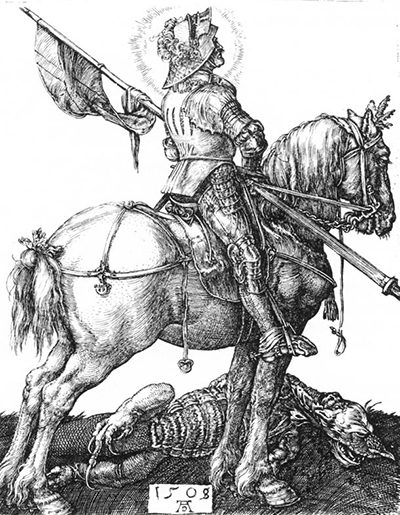
The dragon is already dead. Its heavy body lies beneath the horse, while Saint George turns his face upwards, away from the creature he has defeated. Horse and rider almost fill Albrecht Dürer's small engraving, leaving the raised head silhouetted against an empty background. There is room for a banner, a halo and an elaborate display of armour, but the action has settled into a pause. Dated 1508, Saint George on Horseback measures about eleven centimetres in height: the impression at Te Papa has an image measuring 10.9 × 8.5 cm. [1]
Seen from behind and to one side, George offers us the bright, rounded surfaces of his back and shoulder. His body turns away while the horse faces right, so the rider cannot be read as a flat shape laid over the animal's profile. The projecting knee, the boot in its stirrup and the curved flank establish different distances from the viewer. The horse's broad hindquarters occupy much of the lower left, and its head presses close to the right edge. Dürer makes a shallow, narrow space feel occupied by a substantial living animal carrying a substantial weight.
The long pole introduces a different kind of structure. Running from the upper left towards the lower right, it crosses the composition at an angle to the horse's body and carries the eye through the rider's position. Cloth gathers and curls around its upper end. Down below, narrow straps loop across the horse's rump, while small hanging ornaments and the stirrup supply points of detail against the large areas of flesh. These fittings make the animal appear equipped and controlled. Yet its mane falls in irregular strands, and the modelling of its flank lets the light move gently across a broad surface. The harness and the body offer two ways of describing form: one by enclosing it with lines, the other by shading its volume.
At the bottom, the dragon is much less orderly. Its bent limbs, ridged body and open mouth make a rough, congested base beneath the upright horse. The creature's head lies at the right, close to the forelegs; its body stretches across the ground behind them. This placement keeps the defeated enemy within the same compact group as its conqueror. George's halo is at the opposite end of the image, a light ring of short radiating marks around the helmet. The eye can travel from the dark, crowded ground to that open space in a single upward movement.
At a Glance
- Date 1508 [1]
- Process Engraving [1]
- Example impression Museum of New Zealand Te Papa Tongarewa [1]
- Louvre impression, 558 LR10.6 × 8.4 cm [19]
This work across Albrecht Dürer’s career
Young Hare
1502Praying Hands
1508Melencolia I
1514Four Apostles
1526Contents
- The story after the battle
- A date changed in the plate
- Light made with engraved lines
- The life of individual impressions
- Frequently Asked Questions
The story after the battle
The familiar rescue story supplies what the print leaves outside its frame. In the Golden Legend , as transmitted in William Caxton's English translation, the dragon terrorises the city of Silene. When the king's daughter is selected as its next victim, George intervenes on horseback. He wounds the beast, and the princess leads it into the city with her girdle around its neck. The inhabitants accept baptism before George finally kills it. He refuses the king's payment and directs that the money should help the poor. Rescue, conversion and charity belong together here; defeating the monster is part of a longer religious narrative. [12]
Dürer's engraving contains neither the princess nor a city of witnesses. The dragon's unsevered head also means that the image is not a literal transcription of the legend's final beheading. The print gathers the saint's identity into a handful of visible things: the fallen enemy, the armour, the banner and the halo. Knowledge of the story makes the aftermath intelligible, but the viewer's attention rests on the victorious figure himself. The empty background gives no route back to Silene and no visible destination ahead. The interval after the fight can therefore occupy the whole image.
Art historian Ivan Gerát describes the mounted print's upward gaze and dead dragon as creating a triumphal atmosphere. His discussion places it within a wider culture in which George could express devotional hopes and ideals of Christian knighthood. The saint also had political uses: Maximilian I cultivated associations with George and the chivalric institutions bearing his name. This setting helps explain why an armoured saint carried meanings beyond the episode of a rescued princess. It does not establish an imperial commission for this particular engraving. [13]
The face is too small, and too partly concealed by the helmet, to support an elaborate account of George's feelings. The direction of his attention is clearer. His head tips up while the horse continues to face ahead. Read beside the halo, that difference allows the bodily victory below to acquire a devotional direction above. The figure can seem thankful, absorbed or expectant without any of those responses becoming a documented statement of Dürer's intention. Much of the image's hold on the viewer comes from how little gesture is needed to make the pause expressive.
A date changed in the plate
The tablet at the lower edge bears Dürer's monogram and the date 1508. The National Gallery of Art records that this date was corrected from 1505. The National Gallery of Victoria makes the distinction visible in its catalogue dating, assigning the work to 1505 while identifying the inscribed date as 1508. These two years allow us to think about the engraving as something worked on over time, rather than as a design necessarily conceived, cut and printed within a single short interval. [14] [15]
In his 1897 catalogue, S. R. Koehler suggested that Dürer probably began the plate in 1505 and returned to it after Venice. The change of numeral is firm evidence; the reconstruction of the artist's working timetable is an interpretation of it. It is reasonable to retain the earlier year when discussing the plate's development, while using 1508 for the completed engraving. The altered date cannot, by itself, tell us how much had already been cut, precisely when work stopped or what prompted Dürer to resume it. [16]
The image nevertheless gives a concrete reason to be interested in that development. Its problems are tightly connected: how to set a rider convincingly upon a horse, how to make the animal's body turn in space, and how to give an armoured figure a readable pose when the face contributes so little. Dürer exploits the visible back. Repeated ridges and overlapping plates articulate its surface, and the shoulder's changing light helps the eye follow the torso's turn. The strong enclosure of the armour and the rounded expanse of the horse make their physical relationship particularly clear.
Dürer had already engraved a standing Saint George, dated by Gerát to 1502–03. In that image the saint's uncovered face is readily visible, and his helmet lies near his feet. Bringing the two figures together sharpens the choice made in Saint George on Horseback : the helmet stays on, the body turns away and the horse becomes a major part of the saint's presentation. These are different solutions to showing a recognisable victor with the dragon at his feet. The mounted figure's reserve is a positive compositional choice, with the tilt of the head carrying much of the expression. [13]
Light made with engraved lines
The medium rewards this kind of close attention. Engraving is an intaglio process: the artist cuts grooves into a metal plate with a burin, and those grooves hold the ink. After inking, the surface is wiped and the plate is printed under pressure against dampened paper. Hatching produces tone through the spacing and density of marks; the printed image reverses the design on the plate. In a work this small, broad passages of apparent light emerge from many decisions about where a line should begin, thicken, curve or end. [17]
Across the horse's hindquarters, short, closely organised strokes turn gradually around the flesh, leaving a comparatively pale area at the centre. Under the belly, the marks gather into a denser shadow. The mane demands another rhythm, with flowing lines separated by bright interruptions. On George's armour, abrupt light edges and dark seams break the body into connected pieces. The dragon's ribbed, knotted surface is more crowded still. All these textures share one ink colour, but the changing organisation of the lines makes them feel different to the eye.
The large blank area above the horse is equally consequential. It allows the thin reins, the silhouette of the helmet and the small rays of the halo to remain legible. The dense strip of ground provides a base, while the white field frees the figure from surrounding buildings or scenery. At the top, the folded banner spreads towards the left edge; on the right, the horse's head completes the group's width. Dürer balances these extensions across an image that otherwise rises almost vertically from the dragon to the saint's head.
The life of individual impressions
Engraving also gives this image a history that extends beyond the completion of its design. Each sheet is an individual impression, with its own paper, inking, trimming and subsequent handling. Koehler's entry records one impression in strong black ink and another in a warmer, softer ink with some tone left on the ground and the dragon's hindquarters. He also identified the latter as trimmed, supplied with a false margin and restored around its edges with a pen. His account makes an enlarged photograph seem less self-sufficient: some of what we see in an old print can belong to printing and later treatment as well as to the engraved lines. [16]
The Pushkin Museum offers a further distinction between the date on the plate and the date a sheet was printed. It regards impression Г-3007, bearing a bull's-head watermark with a five-petal flower, as an early impression of 1508. Another sheet, Г-5183, has the same watermark. Since Dürer continued using this paper until 1519, and some of that impression's lines appear blurred, the catalogue proposes a printing date around 1518–19. The later date remains a reasoned proposal based on paper and the appearance of the printing together. The shared watermark alone does not assign both sheets to one year. [18]
The impressions subsequently followed separate collecting paths. Te Papa's entered with Bishop Monrad's gift in 1869. The Louvre's example, 558 LR, came from the Edmond de Rothschild collection as a gift in 1935; it measures 10.6 × 8.4 cm. These dimensions and histories belong to particular surviving sheets. Their differences are part of how the engraving has reached us, carrying a remarkably consistent composition through distinct physical objects. [1] [19]
At its actual scale, the print invites the viewer to come close. Following a strap across the horse's flank or a dark seam around George's shoulder becomes part of understanding the figure. The visible workmanship slows our looking to match the subject's pause: the weight of horse and rider is built from marks small enough to disappear into an apparently continuous surface.
Frequently Asked Questions
Artworks directory
These 187 records include individual works, reverse sides, detail views, paired panels and reconstructed arrangements. Three additional catalogue images repeat works already listed. Related views are not counted as separate originals; qualified attributions and published dating are retained.
Discussion
Look again at the images and ideas explored in Saint George on Horseback. These editorial prompts invite your observations.
Reader Insights
Which detail or idea in Saint George on Horseback most changed your reading, and why?
How does the discussion of “The story after the battle” affect your understanding?
What comparison would you bring to the discussion of “The life of individual impressions”?
Join the Conversation
Share a detail, comparison or question about Saint George on Horseback below.
References
- Museum of New Zealand Te Papa Tongarewa , St. George on horseback , Albrecht Dürer, 1508, registration 1869-0001-122, object metadata and overview by Mark Stocker (December 2016). English. View source .
- ALBERTINA, Selbstbildnis als Dreizehnjähriger, inv. 4839 (German). View source.
- Metropolitan Museum, Four Horsemen from The Apocalypse, 19.73.209 (English). View source.
- Bayerische Staatsgemäldesammlungen, Selbstbildnis im Pelzrock, inv. 537 (German). View source.
- ALBERTINA, Feldhase, inv. 3073 (German). View source.
- ALBERTINA, Das große Rasenstück, inv. 3075 (German). View source.
- Metropolitan Museum, Adam and Eve, 19.73.1 (English). View source.
- ALBERTINA, Betende Hände, inv. 3113 (German). View source.
- Metropolitan Museum, Knight, Death, and the Devil, 43.106.2 (English). View source.
- Metropolitan Museum, Melencolia I, 43.106.1 (English). View source.
- Bayerische Staatsgemäldesammlungen, inventory 545: current collection record (German; descriptive citation). View source.
- Jacobus de Voragine , “Of S. George, Martyr,” The Golden Legend , volume III, translated by William Caxton (1483), edited by F. S. Ellis (Temple Classics, 1900), opening dragon episode; Internet Medieval Sourcebook, Fordham University. English translation of a medieval Latin text. View source .
- Ivan Gerát , “Saint George Between Media and Functions”, Radovi Instituta za povijest umjetnosti 43 (2019), pp. 37–46, especially pp. 38–40 and notes 11–13, 28–34, DOI: 10.31664/ripu.2019.43.03. English. View source 1 . View source 2 .
- National Gallery of Art , Washington, Saint George on Horseback , Albrecht Dürer, 1508, accession 1943.3.3498, object record and inscription. English. View source .
- National Gallery of Victoria , Melbourne, Saint George on horseback , Albrecht Dürer, (1505); dated 1508, accession 1278.479-3, object record. English. View source .
- S. R. Koehler , A Chronological Catalogue of the Engravings, Dry-Points and Etchings of Albert Dürer, as Exhibited at the Grolier Club (New York: Grolier Club, 1897), no. 42, pp. 46–47. English. View source .
- Metropolitan Museum of Art , “Engraving”, Materials and Techniques , 21 December 2018. English. View source .
- Pushkin State Museum of Fine Arts , St. George on Horseback , Albrecht Dürer, 1508, inventories Г-3007 and Г-5183, catalogue entry in Albrecht Dürer and his Teachers, Students and Contemporaries . English version of the Russian museum catalogue. View source .
- Musée du Louvre , Saint George à cheval , Albrecht Dürer, 1508, inventory 558 LR/Recto, collection record, updated 31 August 2023. French. View source .
- Germanisches Nationalmuseum, Barbara Dürer (German and English). View source.
- Web Gallery of Art, Tucher–Rieter reverse (English). View source.
- National Gallery of Art, Portrait of a Clergyman (English). View source.
- Dürer Art, Portrait of a Man (English). View source.
- Hessen Kassel Heritage, Elsbeth Tucher (German). View source.
- Web Gallery of Art, Hans Tucher (English). View source.
- Germanisches Nationalmuseum, Emperor Maximilian I (German and English). View source.
- National Gallery of Art, Lot and His Daughters, reverse (English). View source.
- Bayerische Staatsgemäldesammlungen, Glim Lamentation (German). View source.
- Museo Nacional del Prado, Portrait of a Man (Spanish). View source.
- Bayerische Staatsgemäldesammlungen, Madonna of the Carnation (German). View source.
- Städel Museum, Job on the Dungheap (German). View source.
- Wallraf-Richartz-Museum, Piper and Drummer (German). View source.
- Italian Ministry of Culture / Uffizi, Head of Saint James (Italian). View source.
- Klassik Stiftung Weimar, Dresden Altarpiece (German). View source.
- Staatliche Museen zu Berlin, Girl with a Red Beret (German and English). View source.
- Dresden State Art Museums / Roland Enke, Bernhard von Reesen (German). View source.
- Royal Collection Trust, Burkhard von Speyer (English). View source.
- Dresden State Art Museums, Seven Sorrows of the Virgin (English). View source.
- Bayerische Staatsgemäldesammlungen, Mater Dolorosa (German). View source.
- Bayerische Staatsgemäldesammlungen, Lucretia (German). View source.
- Städel Museum, Young Woman with Her Hair Down (English). View source.
- ALBERTINA, Portrait of a Young Man (German). View source.







