


 by
Tom Gurney
Tom Gurney BSc (Hons) is an art history expert with over 20 years experience
Published on June 19, 2020 / Updated on October 22, 2026
Email:
tomgurney1@gmail.com
/ Phone:
+44 7429 011000
A Nuremberg Woman and a Venetian Woman: Introduction
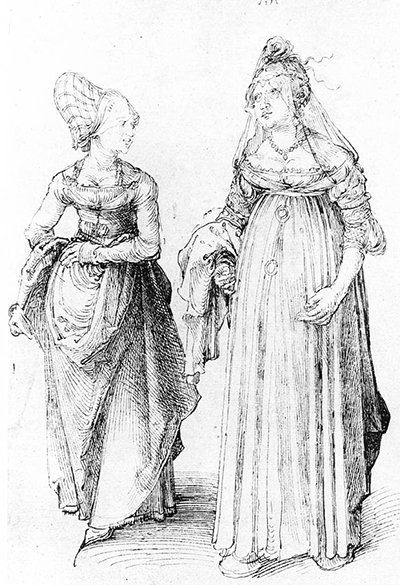
Two women occupy almost the whole of a narrow sheet, their elaborate clothes giving them strikingly different outlines. Albrecht Dürer’s drawing belongs to the Städel Museum in Frankfurt, which dates it to about 1495. Executed in dark grey-brown pen on laid paper, it measures 245 × 159 millimetres. Within that small space, a turn of the head and a handful of shadows suggest an encounter that extends beyond the business of recording dress. [1]
The woman on the left looks towards her companion. Her body faces us more directly, while her face appears in profile; the resulting twist gives her an alert, responsive presence. The taller woman on the right holds her head at a different angle, her eyes directed away from the left figure. Their attention does not quite meet. That slight imbalance is enough to make us wonder whether one has noticed something about the other. Dürer supplies no words or identifying setting to decide the matter.
The museum identifies the left figure’s cap, bodice, apron and dress as Nuremberg clothing, and the right figure’s veil and high-waisted, low-cut gown as Venetian fashion. Geography becomes visible through the shape of a sleeve, the arrangement of cloth around a waist and the way the head is dressed. These are two specifically differentiated figures, although the familiar English title Venetian Women can obscure the distinction. [1]
At a Glance
- Date About 1495 [1]
- Materials Dark grey-brown pen on laid paper [1]
- Collection Städel Museum, Frankfurt [1]
This work across Albrecht Dürer’s career
Young Hare
1502Praying Hands
1508Melencolia I
1514Four Apostles
1526Contents
- Clothes that shape a figure
- The work of the pen
- How the pair came together
- A related Venetian study
- Frequently Asked Questions
Clothes that shape a figure
The Nuremberg woman’s headdress rises behind her head in a rounded, tapering form. Its intersecting lines establish a structure quite unlike the fine, sloping veil of the Venetian. Below it, the left woman’s fitted bodice creates a narrow middle, reinforced by dense horizontal and crossing strokes. Her sleeves bend with her arms. Gathering fabric across the front of her body, she brings several directions together at her waist: the slope of her forearms, the descending apron and the heavier folds of the skirt.
Follow those folds downwards and the apparent simplicity of her dress disappears. A light, looped sweep crosses the front, while a dark triangular mass opens to the right. Further down, an elongated fold cuts diagonally towards the exposed shoe. The garment records the effects of lifting, pulling and taking a step. Its curves and pointed ends provide a changing contour from shoulder to hem. The small projecting foot at the bottom gives this cascade of cloth a direction of movement.
The Venetian woman presents a longer, more continuous front. A band beneath her bust gathers the skirt, from which thin lines descend almost to the ground. The two circular ornaments along its centre interrupt that downward flow without breaking it. The broad neckline, necklace and elaborate sleeves concentrate detail in the upper part of the figure. Below them, long stretches of lightly marked paper remain open. Her dress seems to occupy space through its height and breadth, while the Nuremberg costume makes its volume felt through overlapping folds.
Both women carry gathered cloth, an easily overlooked similarity. At the Venetian’s right arm, towards the centre of the sheet, fabric drops into a deep, rounded pouch of folds. Her other hand rests lower against the skirt. The Nuremberg woman gathers her clothing closer to her middle, with both forearms engaged. Dürer thus varies the practical action of managing a long garment. We see dress as something handled and worn, with consequences for gesture, as well as something displayed.
The difference between the figures also depends on their placement. The Venetian stands closer to the lower edge and reaches higher into the empty space. The Nuremberg woman is smaller and set back, leaving a narrow pocket of blank paper between their heads. Their garments nearly touch in the middle, but their silhouettes remain legible. This arrangement invites comparison without requiring them to face each other like partners in a formal dialogue.
The work of the pen
The dark area beside the Nuremberg woman’s waist is among the drawing’s strongest accents. Lines cross and accumulate until a shaded fold becomes almost a solid mass. Nearby, a lighter surface can be established by a few long strokes. Dürer changes the density and direction of his marks as the cloth changes direction. The eye moves between sharp edges, curved hatching and relatively empty areas, discovering the garment’s construction through those changes.
The Venetian’s skirt offers a different pleasure. Its long lines are unevenly spaced and gently inflected; some extend nearly the full length of the garment, while others stop or divide. They give the hanging cloth a rhythm without enclosing every fold. At the outer right, darker shading helps the broad front turn into depth. Above, the sleeves break into small patterned compartments, loops and bulges. The same pen can describe a tiny ornament and then travel down the length of a skirt in one extended movement.
Near the women’s feet, a few curved, roughly horizontal lines turn the untouched sheet into a ground. The dark patch between the figures helps separate their positions. These marks provide enough support for their bodies without becoming paving, a garden path or a recognisable street. The absence of a developed background keeps every visual decision close to the figures: where they stand, how they turn and how their clothes occupy the available space. Their apparent ease emerges from a carefully organised distribution of detail and emptiness.
How the pair came together
The Städel links the drawing to no painting. It interprets the pairing as Dürer’s invention, with the Nuremberg woman added beside a Venetian drawn first. It also proposes a playful edge to the sideways glance. That reading brings the little scene to life, but the drawing leaves room for a quieter response: curiosity, comparison or simple awareness of another person nearby. The left woman’s finely articulated profile holds our interest even when we resist assigning her a definite thought. [1]
Scholars have long debated the drawing sequence. In 1931 Eduard Flechsig argued that the Venetian was drawn first and the Nuremberg woman later, pointing to differences in scale, lighting and ground shadows. He nevertheless placed both figures in 1495 and saw the addition as a way of making the difference between the costumes clear. In 1936 Friedrich Winkler rejected the proposed interval between them: the matching tone of the ink led him to argue that the second figure followed immediately. He also noted that the Nuremberg woman’s right arm had initially been planned lower. [12] [13]
These observations direct attention back to the physical act of drawing. A changed arm position can alter the whole rhythm of a figure, bringing a hand into a more effective relationship with the gathered skirt. Matching ink colour, however, is an observation about appearance; Winkler’s argument does not establish a chemically verified interval between sittings. The finished relationship is easier to see than the time that elapsed while it was made. What matters most to the viewer is the way two differently conceived figures now share a small area of ground.
A related Venetian study
A separate sheet in Vienna’s ALBERTINA, dated 1495, makes a useful comparison. Its front shows a richly dressed Venetian woman with a smaller rear view beside her; the reverse studies the lower body and includes a separate shoe. In the large front view, the ornamented sleeves, high gathering of the gown and long hanging folds recall the Städel figure. The Vienna sheet gives those details considerably more room. Its conspicuous patterned undergarment and denser modelling also create a different effect from the comparatively open front of the Frankfurt dress. [14] [15]
The small rear view in Vienna is particularly revealing. Seen from behind, the same general kind of costume becomes a system of long folds, crossed bands and gathered cloth. On the reverse, the isolated shoe allows attention to move away from the complete figure and towards an object that helps construct her appearance. Together, these views show how much can be learned by changing the distance and angle of observation. The Städel drawing brings that attention to clothing into a composition organised around two people.
Dress does not securely disclose the Venetian woman’s personal identity or profession. Discussing the Vienna study, costume historian Jutta Zander-Seidel traces its changing labels, from a German noblewoman to a Venetian courtesan. She warns against treating descriptions in Cesare Vecellio’s costume book of 1590 as a reliable key to Dürer’s drawing of almost a century earlier. The history is a useful caution here too: a low neckline or an elaborate hairstyle cannot, by itself, turn the Städel figure into a documented courtesan. The richness of the costume gives us much to look at; a name and a social biography remain beyond what the sheet establishes. [14]
Stephanie Leitch places the Frankfurt drawing within a broader history of cultural encounters expressed through dress. In her account, the pair offers an ironic version of meetings familiar in a trading city such as Venice, where clothing helped people recognise differences within an international population. This approach gives the costumes a social setting without inventing a particular morning’s walk. The drawing’s intimacy can coexist with a larger question: how do people see, compare and respond to unfamiliar appearances? [16]
Later viewers supplied identities of their own. The museum records a Dutch inscription on the reverse naming Ada, Countess of Holland, with her mother Adelheid. It also identifies the AD at the top as another hand’s addition and records the drawing’s acquisition in 1847. These traces belong to the sheet’s subsequent history. The two women in the drawing remain unnamed, their relationship poised between an artist’s comparison of regional dress and the fleeting human interest of one person looking towards another. [1]
Frequently Asked Questions
Artworks directory
These 187 records include individual works, reverse sides, detail views, paired panels and reconstructed arrangements. Three additional catalogue images repeat works already listed. Related views are not counted as separate originals; qualified attributions and published dating are retained.
Discussion
Look again at the images and ideas explored in A Nuremberg Woman and a Venetian Woman. These editorial prompts invite your observations.
Reader Insights
Which detail or idea in A Nuremberg Woman and a Venetian Woman most changed your reading, and why?
How does the discussion of “Clothes that shape a figure” affect your understanding?
What comparison would you bring to the discussion of “A related Venetian study”?
Join the Conversation
Share a detail, comparison or question about A Nuremberg Woman and a Venetian Woman below.
References
- Städel Museum , Nürnbergerin und Venezianerin , about 1495, inv. 696 / 696 Z. German. Object record, inscriptions and collection essay. View source .
- ALBERTINA, Selbstbildnis als Dreizehnjähriger, inv. 4839 (German). View source.
- Metropolitan Museum, Four Horsemen from The Apocalypse, 19.73.209 (English). View source.
- Bayerische Staatsgemäldesammlungen, Selbstbildnis im Pelzrock, inv. 537 (German). View source.
- ALBERTINA, Feldhase, inv. 3073 (German). View source.
- ALBERTINA, Das große Rasenstück, inv. 3075 (German). View source.
- Metropolitan Museum, Adam and Eve, 19.73.1 (English). View source.
- ALBERTINA, Betende Hände, inv. 3113 (German). View source.
- Metropolitan Museum, Knight, Death, and the Devil, 43.106.2 (English). View source.
- Metropolitan Museum, Melencolia I, 43.106.1 (English). View source.
- Bayerische Staatsgemäldesammlungen, inventory 545: current collection record (German; descriptive citation). View source.
- Eduard Flechsig , Albrecht Dürer: sein Leben und seine künstlerische Entwickelung , vol. II, Berlin, 1931, pp. 313–314, entry L. II, 187. German. Entry continues on p. 314. View source 1 . View source 2 .
- Friedrich Winkler , Die Zeichnungen Albrecht Dürers , vol. I, Berlin, 1936, p. 56, no. 75. German. View source .
- Jutta Zander-Seidel , Venezianerin , 1495, ALBERTINA, inv. 3064r. German. Collection record and essay from the 2003 ALBERTINA exhibition catalogue, p. 164, no. 23. View source .
- ALBERTINA , Venezianische Kostümstudie , 1495, inv. 3064v. German. Reverse of inv. 3064r. View source .
- Stephanie Leitch , “Cosmopolitan Renaissance: Prints in the Age of Exchange”, in Daniel Savoy, ed., The Globalization of Renaissance Art: A Critical Review , Leiden and Boston: Brill, 2017, pp. 186–217, especially pp. 204–206. English. View source .
- Germanisches Nationalmuseum, Barbara Dürer (German and English). View source.
- Web Gallery of Art, Tucher–Rieter reverse (English). View source.
- National Gallery of Art, Portrait of a Clergyman (English). View source.
- Dürer Art, Portrait of a Man (English). View source.
- Hessen Kassel Heritage, Elsbeth Tucher (German). View source.
- Web Gallery of Art, Hans Tucher (English). View source.
- Germanisches Nationalmuseum, Emperor Maximilian I (German and English). View source.
- National Gallery of Art, Lot and His Daughters, reverse (English). View source.
- Bayerische Staatsgemäldesammlungen, Glim Lamentation (German). View source.
- Museo Nacional del Prado, Portrait of a Man (Spanish). View source.
- Bayerische Staatsgemäldesammlungen, Madonna of the Carnation (German). View source.
- Städel Museum, Job on the Dungheap (German). View source.
- Wallraf-Richartz-Museum, Piper and Drummer (German). View source.
- Italian Ministry of Culture / Uffizi, Head of Saint James (Italian). View source.
- Klassik Stiftung Weimar, Dresden Altarpiece (German). View source.
- Staatliche Museen zu Berlin, Girl with a Red Beret (German and English). View source.
- Dresden State Art Museums / Roland Enke, Bernhard von Reesen (German). View source.
- Royal Collection Trust, Burkhard von Speyer (English). View source.
- Dresden State Art Museums, Seven Sorrows of the Virgin (English). View source.
- Bayerische Staatsgemäldesammlungen, Mater Dolorosa (German). View source.
- Bayerische Staatsgemäldesammlungen, Lucretia (German). View source.
- Städel Museum, Young Woman with Her Hair Down (English). View source.
- ALBERTINA, Portrait of a Young Man (German). View source.







