


 by Tom Gurney
Tom Gurney BSc (Hons) is an art history expert with over 20 years experience
Email: tomgurney1@gmail.com / Phone: +44 7429 011000
Definition and first recognition
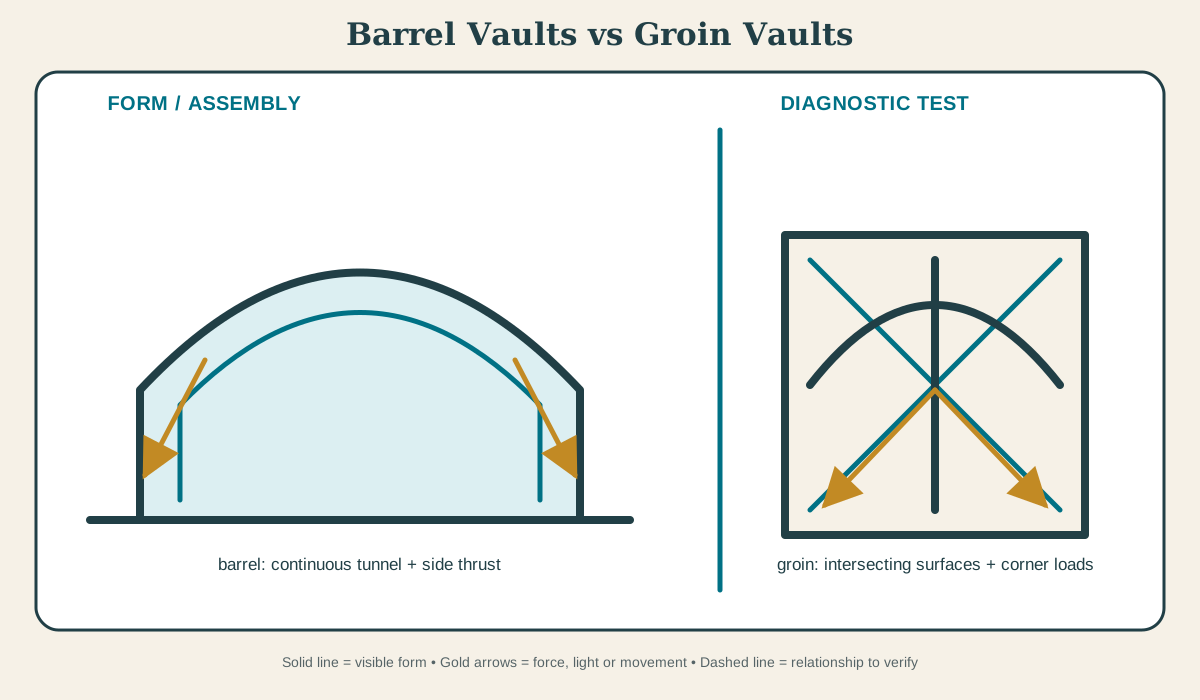
A barrel vault extends one arch through depth; a groin vault is formed by intersecting two barrel vaults. In plan and soffit, a barrel reads as one continuous tunnel while a groin shows diagonal intersection lines crossing a bay. [1][2]
At a Glance
- Basic meaninga barrel vault extends one arch through depth; a groin vault is formed by intersecting two barrel vaults
- Recognition cueIn plan and soffit, a barrel reads as one continuous tunnel while a groin shows diagonal intersection lines crossing a bay.
- Principal roleA barrel tends to load continuous side supports; a groin can concentrate loads toward four corners and open the side bays.
- Historical developmentRoman builders used barrel and intersecting groin vaults at monumental scale; Romanesque and Renaissance construction adapted both systems in churches, undercrofts and arcades.
- Main cautionGroins are the intersection edges, not applied ribs. A rib vault may follow similar geometry but adds built ribs with their own construction sequence.
Contents
What the barrel-or-groin vault does
A barrel tends to load continuous side supports; a groin can concentrate loads toward four corners and open the side bays. This explains the overall form, not the safety of a particular tower, dome or vault. Geometry, supports, deformation, dynamic loads and later ties require measured, building-specific assessment.[2][3]
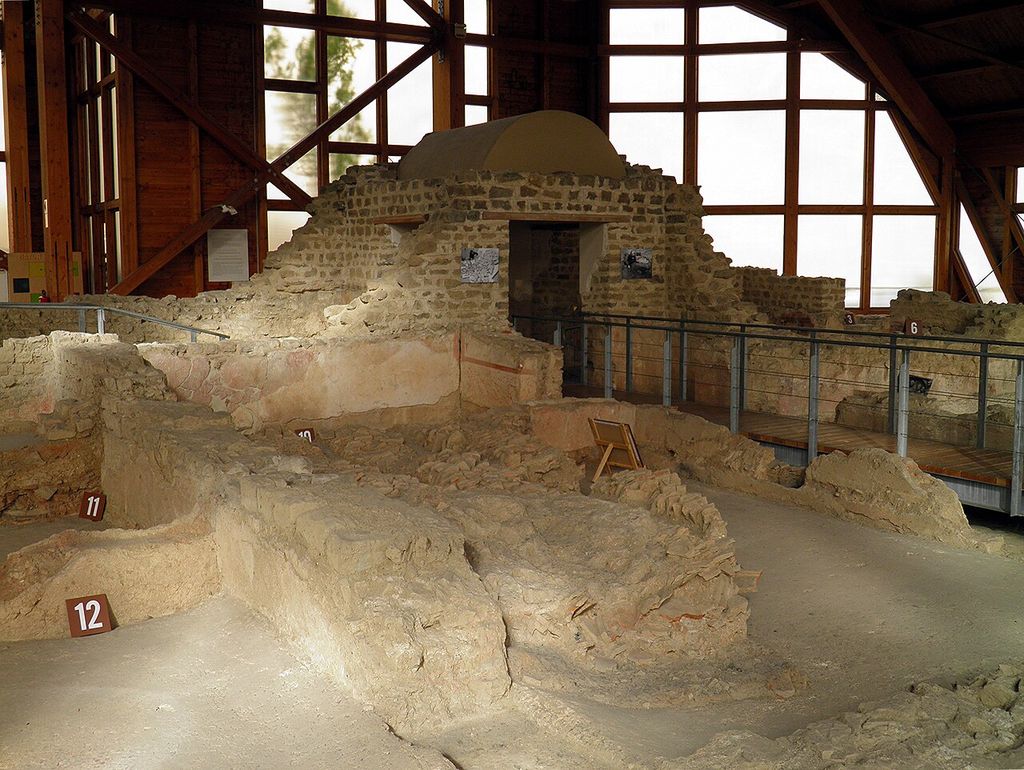
Barrel-shaped vault ceiling, Römervilla (Roman Villa) at Bad Neuenahr-Ahrweiler, Germany (8134292219). In March 1980, during road construction in the outskirts of Ahrweiler, workmen discovered remains of an ancient building, which turned out to be a quite sensational archaeological find. In “What the barrel-or-groin vault does”, this view records the form, material and setting discussed in the passage. Source image dated 2012; that date records the image, not the original construction. Carole Raddato from FRANKFURT, Germany, Barrel-shaped vault ceiling, Römervilla (Roman Villa) at Bad Neuenahr-Ahrweiler, Germany (8134292219); CC BY-SA 2.0. Resized proportionally; no crop, retouch or upscaling.
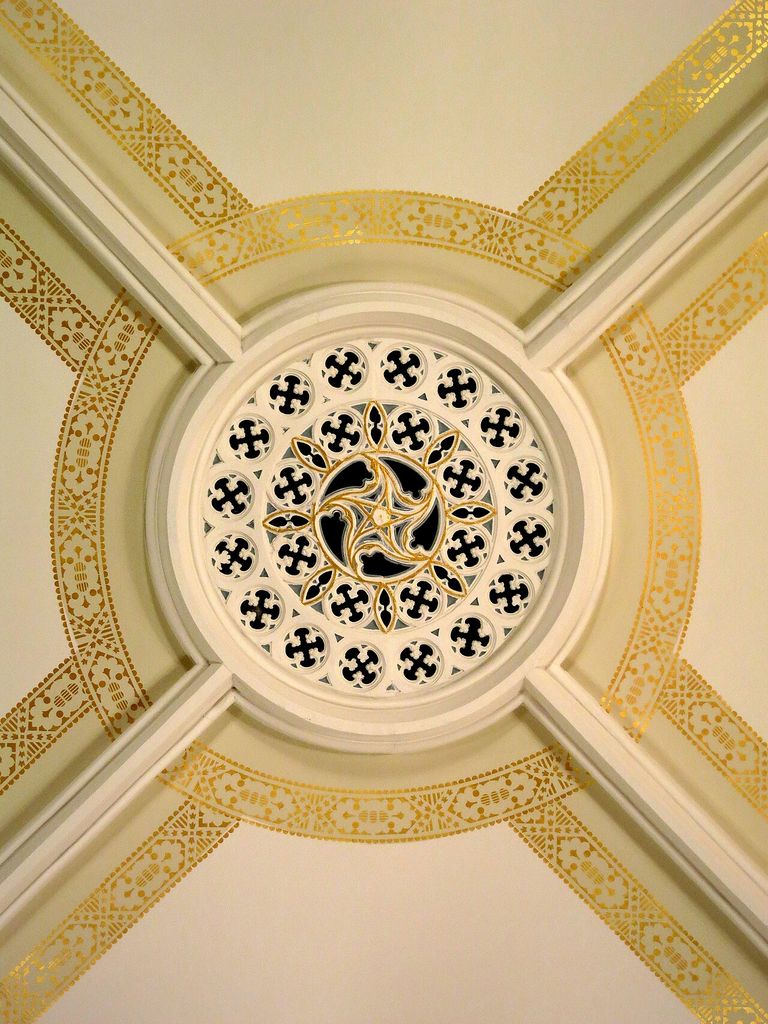
Sacred Heart Catholic Church (Columbia, MO) - interior, barrel vault, boss detail. In “What the barrel-or-groin vault does”, this view records the form, material and setting discussed in the passage. Source image dated 2013; that date records the image, not the original construction. Nheyob, Sacred Heart Catholic Church (Columbia, MO) - interior, barrel vault, boss detail; CC BY-SA 3.0. Resized proportionally; no crop, retouch or upscaling.
A barrel vault extends one arch through depth, creating a tunnel-like surface and usually continuous lateral thrust along its springing lines. A groin vault results when two barrel vaults of compatible geometry intersect, creating diagonal groins and tending to concentrate loads toward four corner supports. Fill, web thickness and abutment determine actual behaviour. High and curved fabric is exposed differently across its surface. Water may enter at a lantern, parapet, roof covering or bell opening and appear far below; thermal movement and wind act alongside gravity. Survey evidence should map these routes before a local stain or crack is given a single cause.
Historical development
Roman builders used concrete barrel and groin vaults in baths, basilicas and substructures at monumental scale. Romanesque churches adopted stone barrel vaults and groin-vaulted aisles but required heavy supports. Renaissance architects revived coffered barrels for antique authority; later engineers used brick, tile, concrete and steel-supported variants. Towers, domes and vaults often preserve several structural campaigns at once: settlement may prompt ties or buttresses, roofs are renewed, bells and lanterns change weight, and earthquake or fire repairs alter concealed construction. Historical sequence must be read through survey, fabric and archives, because the most prominent visible form may belong partly to restoration or reconstruction.[2][3]
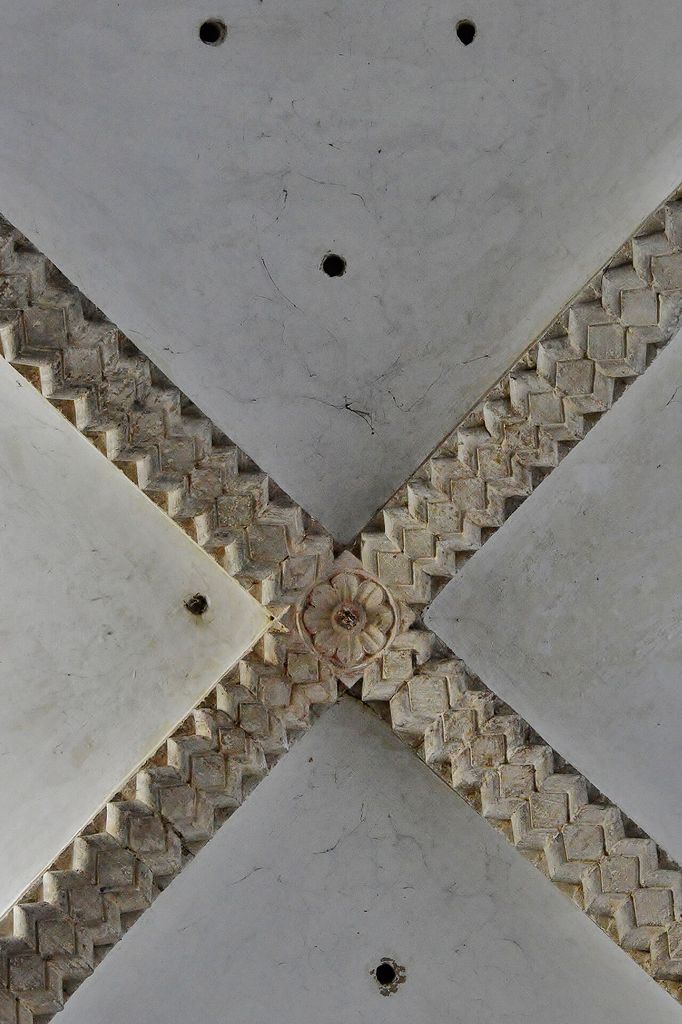
Castle Rising, St. Lawrence's Church, The plain boss at the apex of the groined vault of the original Norman tower - geograph.org.uk - 5109234. Castle Rising, St. In “Historical development”, this view helps identify groin vault interior. Source image dated 2016; that date records the image, not the original construction. Michael Garlick, Castle Rising, St. Lawrence's Church, The plain boss at the apex of the groined vault of the original Norman tower - geograph.org.uk - 5109234; CC BY-SA 2.0. Resized proportionally; no crop, retouch or upscaling.
Terminology and common confusions
A groin is the intersection of two vault surfaces, not an applied rib. A rib vault can follow related geometry but adds built ribs with a distinct construction sequence and visual logic. [1][3]
Conservation and alteration
Historic vaults should be assessed with their haunch fill, supports, roofs and later ties. Removing apparently loose material or adding rigid reinforcement can redirect forces; cracks require monitoring and an understanding of the whole system before treatment. Repair may renew coverings, rebuild parapets, strengthen shells, replace bell frames or introduce ties. These campaigns should be mapped in plan and section so present form is not mistaken for wholly original construction.[3][4]
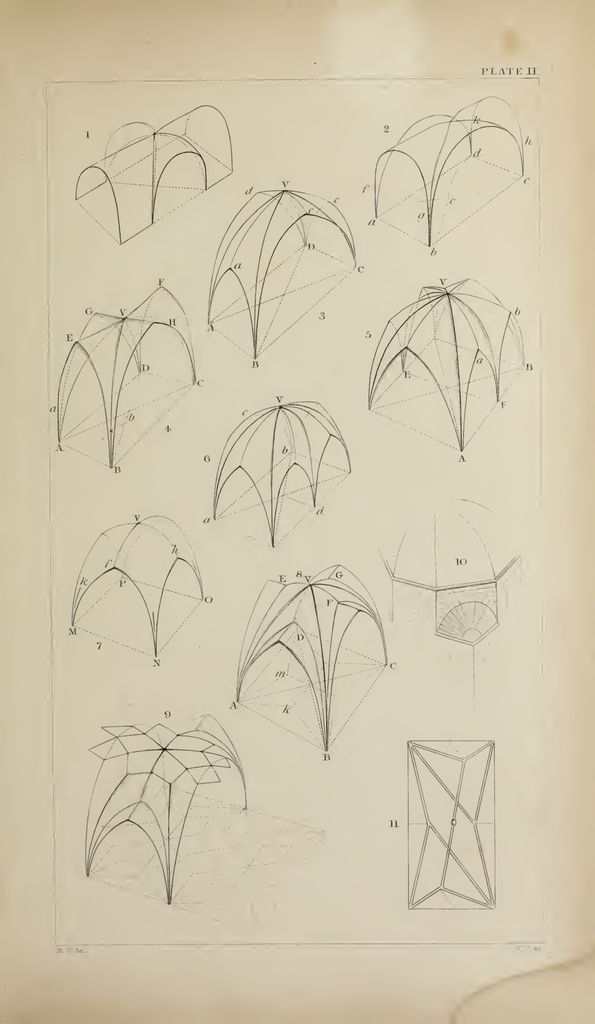
Willis Remarks 1835 Plate 02. Plate 2 from: Willis, Robert (1835) Remarks on the architecture of the middle ages, especially of Italy , Cambridge : J & J.J. In “Conservation and alteration”, this plan helps identify roman groin vault. Source image dated 1835; that date records the image, not the original construction. Willis, Robert, 1800-1875, Willis Remarks 1835 Plate 02; Public domain. Resized proportionally; no crop, retouch or upscaling.
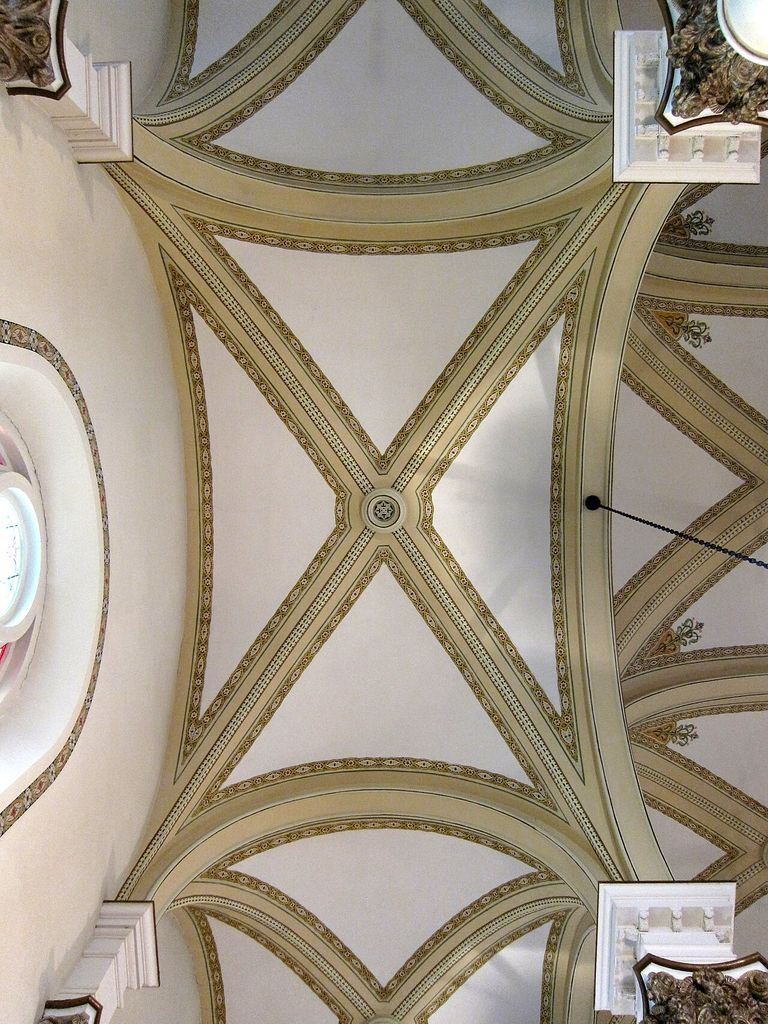
Saint John the Baptist Church (Maria Stein, Ohio) - interior, groin vault. In “Conservation and alteration”, this view records the form, material and setting discussed in the passage. Source image dated 2012; that date records the image, not the original construction. Nheyob, Saint John the Baptist Church (Maria Stein, Ohio) - interior, groin vault; CC BY-SA 3.0. Resized proportionally; no crop, retouch or upscaling.
Dated survey points, crack mapping, vibration or bell data where relevant, and moisture records can separate stable historic deformation from active change and relate local symptoms to the whole system. Conservation is included here as historical evidence: repair changes the object presented to readers and may reveal relationships that a supposedly pristine image conceals.
Examples for Further Study
The examples below show how the form changes across periods, materials and settings.
| Building or setting | Evidence to examine | Variant | Source |
|---|---|---|---|
| Basilica of Maxentius | A vast groin-vaulted central hall was flanked by coffered barrel-vaulted bays. Relate the upper form to its complete support system. | semicircular barrel | Reference 5 |
| Roman bath | Groin vaults opened high thermal rooms toward clerestory windows while concentrating support. Compare internal and external profiles in section. | pointed barrel | Reference 6 |
| Romanesque nave | A barrel vault creates strong continuous thrust answered by thick walls and buttressing. Use cracks, ties or rebuilds as dated evidence rather than visual drama. | cross groin vault | Reference 5 |
| Sant’Andrea, Mantua | A monumental coffered barrel vault recalls Roman basilicas within a Renaissance church. Let the different span, height or civic use expose the limits of the type. | stilted groin vault | Reference 7 |
What the barrel-or-groin vault reveals about the building
At Romanesque nave, a barrel vault creates strong continuous thrust answered by thick walls and buttressing. At Sant’Andrea, Mantua, a monumental coffered barrel vault recalls Roman basilicas within a Renaissance church. Together, these cases show that the barrel-or-groin vault is not a detachable motif: it participates in material, access, environmental control, structure or display according to its setting.[1][4]
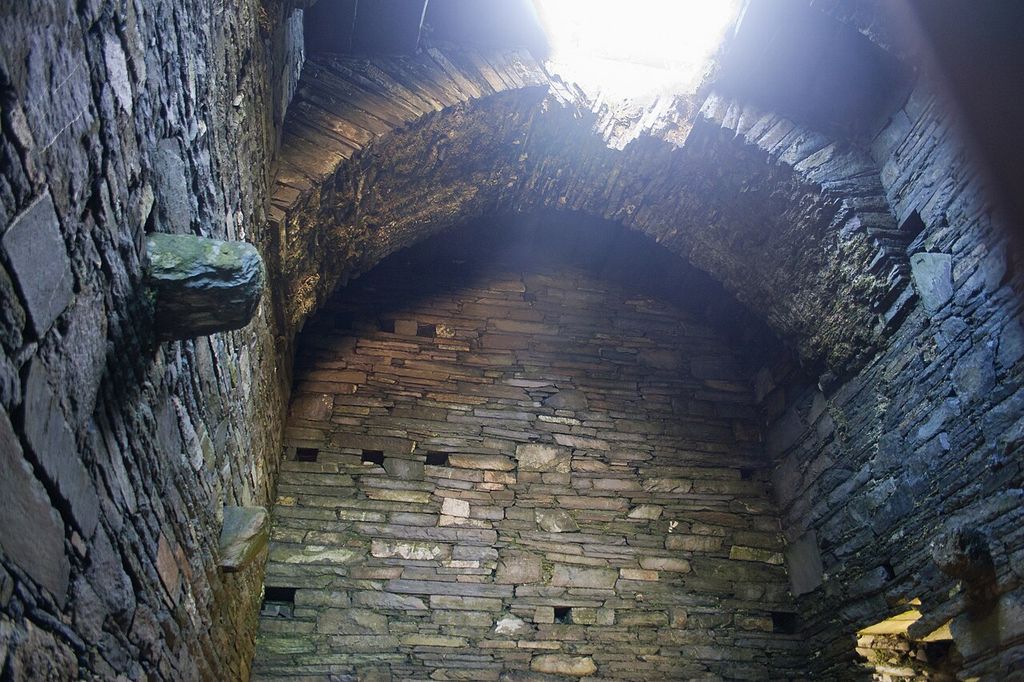
Three Castle Head Dunlough Tower House Barrel Vault 2009 09 10. Surving segment of a barrel vault in the interior of the main tower house of Dunlough Castle at Three Castle Head. In “What the barrel-or-groin vault reveals about the building”, this view records the form, material and setting discussed in the passage. Source image dated 2009; that date records the image, not the original construction. Andreas F. Borchert, Three Castle Head Dunlough Tower House Barrel Vault 2009 09 10; CC BY-SA 4.0. Resized proportionally; no crop, retouch or upscaling.
Comparing the barrel-or-groin vault examples
Basilica of Maxentius and Roman bath illustrate distinct settings: a vast groin-vaulted central hall was flanked by coffered barrel-vaulted bays. By contrast, groin vaults opened high thermal rooms toward clerestory windows while concentrating support. Romanesque nave differs because a barrel vault creates strong continuous thrust answered by thick walls and buttressing. Finally, Sant’Andrea, Mantua shows that a monumental coffered barrel vault recalls Roman basilicas within a Renaissance church.[4][6]
Watch: Three Ways to Read Barrel Vaults vs Groin Vaults
Choose Vault Types: Barrel, Groin and Ribbed, Technology and Revolution in Roman Architecture or Romanesque Architecture Explained. Together, the films connect architectural form with material, use and historical setting.
Vault Types: Barrel, Groin and Ribbed
Compares vault geometries side by side and supports the distinction drawn here between surface shape and load path.
Watch on YouTubeFrequently Asked Questions
A barrel vault extends one arch through depth; a groin vault is formed by intersecting two barrel vaults.
In plan and soffit, a barrel reads as one continuous tunnel while a groin shows diagonal intersection lines crossing a bay. Confirm the identification by checking depth, joints, material and position in a plan or section.
Not necessarily. Historic examples may carry load, protect an edge, manage water or organise space, while later versions can preserve the appearance as applied ornament. The surrounding assembly determines the answer.
No. Shape can narrow a comparison, but revivals, reuse and repair allow the same form to appear in different periods. Documents and material evidence are needed for a defensible date.
Record the complete assembly and diagnose water, movement, corrosion, decay and earlier intervention before replacing visible fabric. Safety-critical decisions require a qualified professional and a building-specific survey.
Discussion
Find a documented example of barrel vaults vs groin vaults. Which joint, section or sign of alteration most changes what a façade photograph alone seems to show? Cite the source and separate observation from inference.
Reader Insights
Name the material, joint, opening or route you can observe.
Give the building, place, approximate date and a reliable source.
Separate documented history from your interpretation.
Join the Conversation
Share a concise observation or useful source below.
References
- Hastings Borough Council. “Glossary of architectural terms.” View source
- Getty Research Institute. “Art & Architecture Thesaurus.” View source
- Francis D. K. Ching. “A Visual Dictionary of Architecture, 2nd edition.” View source
- U.S. National Park Service. “Best Practices in Stone Building Preservation Management.” View source
- Smarthistory. “Basilica of Maxentius and Constantine.” View source
- The Metropolitan Museum of Art. “Gothic Art.” View source
- Smarthistory. “Sant’Andrea in Mantua.” View source
- Brussels-Capital Region Heritage Inventory. “Tambour.” View source
- Sapienza University of Rome. “Restauro e consolidamento del Pantheon negli anni Trenta.” View source
- DergiPark / Turkish Archaeology and Ethnography Journal. “Mimari Gelişimde, Mekân Olgusu Üzerinden Tarihi Bir Sentez—Aya Sofya.” View source
- Linnaeus University Repository. “Analysis and assessment of Swedish vaulted masonry structures using funicular methods.” View source
Explore RELATED Architecture
Domes
further context for barrel versus groin vaults.
Cupola
further context for barrel versus groin vaults.
Pendentives and Squinches
further context for barrel versus groin vaults.
Vaults
further context for barrel versus groin vaults.
Pantheon
further context for barrel versus groin vaults.

Hagia Sophia
further context for barrel versus groin vaults.

Florence Cathedral
further context for barrel versus groin vaults.
St Peter’s Basilica
further context for barrel versus groin vaults.