


 by Tom Gurney
Tom Gurney BSc (Hons) is an art history expert with over 20 years experience
Email: tomgurney1@gmail.com / Phone: +44 7429 011000
Defence, Court and Power: How to Tell a Castle from a Palace
A castle is principally a fortified residence and stronghold connected with territorial power. A palace is principally an elite residence and institution of court, ceremony and government. The difference is emphasis, not an absolute divide. A building can be castle, palace, both or—despite towers and splendour—neither. [1] [2]
Architecture helps explain how each institution worked, but appearance cannot decide the name. Castles included halls, chambers, chapels and kitchens as well as walls. Palaces could stand behind gates, moats or urban fortifications. The safest classification joins documented use, patronage, setting, access and dated fabric.
Contents
Castle and palace at a glance
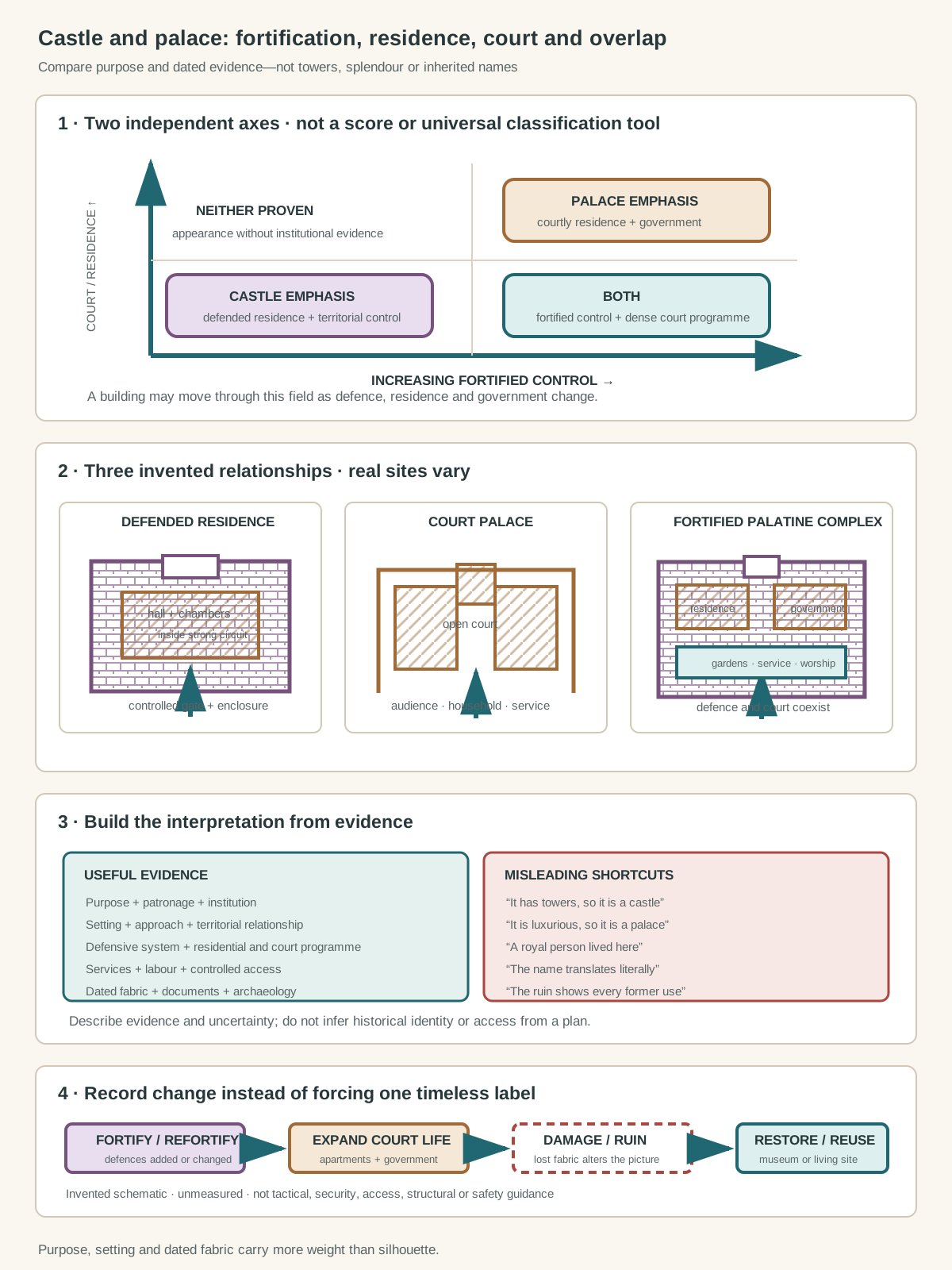
Original relationship diagram with invented geometry. It copies no castle or palace, plan, elevation, section, fortification detail, tactical diagram, coat of arms, royal emblem, crown, flag, access route or security arrangement. It is unmeasured, not to scale, and is not a military, tactical, security, access, restoration, construction, structural or safety document.
Text alternative for the diagram
Panel one uses two independent axes—fortified control and courtly-residential programme—to show castle emphasis, palace emphasis, overlap and neither proven without creating a scoring tool. Panel two compares invented plans for a defended residence, a court palace and a fortified palatine complex. Panel three contrasts useful evidence about purpose, setting, thresholds, residence, government, services and dated fabric with misleading shortcuts such as towers, battlements, luxury, scale and names. Panel four records refortification, residential or court expansion, damage or ruination, and restoration or museum use as distinct phases.
| Question | Castle | Palace |
|---|---|---|
| Primary emphasis | Defended residence, stronghold and territorial control | Courtly residence, ceremony, administration and display |
| Typical setting | Route, frontier, town, estate or strategic landscape | Capital, city, royal estate, sacred centre or court landscape |
| Common spaces | Gate, enclosure, towers, hall, chambers, chapel and stores | Reception courts, audience halls, apartments, offices, worship and services |
| Is fortification required? | Defensibility is normally central to the historical idea | Not necessarily; enclosure may organise privacy or ceremony |
| Can it be luxurious? | Yes | Yes |
| Can one building be both? | Yes | Yes |
This is not a scoring table. A few crenellations do not make a house a castle, and gilded rooms do not create a palace. The same complex may shift emphasis as rulers strengthen walls, enlarge apartments, move a court or open former state rooms as a museum.
What makes a castle?
Historic England describes stone castles as, for the most part, defended residences of medieval lords. [2] That concise definition holds together three ideas often separated in popular imagery: protection, domestic life and authority. A castle could control a road or harbour, administer an estate, lodge an elite household and stage lordship while remaining capable of defence.
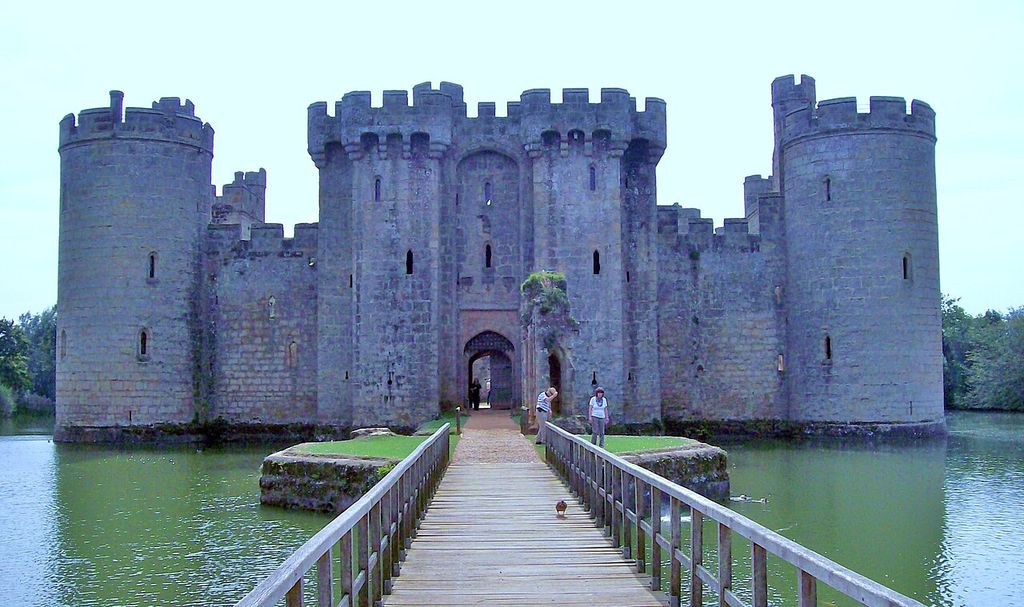
Bodiam Castle’s moat and gatehouse, photographed by Len Williams in September 2014; the present footbridge leads toward an entrance designed within a defended residential enclosure. Len Williams, Bodiam Castle, Gatehouse; CC BY-SA 2.0. JPEG prepared; no crop or retouch.
Plans differ. A great tower might concentrate accommodation and protection; an enclosure castle could depend on its circuit of walls, towers and gatehouse; successive wards could separate service work from privileged rooms. Ditch, curtain wall, parapet and gate matter as relationships rather than a checklist. Terrain, water, supply and approach may contribute as much to defensibility as masonry.
Castle life did not stop between sieges. English Heritage records hierarchies of hall, chamber, chapel, kitchen, store, stable and workshop in which officials, servants, craftspeople, soldiers, visitors and animals sustained the household. [3] [4] The great hall could host meals, justice and ceremony; private chambers offered more restricted access. Domestic comfort and display therefore do not turn a castle into the opposite of a castle.
Fortification also changed. Earthworks and timber could precede stone; walls were heightened, towers projected, gatehouses enlarged and gunports inserted. Later artillery encouraged lower or earth-backed works, while older castles became prisons, stores or comfortable residences. [3] A ruin preserves only part of those sequences, and picturesque battlements may be restored or added.
What makes a palace?
A palace houses power through residence and institution. It can contain reception courts, audience halls, council rooms, archives, apartments, places of worship, kitchens, stores, workshops and gardens. These spaces support a ruler or elite household, but also the clerks, guards, servants, craftspeople and suppliers who make government and ceremony possible.
The programme does not prescribe one plan. The Imperial Palaces in Beijing organise movement through monumental gates, axial courts and halls inside a walled and moated precinct. [17] Topkapı developed through successive courts and pavilions within Ottoman Istanbul. [18] Fatehpur Sikri joined imperial audience, residence, administration, worship and urban life within Akbar's Mughal capital. [21] Each is a palace complex, yet their spatial languages cannot be reduced to the same European room list.
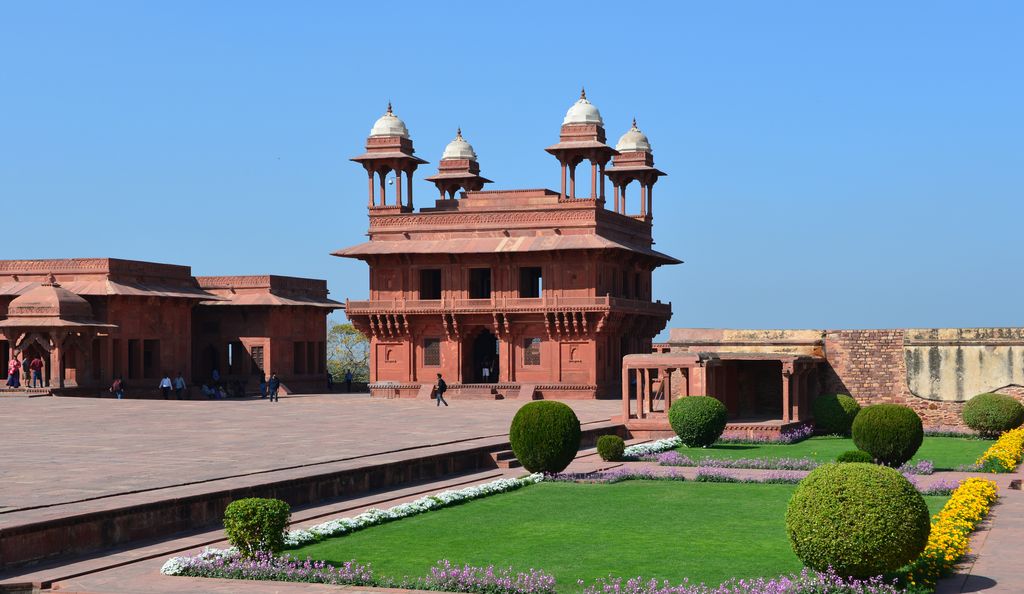
The Diwan-i-Khas at Fatehpur Sikri, photographed by Clément Bardot in February 2016 across its red-sandstone court. The pavilion belongs to a Mughal palace-city joining audience, residence, administration and worship. Clément Bardot, Diwan-i-Khas, Fatehpur-Sikri; CC BY-SA 4.0. JPEG prepared; no crop or retouch.
Enclosure is not proof of a castle. Walls may separate a ruler's household from a city, regulate ceremonial approach, create privacy, or protect a treasury without making military defence the institution's defining purpose. Likewise, the absence of high walls does not reduce a palace to a large house if court and government operated there.
Versailles makes the political programme clear. Louis XIII's hunting lodge grew under Louis XIV, who installed the French court and central government there in 1682. [9] [10] Apartments, state rooms, offices, gardens, waterworks and approaches worked together as an environment of residence, ritual and administration. Its scale expresses concentrated resources; it does not make `palace` a synonym for any enormous decorated building.
Defence and court are two separate axes
Instead of placing castle at one end of a line and palace at the other, imagine two axes. One records the architectural and territorial concentration of defence. The other records the density of courtly residence, ceremony and government. A border stronghold may be high on the first axis and limited on the second. An urban court palace may reverse that relation. A fortified royal complex can be high on both.
The axes still do not classify mechanically. Documentary evidence must establish what walls were intended to do, who lived in the apartments, where government occurred and when. A ceremonial gate can look martial. A residential tower can be highly defensible. Ruination can remove household ranges and leave only the hardest masonry, making a once mixed institution appear purely military.
This method also prevents a false hierarchy. `Palace` is not an upgrade that begins when a castle becomes comfortable, and `castle` is not a rough preliminary stage. Courts occupied fortified residences; palaces could precede, coexist with or replace them according to local politics.
Watch: Palace Compounds and Architectural Evidence
Begin with a specific African palace tradition, then widen the view to transferable tools for reading thresholds, enclosure, materials and routes without forcing one universal castle-palace model.
Royal Palaces of Abomey
UNESCO's short film introduces the linked palace enclosures built by successive rulers at Abomey and foregrounds their spatial and material continuity.
Watch on YouTubeBuildings that are both castle and palace
Windsor Castle offers unusually explicit evidence. The Royal Family describes it as a royal home and fortress of more than nine centuries and as a working palace today. [7] Royal Collection Trust traces how Henry II created public state accommodation and private royal apartments inside the fortified enclosure, and how Edward III transformed earlier military work into a Gothic palace. [8] Its continuing name records the castle without excluding palatial function.
The Tower of London provides a second kind of overlap. Begun as a Norman fortress, it acquired concentric defences and a medieval royal palace. Over time it also housed a prison, mint, armoury, menagerie and other state activities. [6] Much of the palace south of the White Tower later disappeared. The surviving walls can therefore overstate defence if the lost domestic and ceremonial fabric is ignored.
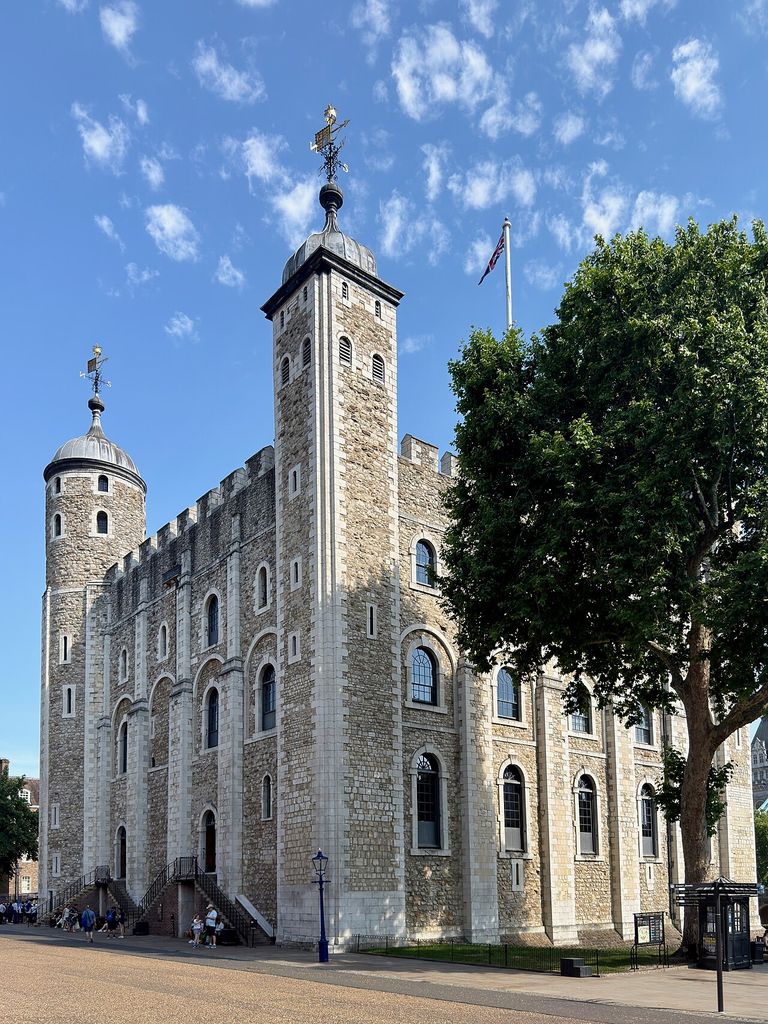
The White Tower at the Tower of London, photographed by Oleg Yunakov in June 2026. Its massive keep survives more visibly than much of the medieval royal palace, which can make the site appear more exclusively military than its history was. Oleg Yunakov, White Tower Norman keep, Tower of London; CC BY-SA 4.0. JPEG prepared; no crop or retouch.
The Alhambra is better understood as a fortified palatine city than as either a simple castle or an undefended palace. Nasrid walls and towers enclosed courts, halls, dwellings, service areas and water landscapes; the Generalife extended the royal environment through gardens and productive land. [11] Its organisation belongs to an Andalusi Islamic court and must not be redrawn as an English keep surrounded by a bailey.
Castel del Monte tests the labels differently. Its octagonal geometry and eight octagonal towers produce an unmistakably castellated image, yet UNESCO emphasises its symbolic design and synthesis of classical, Islamic and northern European elements. [12] The regular, refined work cannot be explained solely as a practical siege machine. `Castle` may remain the historical name while palatial and ceremonial interpretations qualify it.
Why names do not translate literally
The Palace of Versailles addresses the problem directly. Its official account explains that Renaissance and later French usage could call a luxurious rural residence a `château`, distinguishing it from an urban `palais`; Versailles never had the protective role of a medieval `château fort`. [9] Translating every château as `castle` would therefore invent fortification that the word does not promise.
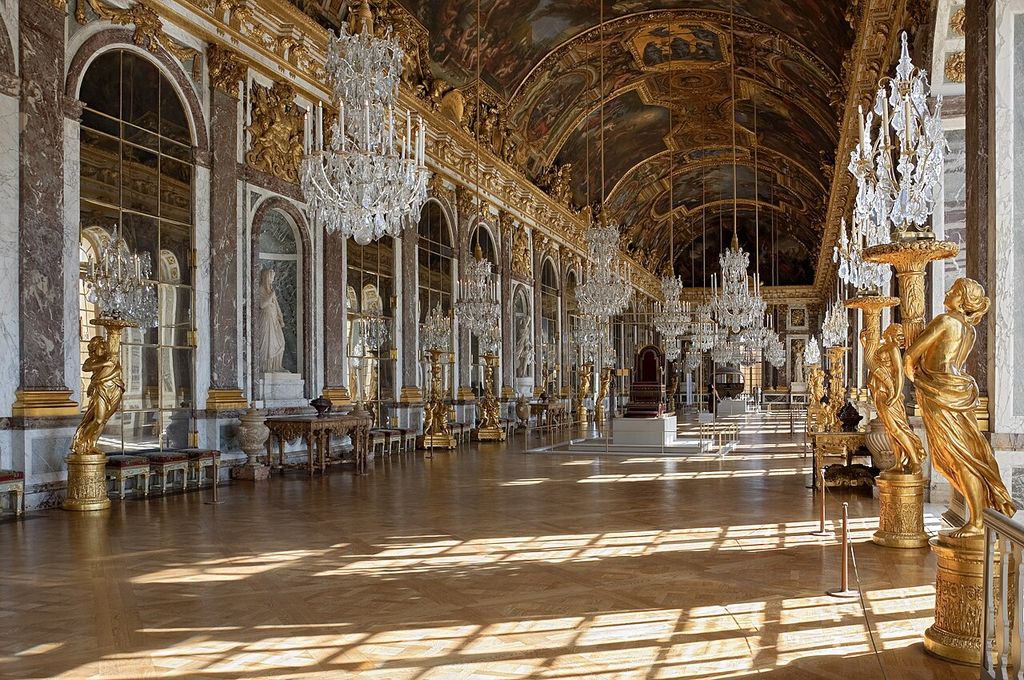
The Hall of Mirrors at Versailles, photographed by Myrabella / Wikimedia Commons in May 2011. Its ceremonial gallery belongs to a palace officially distinguished from the protective role of a medieval château fort. Myrabella / Wikimedia Commons, Chateau Versailles Galerie des Glaces; CC BY-SA 3.0. JPEG prepared; no crop or retouch.
The same discipline applies to `alcázar`, `qasr`, `kremlin`, `kasbah`, `citadel`, `fortress` and `palace`. These terms emerged from particular languages and political landscapes. They may indicate enclosure, elite residence, government or urban stronghold in different combinations. A good English explanation retains the original name, identifies the source's usage and describes the actual institution.
Even familiar English titles can outlast function. A former royal palace may become a museum or legislature. A castle may cease to house a ruler but remain a military site, prison or monument. The name is evidence of history, not a guarantee of present use.
Castle and fortress traditions beyond one model
Himeji-jo demonstrates why European components cannot be universal. More than eighty timber-and-plaster buildings form a Japanese castle ensemble whose gates, passages, baileys and keeps control movement across a hill. [13] Shared ideas of enclosure and defence allow comparison, but culturally specific construction and terminology should remain visible.
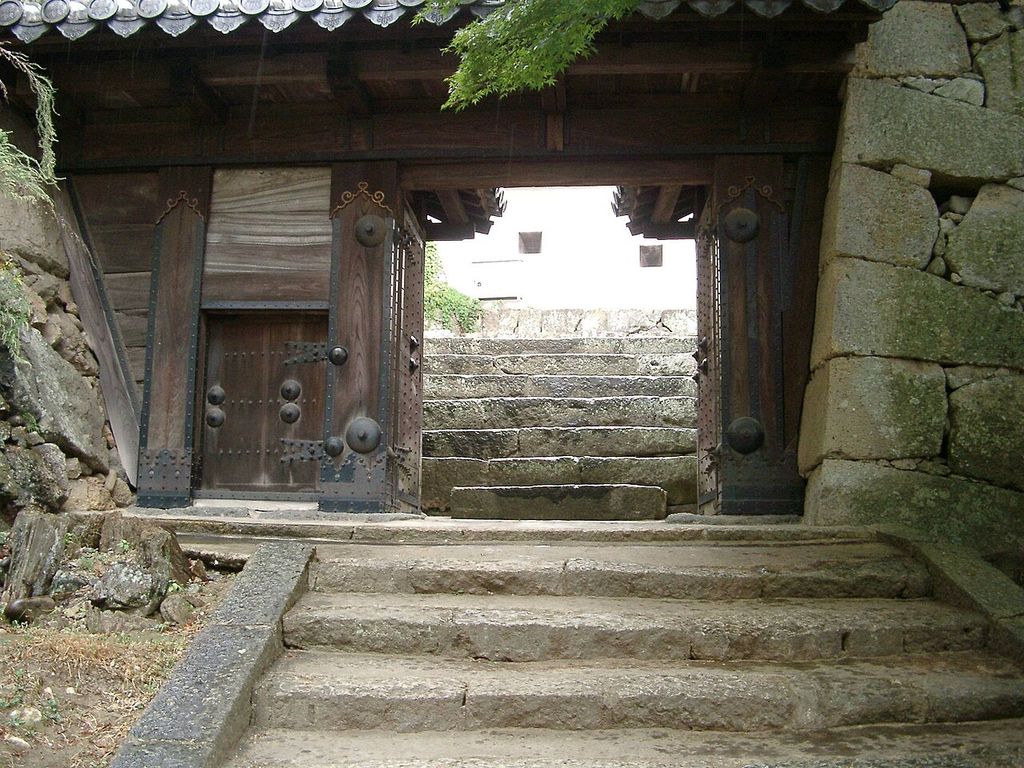
A timber gate and ascending stone steps at Himeji Castle, photographed by Michael Greenhalgh. The threshold demonstrates controlled movement through Japanese timber, plaster and stone construction without forcing the site into one European component list. Michael Greenhalgh, Chicane Gate at Himeji Castle; CC BY-SA 3.0. JPEG prepared; no crop or retouch. Published author permission correspondence.
Malbork combines a Teutonic Order fortress and convent with a grand master's palace, church, refectory and service areas. Its immense brick fabric organised military, religious, administrative and residential life. [14] Calling it only a fort loses the convent and court; calling it only a palace loses the defensive institution.
At Derbent, a citadel anchors long walls crossing the narrow passage between the Caucasus and Caspian Sea, with an inhabited city between defensive barriers. [15] Hwaseong likewise surrounds an urban centre at Suwon; its late-eighteenth-century gates, bastions and artillery positions combined defence with political and commercial planning. [16] Neither is simply an enlarged private castle. The controlled territory is part of the architecture.
These examples justify comparison at the level of route, enclosure, residence and authority while resisting universal labels. They also show that stone is not a measure of sophistication. Timber, earth, brick, plaster and mixed construction respond to climate, craft, resources and maintenance.
Fortified royal landscapes and palace cities
The Potala rises on Red Mountain as a palace-fort complex bound to Tibetan government and religion. Its massive walls and elevated setting express defence and authority, while chapels, assembly spaces, tombs and administrative rooms make a purely secular palace label inadequate. [20]
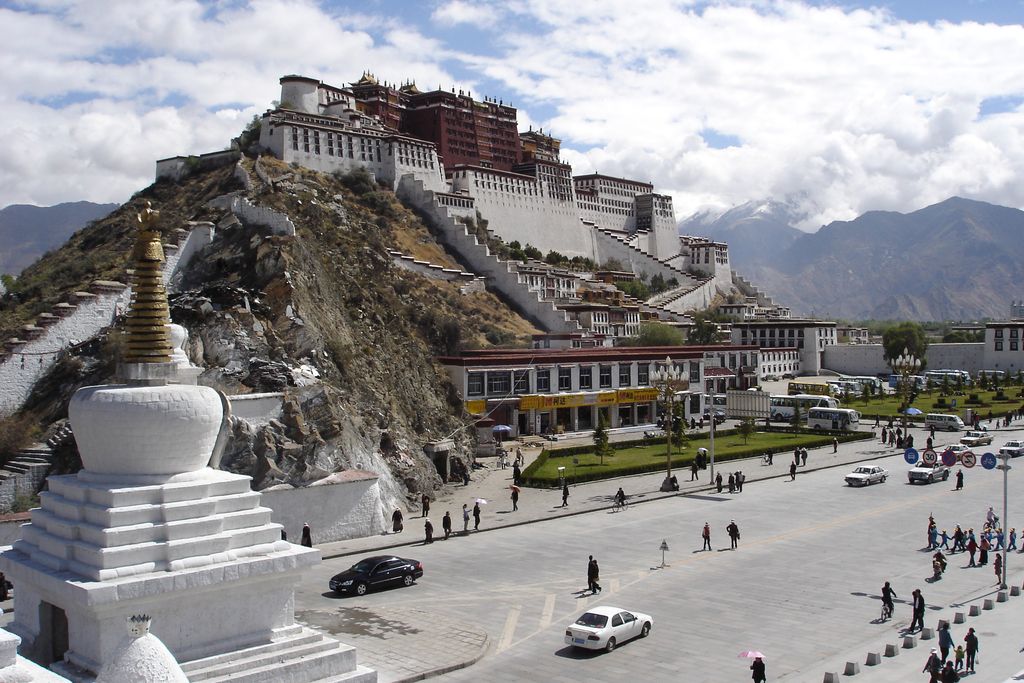
The Potala Palace above Lhasa, photographed by Ondřej Žváček in May 2006. Its massive elevated enclosure joins palace, fortification, Tibetan government and Buddhist religious history. Ondřej Žváček, Potala Palace from Chagpo Ri; CC BY 2.5. JPEG prepared; no crop or retouch.
Abomey formed through successive royal palace compounds within a walled area. Earth, timber, courtyards and polychrome reliefs materialised Aja-Fon kingship through a building tradition unlike European masonry courts. [19] The site's history also includes Dahomey warfare and participation in the Atlantic slave trade, French colonial conquest and later museum use. Descendant royal families and local custodians remain part of its stewardship.
The Royal Hill of Ambohimanga combines gateways and ditches with royal buildings, tombs, sacred water, trees and cultivated land. It is a living Malagasy place of historical and spiritual importance rather than a picturesque hill fortress. [22] Defensive position, residence and sacred landscape overlap without collapsing into one category.
These places expose another limit of the simple comparison: English `castle` and `palace` can assist description, but they cannot replace local political and cultural meanings. The article should say which relationship is being compared and which term the responsible institution uses.
Power, labour and controlled access
Both building types organise unequal access. Castle gates regulated entry to strongholds, stores, courts and territory. Palace thresholds ordered approach to a ruler, audience and administration. In either case, movement through a plan does not reveal every user's identity. Household ordinances, accounts, archaeology and other records are needed before labelling routes `royal`, `servant`, `public` or `secret`.
The Edwardian castle-and-town programme in Wales connected fortification with conquest, ports, roads and new settlements. Cadw's evidence places masons, quarriers, carpenters, smiths and labourers within an operation serving English royal control. [5] [24] Architectural achievement and colonial power belong in the same account.
Palaces likewise concentrated labour and resources. Court splendour depended on construction, food, water, sanitation, textiles, transport, gardens and continual maintenance. At Abomey, responsible interpretation must join royal art with histories of warfare, enslavement, colonial destruction and present cultural custodianship. [19] Naming these systems prevents rulers and architects from absorbing everyone's work.
Controlled access is historical evidence, not tactical instruction. This comparison does not assess weaknesses, guarded routes, present security or defensive effectiveness. Its invented diagram shows only abstract relationships and cannot describe any actual site's operations.
Change, ruins and museums
Castles and palaces are layered rather than frozen. A castle can receive new apartments, lose defensive value, be slighted in civil conflict, decay into a ruin or undergo romantic restoration. A palace can be enlarged for a new dynasty, damaged by fire or war, converted to offices, adapted for parliament or staged as a museum.
Versailles ceased to be a royal residence after the French Revolution and became a museum of French history in 1837. [9] At the Tower of London, vanished palatial ranges and surviving fortress fabric produce a different imbalance. Windsor remains a working palace inside a castle. These present states should never be projected backward across every period.
Conservation evidence should identify original work, later campaigns, damage, reconstruction and current presentation separately. The National Park Service recommends reading architectural character from setting and mass down to openings, materials and details. [23] Cadw's management framework similarly treats castles with their town walls, settings, views, archaeology and continuing interventions. [24] Physical observation is vital, but it cannot by itself establish who used a room or what an institution was called.
How to decide between castle and palace
- Start with documented purpose. Was the complex intended as defended residence, court institution, military stronghold or a combination?
- Map its setting. Relate the buildings to routes, town, frontier, capital, estate, sacred landscape and sources of supply.
- Test defence as a system. Examine enclosure, approach and strongpoints in their historical phase rather than counting battlements.
- Find the residential and governmental programme. Look for evidence of household, audience, ceremony, administration, worship and service.
- Preserve local terminology. Explain rather than mechanically translate château, alcázar, fortress, citadel or other inherited names.
- Date every conclusion. A castle may become palatial; a palace may be fortified, abandoned, restored or converted.
- Separate survival from former use. Lost ranges and later display can distort the apparent balance.
- Name labour and political power. Ask who commissioned, built, supplied, served, was displaced and now cares for the place.
Frequently Asked Questions
Neither word sets a size. Castles range from compact towers to walled complexes; palaces range from small court residences to palace cities. Function and historical institution matter more than area.
Castle or Palace: Five Evidence Tests
Start with documented purpose and dated fabric, then compare defence, residence, government and controlled access without treating the result as a score.
| Evidence | What it can establish | What it cannot establish alone |
|---|---|---|
| Documented purpose | Defended residence, court institution, stronghold or a combination. | Every activity in every building phase. |
| Setting and approach | Relationships with route, frontier, town, capital, estate or sacred landscape. | Defensive effectiveness or present security. |
| Residential programme | Household, audience, ceremony, administration, worship and service. | A palace label based only on luxury. |
| Defensive fabric | Enclosure, gate, wall and strongpoint relationships in a dated phase. | A castle label based only on towers or crenellations. |
| Name and survival | Historical terminology, loss, rebuilding, restoration and reuse. | A literal translation or timeless identity. |
Many palaces housed sovereigns, but the word has also been used for episcopal, governmental and elite residences. The evidence must identify the relevant court or institution rather than relying on luxury.
Yes. Windsor is officially described as a royal home and fortress that remains a working palace. The Tower of London and the Alhambra also combined fortified control with palatial life in historically different ways. [6] [7] [11]
French `château` can mean a prestigious rural residence, while `château fort` specifies a fortified castle. Versailles' official history states that it did not have the protective function of a medieval fortress. [9]
No. Walls and moats can control ceremony, privacy and access as well as provide defence. Determine the institution and its historical use before applying the castle label.
Discussion
Which example most clearly shows why castle and palace are overlapping historical relationships rather than opposite visual styles?
Reader Insights
What do records establish about defence, residence, court and government?
How do approach, town, route, landscape and sources of supply shape the complex?
Which functions and structures were added, lost, restored or reused?
Join the Conversation
Share a documented example below, noting its local name, purpose, building phase, surviving evidence and present use.
References
- Getty Research Institute, Art & Architecture Thesaurus Online. View source
- Historic England, Stone Castles: Introductions to Heritage Assets. View source
- English Heritage, Castles Through Time. View source
- English Heritage, Life in a Castle. View source
- Cadw, The Castles and Town Walls of Edward I. View source
- Historic Royal Palaces, The Story of the Tower of London. View source
- The Royal Family, Royal Residences: Windsor Castle. View source
- Royal Collection Trust, Who built Windsor Castle?. View source
- Palace of Versailles, The Palace: from the seat of power to a museum. View source
- UNESCO World Heritage Centre, Palace and Park of Versailles. View source
- UNESCO World Heritage Centre, Alhambra, Generalife and Albayzín, Granada. View source
- UNESCO World Heritage Centre, Castel del Monte. View source
- UNESCO World Heritage Centre, Himeji-jo. View source
- UNESCO World Heritage Centre, Castle of the Teutonic Order in Malbork. View source
- UNESCO World Heritage Centre, Citadel, Ancient City and Fortress Buildings of Derbent. View source
- UNESCO World Heritage Centre, Hwaseong Fortress. View source
- UNESCO World Heritage Centre, Imperial Palaces of the Ming and Qing Dynasties in Beijing and Shenyang. View source
- UNESCO World Heritage Centre, Historic Areas of Istanbul. View source
- UNESCO World Heritage Centre, Royal Palaces of Abomey. View source
- UNESCO World Heritage Centre, Historic Ensemble of the Potala Palace, Lhasa. View source
- UNESCO World Heritage Centre, Fatehpur Sikri. View source
- UNESCO World Heritage Centre, Royal Hill of Ambohimanga. View source
- National Park Service, Preservation Brief 17: Architectural Character. View source
- Cadw, Castles and Town Walls of King Edward in Gwynedd Management Plan. View source