


 by Tom Gurney
Tom Gurney BSc (Hons) is an art history expert with over 20 years experience
Email: tomgurney1@gmail.com / Phone: +44 7429 011000
Status, Form and Overlap: How to Tell a Cathedral from a Basilica
A cathedral is the church of a bishop's official seat, or `cathedra`. A basilica, in present Roman Catholic usage, is a church granted a particular title by papal authority. Those definitions answer different questions, so the categories overlap: a church can be a cathedral, a basilica, both or neither. Size, age, grandeur, towers, domes and plan do not settle the matter. [1] [2] [5] [9]
There is a second source of confusion. `Basilica` also names an ancient Roman building type and, by extension, a longitudinal architectural form adopted by early Christians. A church can therefore be basilican in plan without holding the Catholic title. A titled basilica can have a different plan entirely. Institutional status and architectural form must be read on separate tracks.
Contents
Cathedral and basilica at a glance
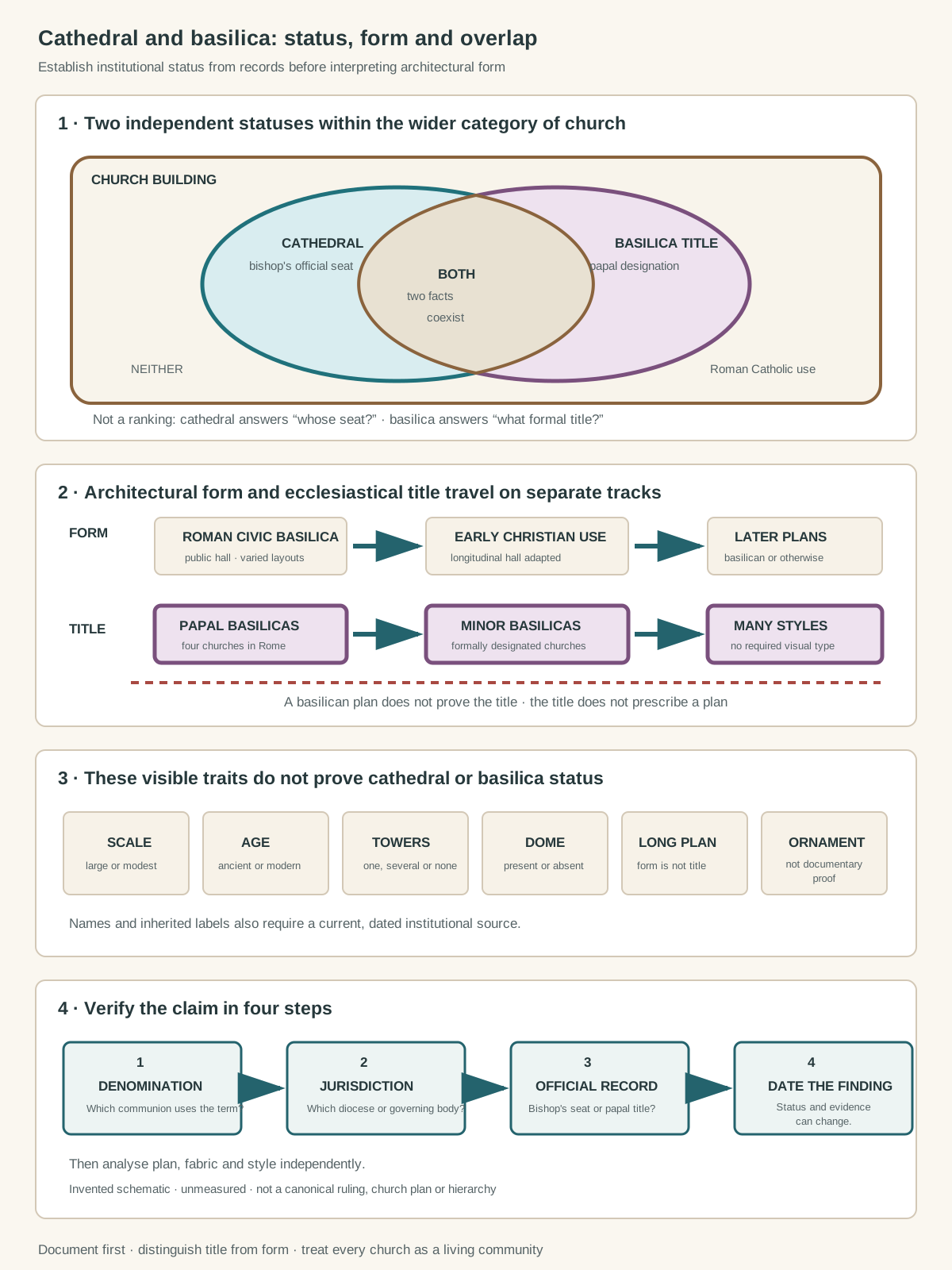
Original relationship diagram with invented geometry. It copies no church, plan, elevation, section, seal, coat of arms, papal emblem, denominational mark, liturgical object, access route or proprietary diagram. It is unmeasured, not to scale, and is not a canonical ruling, real church plan, hierarchy, liturgical, access, conservation, construction or safety document.
Text alternative for the diagram
Panel one places overlapping cathedral and Roman Catholic basilica-title zones inside the broader category of church buildings: some churches are cathedral only, some basilica only, some both and many neither. Panel two separates the architectural history of Roman civic basilicas and early Christian basilican form from the later ecclesiastical title. Panel three states that scale, age, towers, a dome, a longitudinal plan and ornament do not prove either status. Panel four gives a four-step verification path through denomination, jurisdiction, official episcopal or Holy See records, and a dated finding.
| Question | Cathedral | Basilica |
|---|---|---|
| What establishes it? | The presence of a bishop's official seat within a diocese or corresponding jurisdiction | In current Roman Catholic use, an official papal title |
| Is it a building shape? | No | Not when the word identifies the ecclesiastical title |
| Must it be very large or old? | No | No |
| Can it have any style? | Yes | Yes |
| Can one church be both? | Yes: the two statuses are independent | Yes: a cathedral may also receive the title |
| How is it verified? | Current diocesan or denominational records | The Holy See and the church's current official record |
The word `church` remains the broadest of the three in this comparison. Under Latin Catholic canon law it means a sacred building designated for divine worship to which the faithful have a right of entry for public worship. [12] Other communions frame church buildings through their own law and practice, but the architectural point is similar: cathedral and basilica identify particular relationships within a much larger field of worship buildings.
What makes a church a cathedral?
`Cathedral` derives from `cathedra`, the chair associated with a bishop's teaching and governing office. The United States Conference of Catholic Bishops defines the cathedral as the official church of a diocesan bishop, while the Church of England calls each cathedral the mother church of its area and the seat of a bishop. [2] [3] [10] The chair is not merely an expensive furnishing that turns any church into a cathedral. It signifies an institutional relationship between bishop, church and diocese.
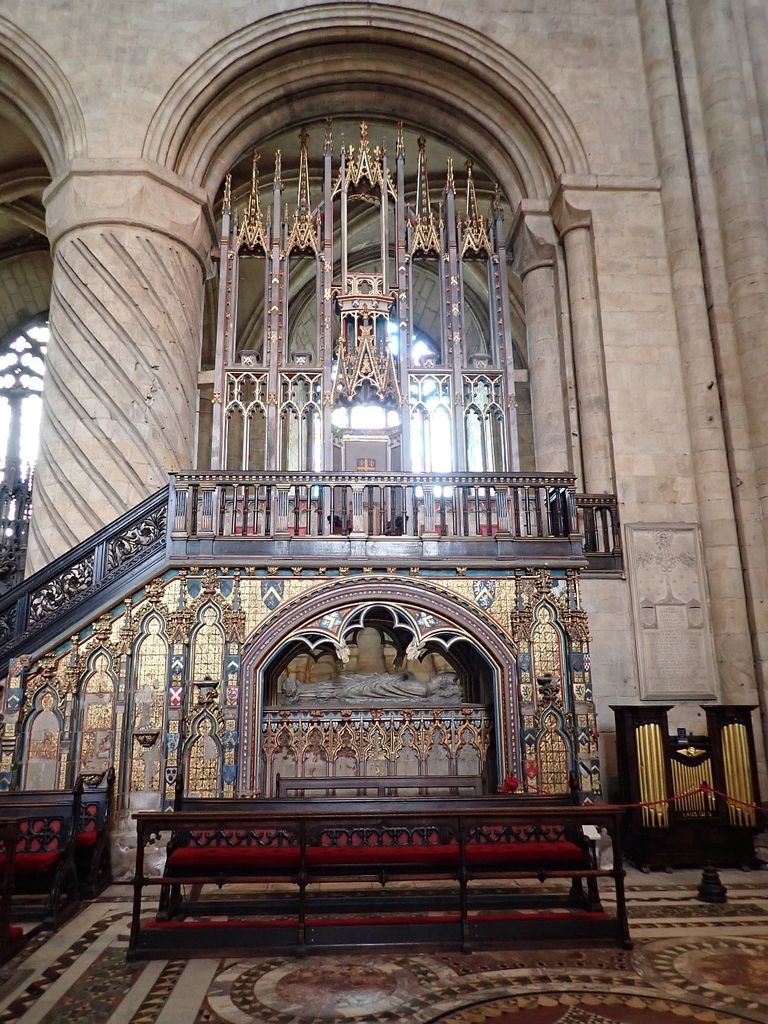
The raised bishop's throne at Durham Cathedral, photographed by Rob Farrow in September 2022; the cathedra signifies the bishop's office, while the chair alone does not turn another church into a cathedral. Rob Farrow, Durham Cathedral — the cathedra (bishop’s throne); CC BY-SA 2.0. JPEG prepared; no crop or retouch.
That relationship explains why visual rules fail. A cathedral can occupy a vast medieval complex, a converted parish church or a modern building. It can be Romanesque, Gothic, Renaissance, Baroque, Classical, revivalist or Modern. It may have a spire, two towers, a dome or none of these. Historic England stresses that English cathedrals are living, changing places where new work joins fabric from many periods. [17] Architectural magnificence is frequent, but it is not the definition.
The Church of England's Cathedrals Measure expresses the same principle institutionally: the cathedral is the church containing the bishop's principal seat and dignity. [4] Its chapter, worship, mission and public work give it a role extending beyond the building as an art object. St Paul's Cathedral, for example, describes itself as the Bishop of London's seat and as a centre for her ministry across the diocese. [22] Its dome is famous; its cathedral status rests on the episcopal seat, not the dome.
Names can mislead as readily as silhouettes. York Minster and Southwell Minster appear in the Church of England's cathedral list. [3] Westminster Abbey, despite its scale and national importance, is not a cathedral: it is an abbey church and Royal Peculiar under the sovereign's jurisdiction. [23] `Minster`, `abbey` and `cathedral` preserve different histories, and none can be safely inferred from the apparent importance of a building.
What makes a church a basilica?
In contemporary Roman Catholic terminology, a basilica is a church recognised with a formal title. The Holy See's constitution Praedicate Evangelium assigns competence for granting the title of minor basilica to the Dicastery for Divine Worship and the Discipline of the Sacraments. [5] Papal acts of designation record individual grants, making status documentary rather than visual. [6] [19]
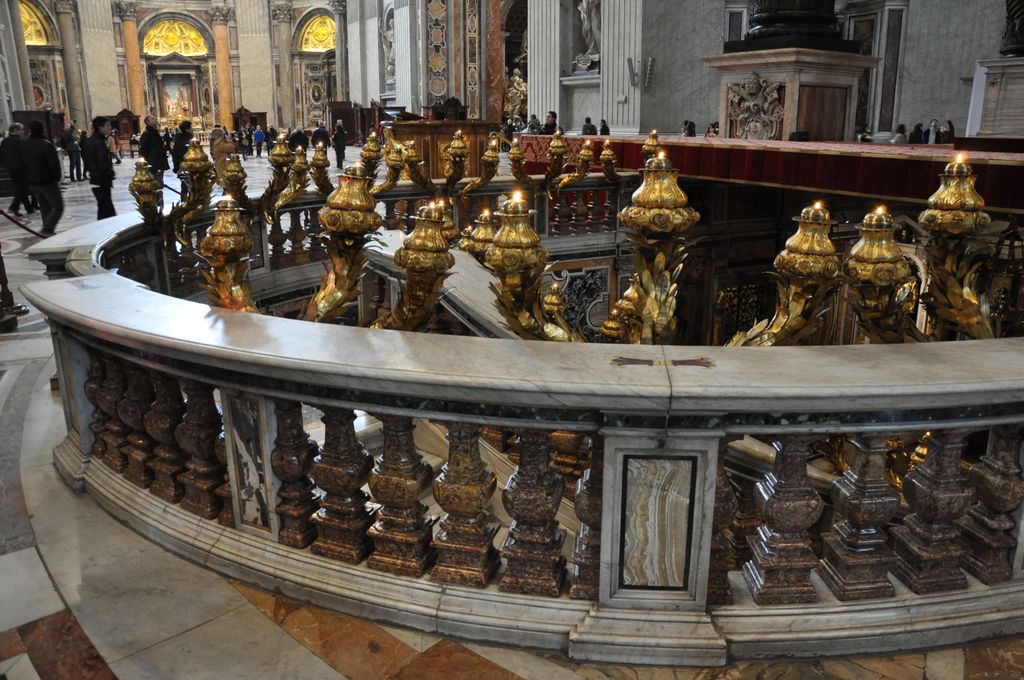
The Confessio opening before the high altar in Saint Peter's Basilica, photographed by Ben Skála in February 2013. Saint Peter's is one of the four papal basilicas named by the Vatican; the photograph illustrates the church but is not documentary proof of its title. Ben Skála, Benfoto, Saint Peter’s Basilica: the Confessio opening; CC BY-SA 3.0. JPEG prepared; no crop or retouch.
The title marks a particular connection with the Church of Rome. Official guidance associates minor basilicas with liturgical responsibilities and authorised privileges. Certain insignia, including the umbrella-like `ombrellino` and a bell called the `tintinnabulum`, may be connected with the title. [9] [20] Yet an emblem seen in a photograph is weak evidence: objects move, reproductions proliferate, and an old caption may outlive an institution's current position. The authoritative grant and current church record are safer.
The Vatican presents four churches in Rome as papal basilicas: Saint Peter's, Saint John Lateran, Saint Mary Major and Saint Paul Outside the Walls. [7] Saint Paul Outside the Walls is governed as one of these four and has a long architectural history of rebuilding and restoration. [8] `Major basilica` is sometimes used for this very small Roman group, while designated churches elsewhere are minor basilicas. The terms should not be converted into a worldwide architectural ranking.
A basilica title also does not mean `more important than a cathedral`. Importance has several possible meanings—administrative, devotional, historical, artistic or civic—and the two statuses organise different ones. A cathedral serves episcopal office. A basilica title recognises a church within Catholic institutional and liturgical life. When the same church holds both, neither label cancels the other.
Basilica as an architectural form
Long before `basilica` became a Catholic title, it identified a Roman civic building. Basilicas accommodated legal and commercial activity and provided large covered halls next to forums and other public spaces. [13] [15] There was variation, but a common arrangement placed a tall central nave between lower side aisles, allowing high-level clerestory light; an apse could focus judicial or ceremonial activity at an end.
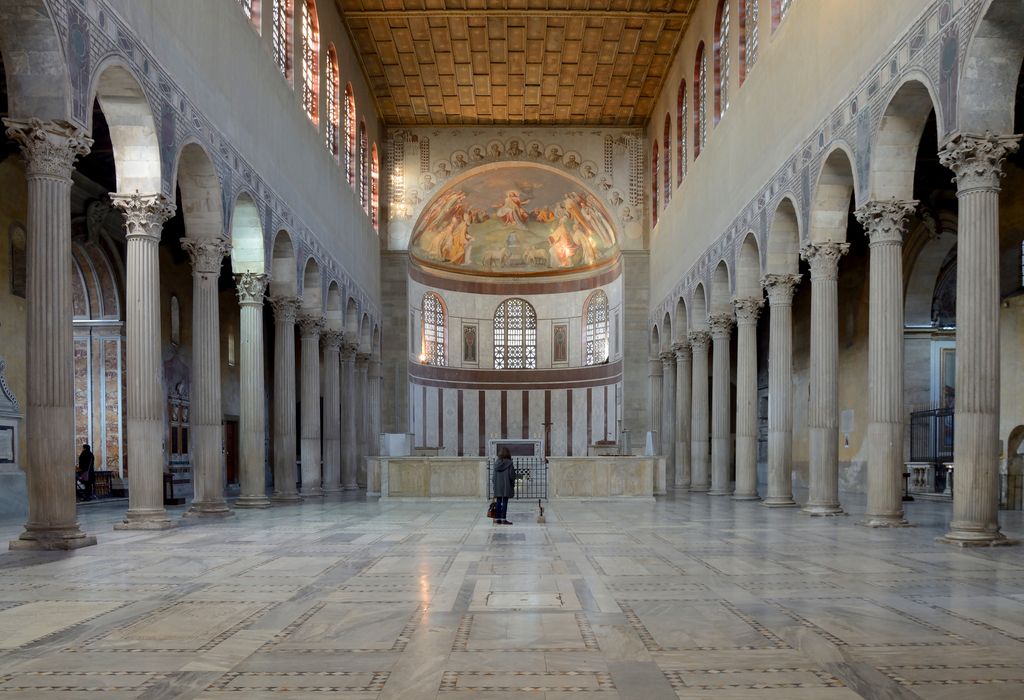
Santa Sabina in Rome, photographed by Livioandronico2013 in March 2015, shows a longitudinal nave, side aisles, arcades, clerestory and apse. These features describe basilican form; they do not establish a papal title. Livioandronico2013, Santa Sabina, Rome: nave toward the apse; CC BY-SA 4.0. JPEG prepared; no crop or retouch.
Early Christian communities adapted the capacious longitudinal hall for congregational worship. The form could guide movement from entrance or atrium along a nave toward the sanctuary, with colonnades or arcades separating aisles and an apse terminating the principal axis. [13] [18] It offered a useful precedent, not a fixed template repeated identically across centuries.
San Clemente in Rome makes the form tangible. Its medieval upper church has a nave, flanking aisles, arcades, clerestory and apse, while floors, furnishings and later interventions reveal a long sequence of change. [14] Calling this arrangement `basilican` describes spatial organisation. It does not, by itself, answer whether any church currently bears an ecclesiastical title.
The distinction works in both directions. A Gothic church can hold the basilica title. So can a domed Baroque or modern church. Conversely, countless churches have longitudinal naves and aisles derived broadly from basilican planning without any papal designation. Historic England's vocabulary preserves `basilica` as a Roman public-building type as well as a term with later church associations, demonstrating why the context of the word matters. [16]
Watch: Basilica Form and Cathedral Fabric
Compare an early Christian basilican interior with a Gothic cathedral, keeping architectural form, successive fabric and institutional status on separate tracks.
Basilica of Santa Sabina, Rome
Santa Sabina's nave, aisles, arcades, clerestory and apse make the longitudinal architectural form visible without turning that form into a test for current ecclesiastical status.
Watch on YouTubeCan a cathedral also be a basilica?
Yes. The Cathedral Basilica of Saint Louis is a clear example. Its official history records that the Cathedral of Saint Louis was designated a basilica by Pope John Paul II on 4 April 1997. [20] The existing cathedral gained an additional title; it did not stop being the archbishop's church. `Cathedral Basilica` is therefore not a hybrid architectural style. It is an accurate conjunction of two institutional facts.
The Holy See's historical lists contain other grants in which cathedrals, shrines, parish churches or abbey churches received basilica titles. [19] This variety reinforces the logic: basilica status does not identify one underlying community type.
The Basilica of the National Shrine of the Immaculate Conception in Washington, DC supplies the reverse example. Its own institutional backgrounder states that it is a national shrine and basilica but neither the cathedral of the Archdiocese of Washington nor a parish church. [21] Its enormous scale does not turn it into the bishop's cathedral. The designation `national shrine` concerns devotional and institutional function, while `basilica` records its title.
St Paul's in London provides a cathedral-without-basilica counterpart. It is the seat of the Bishop of London within the Church of England. [22] A Roman Catholic basilica designation is neither required nor relevant to that Anglican cathedral identity. These three cases—both, basilica only and cathedral only—show why a one-dimensional hierarchy is impossible.
Denominations use the words differently
The core relation between cathedral and bishop extends beyond Roman Catholicism, but terminology is not perfectly uniform. Anglican cathedrals are episcopal seats and mother churches while operating within the law and structure of their own provinces. [3] [4] Their chapters, parishes and governance cannot be explained simply by importing Latin Catholic canon law.
Orthodox practice requires similar care. The Orthodox Church in America explains that a cathedral may be the bishop's church, while in some usage a prominent regional church can also be called a cathedral; Russian terms do not map mechanically onto English. [11] That does not make the word meaningless. It means a responsible account identifies the communion, jurisdiction and current official usage before asserting status.
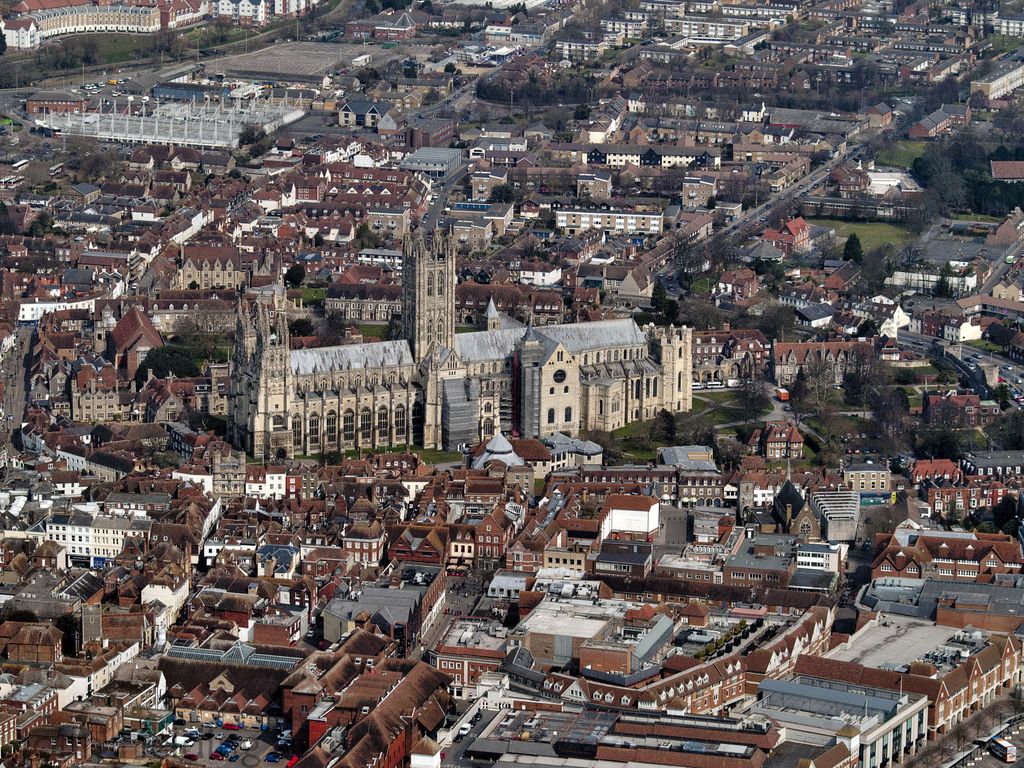
Canterbury Cathedral within its surrounding city, photographed by John Fielding in April 2013. As an Anglican cathedral, its identity belongs to the Church of England's episcopal structure and cannot be tested by Roman Catholic basilica rules. John Fielding, Canterbury Cathedral aerial view; CC BY 2.0. JPEG prepared; no crop or retouch. Original Flickr photograph.
The same caution applies more broadly. Some churches retain `cathedral` in an inherited name after diocesan arrangements change. Others become cathedrals when a new diocese is created, even though their architecture began as a parish church. A label on a tourist map may simplify this history. Current denominational and diocesan records should control the comparison.
Co-cathedrals, pro-cathedrals and former cathedrals
Cathedral status can follow institutional change. A `co-cathedral` shares cathedral function within a diocese or comparable jurisdiction. The Holy See has described former diocesan cathedrals receiving co-cathedral status after jurisdictions were reorganised, preserving their connection with a bishop whose present cathedral lies elsewhere. [24] The prefix does not describe a smaller architectural type.
A `pro-cathedral` serves provisionally as a cathedral. It may be used while a permanent cathedral is planned, unavailable or being replaced. Because circumstances can change, the term particularly demands a dated source from the relevant church authority. A former cathedral, meanwhile, is historically important but is not necessarily a current episcopal seat.
These terms expose a larger truth: the building and the office have related but distinct biographies. Stone walls can outlast a diocese; a seat can move into an older church; a new cathedral can rise around an existing congregation. Recording the date of a status claim is therefore part of architectural accuracy.
Church, chapel, shrine, abbey and parish
Related labels do not form a single ladder. A parish church serves a defined local community. An abbey church belongs, or historically belonged, to a monastic foundation. A collegiate church is associated with a college or chapter of clergy without necessarily being a bishop's seat. `Minster` is a historical honorific or inherited name in British usage, not a visible plan type.
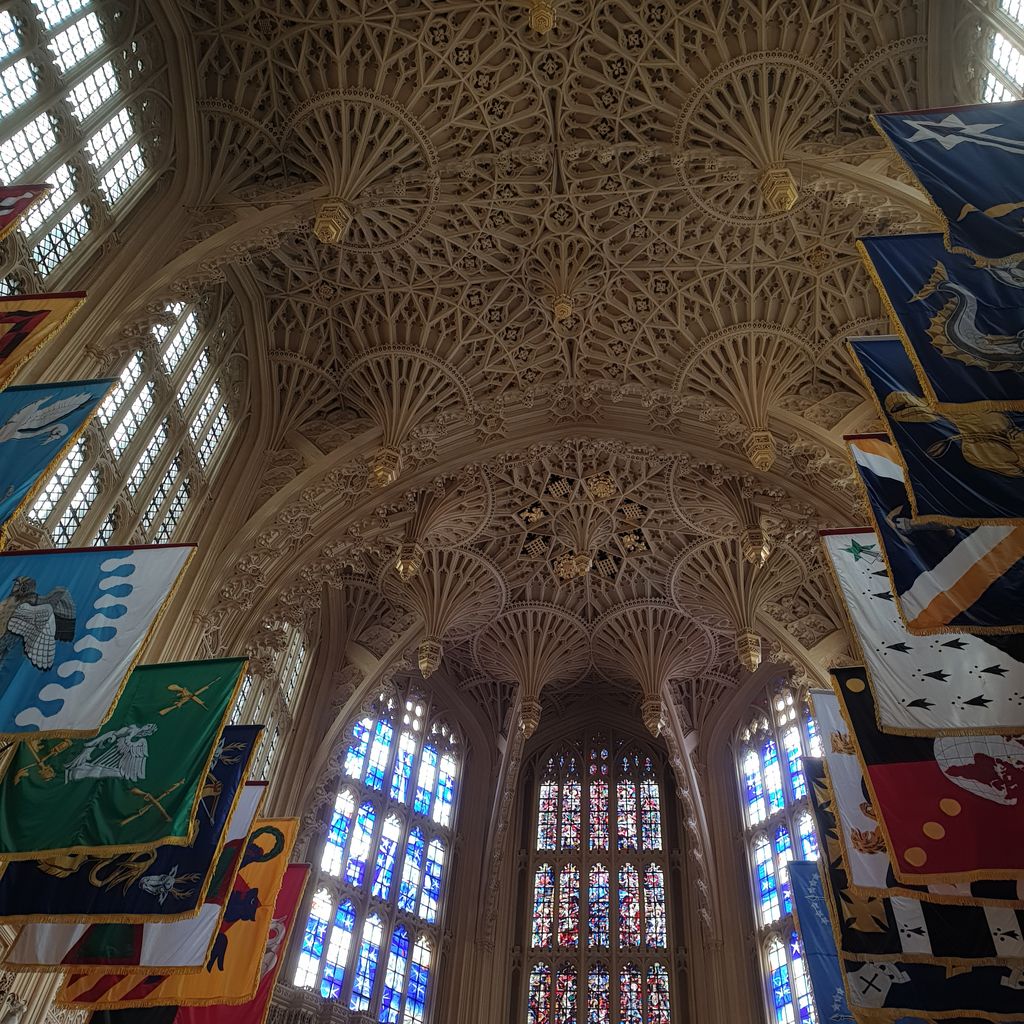
Fan and pendant vaults fill Henry VII Chapel at Westminster Abbey, photographed by JRennocks in May 2021. The article's example shows why architectural grandeur does not make an abbey or chapel a cathedral. JRennocks, Ceiling of Henry VII Chapel, Westminster Abbey; CC BY-SA 4.0. JPEG prepared; no crop or retouch.
A chapel is normally a smaller or specially assigned place of worship, although celebrated chapels can be architecturally large. Under Latin canon law, a shrine is a church or other sacred place to which people make pilgrimage for a particular devotional reason with ecclesiastical approval. National and international shrine titles require specified levels of approval. [12] A shrine may also be a parish church or basilica, but the words still identify different relationships.
This overlapping vocabulary prevents simple rankings. Westminster Abbey is an abbey and Royal Peculiar, not a cathedral. [23] The Washington National Shrine is a shrine and basilica, but not a cathedral or parish. [21] Cathedral Basilica of Saint Louis is cathedral, parish and basilica. [20] Accurate description keeps every relevant label and avoids treating one as a decorative synonym for another.
Why appearance cannot decide status
Five visual shortcuts cause most errors.
- Scale: a vast basilica or abbey need not be a cathedral, while a modest church can become an episcopal seat.
- Age: ancient fabric proves neither current cathedral nor basilica status; a modern church can hold either.
- Towers and domes: these belong to architectural composition, not the institutional definition.
- Longitudinal plan: nave, aisles and apse may indicate basilican form, not a papal title.
- Ornament and insignia: decoration requires interpretation, and even title-related objects should be checked against documentary evidence.
The Metropolitan Museum's account of Vatican architecture shows how Saint Peter's moved from an early basilican predecessor into a great centralised and longitudinal Renaissance-Baroque complex. [18] Architectural form changes across campaigns, while institutional identities follow another history. The safest sequence is to establish status from records and only then analyse plan, style and fabric.
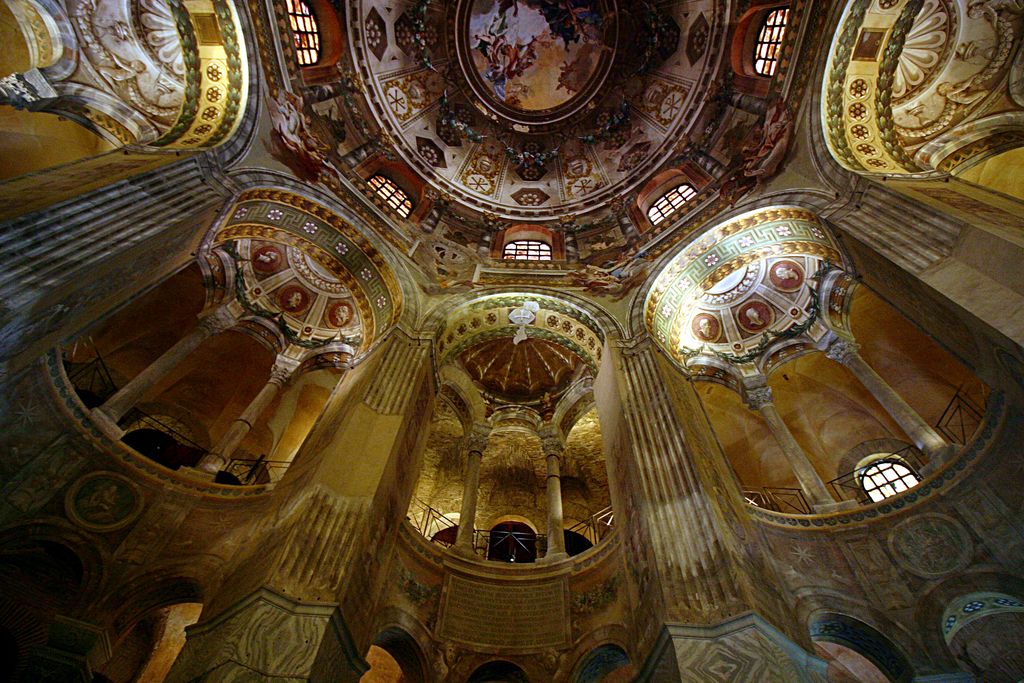
Curving galleries and a dome define the centralised interior of San Vitale in Ravenna, photographed by José Luiz Bernardes Ribeiro in September 2016. Its geometry contrasts with Santa Sabina's long nave and reinforces that church titles cannot be inferred from plan alone. © José Luiz Bernardes Ribeiro, Galleries, San Vitale, Ravenna; CC BY-SA 4.0. JPEG prepared; no crop or retouch.
How to verify a cathedral or basilica
- Identify the denomination. Do not apply Catholic title rules to Anglican, Orthodox or other churches.
- Find the current jurisdiction. Locate the diocese, eparchy, province or other governing body and its official church list.
- Verify the bishop's seat. For a cathedral claim, seek a current denominational or diocesan statement linking the church with the bishop.
- Verify a Catholic basilica title. Use the Holy See, a documented papal act, or the church's official institutional history rather than an informal directory. [5] [6]
- Separate form from title. Describe a basilican plan only from architectural evidence; never use it to infer designation.
- Date the finding. Co-cathedrals, pro-cathedrals, former cathedrals and newly designated basilicas show that status can change.
- Treat the church as living. Current worship, governance and community coexist with architectural history. [3] [9]
This method identifies categories; it does not provide case-specific canon-law advice, guarantee access, interpret privileges, or replace a church's current visitor and worship information.
Cathedral or Basilica: Five Evidence Tests
Establish current institutional status from dated records, then analyse architectural form, fabric and history independently.
| Evidence | What it can establish | What it cannot establish alone |
|---|---|---|
| Episcopal record | A church is the current official seat of a bishop. | Its size, style, plan or age. |
| Papal designation | A Roman Catholic church holds a basilica title. | A required plan or architectural rank above cathedrals. |
| Plan and section | Nave, aisles, apse, clerestory and other basilican relationships. | Present cathedral or basilica status. |
| Name and signage | A useful lead toward institutional history. | Current status without an authoritative dated source. |
| Fabric and alteration | Building phases, reuse, repair and changing architectural form. | Whether a title or episcopal seat still applies. |
Frequently Asked Questions
No single ladder joins the terms. A cathedral is defined by the bishop's seat; a Catholic basilica holds a papal title. A church may be both, as at Saint Louis, or only one. [9] [20]
No. Anglican and Orthodox churches also use cathedral terminology, though their institutional details and local usages differ. Check the relevant communion's official record. [3] [11]
No. Nave, aisles, clerestory and apse are common elements in historical basilican forms, not requirements for every titled basilica. The architectural form and Catholic title must be established independently. [13] [16]
No. The Basilica of the National Shrine of the Immaculate Conception explicitly states that it is not a cathedral despite its exceptional scale. Cathedral status depends on the bishop's seat. [21]
Yes. A bishop's seat may move, dioceses may be reorganised, and churches may become co-cathedrals, pro-cathedrals or former cathedrals. Use a current, dated institutional source. [24]
No. Architecture can support a description such as `basilican plan`, but only an authoritative ecclesiastical record establishes the current Catholic title.
Discussion
Which example most clearly shows why appearance alone cannot decide whether a church is a cathedral, a basilica, both or neither?
Reader Insights
Which current church or denominational record establishes the institutional claim?
Which spatial relationships can be described without turning them into a title test?
How have building fabric, jurisdiction and naming changed on different timelines?
Join the Conversation
Share a documented example below, noting its denomination, current status source, architectural form and date checked.
References
- Getty Research Institute, Art & Architecture Thesaurus Online. View source
- United States Conference of Catholic Bishops, Catechism glossary: cathedral. View source
- Church of England, Our cathedrals. View source
- Church of England, Cathedrals Measure 2021. View source
- Holy See, Praedicate Evangelium. View source
- Holy See, Apostolic letter Ex annalium memoria. View source
- Holy See, The Papal Basilicas. View source
- Holy See, Basilica of Saint Paul Outside the Walls: the complex. View source
- United States Conference of Catholic Bishops, Committee on Divine Worship Newsletter, September 2019. View source
- United States Conference of Catholic Bishops, Committee on Divine Worship Newsletter, March 2018. View source
- Orthodox Church in America, Mission, Church, Cathedral. View source
- Holy See, Code of Canon Law: Sacred Places and Times, canons 1205–1243. View source
- Smarthistory, Medieval churches: sources and forms. View source
- Smarthistory, San Clemente. View source
- Metropolitan Museum of Art, Roman Art: A Resource for Educators. View source
- Historic England, Asset Type Terms. View source
- Historic England, Creativity and Care: New Works in English Cathedrals. View source
- Metropolitan Museum of Art, The Building of the Vatican: The Papacy and Architecture. View source
- Holy See, Apostolic Letters of Pope John XXIII, 1959. View source
- Cathedral Basilica of Saint Louis, Basilica Designation. View source
- Basilica of the National Shrine of the Immaculate Conception, Basilica Backgrounder. View source
- St Paul's Cathedral, The Bishop of London. View source
- Church of England, What is a Royal Peculiar?. View source
- Holy See, Annual Plenary Indulgence in Co-Cathedrals. View source