


 by Tom Gurney
Tom Gurney BSc (Hons) is an art history expert with over 20 years experience
Email: tomgurney1@gmail.com / Phone: +44 7429 011000
At the Point of Transition: How Column Capitals Carry Form, Meaning and History
A column capital is the upper member where a column, pier or pilaster meets the construction above. It marks a change between vertical support and architrave, beam, arch or bracket system. Some capitals spread outward through mouldings or carved bodies; some receive an abacus or impost; others belong to timber assemblies whose local names describe a different construction. Position is the common feature. Shape, ornament and material vary too widely for one universal parts list. [1] [2] [3] [4]
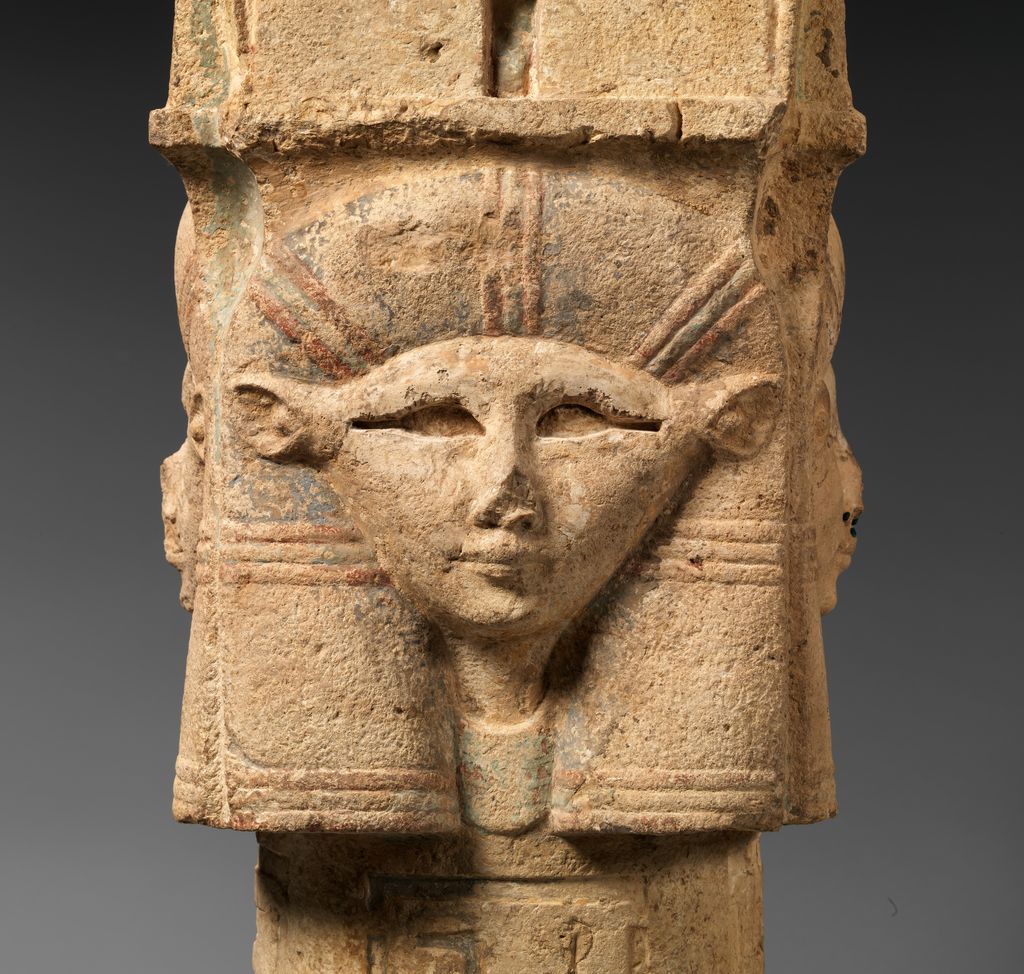
Limestone column with a four-faced Hathor-emblem capital naming Nectanebo I, 380–362 BCE, The Met 28.9.7; traces of blue-green and red pigment remain. Photographer not identified; image provided by The Metropolitan Museum of Art, Column with Hathor-emblem capital and names of Nectanebo I, The Met 28.9.7; CC0. JPEG prepared; no crop or retouch.
A capital is not the whole column, and a capital alone is not an architectural order. In classical architecture an order coordinates the column with an entablature. Its capital can be the quickest clue to Doric, Ionic or Corinthian, but the shaft, base, upper members, building, date and region still matter. Beyond the classical world, calling every widened or decorated pillar head a version of those three orders conceals more than it explains. [5] [6] [7] [18]
The safest method begins with evidence rather than resemblance. Record whether the piece is in place or detached, free-standing or wall-bound, complete or broken, original or reused. Examine its faces, underside and upper surface. Identify material, tool marks, joints, paint, repairs, findspot and acquisition history. Only then apply the narrowest name supported by a building record, excavation, catalogue or specialist study. [9] [10] [19] [21]
Contents
- What a Capital Does
- How to Examine a Capital
- Egyptian Capitals
- Achaemenid Capitals
- Greek and Roman Orders
- Reuse and Byzantine Capitals
- Islamic Contexts
- Romanesque and Gothic
- South Asian Capitals
- Dougong Distinction
- Material and Conservation
- Identification Sequence
- Recommended Books
- Watch Architectural Elements
- Reading the Diagram
- Evidence Table
- Frequently Asked Questions
- Discussion
- References
What a capital does
At its simplest, a capital forms a transition. A narrow shaft may meet a wider horizontal member, a square block or the springing of an arch. The capital can broaden the contact area and make the change in geometry visible. Its projection may also offer room for moulding, foliage, figures, inscriptions or heraldic forms. These observations do not reveal the hidden structure. A surface view cannot show internal reinforcement, exact load paths or every joint. [2] [3] [4]
The support below may be circular, square, polygonal, clustered or shallow like a pilaster. The work above may be straight, curved or assembled from many timber brackets. The capital therefore has to be read in more than one elevation. A front can be richly finished while the back remains rough against a wall. Corners can address diagonal views. An underside may preserve a socket, dowel hole or setting-out mark that cannot be seen from the floor. [9] [10] [15]
Words such as necking, bell, cushion, echinus, volute and abacus describe particular forms. Getty defines an abacus as an uppermost capital member, often a square slab but sometimes moulded or enriched. An impost block, by contrast, is placed between a capital and an arch springing above it. Neither element belongs to every capital. The distinction matters in late-antique, Byzantine and medieval buildings where capital, impost and arch can form a layered transition. [1] [2] [3]
A bracket is not simply another word for capital. It projects or steps outward to support another member, and in some timber traditions many brackets interlock as a system. A corbel projects from a wall. A console is a particular scroll-like support. These elements can sit near a column head, but proximity does not erase their construction or vocabulary. The National Park Service glossary is useful for basic distinctions, while cultural and technical sources must govern more specific terms. [4] [27] [28]
How to examine a capital
Start by establishing orientation. Is the piece still above its shaft? If it is detached, do abrasion, clamp cuttings or unfinished surfaces indicate a back, top or underside? A museum label may supply dimensions and provenance, but eye-level display reverses the original viewing condition of a capital once placed several metres overhead. A bright gallery also reveals carving that a shaded portico would have presented differently. [7] [10] [21]
Next describe before classifying. Note the profile from shaft to upper member, the number of worked faces, the relation of curves and blocks, and whether ornament is carved, painted, modelled, assembled or cast. “Bell-shaped,” “cushion,” “voluted,” “foliate,” “figurative,” “impost-like” and “bracketed” can organise observation. They do not by themselves prove a period, people or route of transmission. [1] [12] [39]
Material is part of the answer. Limestone and marble take different edges; sandstone can support deep patterns yet weather unevenly; timber permits joints and separate applied members; terracotta can reproduce forms at another scale; stucco, plaster, metal, brick and concrete introduce other production methods. A capital may be monolithic, built from blocks or joined to its shaft. General structural claims should stop where the object record stops. [12] [15] [20] [24]
Finally, distinguish dates. The stone may have been carved in one century, reused in another building, recut later, restored in a modern campaign and moved again to a museum. A single label such as “Roman” or “medieval” can refer to manufacture, find context or receiving structure. Secure identification keeps those events separate instead of blending them into one supposed original state. [13] [19] [34]
Egyptian plant and Hathor capitals
Ancient Egyptian architecture developed several column and capital families long before classical Greek orders. Terms such as papyriform, lotiform and palmiform refer to plant-derived forms in specific monuments and periods. Their carved profiles are not field-guide specimens. A closed bud, open umbel or radiating leaf must be identified from Egyptian architectural scholarship, not assigned from a generic silhouette. [12] [13] [17]
The two capitals from the Temple of Harendotes at Philae demonstrate how date and place complicate broad labels. They are Roman-period Egyptian works in sandstone, carved with dense palmette patterns over bell-shaped cores. The plants were once brightly painted. The temple was later dismantled, and elements entered Byzantine churches. “Roman,” “Egyptian,” “painted,” “reused” and “museum object” are all true, but each describes a different part of their history. [12] [13]
Hathor-emblem capitals require still greater care because the architecture carries divine imagery. A limestone column naming Nectanebo I presents the goddess’s face on four sides beneath a naos-like element and abacus. Paint and inlay survive. The four directions relate to documented understandings of Hathor, so the faces cannot be reduced to decorative masks or treated as evidence for every Egyptian capital. [14] [17]
Timber evidence shows another scale and assembly. A wooden Hathor element from Saqqara has one worked face, a blank back and a slot that once joined another piece. A cedar panel may have formed one side of a light structure; tree-ring research provides a useful earliest possible date while leaving the exact original arrangement uncertain. Fragmentary evidence supports alternatives, not a falsely complete reconstruction. [15] [16]
Colour is not an optional embellishment in these records. Pigment analysis of the Nectanebo column helped researchers develop a digital reconstruction, while the object itself preserves traces rather than a uniformly fresh surface. Such work demonstrates that present limestone colour is not the ancient appearance. It does not authorise one standard palette for every plant or Hathor capital. [14] [17] [51]
Achaemenid column heads at Persepolis
Achaemenid palace halls used tall stone columns beneath timber roofs. At Persepolis, capitals could include paired foreparts of bulls, lions or griffins positioned back to back, with their bodies forming supports for crossing beam members. UNESCO describes this arrangement within a royal complex of audience halls, terraces, reliefs and ceremonial routes. The animal forms belong to that imperial architecture, not to a decorative catalogue detached from patronage. [18] [20]
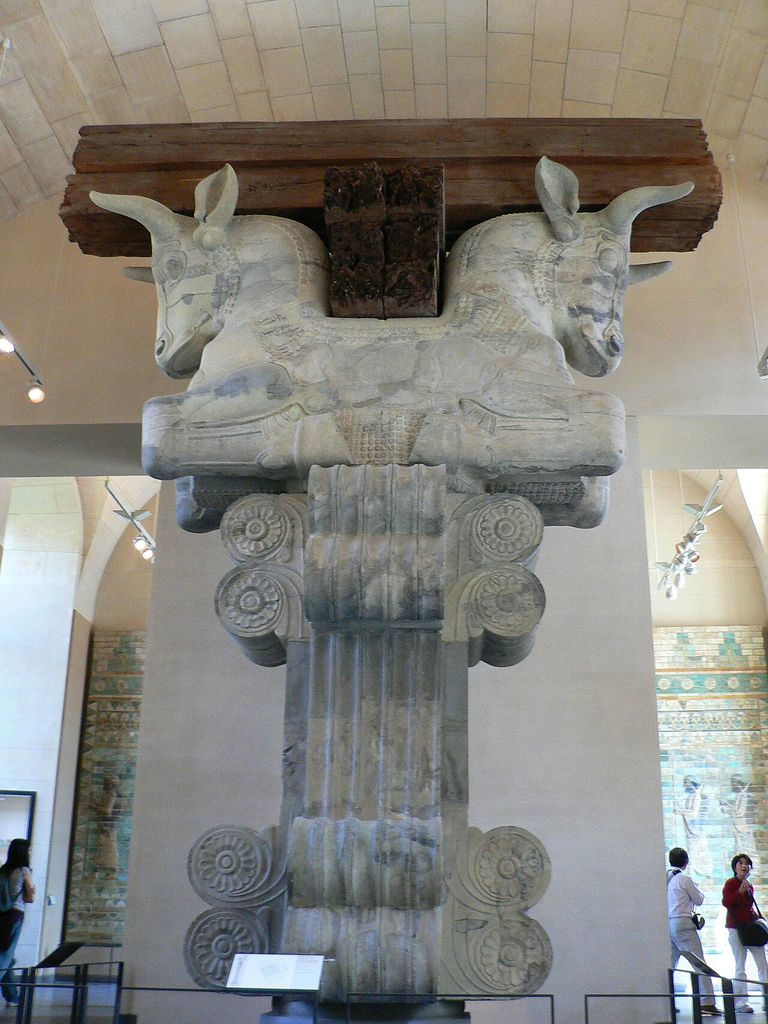
Double-bull capital from the Apadana of Darius I at Susa, about 510 BCE, displayed in the Louvre with reconstructed crossing timber beams. Rmashhadi, Bull capital Apadana (8); Public domain. JPEG prepared; no crop or retouch. Louvre object record AOD 1 (Susa).
A limestone bull head in the Metropolitan Museum is only one surviving portion of such a capital. Its original paired composition must be understood through comparable site evidence. The fragment also has a second life: it was found reused at Istakhr, where medieval testimony described columns with cattle forms in a mosque. Manufacture at Persepolis and reuse in an early Islamic setting are related facts, not one undated building phase. [19] [21]
The capitals sometimes include volute-like elements, and the shafts and bases show contacts with traditions across the empire. Resemblance does not make them Ionic capitals. The structural arrangement, paired animals, timber beams, royal hall and Achaemenid workshop synthesis establish another architectural grammar. Borrowing and adaptation may be studied, but they cannot be proved from one curl or profile. [18] [19] [20]
Modern knowledge also has a history. Ernst Herzfeld’s excavation, photography, removal of finds and incomplete publication shaped the collections through which Persepolis is often encountered. Museum provenance and archaeological archives are therefore part of the evidence. A capital fragment is simultaneously ancient fabric, a reused object, an excavated find and a modern collection record. [19] [21]
Capitals in the Greek and Roman orders
In Greek Doric, a curved echinus rises to a square abacus, coordinating with a shaft and a triglyph-and-metope entablature. Ionic capitals use volutes and have strongly directional faces with bolster-like sides. Corinthian capitals organise foliage, stalks and corner members around a bell beneath a shaped abacus. These summaries identify relationships; they do not replace the full histories of the orders. [5] [6]
A Hellenistic Corinthian capital in the British Museum was associated with an upper storey of a stoa or portico. Its form, marble and broad date are recorded, while the find history—possibly from Smyrna and later acquired from a ship store in Portsmouth—is less secure. That uneven evidence is valuable. Material certainty and provenance uncertainty can coexist in one catalogue entry. [7]
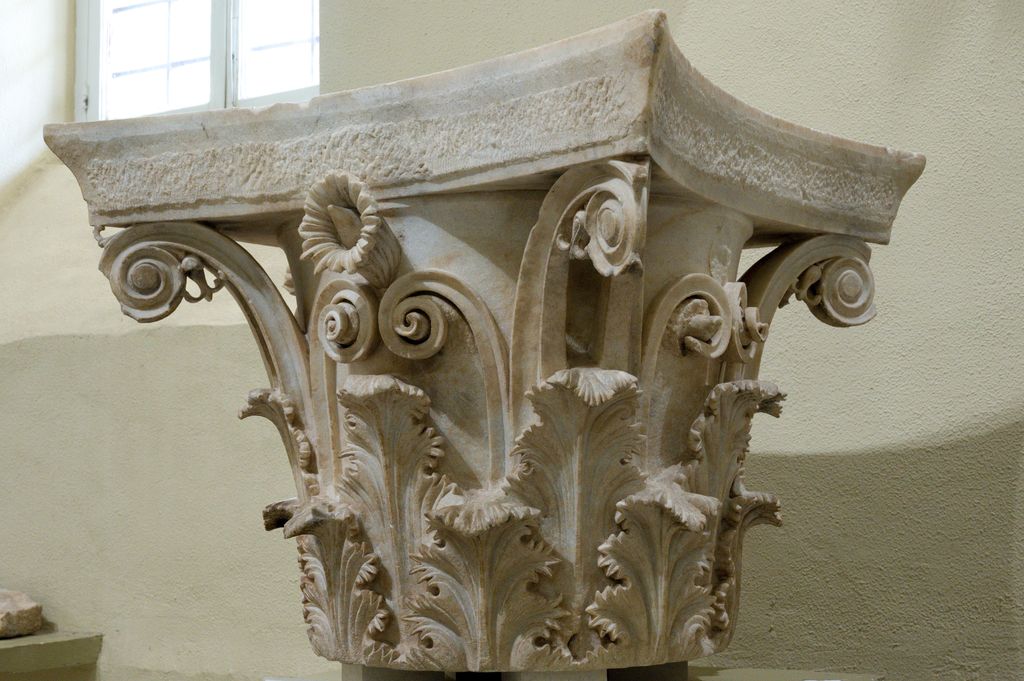
Detached Corinthian capital associated with the Tholos at Epidaurus, photographed in the archaeological museum in September 2020; interpretations differ over whether it was a paradeigma or a later copy. Zde, Corinthian capital in the Archaeological Museum of Epidaurus; CC BY-SA 4.0. JPEG prepared; no crop or retouch.
The so-called Tower of the Winds type shows why textbook checklists fail. Its capital uses one zone of acanthus beneath palm leaves, and the surviving fragment later influenced Greek Revival design through publication. Difference from a familiar two-tier Corinthian drawing does not make the object an error. The correct label records a documented variant and its later reception. [8] [46]
Roman builders multiplied capital forms across free columns, engaged supports and pilasters. A marble pilaster capital at the Met once crowned a rectangular support set against a wall; its shallow, straight-backed arrangement differs from an object meant to be seen in the round. A capital in the Carlos Museum has unfinished backs that help identify its place in a façade screen. These conclusions come from individual physical records. [9] [10]
Roman practice also challenges the later five-order chart. Tuscan and Composite became useful categories, but actual capitals range across regional workshops, building types and dates. Enlarged Ionic-like corner volutes above foliage often support a Composite description; other works are called Corinthianising when they share a vocabulary without following a regular scheme. The categories are tools, not natural species. [1] [9] [11]
Renaissance authors made those tools more systematic. Vignola, Palladio and Perrault each presented an authored way of ordering profiles and proportions. Their books shaped building practice, teaching and later revival architecture. A printed module is evidence for the author’s method and reception, not a measurement secretly governing all Greek and Roman capitals. [11] [47] [48]
Reuse, imposts and Byzantine capitals
Late-antique and Byzantine builders inherited, moved, recut and newly made column elements. Reuse is often called spolia, but the term should describe an evidenced material history rather than any visual similarity. An earlier capital installed beneath a later arch has at least two dates: the carving of the object and its placement in the receiving building. Cuttings or an added impost may show how it was adapted. [3] [19] [34]
Impost blocks widen the transition between a capital and arch. Some capitals incorporate an impost-like upper body, while others carry a separate dosseret. A mid-twelfth-century French impost capital associated with Saint-Denis preserves deeply cut foliage and traces of colour; related blocks in the crypt help scholars propose how it may have functioned. “Proposed” remains important because the museum object is detached. [3] [40]
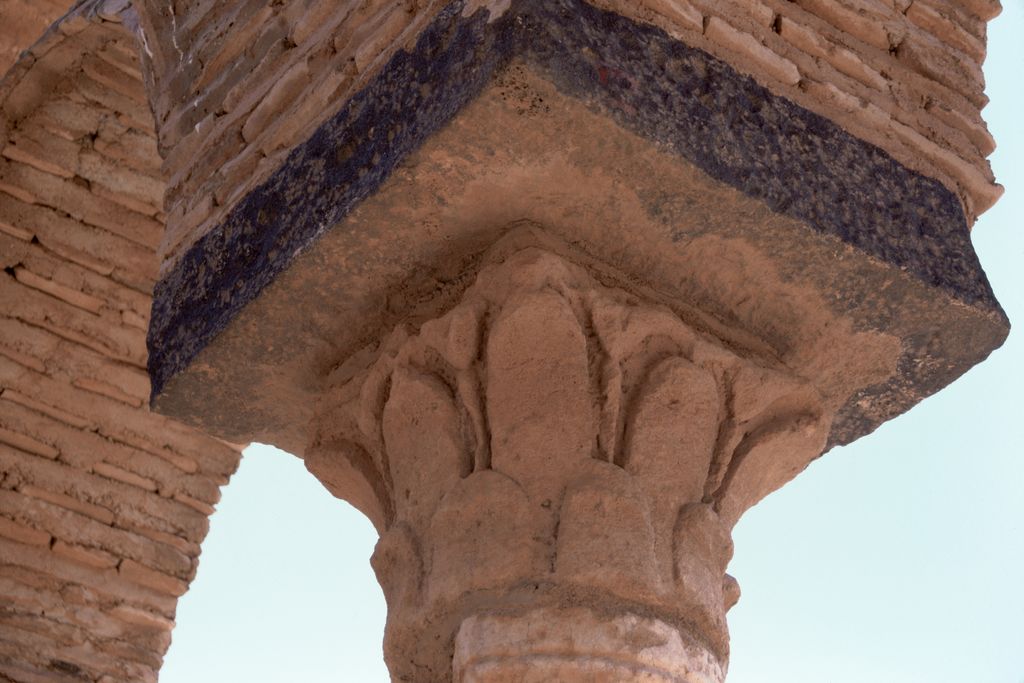
Carved capital beneath a separate impost block and brick arch in the north gallery of the church at Qasr Ibn Wardan, Syria, photographed by Frank Kidner in 1996. Frank Kidner, Capital and separate impost block in the north gallery of the church at Qasr Ibn Wardan; CC BY-SA 4.0. JPEG prepared; no crop or retouch.
Byzantine capitals include pierced baskets, folded or wind-blown foliage, impost forms and figures, among many other solutions. A marble capital with a bust of the Archangel Michael carries a Christian iconographic programme and has a modern custody history: the Met records that it was a loan subsequently returned. Form, sacred image and present ownership all belong in a responsible description. [38]
A British Museum limestone capital combines foliage and volutes above twin columns and is catalogued as Byzantine. Its shape may recall classical work, but the date, architectural arrangement and collection context prevent it from becoming merely “late Corinthian.” Continuity and transformation are more precise when both traditions are named. [39]
Capitals in Islamic architectural contexts
Islamic architecture does not have one capital type. Early buildings could reuse Roman or Byzantine columns, bases and capitals, particularly around the eastern Mediterranean. Builders also commissioned new pieces, adjusted older blocks and combined inherited forms with new inscriptions, surface rhythms and spatial programmes. The receiving mosque or palace has its own patronage and meaning. [33] [34]
At Madinat al-Zahra near Córdoba, marble capitals were newly carved for an Umayyad court city. A Met example has four worked sides, deeply cut vegetal ornament and a probable Cordoban origin. Related works retain Arabic inscriptions naming carvers and traces suggesting paint. Classical references are present, yet the result belongs to tenth-century Andalusi workshops and caliphal display. [30] [31] [32]
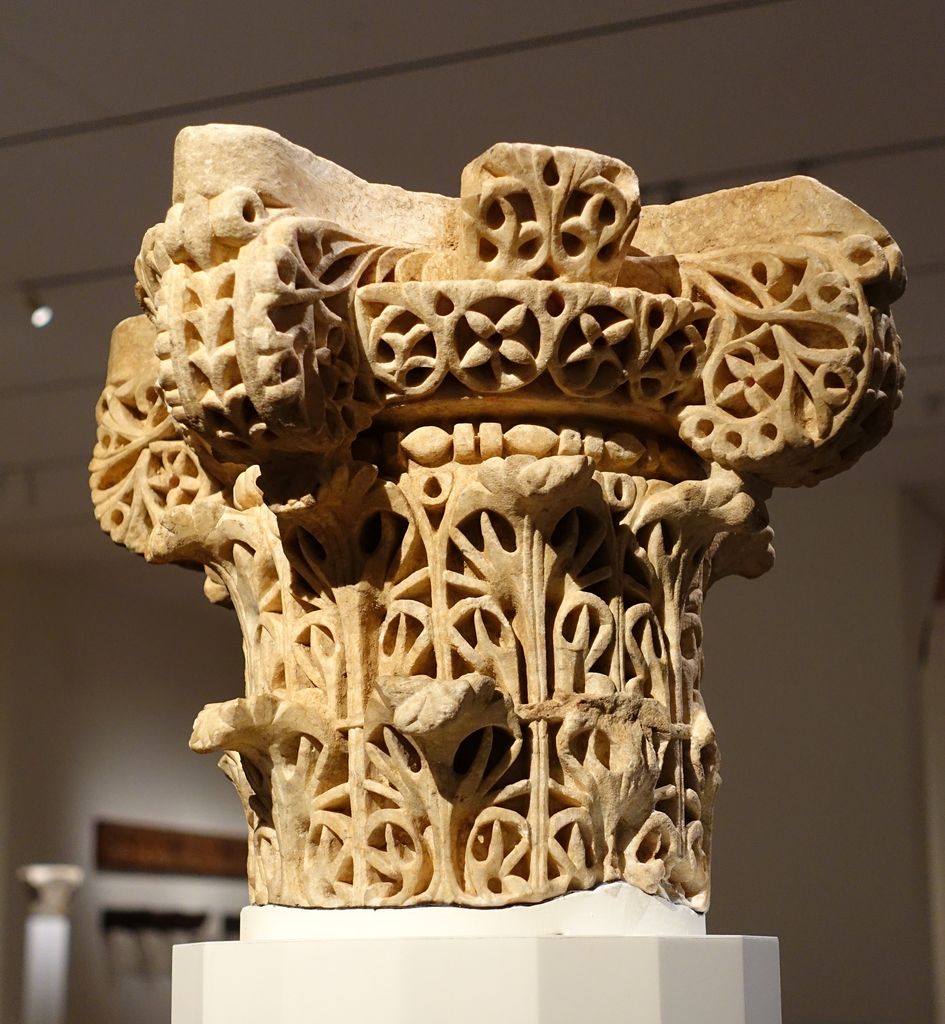
Detached marble capital from Madinat al-Zahra, about 950–970, photographed in the Aga Khan Museum in October 2015. Daderot, Marble capital from Madinat al-Zahra, Aga Khan Museum; CC0. JPEG prepared; no crop or retouch.
That example should not stand for Nasrid Granada, Abbasid Iraq, Fatimid Egypt, Seljuk Anatolia, Ottoman building or Mughal India. Each context has its own materials, inherited fabric and specialised terms. The Alhambra’s Nasrid palaces belong to another dynasty and centuries, with their own conservation and reception. “Islamic” identifies a broad field, not a formal diagnosis from leaves. [32] [35]
The Qutb complex in Delhi presents reuse with particularly charged histories. Pillars and carved stones from older Hindu and Jain temples were installed in early Sultanate colonnades, sometimes stacked to achieve the desired height. The new arrangement does not erase the source buildings or their religious images, and it cannot be described as a neutral sequence of styles. Dates, patrons, destruction, reuse and later additions must remain visible together. [36] [37]
Romanesque and Gothic capitals
Romanesque capitals can be cushion-shaped, scalloped, foliate, animal-filled, figurative or historiated. Their carving may occupy a nave, portal or cloister, where route and viewpoint affect interpretation. A double capital from a possible Toulouse-region cloister combines birds, human and animal heads with foliage. Scholarship debates whether such imagery was decorative, admonitory or both. Appearance alone does not settle the meaning. [43]
A capital showing the Temptation of Jesus arranges episodes around its faces without a simple left-to-right sequence. Its Christian narrative requires textual and iconographic knowledge; calling it merely “figurative” would omit what the scenes do. The Met dates it to the late twelfth century and relates its drapery and narrative energy to emerging Gothic work, a historical attribution rather than a universal progress claim. [41]
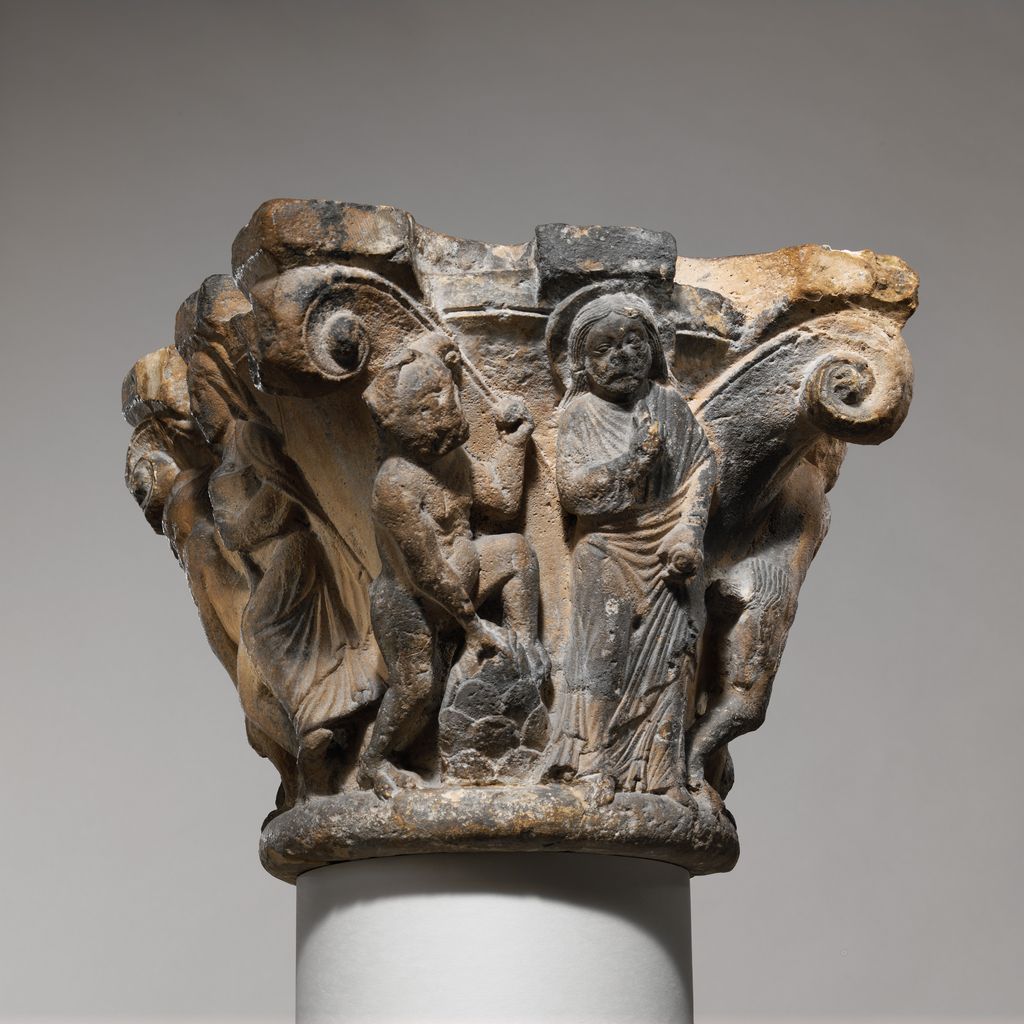
North French limestone capital with the Temptation of Jesus, about 1175–1200, The Met 21.21.1; the episodes continue around faces not all visible here. Photographer not identified; image provided by The Metropolitan Museum of Art, Capital with the Temptation of Jesus, The Met 21.21.1; CC0. JPEG prepared; no crop or retouch.
A South Italian capital of the late twelfth or early thirteenth century brings different evidence. Naxian marble points to trade across the Mediterranean, extensive drillwork to regional making, and corner volutes transformed into ram heads to an inventive local design. Probable production in Campania stays qualified because attribution and material origin answer different questions. [42]
Terms such as stiff-leaf, waterleaf, crocket and naturalistic foliage can help distinguish Gothic carving when tied to a region and date. They should not create a ladder from abstract Romanesque to realistic Gothic. Carving changes with stone, tools, workshop, height, iconography and building campaign. Plain and intricate surfaces are choices within contexts, not measures of cultural achievement. [40] [41] [43]
South Asian pillar capitals and brackets
Mauryan pillars place animal capitals within royal and Buddhist histories. At Sanchi, UNESCO records a monolithic pillar associated with Ashoka and an elaborate lion capital. At Sarnath, part of the inscribed shaft remains in place while the Lion Capital is housed in the archaeological museum; the wheel once above it is missing. Site, museum object and national emblem are separate but connected lives. [22] [23]
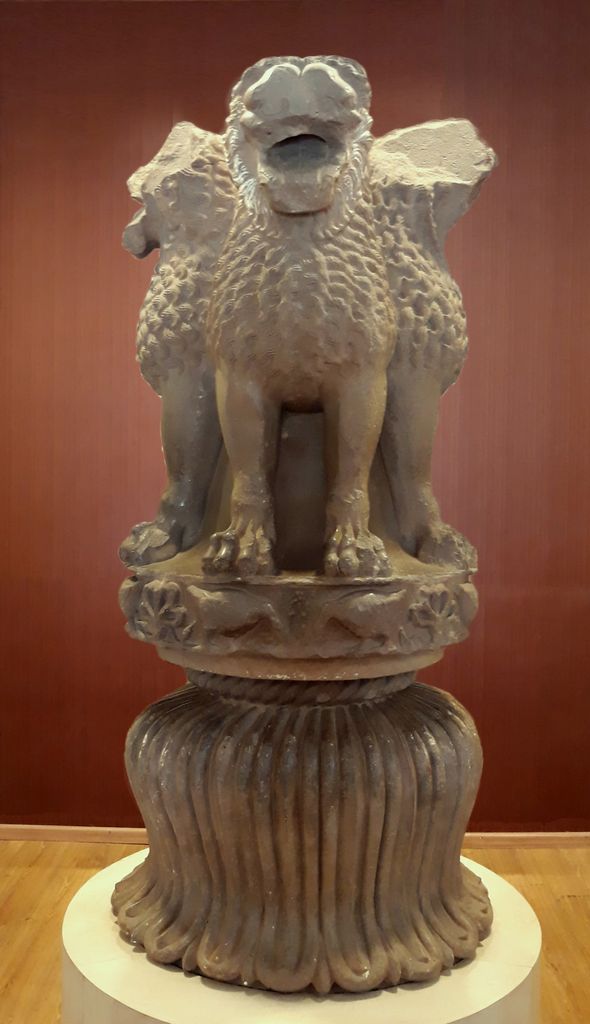
Modern simulation of the proposed original appearance of the Ashokan lion capital at Sanchi, photographed by Ashok Shrikhande in February 2018; the associated wheel is not included. Ashok Shrikhande, Simulation of the original appearance of the Sanchi Ashokan capital; CC BY-SA 2.0. JPEG prepared; no crop or retouch.
The animal form cannot be treated as generic decoration. Lions and wheels participate in Buddhist and imperial programmes documented at particular sites. A small Gupta-period terracotta lion standing on a capital belongs to another region, material, scale and century. Similar subject matter does not make those objects interchangeable. [22] [23] [24]
Rock-cut architecture offers another relationship. At Elephanta, pillars have fluted upper portions and cushion capitals beneath carved beams and brackets. The hall was cut from living rock, so its forms evoke assembled construction while remaining part of one excavated mass. The surrounding reliefs and shrine give the supports a Shaiva sacred context that a formal diagram cannot reproduce. [25] [50]
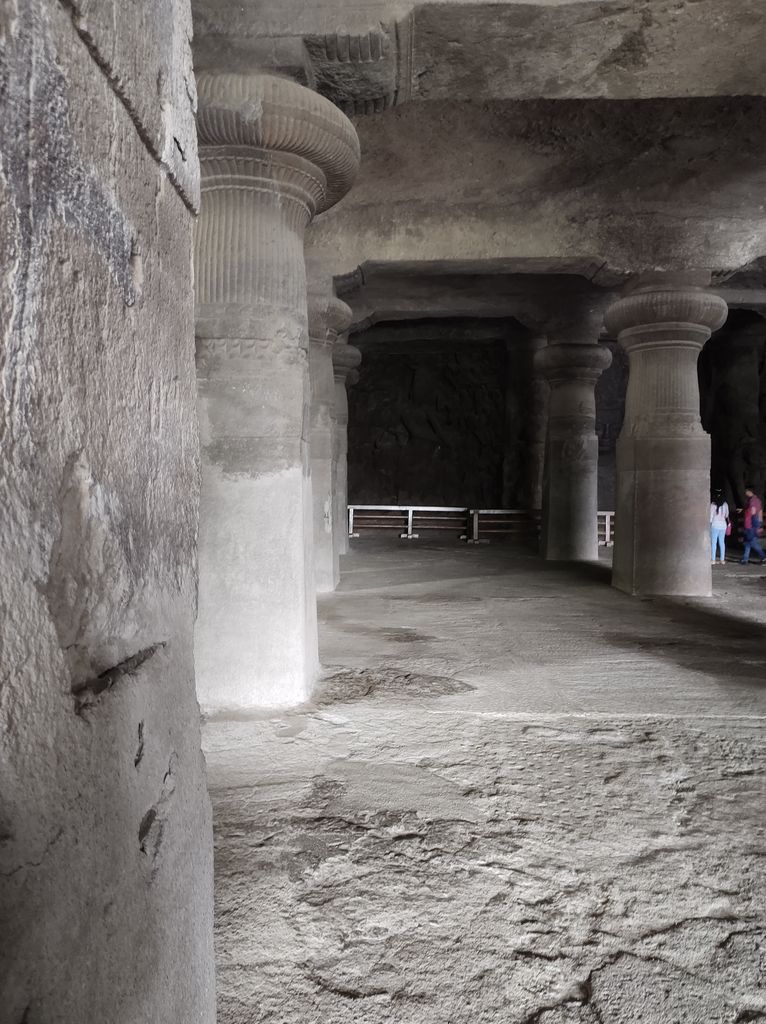
Fluted upper pillar zones, cushion capitals and carved beam forms in the main mandapa of Elephanta Cave 1, photographed in September 2022. Saankav, Main mandapa and rock-cut pillars in Cave 1 at Elephanta; CC BY-SA 4.0. JPEG prepared; no crop or retouch.
The British Museum’s Amaravati pillar preserves carvings of other pillars, trees, wheels, stupas, figures and foliage. Its nineteenth-century transfer from the former India Museum is documented alongside excavation history. It reminds us that an architectural fragment can depict a capital without preserving that represented capital as a physical member. It also makes colonial collection history inseparable from present access. [26]
Vijayanagara architecture at Hampi includes richly carved pillars, brackets and mythical figures within temple and courtly spaces. Terms such as yali and mandapa carry regional architectural meanings. A bracket figure or animal-bodied support must not be renamed a Corinthian capital because it projects at a pillar head. Local form, devotion, ceremony and patronage govern the description. [49]
Why dougong is not simply a Chinese capital
In historic Chinese timber construction, dougong describes interlocking bracket sets that mediate between columns, beams and roof frames. It is a layered assembly rather than a single carved block crowning a shaft. Treating it as a decorative “Chinese capital” would hide joinery, construction sequence and the technical vocabulary preserved in sources such as the Yingzao Fashi. [28] [52]
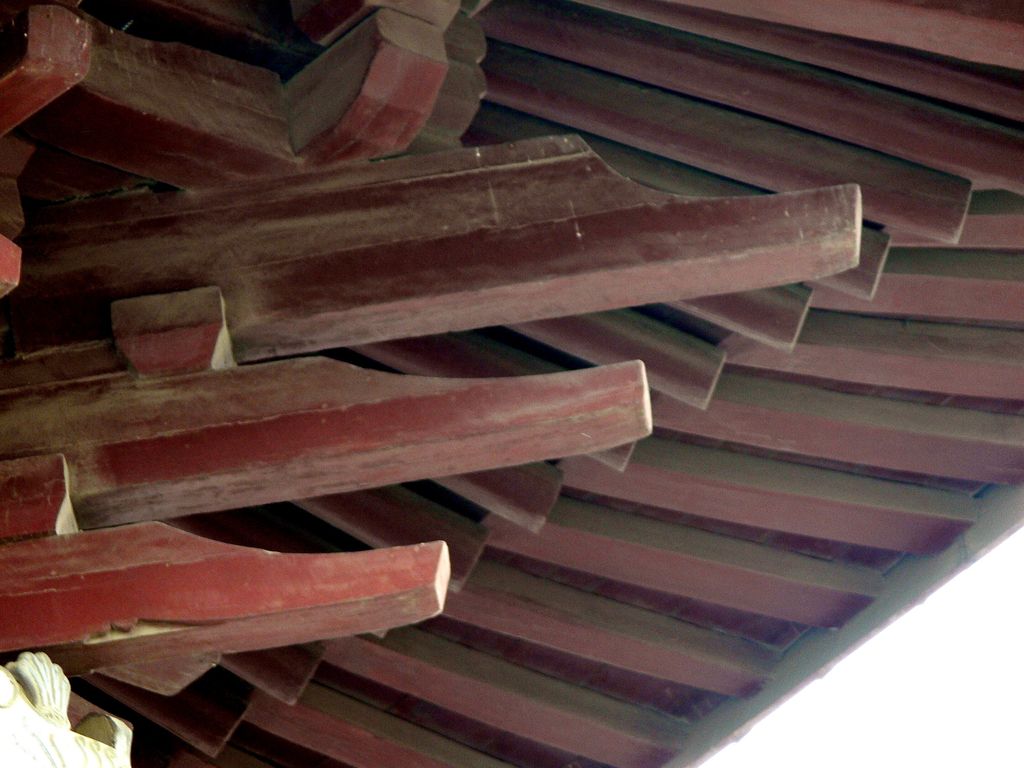
Harp-shaped dougong at the Supreme Trinity Taoist Temple in Suzhou, photographed by Gisling in October 2008. Gisling, Harp-shaped dougong at the Supreme Trinity Taoist Temple, Suzhou; CC BY 3.0. JPEG prepared; no crop or retouch.
UNESCO documentation for Dengfeng describes bracket forms, repairs and relationships to the early-twelfth-century building manual. A tentative listing for Liao timber buildings distinguishes column, bracket and roof layers and records many bracket types. These are dated regional records, not proof that one bracket system represents all Chinese architecture. [28] [29]
At Horyu-ji, intricate cloud-shaped brackets transfer the heavy tiled roof toward substantial wooden columns. UNESCO places those buildings within Japanese adaptations of Chinese Buddhist architecture transmitted through the Korean peninsula. The description names contact and adaptation without erasing Japanese building history. [27]
The comparison is therefore about position, not identity. A stone abacus, a Byzantine impost and an East Asian bracket complex can all occupy the zone between vertical support and work above. Their materials, joints, number of components and cultural names differ. Good comparative writing explains that shared problem while preserving the separate solutions. [2] [3] [27]
Material, colour and conservation
Capital surfaces change through weathering, salt, soot, biological growth, fractures and cleaning. Deep carving can lose its ridges; projecting corners are easily broken; timber can split at joints; porous stone can carry salts. A damaged profile should be recorded as condition, not interpreted immediately as deliberate simplicity. Conservation reports, not intuition, establish causes and treatment. [13] [17] [51]
Paint and inlay survive selectively. The Nectanebo Hathor column retains both, Philae capitals are documented as once brightly painted, and the Saint-Denis impost capital carries traces of polychromy. Scientific research on ancient colour demonstrates possibility and method while resisting a universal reconstruction palette. Evidence must attach to an object, sample and analysis. [13] [14] [17] [40] [51]
Restoration introduces another layer. A replaced corner, inserted dowel, reassembled fragment or reconstructed bracket can clarify a building yet alter the surface a visitor sees. Labels should distinguish original fabric, anastylosis, replacement, cast and digital model. The V&A’s cast collection shows that replicas can preserve and teach forms while changing material, scale relationships and display context. [44] [45]
Provenance also affects interpretation. The Portsmouth history of the Hellenistic capital, Herzfeld’s work at Persepolis, the colonial transfer of Amaravati fragments and a returned Byzantine loan are not administrative trivia. They determine which contexts survive, who holds the object and what remains uncertain. Current ownership or restitution claims require dated authoritative evidence, not assumptions from an old label. [7] [21] [26] [38]
How to identify a column capital
First locate the transition. Identify the support below and the member above. Decide whether the object is a capital, impost, bracket, corbel or another adjacent part. If it is detached, use documented surfaces and cuttings to orient it. Do not infer a complete column from an eye-level fragment. [1] [3] [4]
Second record attachment and views. A free-standing capital may be worked around; an engaged capital can have a hidden back; a pilaster capital is shallow; a compound pier may answer several arch directions. Examine corners and underside as well as the most photogenic face. [9] [10] [40]
Third describe form and material before applying a cultural label. Moulded, cushion, voluted, foliate, figurative, block-like and bracketed are observations. Doric, Hathor, Achaemenid, Corinthian, Byzantine, Umayyad, Romanesque or Mauryan require matching evidence from date, building, region, iconography and source terminology. [6] [14] [18] [22] [30] [43]
Fourth separate condition and chronology. Ask what is original, missing, recut, reused, repaired or replaced. Check whether the capital and building share a date. Record museum acquisition and original find context independently. If decisive evidence is absent, “unidentified foliate capital” can be more accurate than a confident but false attribution. [7] [19] [26] [44]
Watch: Capitals within Architectural Systems
Begin with classical capital systems, then widen the view to recurring architectural transitions so similarities can be compared without flattening distinct materials, meanings and building traditions.
The Classical Orders
Beth Harris and Steven Zucker distinguish Tuscan, Doric, Ionic, Corinthian and Composite while keeping capitals connected to shafts and entablatures.
Watch on YouTubeReading the diagram
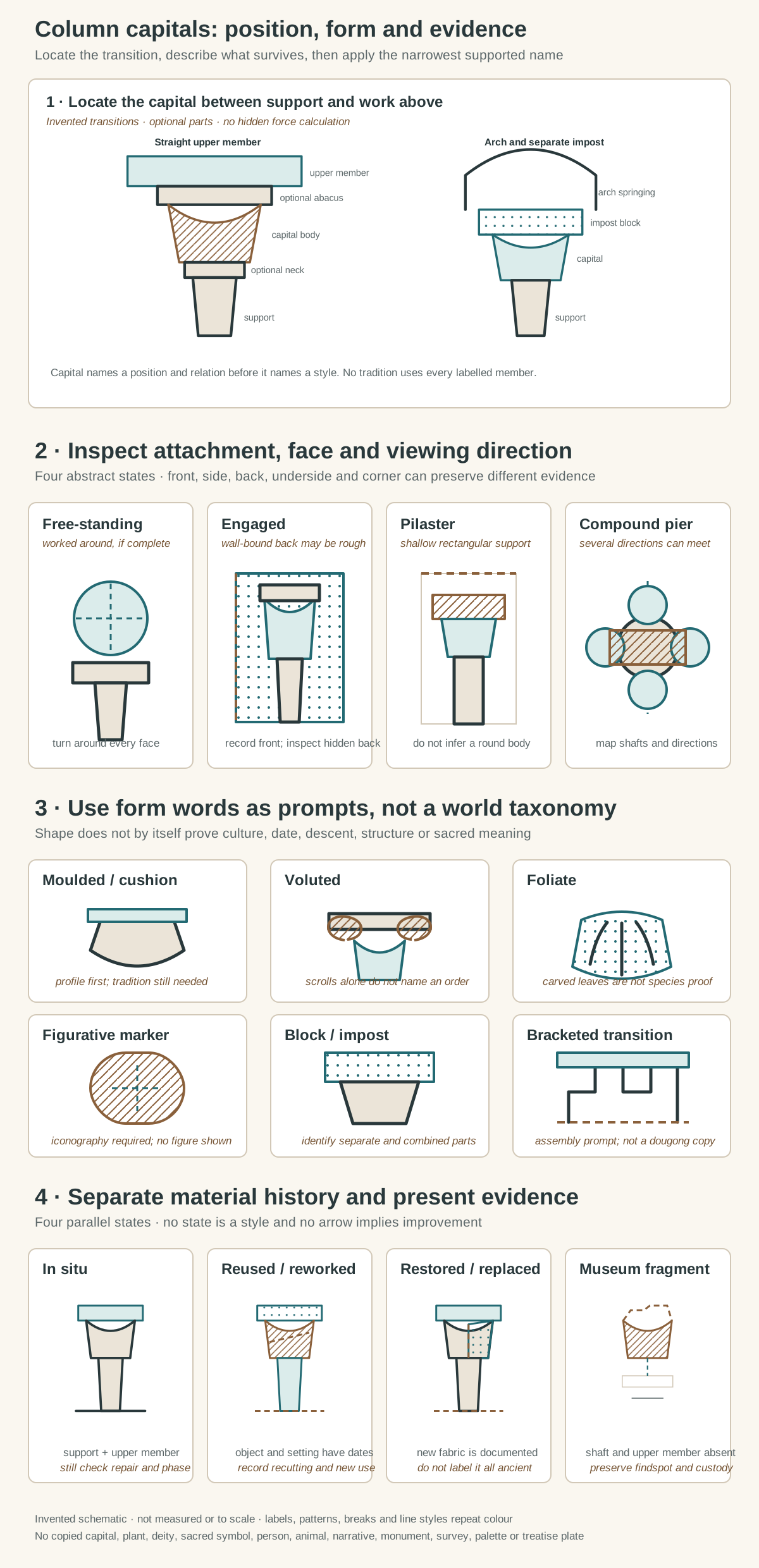
Original architectural-reading diagrams, not a measured object and not to scale. They locate a capital between support and upper member; distinguish free-standing, engaged, pilaster and compound-pier evidence; use moulded, voluted, foliate, figurative-marker, block/impost and bracketed as descriptive prompts only; and separate fabric in place from reuse, restoration and museum displacement. No named capital, plant, deity, sacred symbol, person, animal, narrative, survey, reconstruction palette or treatise plate is reproduced.
Text alternative for the diagram
Panel one shows two invented transitions. On the left a shaft widens through an optional neck and capital body to an optional abacus and straight upper member. On the right a shaft and capital meet a separate impost beneath an arch springing. A note says no tradition uses every labelled member. Panel two compares four abstract attachments: a free-standing round support worked around; an engaged support with a wall-bound back; a shallow rectangular pilaster; and a compound pier answering more than one direction. Panel three shows six generic signs labelled moulded or cushion, voluted, foliate, figurative marker, block or impost, and bracketed transition. The figurative marker contains no figure, and the bracketed sign does not reproduce dougong. A heading says shape does not prove culture, date or descent. Panel four sets four evidence states side by side: an in-situ capital aligned with its shaft and upper member; a reused and recut capital placed in a differently patterned setting; a restored capital with dashed replacement portions; and a museum fragment separated from both shaft and upper member. Every shape is invented, unmeasured and not to scale.
The diagram teaches this method without reproducing any named capital. Its first panel shows an invented shaft, transition, capital body and upper member, with a separate arch-and-impost possibility. Labels state that no parts list applies everywhere. The second panel compares free-standing, engaged, pilaster and compound-pier attachments through abstract circles and blocks. [1] [2] [3]
The third panel presents six descriptive families: moulded or cushion, voluted, foliate, figurative marker, block or impost, and bracketed transition. These are prompts for observation, not a world taxonomy. No plant, deity, human, animal or sacred emblem is drawn. The fourth panel distinguishes in-situ, reused or reworked, restored or replaced, and museum-fragment evidence. [17] [19] [27] [44]
Every shape is invented, unmeasured and not to scale. Pattern, broken outlines, labels and line style repeat colour. The visual contains no copied capital profile, archaeological reconstruction, treatise plate, survey dimension or structural calculation. Authority remains with the cited objects, buildings and technical records. [28] [47] [51]
Column Capitals: Five Evidence Tests
Locate the transition, record attachment and viewing direction, describe form and material, then separate original fabric from reuse and restoration.
| Evidence | What it can establish | What else to verify |
|---|---|---|
| Position | The member mediates between a column, pier or pilaster and a beam, arch or bracket system. | Distinguish the capital from a separate impost, corbel or bracket assembly. |
| Attachment | Free-standing, engaged, pilaster and compound-pier settings preserve different faces. | Inspect backs, undersides, joints and missing adjoining members. |
| Form and imagery | Moulded, cushion, voluted, foliate, figurative and block-like are useful observations. | Shape alone does not prove culture, date, descent or sacred meaning. |
| Material and making | Stone, timber, terracotta, plaster, carving, paint and joints constrain interpretation. | Separate surface appearance from hidden connection and load behaviour. |
| Evidence state | In-situ, reused, recut, restored and museum fragments carry different information. | Record chronology, provenance, repairs and custodial context. |
Frequently Asked Questions
It is the upper member or transition at the top of a column, pier or pilaster. It can mediate between the support and an architrave, beam, arch or bracket system, and it may be moulded, carved, painted or assembled. Position defines the category more reliably than ornament. [1] [4]
There is no universal list. Classical examples may include necking, an echinus or bell, volutes or foliage, and an abacus. Arched construction may add an impost or dosseret. Other traditions use different members and terms, especially timber bracket systems. [2] [3] [27]
Establish its orientation, support, member above, attachment, material, worked faces, condition, date, region and provenance before naming its style. Compare object-level or building-level records. Similar leaves, scrolls or animal forms do not prove a shared tradition. [7] [9] [19]
They can participate in the physical transition between support and work above while also carrying ornament and meaning. The visible surface does not reveal every load, joint or reinforcement, so structural statements must come from building-specific evidence rather than appearance. [3] [18] [28]
No. They are three important Greek classical order families, later joined by other classical classifications. Egyptian, Achaemenid, Byzantine, Islamic, Romanesque, Gothic, South Asian and many other traditions developed distinct capital or pillar-head forms, while East Asian bracket systems should retain their own names. [6] [14] [18] [27] [30]
Discussion
Which capital most clearly shows why position, attachment, imagery, material and provenance must be read together?
Reader Insights
What support lies below, what member lies above, and is an impost or bracket separate?
Which faces, profiles, carvings, joints and traces of colour are actually preserved?
Is the capital in situ, reused, recut, restored, replaced or displaced in a museum?
Join the Conversation
Share a documented capital below, noting its support, upper member, attachment, material, date, condition and provenance.
References
- Getty Research Institute, AAT hierarchy: capitals and capital components View source
- Getty Research Institute, AAT: abaci, capital components View source
- Getty Research Institute, AAT: impost blocks View source
- National Park Service, Historic Natchez Design Guidelines glossary View source
- Metropolitan Museum of Art, Architecture in Ancient Greece View source
- Metropolitan Museum of Art, Greek Art from Prehistoric to Classical View source
- British Museum, Hellenistic Corinthian capital from a stoa or portico View source
- British Museum, Tower of the Winds type capital View source
- Metropolitan Museum of Art, Roman marble pilaster capital View source
- Michael C. Carlos Museum, Emory University, Roman Corinthian capital View source
- Metropolitan Museum of Art, The Five Orders of Architecture, Vignola View source
- Metropolitan Museum of Art, Egyptian column capital from Philae View source
- Metropolitan Museum of Art, Egyptian palmette column capital from Philae View source
- Metropolitan Museum of Art, Hathor-emblem capital of Nectanebo I View source
- Metropolitan Museum of Art, Wooden Hathor column for a shrine View source
- Metropolitan Museum of Art, Panel from a Hathor column View source
- Metropolitan Museum of Art, Petrified Sound and Digital Color: a Hathor column View source
- UNESCO World Heritage Centre, Persepolis View source
- Metropolitan Museum of Art, Bull head from an Achaemenid column capital View source
- Metropolitan Museum of Art, Guide to Ancient Near Eastern Art collections View source
- Metropolitan Museum of Art, Ernst Herzfeld in Persepolis View source
- UNESCO World Heritage Centre, Buddhist Monuments at Sanchi View source
- UNESCO World Heritage Centre and ICOMOS, Sarnath nomination evaluation View source
- Metropolitan Museum of Art, Lion standing on a pillar capital View source
- Smarthistory, The Cave of Shiva at Elephanta View source
- British Museum, Carved pillar from Amaravati View source
- UNESCO World Heritage Centre, Buddhist Monuments in the Horyu-ji Area View source
- UNESCO World Heritage Centre, Historic Monuments of Dengfeng nomination View source
- UNESCO World Heritage Centre, Wooden Structures of the Liao Dynasty View source
- Metropolitan Museum of Art, Umayyad Spanish capital with acanthus leaves View source
- Metropolitan Museum of Art, Courtly Splendor in the Islamic World, Unit 5 View source
- Metropolitan Museum of Art, The Art of the Umayyad Period in Spain View source
- Metropolitan Museum of Art, The Art of the Umayyad Period View source
- Metropolitan Museum of Art, Masterpieces from the Department of Islamic Art View source
- UNESCO World Heritage Centre, Alhambra, Generalife and Albayzín, Granada View source
- UNESCO World Heritage Centre, Qutb Minar and its Monuments, Delhi View source
- Smarthistory, The Qutb complex and early Sultanate architecture View source
- Metropolitan Museum of Art, Byzantine capital with the Archangel Michael View source
- British Museum, Byzantine limestone capital View source
- Metropolitan Museum of Art, Impost capital with acanthus-leaf decoration View source
- Metropolitan Museum of Art, Capital with the Temptation of Jesus View source
- Metropolitan Museum of Art, South Italian medieval capital View source
- Metropolitan Museum of Art, Set in Stone: The Face in Medieval Sculpture View source
- Victoria and Albert Museum, Cast Collection View source
- Victoria and Albert Museum, Trajan’s Column: making an epic Roman replica View source
- Metropolitan Museum of Art, Ionic capital in the Speculum Romanae Magnificentiae View source
- Getty Research Institute, Perrault, Ordonnance for the Five Kinds of Columns View source
- Internet Archive and University of Toronto, Palladio, The Four Books of Architecture View source
- UNESCO World Heritage Centre, Group of Monuments at Hampi View source
- UNESCO World Heritage Centre, Elephanta Caves View source
- Metropolitan Museum of Art, Chroma: Ancient Sculpture in Color View source
- UNESCO World Heritage Centre, Beijing Central Axis nomination dossier View source