


 by Tom Gurney
Tom Gurney BSc (Hons) is an art history expert with over 20 years experience
Email: tomgurney1@gmail.com / Phone: +44 7429 011000
Beyond Domes and Minarets: Reading Islamic Architecture through Place, Use and Change
Islamic architecture is the architecture of many societies in which Islam, Muslim patrons or Muslim communities have been historically significant. The term covers religious and secular buildings, cities, gardens and infrastructure from the seventh century to the present. It does not name one universal style, one ethnic identity or a checklist of domes, arches and ornament.
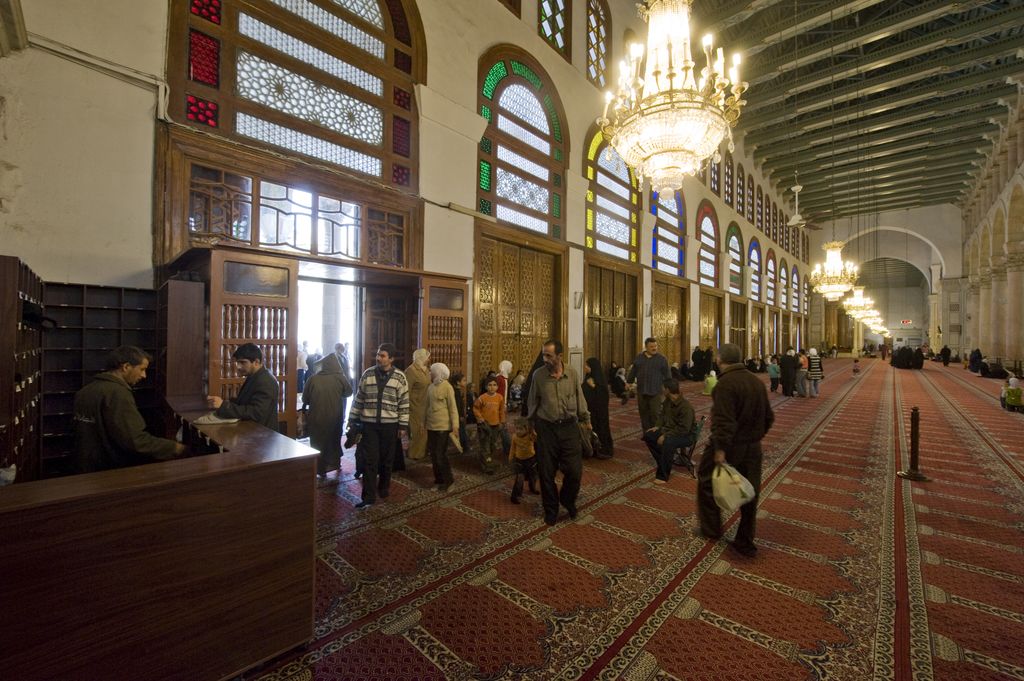
The northern aisle of the Umayyad Mosque in Damascus, photographed by Dosseman in April 2009. Repeated columns, roof beams, windows and courtyard doors belong to a layered city where inherited fabric and later Islamic use coexist. Dosseman, Northern aisle of the Umayyad Mosque, Damascus; CC BY-SA 4.0. JPEG prepared; no crop or retouch.
The field extends from Iberia and West Africa to Central, South, Southeast and East Asia. Its buildings were made and used by Muslims and non-Muslims, under dynasties with different languages and institutions, through local materials and craft traditions. The Metropolitan Museum of Art consequently presents Islamic art as regionally varied rather than as a monolithic culture defined only by religion. The label is useful when it opens these histories; it misleads when it flattens them. [1]
This guide explains the broad field. Separate pages own detailed accounts of mosque architecture, the mihrab and minaret, and Ottoman, Mughal, Persian, Moorish, Moroccan and Andalusian traditions. Their forms may overlap, but the names describe different scales of evidence.
Contents
- What Makes Architecture Islamic?
- Continuity and Transformation
- More than the Mosque
- Plural Mosque Architecture
- City and Regional Agency
- Structure, Surface and Light
- Recommended Books
- Watch Islamic Architecture
- Patronage and Labour
- Classification and Contemporary Practice
- Responsible Reading
- Evidence Tests
- Frequently Asked Questions
- Discussion
- References
What makes architecture Islamic?
No single feature makes a building Islamic. A mosque is connected to Islamic worship by programme and use, but a pointed arch or geometric surface can occur in many settings. A palace, market, hospital or house may belong to the history of an Islamic society without being a religious building. Attribution therefore begins with place, date, patronage, makers, institution and use—not appearance alone.
The word also changes meaning with context. It can describe work commissioned by a Muslim ruler, built for an Islamic institution, made within a society shaped by Muslim governance, or discussed within the modern scholarly field of Islamic art. Those relationships are not interchangeable. Getty's controlled vocabularies are useful precisely because they keep work type, material, culture, period, creator and place as connected but separate categories. [5]
Architecture made in Islamic societies includes participation by Christian, Jewish, Hindu and other communities as patrons, builders, craft workers, residents and visitors. Nor did political borders stop exchange. Trade, pilgrimage, migration, diplomacy, conquest and workshop mobility connected regions while local choices remained decisive. The most accurate definition is therefore historical and relational rather than visual.
Beginnings through continuity and transformation
Islam emerged in a late antique world already filled with Roman, Byzantine, Sasanian, Jewish, Christian and other built environments. Early Islamic patrons occupied, adapted and constructed within that world. The transition did not erase existing cities or suddenly invent an isolated architectural language. Metropolitan Museum research on the seventh to ninth centuries instead documents continuities and transformations across objects, techniques and communities. [3]
Damascus makes that layered history tangible. Its ancient street pattern, Roman fabric, Christian monuments, Umayyad mosque and later buildings occupy the same urban field. UNESCO describes a city whose importance spans multiple civilisations and whose fabric developed through successive periods. Reading only its Umayyad phase would miss both what early builders inherited and what later inhabitants changed. [9]
Jerusalem's Dome of the Rock, completed in the late seventh century, is a shrine rather than a congregational mosque. Its centralised form and mosaic workmanship engage late antique building traditions, while its inscriptional programme and political-religious setting make a new statement. The Met also notes imagery associated with conquered Sasanian rule. The building demonstrates selective adaptation: inherited techniques and forms acquired new relationships rather than remaining unchanged or proving a simple origin story. [4]
That process continued. Builders could reuse columns, alter existing buildings, recruit regional craftspeople, or combine established construction with new patronal aims. Such evidence supports a history of negotiated choices. It does not justify treating Byzantine or Sasanian architecture as a passive source from which a unified Islamic style descended.
More than the mosque
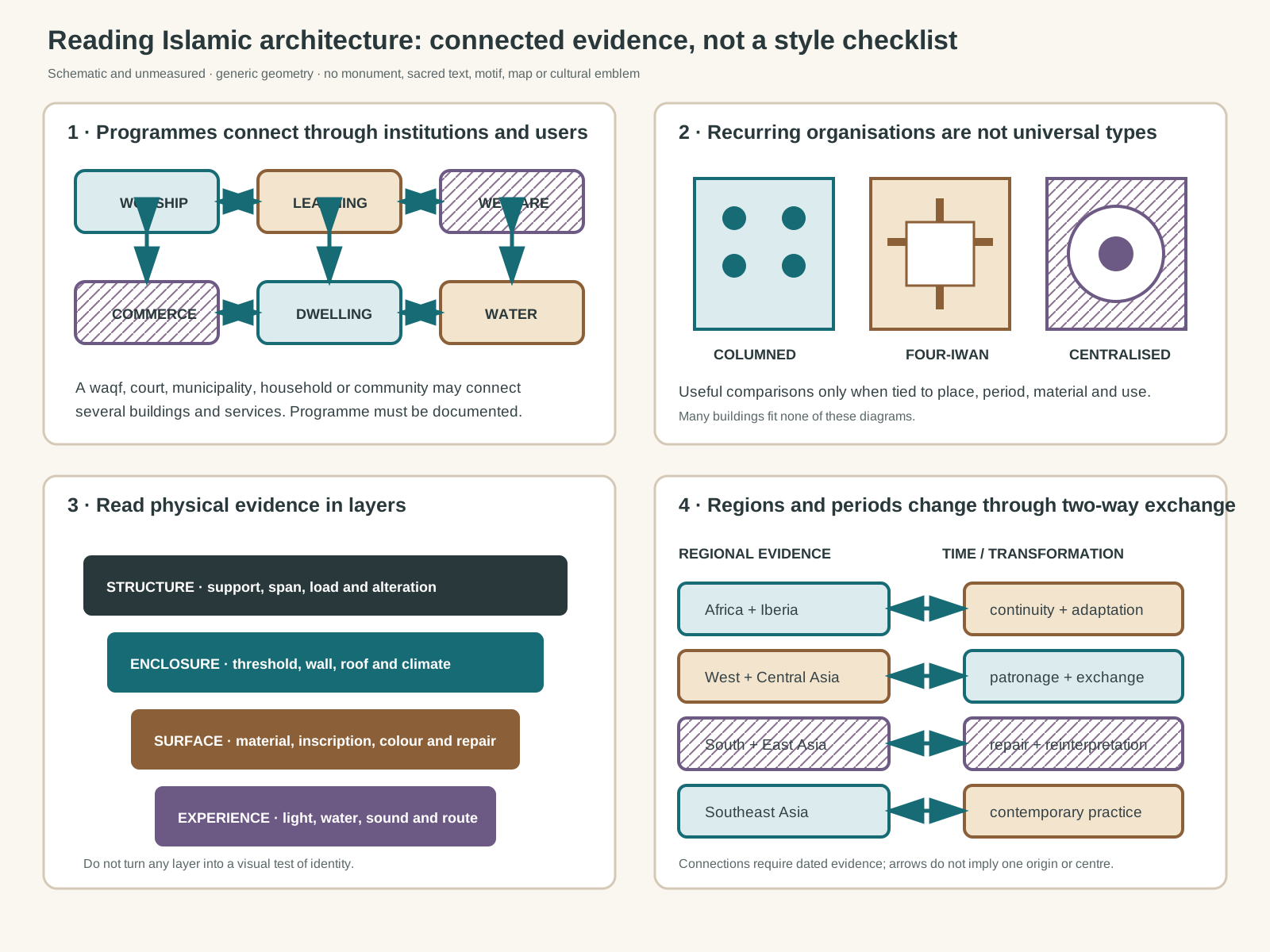
Original unmeasured evidence diagram. It is not a map, monument plan, sacred image, chronology or visual identification key.
Text alternative for the diagram
Panel one links worship, learning, welfare, commerce, dwelling and water to show that an institution or community may connect several programmes. Panel two presents generic columned, four-iwan and centralised arrangements as comparisons that are never universal. Panel three separates structure, enclosure, surface and sensory experience. Panel four connects evidence from Africa and Iberia, West and Central Asia, South and East Asia, and Southeast Asia to continuity, adaptation, exchange, repair and contemporary practice. Bidirectional arrows require dated evidence and imply no single origin or centre.
Mosques are essential to the subject, but they are not the whole of Islamic architecture. Cities contained homes, palaces, fortifications, workshops, markets, schools, hospitals, baths, fountains, bridges, caravanserais, gardens, tombs and water systems. These places connected worship to learning, care, commerce, government and daily life.
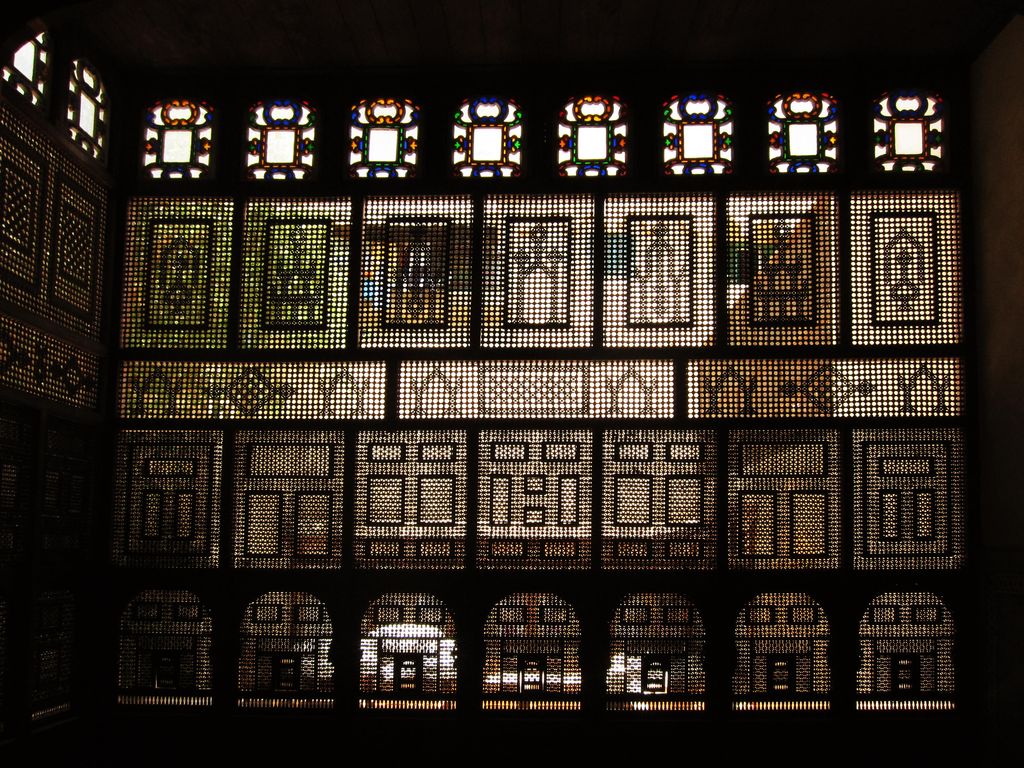
A timber mashrabiya at Bayt al-Suhaymi in Cairo, photographed by Ahmed Al.Badawy in May 2010. The domestic screen connects craft, light, privacy and air without turning one feature into an identity test. Ahmed Al.Badawy, Mashrabiya at Bayt al-Suhaymi, Cairo; CC BY-SA 2.0. JPEG prepared; no crop or retouch.
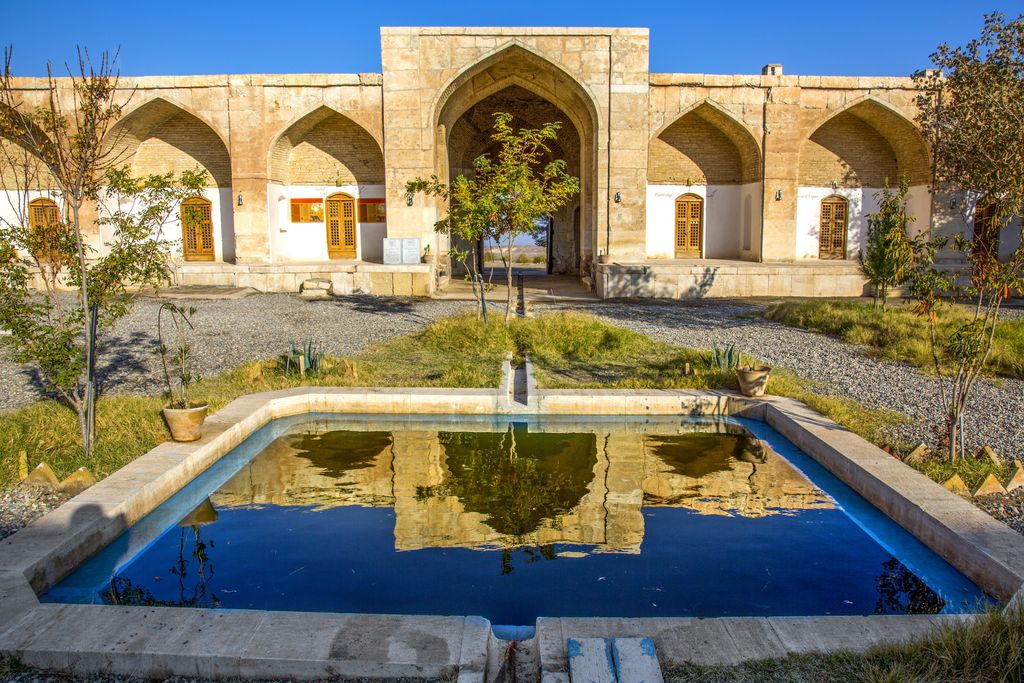
The courtyard of Qasr-e Bahram caravanserai in Iran, photographed by Reza Sobhani in November 2018, joins a central passage, repeated room bays, planted beds and water. Travel and commerce are part of Islamic architectural history alongside worship. Arosha-photo (Reza Sobhani), Courtyard of Qasr-e Bahram Caravanserai; CC BY-SA 4.0. JPEG prepared; no crop or retouch.
Historic Cairo preserves that density. Its long-lived fabric includes religious and educational foundations, residences, commercial streets, walls and public works from several political periods. [11] The Medina of Fez similarly records an urban system of dwelling, craft, commerce and teaching rather than a collection of isolated monuments. [17] Neither city can be represented adequately by a skyline of minarets.
Endowment helped join buildings and services. A waqf could direct income from property toward a mosque, school, water supply or charitable provision, though its precise legal form varied by time and jurisdiction. The documented Ferhad Pasha complex at Banja Luka connected mosque, madrasa, bath, fountain, tombs, caravanserai, market, aqueduct, bridge and palace. [8] At Divriği, a thirteenth-century mosque and hospital form an adjoining complex with distinct patrons and richly worked stone portals. [22] These examples show architecture operating through institutions and networks, not just freestanding forms.
Courtly and residential building matters too. The Alhambra was a Nasrid palatine city with reception spaces, residences, gardens, waterworks and fortifications; later Christian intervention and conservation became part of its physical history. [16] The Persian Garden serial property shows buildings, water management, planting and view as an integrated system adapted to different climates and periods. [25] Garden is not decorative scenery here. It organises movement, microclimate, production, representation and sensory experience.
Mosque architecture is plural
A mosque provides space oriented toward communal prayer, but its architectural organisation has never been uniform. Introductory mosque histories identify recurring elements such as a prayer hall, qibla orientation and mihrab, while also warning that regional forms differ widely. [6] A minaret may mark presence and support the call to prayer, yet not every mosque has one and its form does not identify a whole tradition.
Some early and later mosques use a columned or hypostyle hall beside a court. Kairouan's Great Mosque is a major example within the history of Ifriqiya, rebuilt and altered through several phases. [10] Samarra, an Abbasid capital created in the ninth century, preserves archaeological traces of vast mosques, palaces, streets and settlements at an imperial scale. [12] Neither example supplies a timeless template.
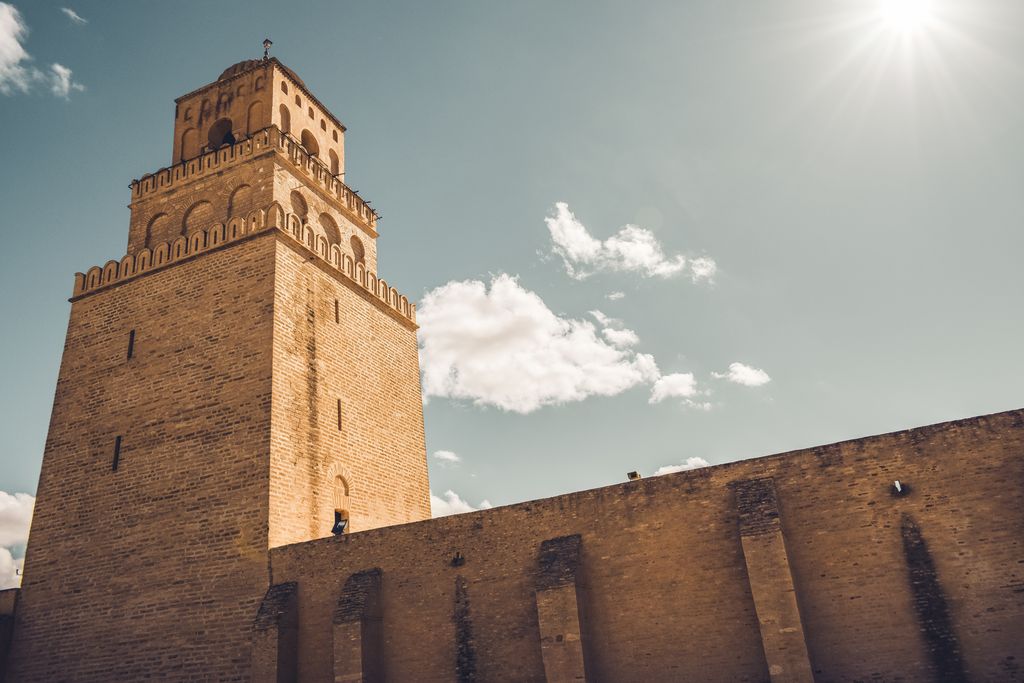
The three square stages of the Great Mosque of Kairouan's minaret rise above its enclosure wall, photographed by Monaam Ben Fredj in February 2018. The form belongs to this Ifriqiyan site and is not a universal mosque marker. Monaam Ben Fredj, Kairouan: three stages of the Great Mosque minaret; CC BY-SA 4.0. JPEG prepared; no crop or retouch.
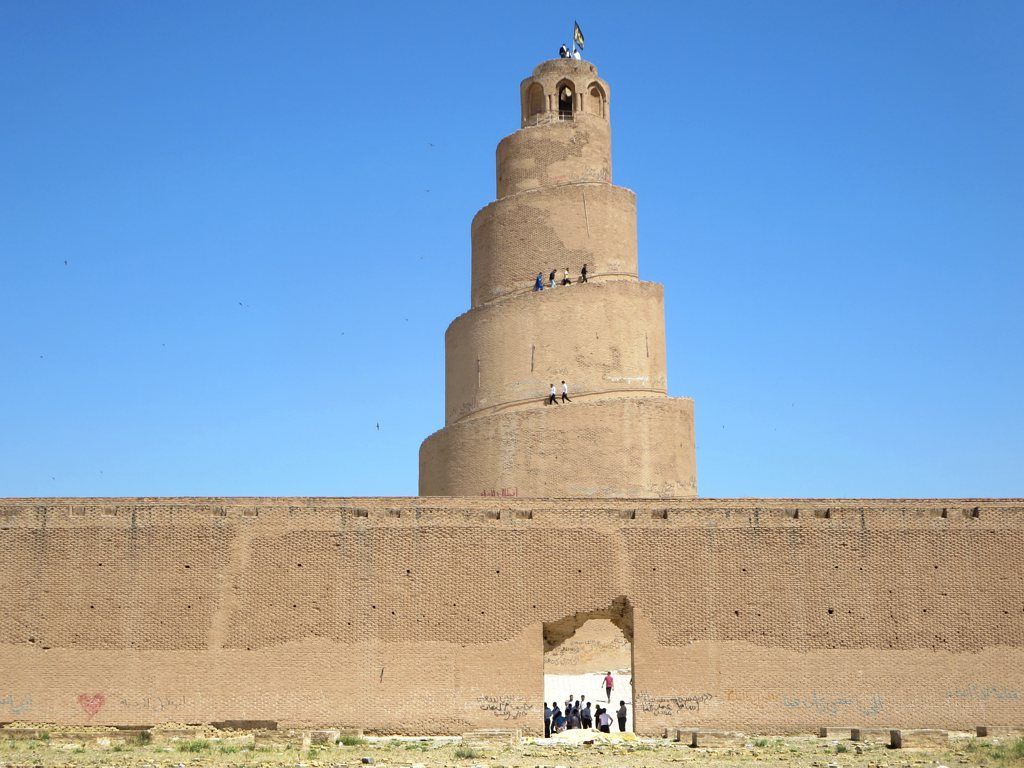
The spiral minaret of Samarra's Great Mosque, photographed by David Stanley in April 2016, rises beyond the surviving enclosure. Its ramp and tower belong to a ninth-century imperial capital rather than a timeless mosque formula. David Stanley, www.flickr.com/people/79721788@N00, Samarra: spiral minaret beyond the Great Mosque enclosure; CC BY 2.0. JPEG prepared; no crop or retouch.
Other relationships became prominent in particular settings. In Iran, a four-iwan court could organise major religious and educational complexes. Isfahan's central square joins the Shah Mosque, Sheikh Lotfallah Mosque, Ali Qapu palace and bazaar entrance in a Safavid urban programme. [13] Ottoman builders developed centralised domed spaces through their own structural, ceremonial and institutional histories; Sinan's Selimiye at Edirne belongs to a social complex and a specific sixteenth-century imperial commission. [14]
Smarthistory's comparison of mosque types emphasises that hypostyle, four-iwan and centrally planned forms are analytical groupings, not worldwide rules. It also points to mosques in China, West Africa and Indonesia shaped through local building knowledge and materials. [7] The separate mosque guide examines these questions in depth; here their purpose is to disprove the notion that Islamic architecture has one plan.
City, landscape and regional agency
Architecture changed as communities worked with particular environments, economies and inherited settlements. Local agency is not a decorative variation applied to a central model. It includes choices about structure, material supply, labour organisation, drainage, repair, urban density and public life.
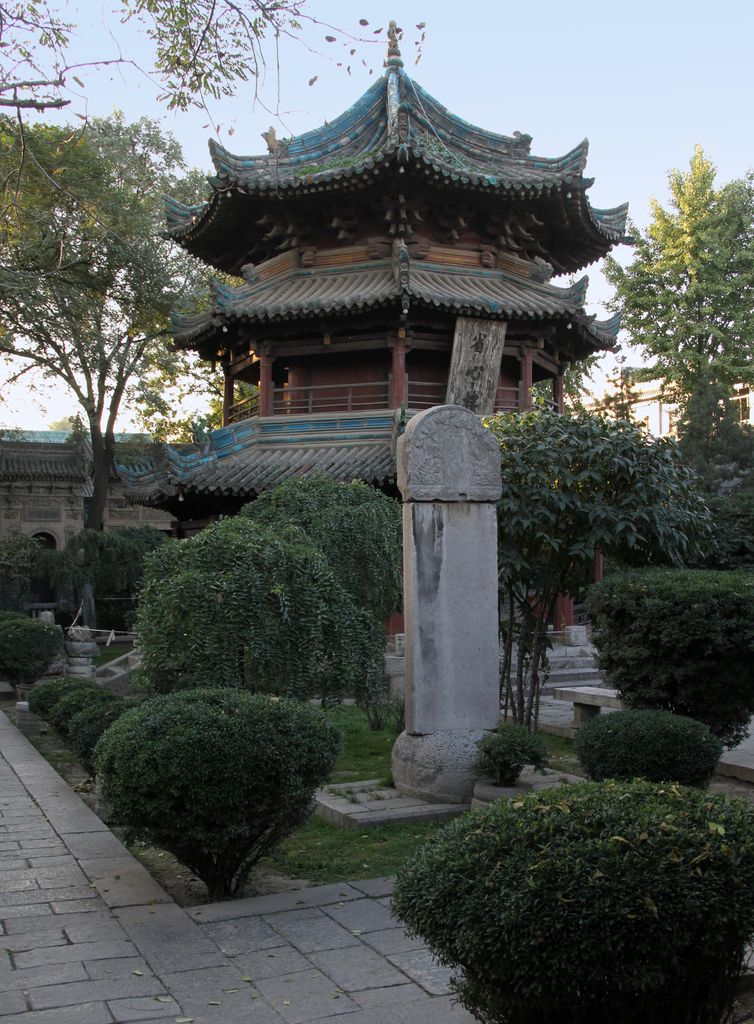
A multistorey timber pavilion at the Great Mosque of Xi'an, photographed by Gerd Eichmann in October 2012, combines layered tiled roofs and a mosque precinct without resembling common dome-and-minaret stereotypes. Gerd Eichmann, Xi’an: multistorey pavilion at the Great Mosque; CC BY-SA 4.0. JPEG prepared; no crop or retouch.
In West Africa, earth construction requires skilled cycles of maintenance as well as knowledge of wall mass, timber reinforcement and surface renewal. The mosques and scholarly sites of Timbuktu survive within a living urban and religious setting. [18] Djenné's earthen townscape includes houses and archaeological tells as well as the celebrated Great Mosque. [19] The Tomb of Askia at Gao belongs to a fifteenth-century Songhai imperial and Islamic context expressed through local earthen building practice. [24] Calling these works versions of a supposedly standard Middle Eastern type would erase their makers and environments.
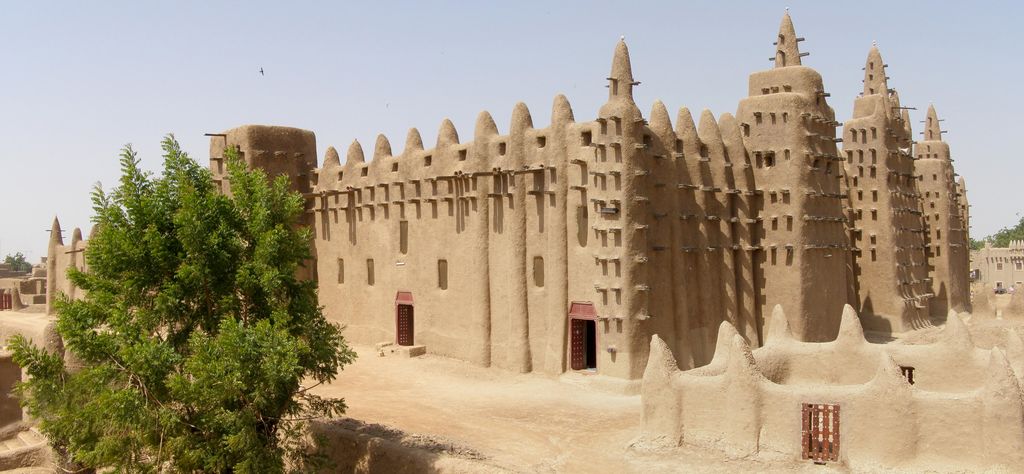
The Great Mosque of Djenné, photographed by BluesyPete in November 2007, shows earthen walls, projecting timbers and minaret forms sustained through recurring maintenance and local material knowledge. BluesyPete, Djenné: earthen mosque and minarets from the southeast; CC BY-SA 3.0. JPEG prepared; no crop or retouch.
At Bagerhat in Bangladesh, a fifteenth-century city associated with Khan Jahan used abundant fired brick and developed mosques, roads, bridges, tanks and other structures in a deltaic landscape. [20] Delhi's Qutb complex records early Sultanate construction alongside reused carved stone, inscriptions, later additions and the monumental minaret. [23] Each site involves political power and cultural encounter, but their material and historical conditions are different.
Quanzhou, a major port in Song-Yuan China, preserves evidence of maritime trade and diverse religious communities, including an early mosque. UNESCO treats its religious structures, production sites, transport network and administrative remains as parts of one mercantile system. [21] This is evidence of connected Muslim presence within a Chinese port, not permission to treat Chinese Islamic architecture as foreign matter untouched by local histories.
In Iberia, Córdoba contains Roman, Islamic, Jewish and Christian phases in a city repeatedly transformed after conquest. [15] Granada's Alhambra and Albayzín reveal a later Nasrid palatine and urban context, followed by Christian alteration and modern conservation. [16] Morocco's Fez has its own dynastic, urban and craft histories. These relationships explain why Andalusian, Moorish and Moroccan architecture need separate treatment even where exchange connected them.
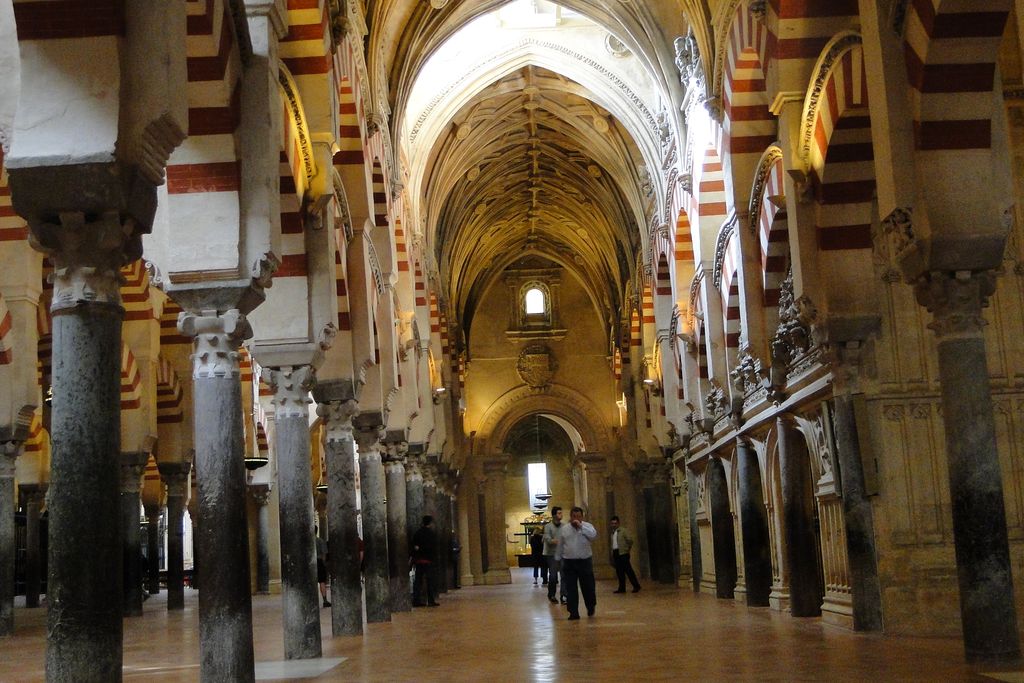
Arcades from Córdoba's former mosque stand beside later cathedral vaulting and wall decoration in a photograph by Adam Jones from May 2010. The juxtaposition records adaptation and contested histories rather than one unchanged phase. Adam Jones, Ph.D., Arcades and later cathedral fabric, Mosque–Cathedral of Córdoba; CC BY-SA 3.0. JPEG prepared; no crop or retouch.
Structure, material, surface and light
Islamic architecture cannot be understood by separating ornament from building. Brick bonds, carved stone, timber roofs, plaster, tile, glass, marble revetment, metalwork and textiles affect structure, enclosure, light, acoustics and bodily movement. Materials also reveal quarrying, firing, transport, workshop practice, repair and unequal access to resources.
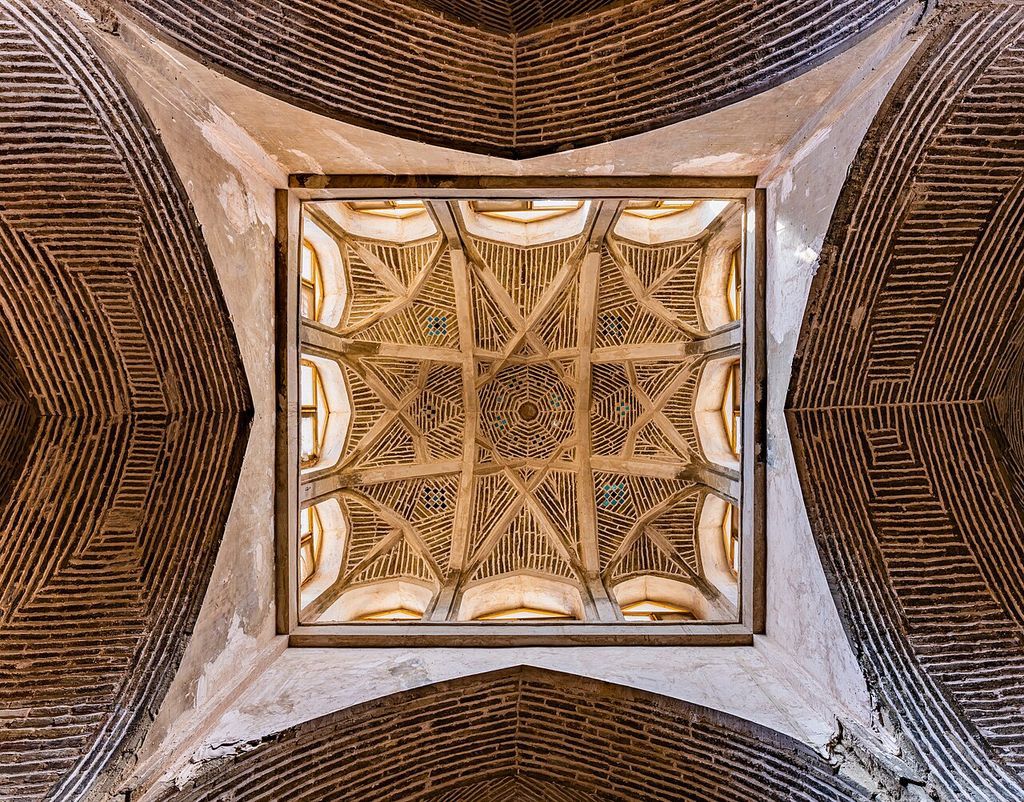
Intersecting brick ribs form a vault in the Jameh Mosque of Isfahan, photographed by Amir Pashaei in September 2019. Structure, pattern, surface and light work together within a mosque altered across many periods. Amir Pashaei, Ribbed vault of Jameh Mosque of Isfahan; CC BY-SA 4.0. JPEG prepared; no crop or retouch.
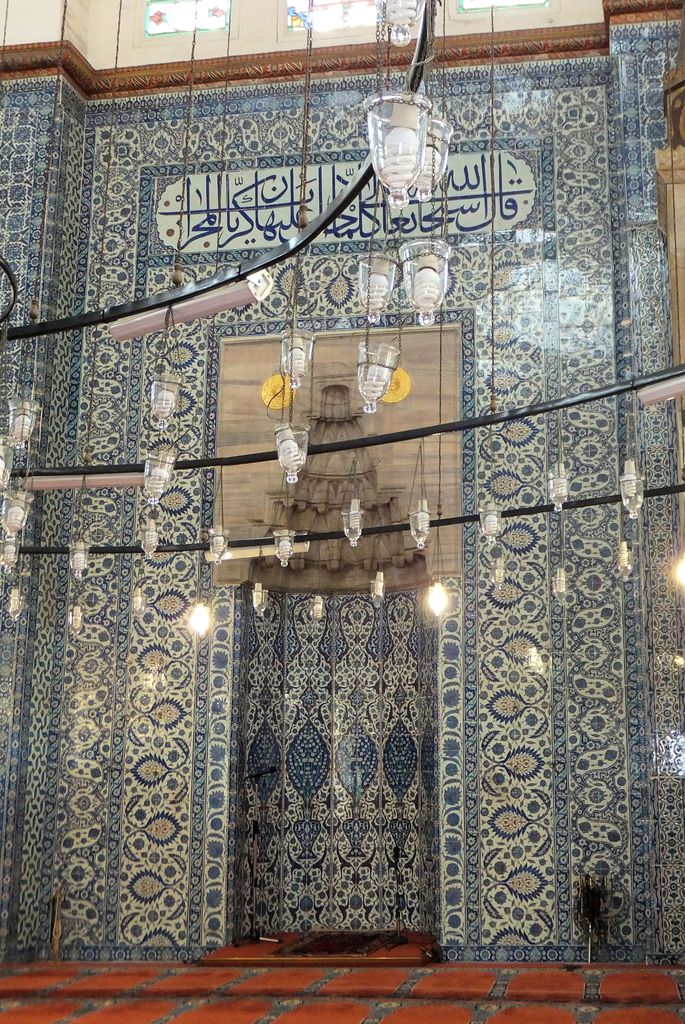
The mihrab and İznik tile revetment of the Rüstem Pasha Mosque in Istanbul, photographed by R Prazeres in July 2011. Floral pattern, inscription, stone and light articulate a worship space rather than serving as detachable decoration. R Prazeres, Rüstem Pasha Mosque: mihrab and İznik tile revetment; CC BY-SA 4.0. JPEG prepared; no crop or retouch.
The Met's study of architectural ornament in the Near East between 500 and 1000 shows pattern, colour and light crossing political and religious boundaries through media including mosaic, marble, stucco, wood and glass. [2] Surface could articulate a threshold, enlarge a patronal programme, soften a structural transition or alter as daylight moved. Describing it as mere decoration loses this spatial work.
Geometry and vegetal forms recur in many contexts, but neither is an identity test. Inscriptions may name a patron, date construction, transmit a religious text or shape rhythm and scale; unreadable imitation strips away that content. Figural imagery also appears in palaces and objects and varies with setting. A universal ban on images is historically false, just as universal permission would be.
Water may support washing, cooling, cultivation, spectacle and hydraulic supply in different combinations. Light may direct attention or expose material depth. An arch transfers loads but may also frame a route. A dome spans space and can signal hierarchy, yet domes predate Islam and occur far beyond Islamic settings. Responsible reading keeps technical action, sensory effect and attributed meaning distinguishable.
Watch: Islamic Architecture through Layered Use and Shared Building Elements
Begin with Hagia Sophia’s separately dated mosque adaptations, then use RIBA’s wider guide to compare institution, structure, enclosure, surface, light and movement.
Hagia Sophia as a Mosque
A focused account of the building after 1453 shows how minarets, furnishings, inscriptions and repair became separately dated parts of its continuing Islamic architectural history.
Watch on YouTubePatronage, labour and maintenance
Rulers dominate inscriptions and chronicles, but architecture depended on many agents: administrators, legal institutions, merchants, donors, architects, engineers, masons, carpenters, tile makers, plaster workers, gardeners, water managers and labourers whose names often went unrecorded. A monument should not become the biography of its patron.
Commissioning also occurred at several scales. Imperial capitals could marshal distant resources, while neighbourhood foundations organised local worship or water. Merchant wealth shaped ports and caravan routes. Court workshops moved people and designs; craft communities transmitted practical knowledge. Conquest could coerce labour, redistribute materials and overwrite earlier meanings. Exchange was never automatically equal.
Maintenance is part of authorship over time. Earthen surfaces need renewal, timber components are replaced, tiled skins are repaired and active buildings adapt to contemporary safety and service needs. Conservation records must therefore distinguish original fabric, later repair, reconstruction and current use without assuming that replacement always destroys authenticity.
Revival, classification and contemporary practice
The modern category Islamic architecture was shaped partly through European collecting, colonial surveys, museums and architectural histories. Terms such as Saracenic, Moorish and Indo-Islamic were applied unevenly and sometimes arranged buildings within racial or civilisational hierarchies. Modern readers should ask when a label arose, who used it and whether it matches local or current scholarship.
Nineteenth- and twentieth-century revivals reused selected arches, domes, tile patterns and screens for mosques, palaces, exhibitions, railway stations and commercial buildings. Revival can express community identity, state authority, tourism or international modernism. Visual quotation alone does not recover an earlier institution or craft system.
The field remains active. The Aga Khan Award for Architecture considers contemporary design, housing, planning, landscape, preservation and community needs in places where Muslims have a significant presence. Its remit deliberately exceeds religious monuments and includes local resources, technology and social impact. [26] Contemporary Islamic architecture may therefore involve a restored historic district, a school, infrastructure or climate-responsive housing as well as a new mosque.
There is no contradiction between modern construction and historical continuity. Designers can engage inherited spatial practices or materials without copying a canonical image; communities may also choose forms associated with global modernism. The analytical task is to document the actual commission, users and design decisions.
How to read an Islamic building
Use a sequence of evidence rather than a recognition checklist:
- Establish the building's present and historical place, date range and phases.
- Identify its actual programme, institution, patrons, makers and users.
- Separate structure, enclosure, surface, light, water and landscape.
- Ask which materials and skills were locally available, imported or adapted.
- Compare within the same region and period before proposing distant influence.
- Distinguish religious use from the wider social history of an Islamic society.
- Record conversion, repair, reconstruction and living maintenance.
- State which meaning is documented and which is an interpretation.
A dome, court, arch, minaret or patterned surface can start a question. It cannot answer who built the work, for what purpose, in which political setting or through whose labour. Strong interpretation joins observable fabric to bounded historical evidence.
Islamic Architecture: Five Evidence Tests
Begin with place, date and institution, then connect regional history, physical evidence, makers and change rather than applying a style checklist.
| Evidence | What it can establish | What else to verify |
|---|---|---|
| Institution and use | Worship, learning, welfare, commerce, dwelling and water connect varied programmes. | A mosque is central to the field but does not represent every building. |
| Place and period | Regional chronology binds a building to specific communities and political settings. | No region, dynasty or silhouette supplies a universal Islamic type. |
| Physical layers | Structure, enclosure, surface, light, sound and route reveal different evidence. | Pattern, arch, dome or minaret alone cannot establish identity. |
| Patronage and labour | Institutions, donors, craftspeople, workers and maintenance sustain architecture. | Do not reduce a building to its ruler or celebrated architect. |
| Continuity and change | Exchange, conversion, repair and contemporary practice explain transformation. | Resemblance is not proof of one origin or passive copying. |
Frequently Asked Questions
It is a broad historical field covering religious and secular architecture made across varied societies in which Islam, Muslim patrons or Muslim communities were significant. It is not one universal style.
No. The field also includes houses, palaces, schools, hospitals, baths, markets, gardens, fortifications, infrastructure and whole urban landscapes. Mosque architecture is an important but separate building-type subject.
No. Mosque forms differ by period, region, material and community. Orientation and provision for prayer matter more than a universal silhouette. [6] [7]
No. Geometry is one of many surface practices and also occurs outside Islamic settings. Material, workshop, date and programme are necessary evidence; pattern alone cannot establish identity.
No universal rule explains all periods and settings. Figural representation varies across religious, courtly and secular contexts. Claims should be tied to a specific community, object, building and date.
No. Arab regions are part of the history, but Islamic architecture also developed across Africa, Iran, Central Asia, Turkey, South and Southeast Asia, China and Europe. Muslim communities and makers are culturally and linguistically diverse.
No. Early patrons and craftspeople worked within late antique and Sasanian-connected worlds, selectively adapting techniques and forms for new settings. Continuity, exchange and local agency are more accurate than a single line of copying. [3] [4]
No. It is a living field that includes contemporary design, planning, housing, conservation, landscape and public architecture. [26]
Discussion
Which building most clearly shows why Islamic architecture must be read through place, institution, material, labour and change?
Reader Insights
Which place, period, institution and community make the building historically specific?
How do structure, enclosure, surface, light, water and route work together?
What changed through exchange, conversion, repair, maintenance or contemporary use?
Join the Conversation
Share a documented example below, noting its place, institution, makers, material, phase and evidence limits.
References
- Metropolitan Museum of Art, The Art of the Islamic World: A Resource for Educators. View source
- Metropolitan Museum of Art, Pattern, Color, Light: Architectural Ornament in the Near East, 500–1000. View source
- Metropolitan Museum of Art, Byzantium and Islam: Age of Transition. View source
- Metropolitan Museum of Art, The Dome of the Rock (Qubbat al-Sakhra). View source
- Getty Research Institute, Getty Vocabularies. View source
- Smarthistory, Introduction to mosque architecture. View source
- Smarthistory, Common types of mosque architecture. View source
- Archnet, Ferhat Pasha Complex. View source
- UNESCO World Heritage Centre, Ancient City of Damascus. View source
- UNESCO World Heritage Centre, Kairouan. View source
- UNESCO World Heritage Centre, Historic Cairo. View source
- UNESCO World Heritage Centre, Samarra Archaeological City. View source
- UNESCO World Heritage Centre, Meidan Emam, Esfahan. View source
- UNESCO World Heritage Centre, Selimiye Mosque and its Social Complex. View source
- UNESCO World Heritage Centre, Historic Centre of Cordoba. View source
- UNESCO World Heritage Centre, Alhambra, Generalife and Albayzín, Granada. View source
- UNESCO World Heritage Centre, Medina of Fez. View source
- UNESCO World Heritage Centre, Timbuktu. View source
- UNESCO World Heritage Centre, Old Towns of Djenné. View source
- UNESCO World Heritage Centre, Historic Mosque City of Bagerhat. View source
- UNESCO World Heritage Centre, Quanzhou: Emporium of the World in Song-Yuan China. View source
- UNESCO World Heritage Centre, Great Mosque and Hospital of Divriği. View source
- UNESCO World Heritage Centre, Qutb Minar and its Monuments, Delhi. View source
- UNESCO World Heritage Centre, Tomb of Askia. View source
- UNESCO World Heritage Centre, The Persian Garden. View source
- Aga Khan Development Network, Aga Khan Award for Architecture. View source