


 by Tom Gurney
Tom Gurney BSc (Hons) is an art history expert with over 20 years experience
Email: tomgurney1@gmail.com / Phone: +44 7429 011000
After Antiquity: How Egyptian Revival Turned Monuments into Modern Symbols
Egyptian Revival architecture turned selected forms associated with ancient Egypt into later monuments, cemetery gates, prisons, churches, factories, banks, theatres and houses. Battered walls, pylon-like entrances, cavetto cornices and lotus or papyrus capitals could suggest endurance, mystery, death, spectacle or commercial novelty. Those meanings belonged to the later building and its audience; they were not fixed properties carried unchanged from Egypt.
The revival arrived in waves. European military expansion, publications, museum collecting, travel, exhibitions and archaeological discoveries repeatedly made Egyptian imagery visible to Western designers. Each wave produced different mixtures of study, fantasy, empire and commerce. Egyptian Revival must therefore be read critically within revival architecture, not as a convenient summary of Egyptian culture.
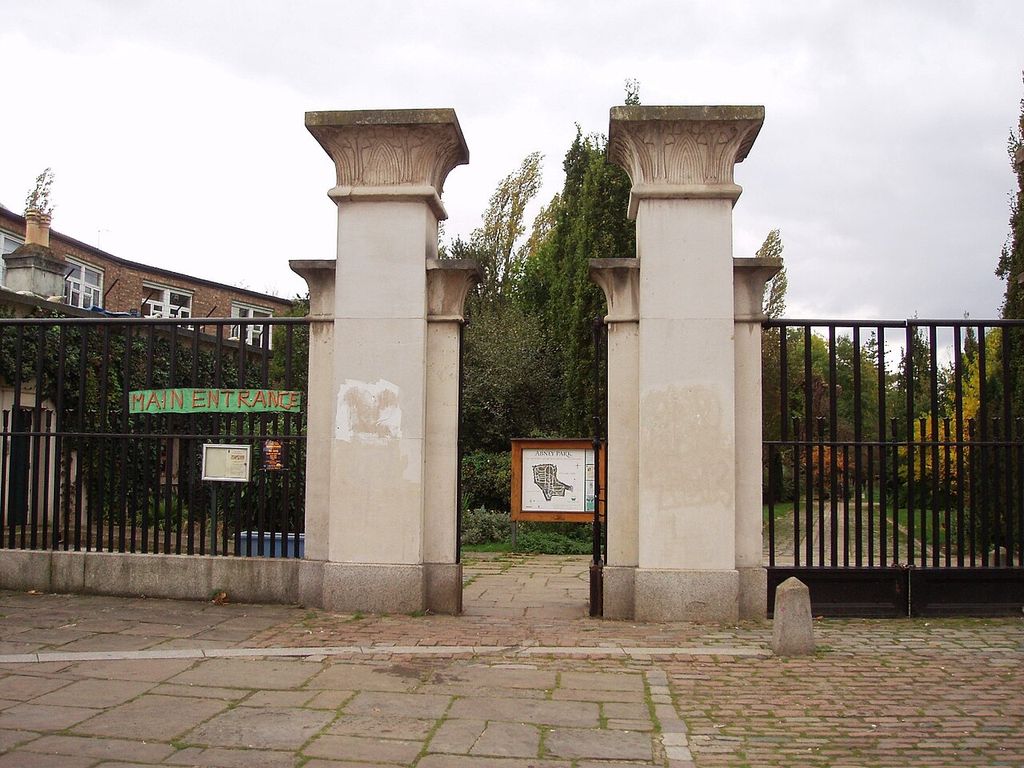
Abney Park Cemetery’s entrance piers and gates, photographed in October 2008. Ewan Munro, www.flickr.com/people/55935853@N00, Abney Park Cemetery entrance; CC BY-SA 2.0. JPEG prepared; no crop or retouch.
At a Glance
- ScopeEgyptian Revival is later selective reuse, distinct from the many periods and communities of ancient Egyptian architecture.
- WavesNapoleonic publication, nineteenth-century travel and exhibitions, and the Tutankhamun-era cycle produced different revivals.
- RecognitionBattered pylon forms, cavetto cornices, plant capitals, obelisks and symbolic surfaces recur but are not universal.
- Building rangeCemeteries, churches, medical schools, prisons, factories, theatres, banks and houses used the language differently.
- Critical contextMilitary invasion, empire, collecting, appropriation, entertainment and commerce shaped Western access to Egyptian imagery.
- Reading ruleCombine wave, place, programme, mass, surface, inscription, construction and source history.
Contents
- What Is Egyptian Revival?
- Invasion and Documentation
- How to Read the Buildings
- Cemeteries and Eternity
- Churches and Institutions
- Industry Behind a Temple Image
- Theatres and Spectacle
- Watch Egyptian Revival Architecture
- How to Recognise Egyptian Revival
- Evidence Table
- Recommended Books
- Frequently Asked Questions
- Discussion
- References
What is Egyptian Revival architecture?
Egyptian Revival is later architecture that selectively reuses forms understood as ancient Egyptian. It is separate from Ancient Egyptian architecture, whose temples, tombs, settlements and landscapes developed within changing political, religious, environmental and material conditions over millennia.
The Metropolitan Museum of Art describes Egyptian Revival as a recurring phenomenon in American architecture and decorative arts from the nineteenth century into the 1920s. Obelisks, sphinxes, hieroglyphs and pyramids moved across buildings, furniture, ceramics and metalwork, changing with contemporary taste. [1] `Egyptomania` names that wider popular fascination; not every Egyptianising object creates a complete architectural style.
Washington State's guide places a regional architectural phase mainly around 1920–30. It lists massive smooth walls, flat roofs, straight-headed openings, sloping pylons, cavetto cornices and stylised plant capitals. [3] Those clues work for interwar examples, but they cannot define earlier cemeteries, churches or industrial buildings everywhere.
Invasion, documentation and the first modern wave
Napoleon Bonaparte invaded Egypt in 1798 with military and geopolitical aims. He also brought artists, scientists, architects and printers to record antiquities, contemporary communities and natural history. Their vast Description de l'Égypte appeared between 1809 and 1829, circulating large, detailed images far beyond the expedition. [2]
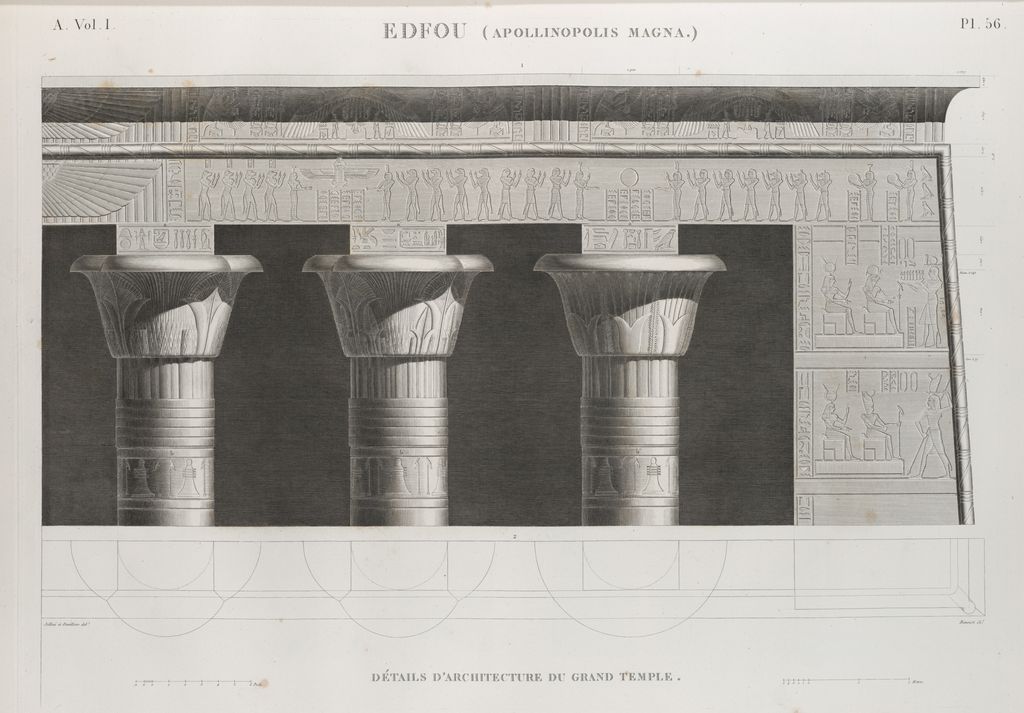
Architectural details at Edfu in Description de l’Égypte, Antiquités, volume I, plate 56, catalogued 1809. Jollois and Devilliers (drawing); Benoist (engraving); Imprimerie impériale (publisher); New York Public Library (source), Description de l’Égypte, Antiquités, vol. I, plate 56: architectural details of the Grand Temple at Edfu; Public domain. JPEG prepared; no crop or retouch. New York Public Library, General Research Division, image 1267885.
This knowledge was not produced outside power. French forces sought control of Egypt and a route affecting British interests. After French defeat, Britain took prominent antiquities including the Rosetta Stone, while participants retained notes used for publication. [2] [4] Calling the episode a simple `rediscovery` makes Egyptian people disappear from their own history.
The decipherment of hieroglyphs in 1822 expanded scholarly understanding and public fascination. Architects could study recorded monuments with new specificity, yet they still selected, enlarged, rearranged and sometimes invented forms. The same published plate could inform a serious archaeological comparison, a commercial object or a theatrical fantasy. [1] [4]
Early United States applications were often architectural. The Met points to Benjamin Henry Latrobe's 1808 Library of Congress interiors, funerary structures and the Washington Monument. [1] Egyptian design offered an alternative to Greek Revival architecture, but its associations with antiquity did not imply the same claims about democracy or civic ancestry.
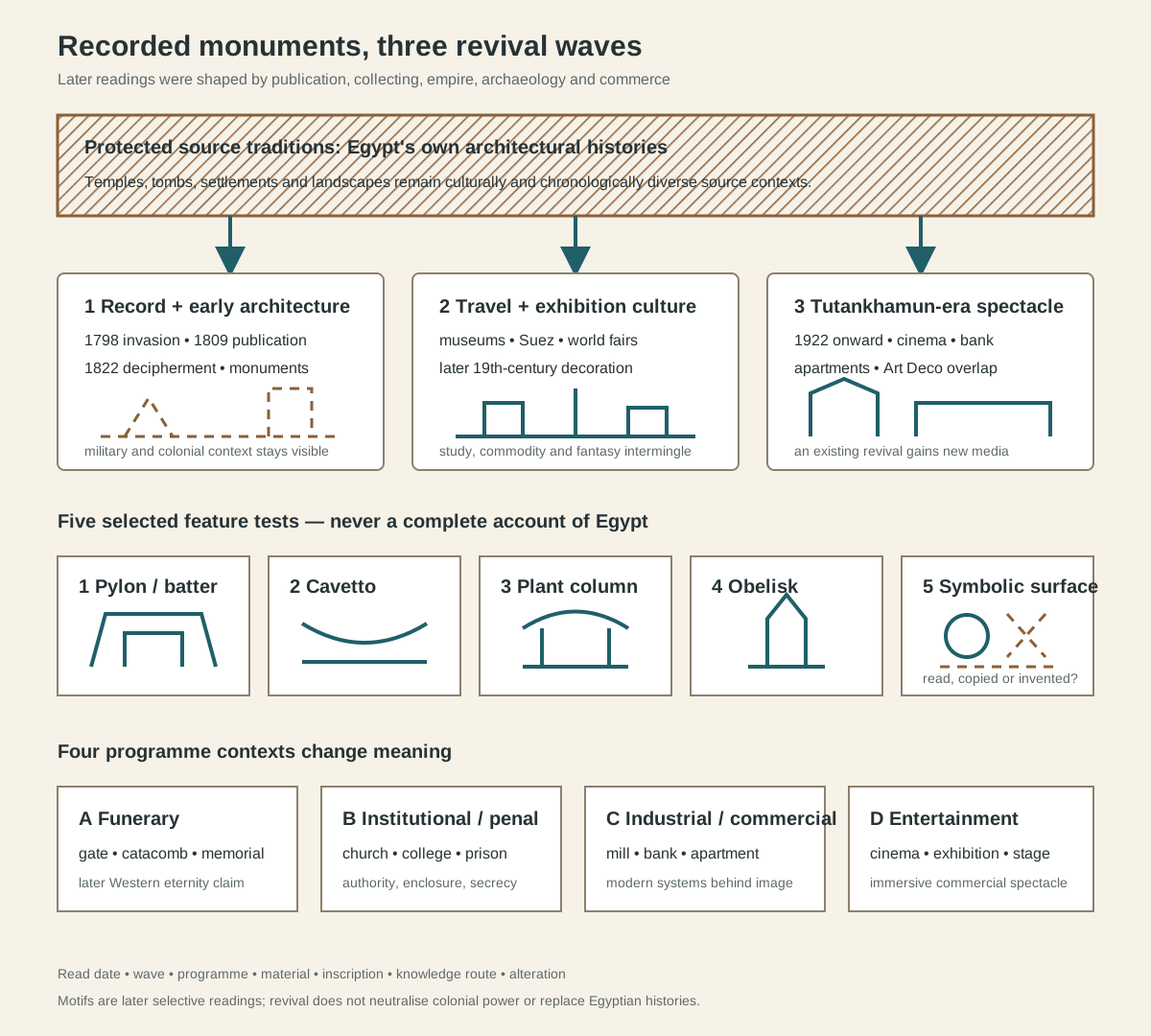
A transmission and recognition map, not an ancient-temple reconstruction. Later motifs changed through publication, empire, archaeology, programme and commerce.
Text alternative for the revival-family map
A protected band reserves Egypt's own architectural histories. Three later waves show Napoleonic publication and early monuments, later travel and exhibition culture, and the Tutankhamun-era cinema and Art Deco phase. Five tests cover pylon or batter, cavetto cornice, plant column, obelisk and symbolic surface. Four contexts—funerary, institutional or penal, industrial or commercial, and entertainment—show why meaning changes with programme.
How to read an Egyptian Revival building
Begin with mass and entrance. A pylon is a monumental gateway formed by inward-sloping towers and a lower central opening. Revival buildings may compress that relationship into a flat façade or use battered jambs around doors and windows. Thick-looking, largely unbroken walls can heighten the effect even when the actual construction is brick, plaster, terracotta or concrete.
A cavetto cornice uses a deep concave curve near the top of a wall or opening. Columns may broaden towards the base and carry stylised lotus, papyrus or palm capitals. Winged sun disks, scarabs, sphinxes and hieroglyph-like bands can reinforce the identification. Obelisks may stand independently, frame a gate or become thin applied ornaments. [3] [10] [11]
These are later design choices, not a checklist of all Egyptian architecture. Identify whether inscriptions have meaning or merely imitate writing. Determine whether colour survives or has been painted over. Examine roof, plan, structure and programme. One lotus capital on an otherwise classical bank supports a hybrid description rather than proving a pure Egyptian Revival building. [12] [16]
Cemeteries and the Western idea of eternity
Egyptian Revival became strongly associated with burial in Europe and the United States. Western observers encountered ancient Egypt disproportionately through tombs, monuments and excavated funerary objects. Designers then linked apparently enduring stone forms to memory, secrecy and eternity.
Historic England's national survey shows the extraordinary range of English Egyptian-style work, but gives cemeteries a distinct place alongside cinemas, factories, synagogues, Masonic buildings and houses. [5] The revival's funerary reputation was powerful, not exclusive.
Abney Park Cemetery in London opened with 1840s entrance lodges and gates designed by William Hosking in an Egyptian style. Beyond them, a picturesque landscape and a Gothic chapel served a nonconformist burial ground. [7] The contrast makes clear that one site could assign different historical languages to gateway, worship and landscape.
At Highgate Cemetery, Egyptian Avenue led towards the Lebanon Circle and catacombs within an early Victorian commercial cemetery landscape. [8] The sequence used enclosure and descent to stage mourning. Similar forms spread to other cemeteries and memorials, where obelisks and cavetto cornices could be produced in stone at very different scales. [6]
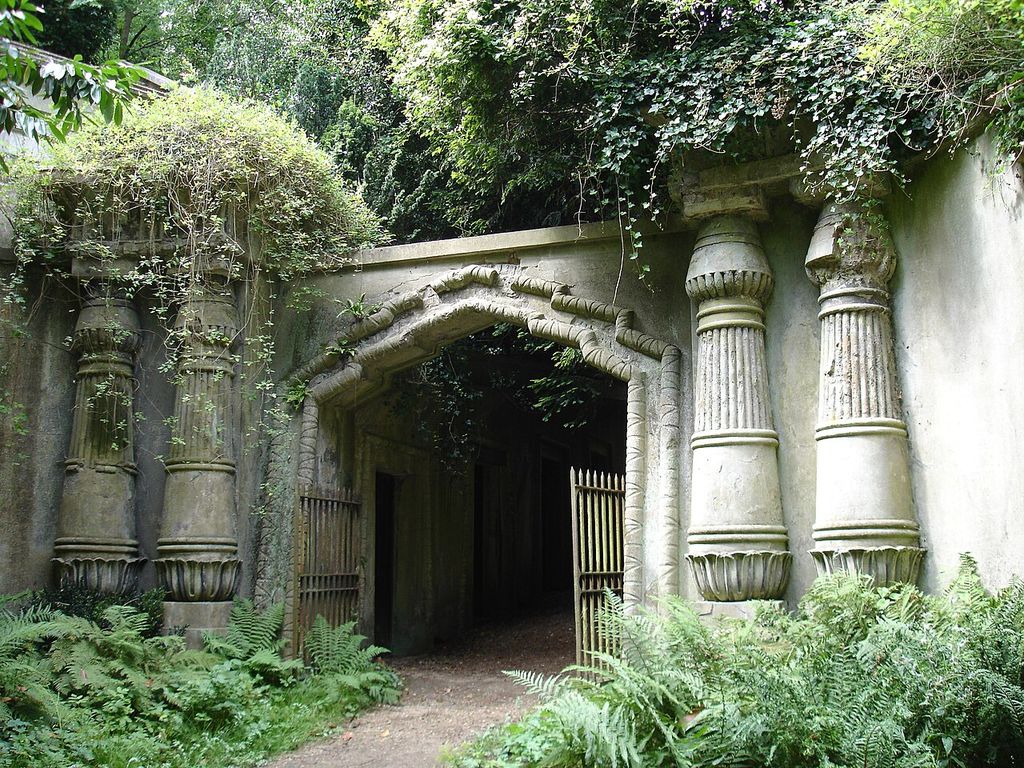
The entrance to Egyptian Avenue at Highgate Cemetery, photographed in August 2007. JohnArmagh, Entrance to Egyptian Avenue, Highgate Cemetery; Public domain. JPEG prepared; no crop or retouch.
The later association should not be projected backwards as the only meaning of Egyptian monuments. Nor was it politically neutral. European burial culture used an appropriated ancient past to give private family memorials an aura of timelessness.
Churches, medicine and institutional authority
William Strickland designed First Presbyterian Church in Nashville after its predecessor burned. Begun in 1849 and completed in 1851, it remains an exceptional Egyptian Revival church with battered masses, Egyptian columns, mouldings and painted interior effects. [10] [11]
Its history complicates any assumption that the style naturally belonged to pagan worship or funerary use. A Presbyterian congregation selected the language for a Christian building. During the Civil War the church became a hospital, with pews removed and parts of the building used for wounded soldiers and horses. [11] Programme changed while the architectural image remained.
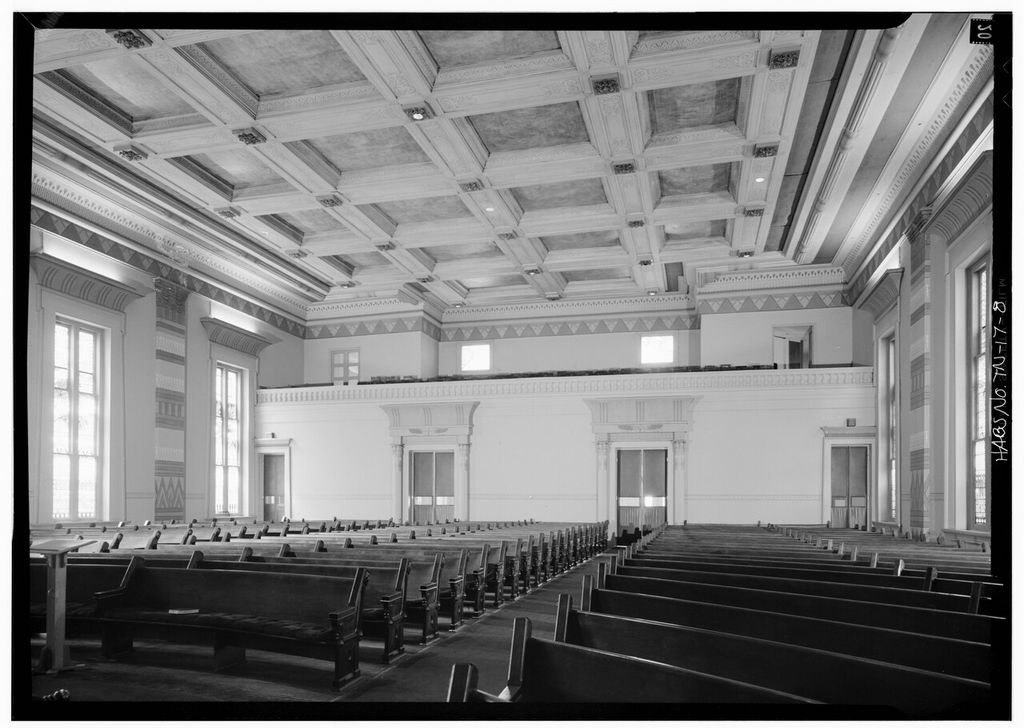
First Presbyterian Church in Nashville, looking north in an undated HABS survey photograph. Historic American Buildings Survey / National Park Service; individual photographer uncredited, First Presbyterian Church, Nashville — interior looking north; Public domain. JPEG prepared; no crop or retouch. Library of Congress, Prints & Photographs Division, HABS TENN,19-NASH,13-8.
Thomas Stewart's Egyptian Building in Richmond was constructed in 1845 for the Medical College of Virginia. Its sloping forms, ornamental fence and obelisk-like posts made a medical teaching building conspicuous on its site. A 1929 interior remodelling altered how the revival survives. [12]
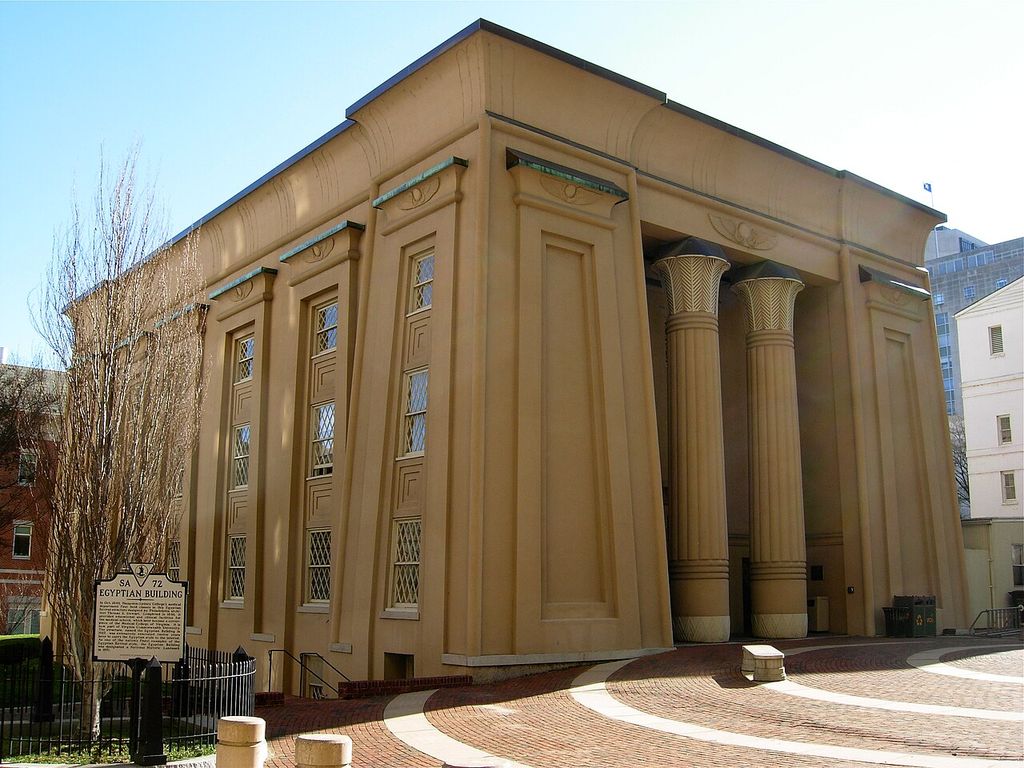
Richmond’s Egyptian Building, photographed in January 2012. Crazyale, Egyptian Building, Richmond, Virginia; CC BY-SA 3.0. JPEG prepared; no crop or retouch.
Prisons also adopted Egyptian forms. Monumental blankness and restricted openings could make security appear ancient and absolute. Lodges and Masonic interiors used associations with secrecy and remote wisdom. These were Western institutional readings, not direct continuations of Egyptian functions. [5] [14]
Industry behind a temple image
Temple Mills in Leeds demonstrates that Egyptian Revival could frame advanced industrial production. Historic England describes the 1840 mill as both technologically innovative and architecturally distinctive. [9] The historical skin did not turn machinery, labour organisation and factory discipline into ancient practice.
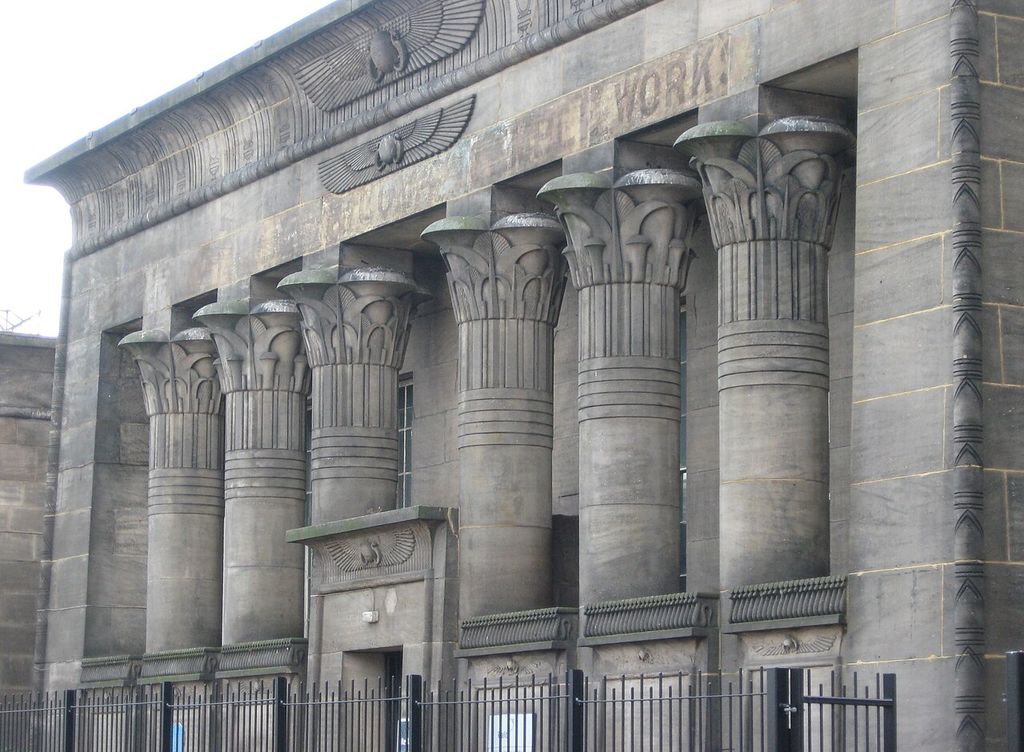
The Egyptian-derived frontage of Temple Works in Leeds, photographed in April 2008. Sarah Grice, www.flickr.com/people/7171876@N07, Temple Works former flax mill, Leeds; CC BY-SA 2.0. JPEG prepared; no crop or retouch.
Industrial use reveals the gap between image and operation. A pylon-like entrance might conceal large work floors, iron structures, roof lighting, power transmission and tightly managed circulation. Builders translated engravings into brick, stone, plaster and cast components available to a nineteenth-century economy.
The workers who built and operated such places belong to their meaning. An architect's historical concept depended on quarrying, brickmaking, carving, plastering, painting and engineering. Inside, the monumental façade could represent an owner's authority over a labour force and production system.
The Independent Order of Odd Fellows Hall in Philadelphia offers a record of a different organisational building. Erected in 1846 for meetings and ceremonies, it used large geometric masses and applied Egyptian decoration. HABS documented alteration and decay before fire destroyed it in 1976. [13] Survival cannot be assumed simply because a style advertises permanence.
Later waves, exhibitions and commerce
Egyptian interest intensified again later in the nineteenth century. The opening of the Suez Canal in 1869, international exhibitions, travel, opera and museum collections expanded the settings in which Western audiences encountered Egyptian imagery. Obelisks taken from Egypt were raised in Paris, London and New York. [15]
After the American Civil War, Egyptian motifs often appeared in furniture and decorative arts combined with Western forms. The Met distinguishes this from the earlier architecture-heavy phase and notes that an Egyptian detail could act as an accent within an otherwise conventional room. [1] Revival could be fragmentary and commercial.
This circulation depended on unequal access to objects and authority. The British Museum describes Egyptomania as focused on European interpretations of Egypt's past, fuelled by travel, publications, museum acquisitions and the 1922 discovery of Tutankhamun's tomb. [19] Egyptian histories were often reduced to a recognisable pharaonic brand even as modern Egypt pursued political and cultural self-definition.
The discovery of Tutankhamun's tomb did not create Egyptian Revival from nothing. It energised another existing cycle. News, film, fashion and mass production made motifs available to wider audiences, while Art Deco designers responded to their geometry and colour. [14] [15]
Theatres and the architecture of spectacle
Movie palaces made the 1920s phase unusually immersive. Façades could resemble temple gateways; foyers and auditoriums used columns, painted ceilings, reliefs and dramatic lighting to transport audiences before a film began. Archaeological reference mixed openly with entertainment.
The Ada Theatre in Boise, completed in 1927, used a reinforced-concrete structure and an Egyptian Revival front with pylon-like masses. HABS relates the design to Edfu and to the broader cinema fashion that followed archaeological discoveries. [17] The comparison records inspiration, not an archaeological reconstruction.
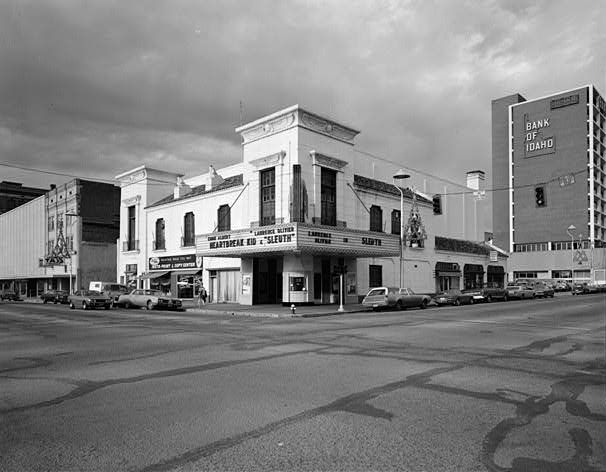
The Ada Theatre in Boise, photographed by Duane Garrett in December 1973. Duane Garrett, Historic American Buildings Survey, Ada Theatre, Boise; Public domain. JPEG prepared; no crop or retouch. Library of Congress, Prints & Photographs Division, HABS ID,1-BOISE,8-10.
SFO Museum's survey of Harold Allen's photographs places such theatres within a much larger American field extending from early medical and funerary buildings to apartments and postwar roadside novelty. [14] His archive matters because many examples were altered or demolished.
Boise's preservation history records community action that saved the Egyptian Theatre from demolition, landmark designation and continuing cultural use. [18] Conservation nevertheless raises choices: paint schemes change, new screens disrupt prosceniums, services must be upgraded and modern access introduced. A restored theatre is a negotiated survival, not a frozen 1927 interior.
Banks, classical hybrids and Art Deco
The American National Bank Building in Florida shows how Egyptian Revival could merge with a conventional commercial frame. Its National Register record identifies a 1920–30 phase marked by distinctive columns, smooth walls, straight-headed windows, a flat roof and monumental effect. Egyptian forms complement rather than replace classical organisation. [16]
Such hybrids can be confused with Art Deco. Both may use simplified geometry, strong verticals, coloured terracotta and stylised ornament. The distinction depends on the building's composition, date and documentary sources. A pylon entrance with papyrus capitals points more specifically towards Egyptian Revival; abstract zigzags alone do not.
Commercial revival also converted ancient imagery into a sign. A bank could imply solidity, while a cinema promised exotic spectacle. The forms were similar enough to be recognised yet flexible enough to sell different experiences.
Colonial power, appropriation and changing interpretation
Egyptian Revival is often celebrated for visual invention. It must also be placed within military invasion, imperial rivalry, antiquities removal and the authority of Western museums. Publications that improved knowledge could simultaneously turn a living country into a catalogue of usable motifs. [2] [4] [19]
`Egyptian` was frequently made to mean exclusively pharaonic, ancient and mysterious. That frame obscures later Egyptian histories and communities. It also collapses enormous differences among ancient periods and sites. A winged disk copied from a plate did not carry the full ritual meaning, material setting or linguistic context of its source.
This does not make every revival building identical or interpretation impossible. It asks better questions. Who selected the sources? How were objects or images acquired? What did patrons claim through them? Did an inscription communicate, decorate or fabricate mystery? How have Egyptian scholars and modern audiences challenged the inherited account?
Survival into contemporary architecture
Egyptian Revival did not end with Art Deco. Sphinx Hill in Oxfordshire was built in 1998–99 by John Outram Associates for clients with a sustained interest in Egypt. Historic England identifies it as both a major Post-Modern work and a rare late contribution to Egyptian Revival. [20]
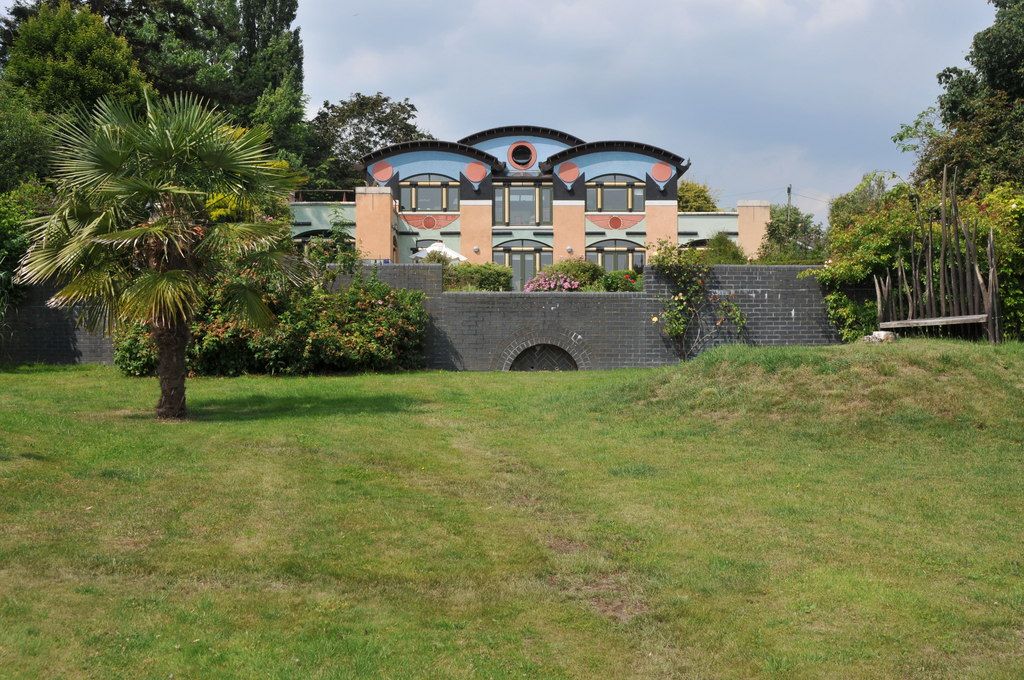
Sphinx Hill at Moulsford, photographed from the Thames side in July 2011. Philip Halling, Modern house overlooking the Thames — Sphinx Hill; CC BY-SA 2.0. JPEG prepared; no crop or retouch.
Its strong colour, bespoke interiors and symbolic landscape differ fundamentally from a Regency cemetery gate or 1920s cinema. The example proves that a revival is a recurring relationship with history, not a closed chronological box.
Contemporary reuse carries the same responsibility to distinguish reference from source culture. Creative transformation can be acknowledged while explaining what has been selected, invented or omitted.
Watch: Egyptian Revival from Cemetery Threshold to Cinema
Choose a history of Boise's Egyptian Theatre or a short visual tour through Highgate Cemetery's Egyptian Avenue.
History of Boise's Egyptian Theatre
A local historical account of Boise's Egyptian Theatre, connecting its 1920s design and cinema use to the continuing work of preservation.
Watch on YouTubeHow to recognise Egyptian Revival architecture
1. Find the wave and location. Early nineteenth-century, later Victorian and 1920s examples answer different events.
2. Protect Egyptian source histories. Revival is later selection, not a continuation of ancient practice.
3. Read mass before motif. Look for battered pylons, broad walls and a staged entrance.
4. Check the cornice and columns. Cavetto curves and plant-derived capitals are useful in combination.
5. Examine symbolic surfaces. Distinguish meaningful inscriptions from invented or decorative signs.
6. Identify the construction. Brick, plaster, terracotta and concrete can create stone-like monumentality.
7. Study the programme. Cemetery, church, prison, mill, bank and theatre use the imagery differently.
8. Trace the knowledge route. Publications, collections, exhibitions and archaeology were shaped by power.
9. Allow hybrid labels. Classical and Art Deco systems frequently overlap.
10. Record loss and alteration. Paint, cinema technology, interiors and whole buildings may have changed.
Egyptian Revival: Waves, Motifs and Programme Tests
Identify the revival wave and programme before treating any individual motif as decisive evidence.
| Evidence | What it can suggest | What else to verify |
|---|---|---|
| Pylon or battered mass | Inward-sloping walls or towers framing a monumental entrance. | Structure, date, source monument and whether the form is applied or spatial. |
| Cavetto and plant capitals | Concave cornices with lotus-, papyrus- or palm-derived column forms. | Surviving colour, material, accuracy and combination with other styles. |
| Funerary context | A gate, catacomb or memorial using Western ideas of eternity and secrecy. | Local burial culture, patronage and the difference from ancient Egyptian meanings. |
| Institution or industry | Historical monumentality framing a church, medical school, prison or factory. | Programme, labour, hidden construction and the authority the image projected. |
| Cinema or Art Deco wave | 1920s spectacle combining Egyptian motifs with modern entertainment and geometry. | Tutankhamun-era documentation, later alteration and distinction from generic Art Deco. |
Frequently asked questions
No. It is later architecture inspired by selected Egyptian forms. Ancient Egyptian buildings belong to their own periods, communities, religions, materials and landscapes.
Western audiences associated surviving Egyptian monuments and excavated tombs with death and eternity. Nineteenth-century cemetery designers adapted that modern association for gates, catacombs and memorials.
No. The revival was already more than a century old. The 1922 discovery stimulated a new wave in cinemas, commercial buildings, interiors, fashion and Art Deco design.
No. Use mass, entrance, cornice, surface, date, programme and documentation together. Isolated Egyptian motifs often decorate otherwise classical or eclectic buildings.
Egyptomania is broader popular fascination expressed through buildings, objects, advertising, film and fashion. Egyptian Revival architecture is one part of that larger cultural phenomenon.
Discussion
Which Egyptian Revival building most clearly shows how the same historical imagery changed with programme, place and period?
Reader Insights
Does the building belong to an early publication-led revival, a Victorian cycle or the Tutankhamun-era wave?
How do pylon massing, cavetto cornices, plant capitals or symbolic surfaces relate to the modern structure behind them?
What did a cemetery, church, factory, bank or cinema claim by using selected Egyptian forms?
Join the Conversation
Share a documented example or useful source below, noting date, programme, source imagery, materials, cultural context and later alteration.
References
- Metropolitan Museum of Art, Egyptian Revival.
- Metropolitan Museum of Art, Description de l'Égypte, 1809–1829.
- Washington State Department of Archaeology and Historic Preservation, Egyptian Revival.
- National Museum of American History, How we became Egyptomaniacs.
- Historic England, Egypt in England.
- US National Park Service, National Historic Landmarks guide.
- Historic England, Abney Park Cemetery.
- Historic England, Highgate Cemetery.
- Historic England, Sustaining England's industrial heritage.
- Library of Congress, First Presbyterian Church, Nashville.
- US National Park Service, First Presbyterian Church nomination.
- US National Park Service, Egyptian Building, Richmond nomination.
- Library of Congress, HABS, Independent Order of Odd Fellows Hall, Philadelphia.
- SFO Museum, Harold Allen: Egyptian Revival Architecture.
- SFO Museum, Egyptian Revival: An Everlasting Allure.
- US National Park Service, American National Bank Building nomination.
- Library of Congress, HABS, Ada Theater.
- City of Boise, Historic Preservation Plan 2010.
- British Museum, The past is present: becoming Egyptian in the twentieth century.
- Historic England, Sphinx Hill.