


 by Tom Gurney
Tom Gurney BSc (Hons) is an art history expert with over 20 years experience
Email: tomgurney1@gmail.com / Phone: +44 7429 011000
Definition and first recognition
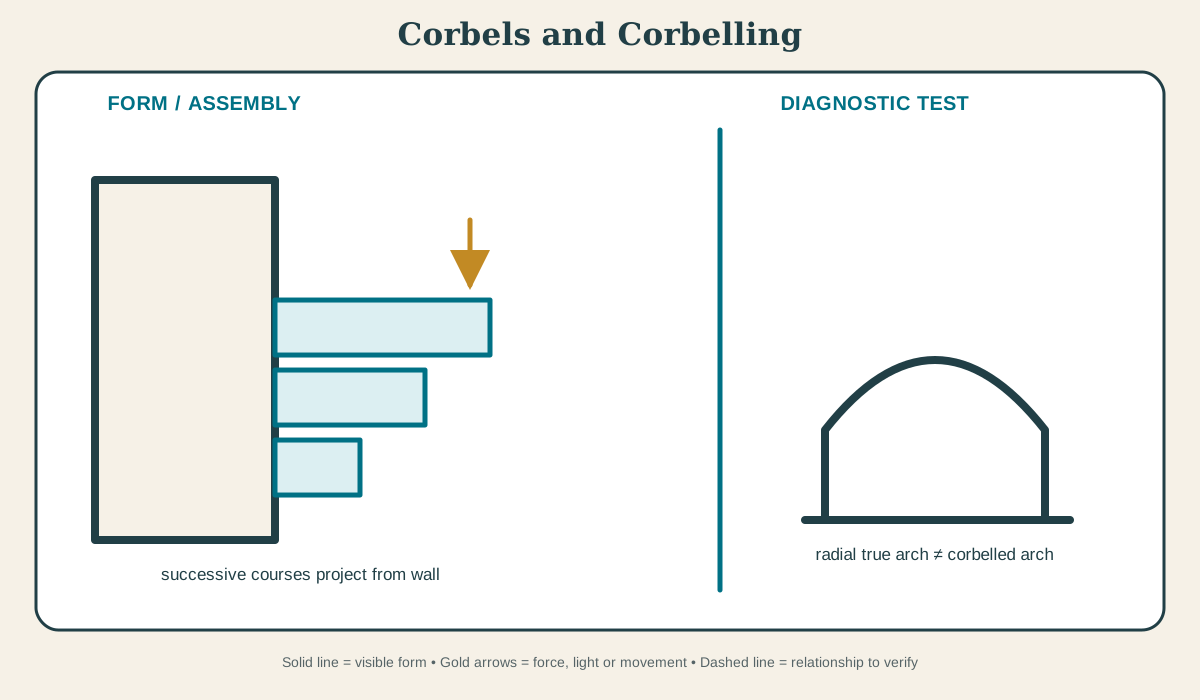
The corbel is a block or series of projecting courses that carries weight beyond the face of a wall. Look beneath a projection for stepped or shaped units that cantilever successively from the masonry. [1][2]
At a Glance
- Basic meaninga block or series of projecting courses that carries weight beyond the face of a wall
- Recognition cueLook beneath a projection for stepped or shaped units that cantilever successively from the masonry.
- Principal roleIt transfers a balcony, beam, cornice, turret or arch-like construction back into the wall through compression and bending.
- Historical developmentProjecting masonry courses appear in ancient and vernacular traditions worldwide, while medieval builders developed corbel tables, supported galleries and tower projections in stone and timber.
- Main cautionA corbelled arch advances horizontal courses; it does not work like a true arch of radial voussoirs.
Contents
What the corbel does
It transfers a balcony, beam, cornice, turret or arch-like construction back into the wall through compression and bending. This explains a general masonry relationship, not the stability of a particular wall. Embedment, backing, concealed anchors and altered loads require building-specific investigation before the force path or condition can be judged.[2][3]
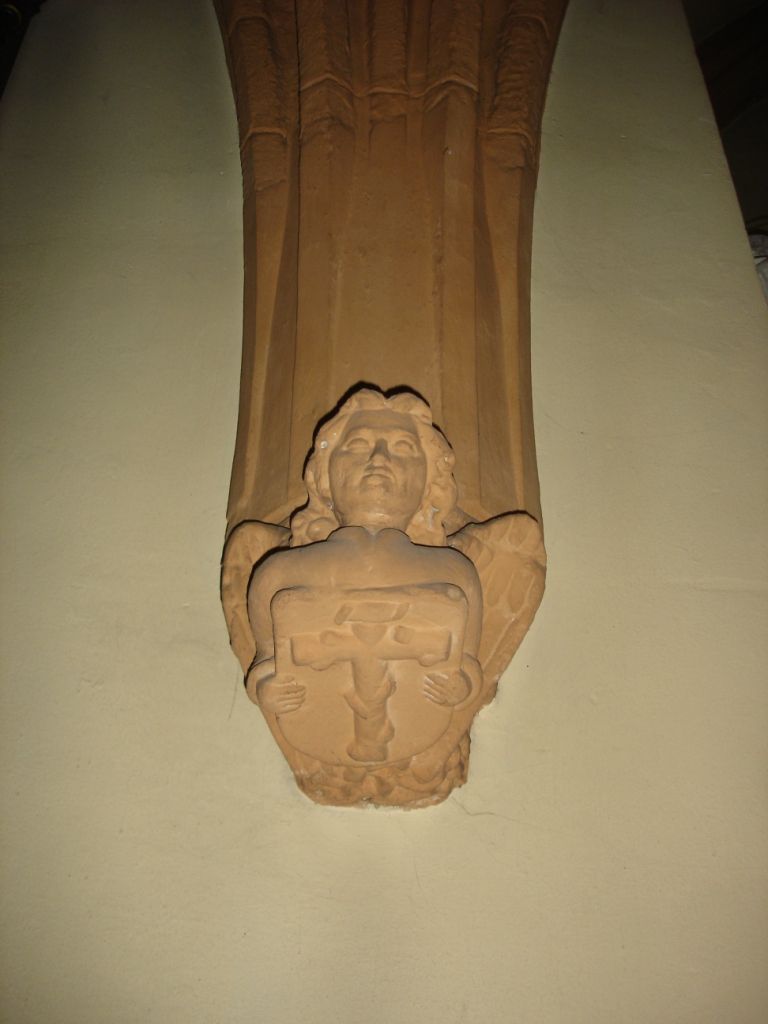
The corbel of arched roof - Cathedral of Maribor. Arched roof, Cathedral of Maribor, Slovenia. In “What the corbel does”, this view records the form, material and setting discussed in the passage. Source image dated 2007; that date records the image, not the original construction. Janezdrilc, The corbel of arched roof - Cathedral of Maribor; Public domain. Resized proportionally; no crop, retouch or upscaling.
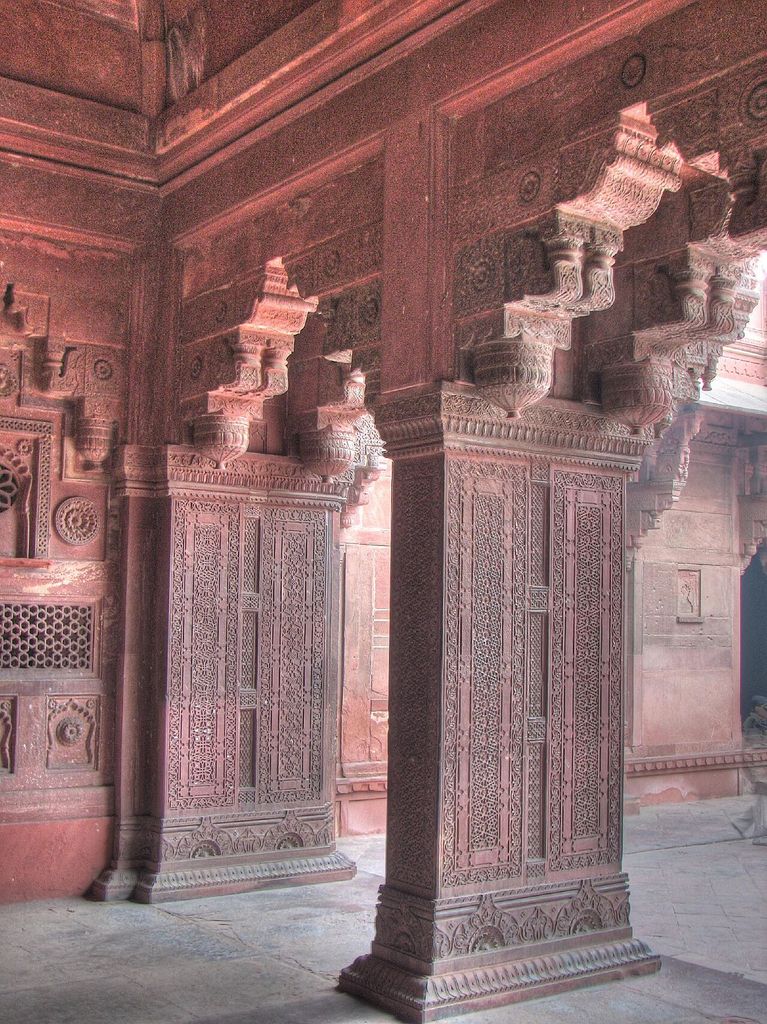
Red sandstone corbel brackets, Agra Fort. Carved sandstone architectural sculptures at Agra Fort — India. In “What the corbel does”, this view records the form, material and setting discussed in the passage. Source image dated 2008; that date records the image, not the original construction. michael clarke stuff, Red sandstone corbel brackets, Agra Fort; CC BY-SA 2.0. Resized proportionally; no crop, retouch or upscaling.
A corbel projects from a wall to support weight beyond its face. A single block behaves as a short cantilever with compressive bearing at the wall; successive masonry courses can step inward until they meet, forming a corbelled arch or vault. That stepped construction differs from radial voussoirs in a true arch. Exposure is read at ledges, upper beds and wall junctions. Water lingering on a projection can drive salt movement, frost damage or corrosion of hidden cramps, while sheltered returns may preserve tooling lost from the face. Uneven decay can therefore disclose orientation and repair material as readily as age.
Historical development
Corbelling appears independently in ancient and vernacular stone traditions around the world. Medieval European builders used carved corbels beneath beams, parapets and vault ribs and arranged corbel tables beneath rooflines. Timber brackets perform related work with different joints. Revival architecture often copied the silhouette in plaster or terracotta. The surviving sequence is shaped by repair as much as invention. Projecting stones, corner dressings and textured wall surfaces were repeatedly reset, refaced or copied, and later metal anchors can make an old profile perform in a new way. A defensible history therefore follows the dated wall campaign, the bond with adjacent masonry and documented repair rather than treating a familiar silhouette as a period label.[2][3]
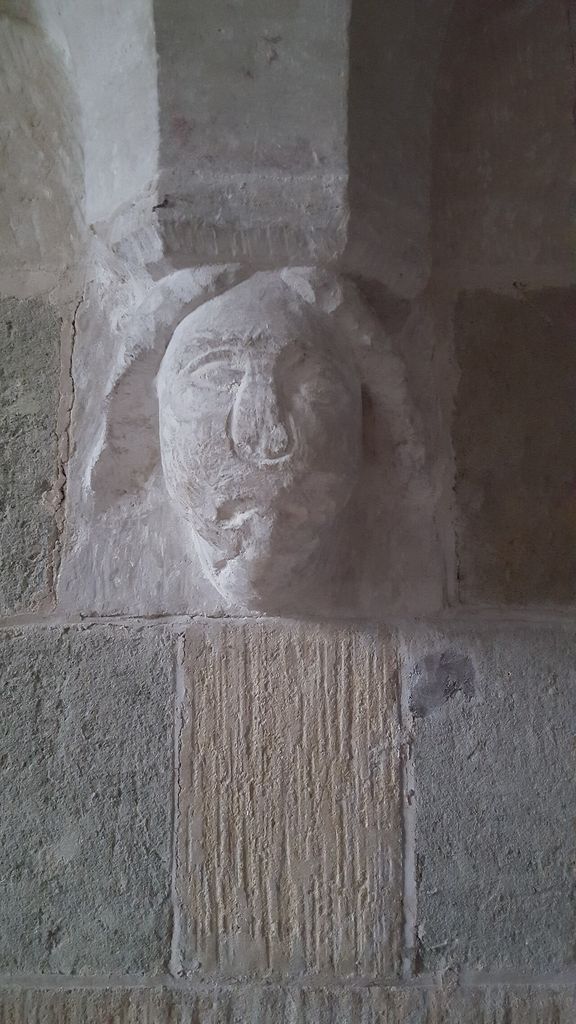
Carved corbel in Idmiston Chuch. This is one of many carved corbels in this church. In “Historical development”, this view helps identify corbel table architecture. Source image dated 2020; that date records the image, not the original construction. Richard Avery, Carved corbel in Idmiston Chuch; CC BY-SA 4.0. Resized proportionally; no crop, retouch or upscaling.
Terminology and common confusions
A corbelled arch advances horizontal courses and does not work like a true arch of radial voussoirs. ‘Bracket’ is a broader term often applied to timber or metal, so material, joint and supported element must accompany the label. [1][3]
Conservation and alteration
Conservation begins with water and movement. Open joints, failed copings, salt crystallisation and incompatible hard cement repairs can accelerate stone or brick decay. Repair should retain sound material, use compatible mortar and address the source of displacement before rebuilding a visually tidy surface. Repair may introduce indented stone, new mortar, pins, cramps, anchors or local rebuilding. Each intervention should be dated where possible, and cleaning must retain tooling, paint and weathering that help distinguish campaigns.[3][4]
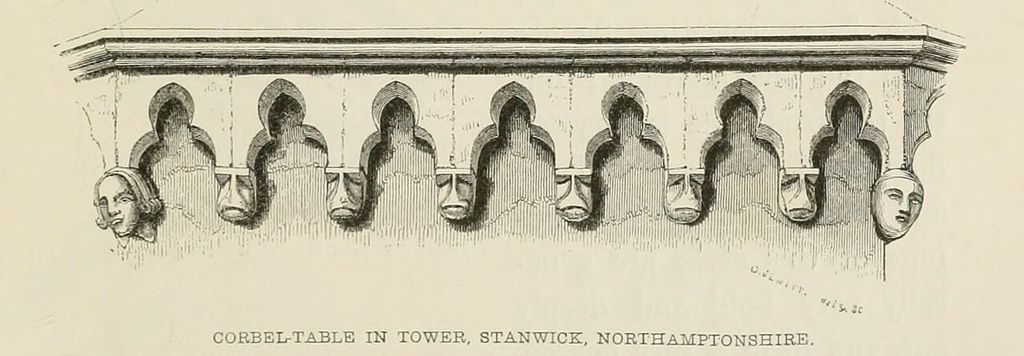
Stanwick Corbel Table stylesofarchitec00rick 0185. Illustration from An attempt to discriminate the styles of architecture in England : from the Conquest to the Reformation : with a sketch of the Grecian and Roman orders : notices of numerous British edifices :and…. In “Conservation and alteration”, this view records the form, material and setting discussed in the passage. Source image dated 1848; that date records the image, not the original construction. Rickman, Thomas, 1776-1841, Stanwick Corbel Table stylesofarchitec00rick 0185; Public domain. Resized proportionally; no crop, retouch or upscaling.
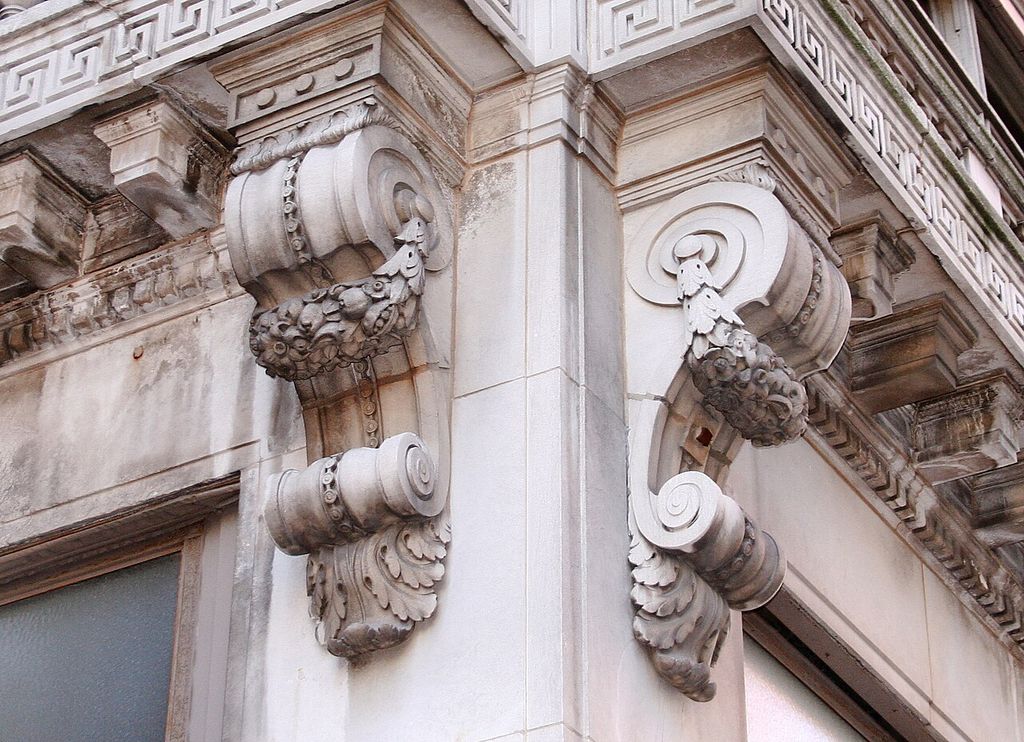
Architecture-corbels. Stone corbels on a building in Indianapolis, Indiana. In “Conservation and alteration”, this view records the form, material and setting discussed in the passage. Source image dated 2005; that date records the image, not the original construction. Derek Jensen ( Tysto ), Architecture-corbels; Public domain. Resized proportionally; no crop, retouch or upscaling.
Repeated photographs, joint and moisture surveys, and—where movement is suspected—measured monitoring can distinguish old distortion from active change without sacrificing sound historic masonry. Conservation is included here as historical evidence: repair changes the object presented to readers and may reveal relationships that a supposedly pristine image conceals.
Examples for Further Study
The examples below show how the form changes across periods, materials and settings.
| Building or setting | Evidence to examine | Variant | Source |
|---|---|---|---|
| Romanesque corbel table | A rhythmic row carries or appears to carry a projecting eaves course. Trace the unit into its backing wall. | single stone corbel | Reference 5 |
| Medieval hall | Carved stone corbels receive roof or floor beams and may include figures. Compare projection and bearing in section. | timber bracket | Reference 6 |
| Maya corbel vault | Successive wall courses project inward; the type must not be called a true arch. Use joints and material change to identify campaigns. | corbel table | Reference 5 |
| Oriel window | Brackets or corbels transfer an upper-storey projection back into the wall. Treat difference of scale as evidence, not as an exception to hide. | corbelled arch | Reference 6 |
What the corbel reveals about the building
At Maya corbel vault, successive wall courses project inward; the type must not be called a true arch. At Oriel window, brackets or corbels transfer an upper-storey projection back into the wall. Together, these cases show that the corbel is not a detachable motif: it participates in material, access, environmental control, structure or display according to its setting.[1][4]
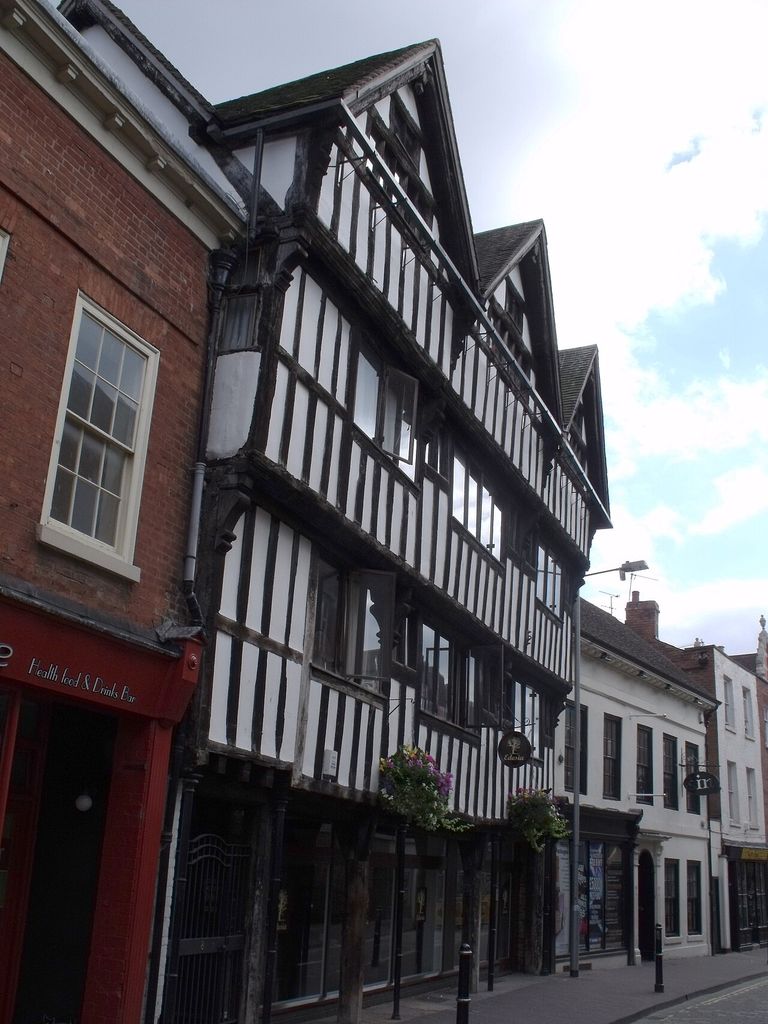
Edesia, Nash House - 6-8 New Street, Worcester (3920684102). This is Edesia at 6-8 New Street in Worcester. In “What the corbel reveals about the building”, this view helps identify timber corbel bracket. Source image dated 2009; that date records the image, not the original construction. Elliott Brown from Birmingham, United Kingdom, Edesia, Nash House - 6-8 New Street, Worcester (3920684102); CC BY 2.0. Resized proportionally; no crop, retouch or upscaling.
Comparing the corbel examples
Romanesque corbel table and Medieval hall illustrate distinct settings: a rhythmic row carries or appears to carry a projecting eaves course. By contrast, carved stone corbels receive roof or floor beams and may include figures. Maya corbel vault differs because successive wall courses project inward; the type must not be called a true arch. Finally, Oriel window shows that brackets or corbels transfer an upper-storey projection back into the wall.[4][6]
Watch: Three Ways to Read Corbels and Corbelling
Choose The Impressive Engineering of the Roman Arch, Romanesque Architecture Explained or Gothic Architecture Explained. Together, the films connect architectural form with material, use and historical setting.
The Impressive Engineering of the Roman Arch
Animates the compression logic of an arch, making voussoirs, abutment and centring easier to distinguish.
Watch on YouTubeFrequently Asked Questions
A block or series of projecting courses that carries weight beyond the face of a wall.
Look beneath a projection for stepped or shaped units that cantilever successively from the masonry. Confirm the identification by checking depth, joints, material and position in a plan or section.
Not necessarily. Historic examples may carry load, protect an edge, manage water or organise space, while later versions can preserve the appearance as applied ornament. The surrounding assembly determines the answer.
No. Shape can narrow a comparison, but revivals, reuse and repair allow the same form to appear in different periods. Documents and material evidence are needed for a defensible date.
Record the complete assembly and diagnose water, movement, corrosion, decay and earlier intervention before replacing visible fabric. Safety-critical decisions require a qualified professional and a building-specific survey.
Discussion
Find a documented example of corbels and corbelling. Which joint, section or sign of alteration most changes what a façade photograph alone seems to show? Cite the source and separate observation from inference.
Reader Insights
Name the material, joint, opening or route you can observe.
Give the building, place, approximate date and a reliable source.
Separate documented history from your interpretation.
Join the Conversation
Share a concise observation or useful source below.
References
- Hastings Borough Council. “Glossary of architectural terms.” View source
- Getty Research Institute. “Art & Architecture Thesaurus.” View source
- Francis D. K. Ching. “A Visual Dictionary of Architecture, 2nd edition.” View source
- U.S. National Park Service. “Best Practices in Stone Building Preservation Management.” View source
- Wakefield Council. “District Design Code glossary: corbel.” View source
- Smarthistory. “Italo-Roman building techniques.” View source
- Istituto Treccani. “Mensola.” View source
- Edinburgh Research Archive. “Medieval masonry techniques and architectural elements in central-eastern Umbria.” View source
- Brussels-Capital Region Heritage Inventory. “Glossaire de l’architecture.” View source
- French Ministry of Culture, POP. “Mérimée architectural inventory.” View source
- Istituto Treccani. “Mensola.” View source
Explore RELATED Architecture
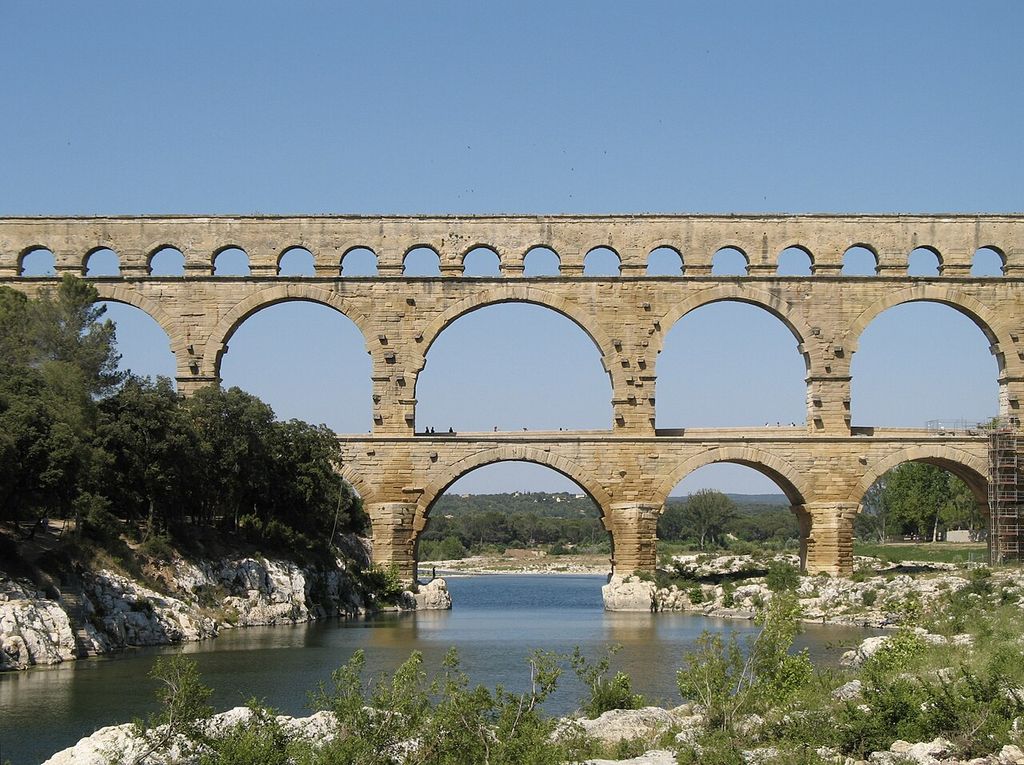
Arches
further context for corbels and corbelling.
Vaults
further context for corbels and corbelling.
Arcade
further context for corbels and corbelling.
Round vs Pointed Arches
further context for corbels and corbelling.
Roman Architecture
further context for corbels and corbelling.
Romanesque Architecture
further context for corbels and corbelling.
Historic Bridges
further context for corbels and corbelling.
Colosseum
further context for corbels and corbelling.