


 by Tom Gurney
Tom Gurney BSc (Hons) is an art history expert with over 20 years experience
Email: tomgurney1@gmail.com / Phone: +44 7429 011000
Definition and first recognition
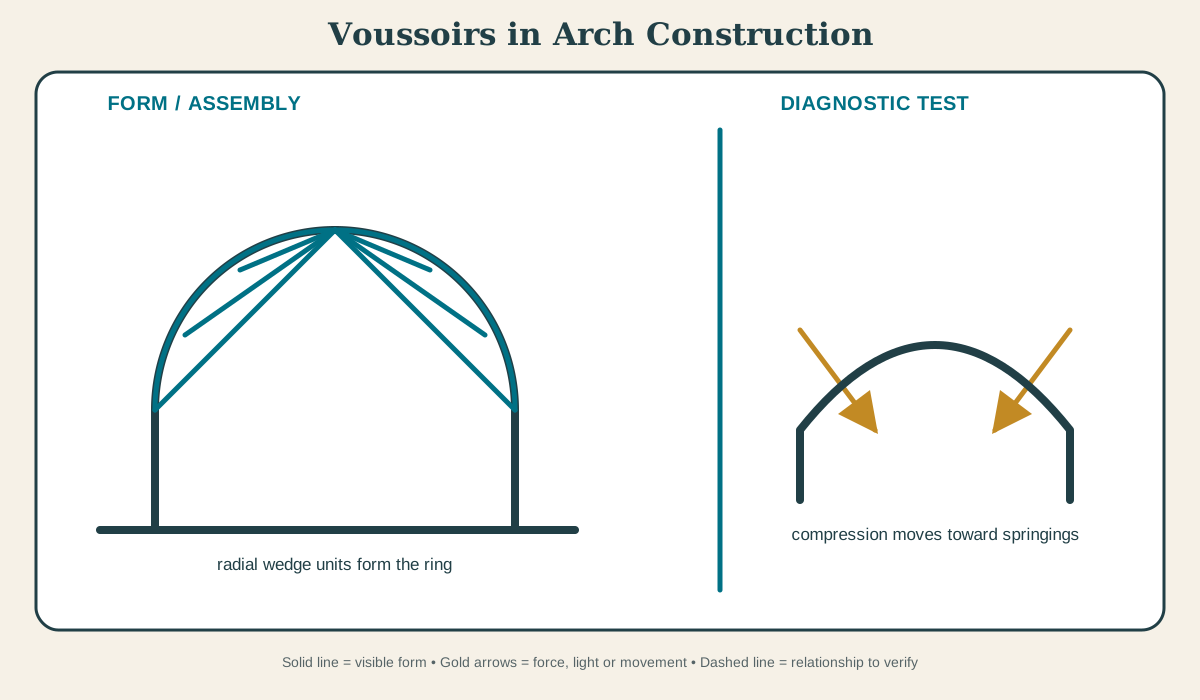
The voussoir is one of the wedge-shaped masonry units that together form an arch or a masonry vault. Read the radiating joints around the curve; the units taper toward the centre of curvature. [1][2]
At a Glance
- Basic meaningone of the wedge-shaped masonry units that together form an arch or a masonry vault
- Recognition cueRead the radiating joints around the curve; the units taper toward the centre of curvature.
- Principal roleCompression passes from unit to unit toward the springings and supporting piers or walls.
- Historical developmentRadial masonry units enabled durable arches in ancient traditions and became visibly expressive through moulding, colour alternation and rustication in medieval and early-modern buildings.
- Main cautionThe keystone is the central voussoir, not a separate structural species; decorative wedge patterns may imitate voussoirs without matching the hidden construction.
Contents
What the voussoir does
Compression passes from unit to unit toward the springings and supporting piers or walls. This explains the general geometry and construction, not the stability of a particular arch or vault. Ring depth, fill, abutment, deformation and later reinforcement require measured investigation.[2][3]
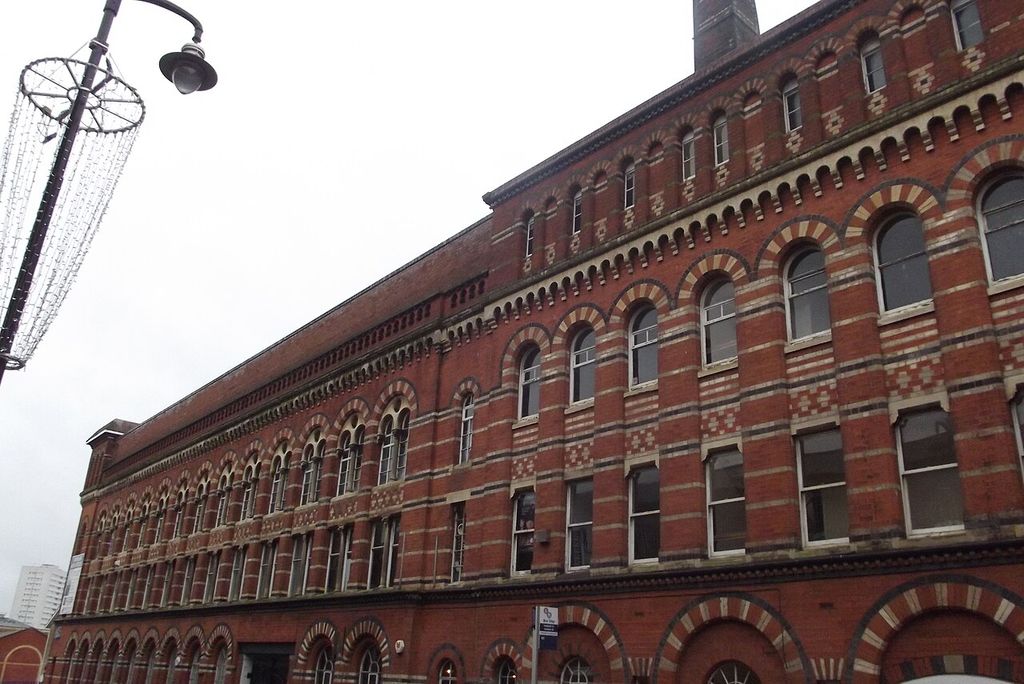
The Argent Centre - Frederick Street - Jewellery Quarter (8323148318). The Argent Centre on the corner of Legge Lane and Frederick Stret in the Jewellery Quarter. In “What the voussoir does”, this plan helps identify polychrome voussoirs. Source image dated 2012; that date records the image, not the original construction. Elliott Brown from Birmingham, United Kingdom, The Argent Centre - Frederick Street - Jewellery Quarter (8323148318); CC BY 2.0. Resized proportionally; no crop, retouch or upscaling.
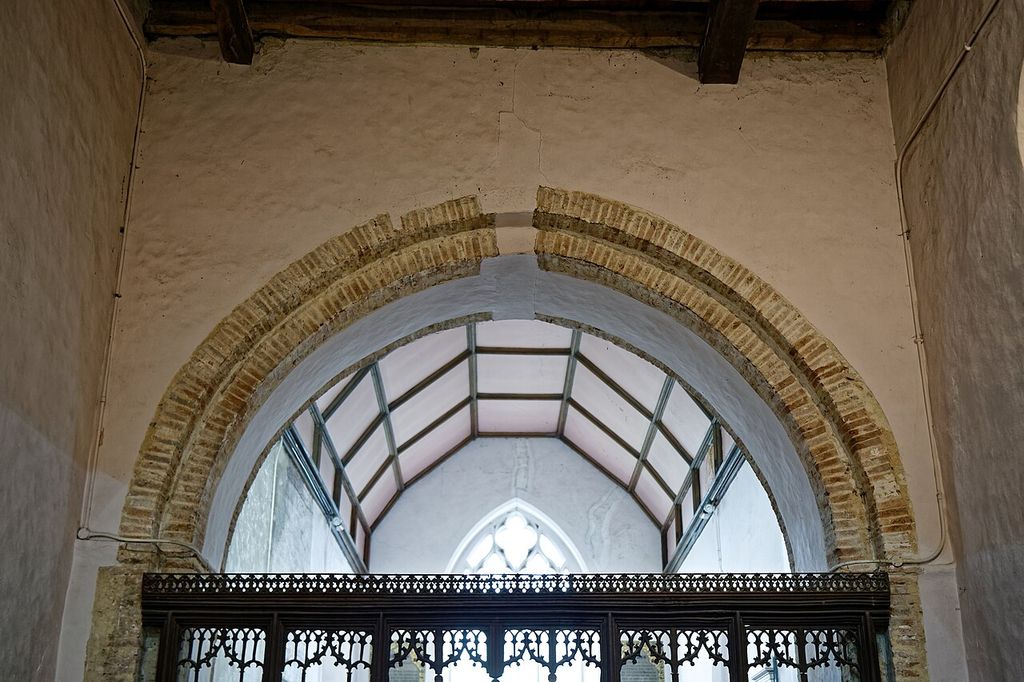
Church of St Andrew's, Boreham, Essex - chancel arch voussoir remains. The central tower side of the chancel arch, with voussoir remains of the late 11th- or early 12th century round headed arch, of the Grade I listed 11th- to 15th-century Parish Church of St Andrew's, in Boreham…. In “What the voussoir does”, this view records the form, material and setting discussed in the passage. Source image dated 2017; that date records the image, not the original construction. Acabashi, Church of St Andrew's, Boreham, Essex - chancel arch voussoir remains; CC BY-SA 4.0. Resized proportionally; no crop, retouch or upscaling.
Voussoirs are wedge-shaped units laid radially so that compressive forces pass around the curve toward the springings. During construction they require temporary centring until the ring is complete. Their beds should point broadly toward the centre of curvature; poorly shaped joints can concentrate stress. Several concentric rings may form a deep arch or archivolt. Moisture entering from parapets, spandrels or failed drainage can weaken mortar and mobilise salts above an arch or vault. Staining should be mapped against joints and the construction above before it is attributed to a structural crack; water and thrust may share a visible route without sharing a cause.
Historical development
Cut-stone and brick voussoirs appear across ancient Mediterranean and Near Eastern building. Roman engineering deployed them in bridges, aqueducts and monumental arcades. Medieval portals multiplied and moulded arch rings; Islamic builders used alternating colours and varied profiles; Renaissance designers enlarged or rusticated voussoirs for visual force. Arched construction has no single line of progress from crude to perfected form. Geometry, centring, mortar, abutment and the material above the arch all changed across regions, while old openings were widened, blocked and rebuilt. Dating must attach to the particular arch campaign and its surrounding wall; the presence of a pointed, round or ogee outline alone cannot establish a century.[2][3]
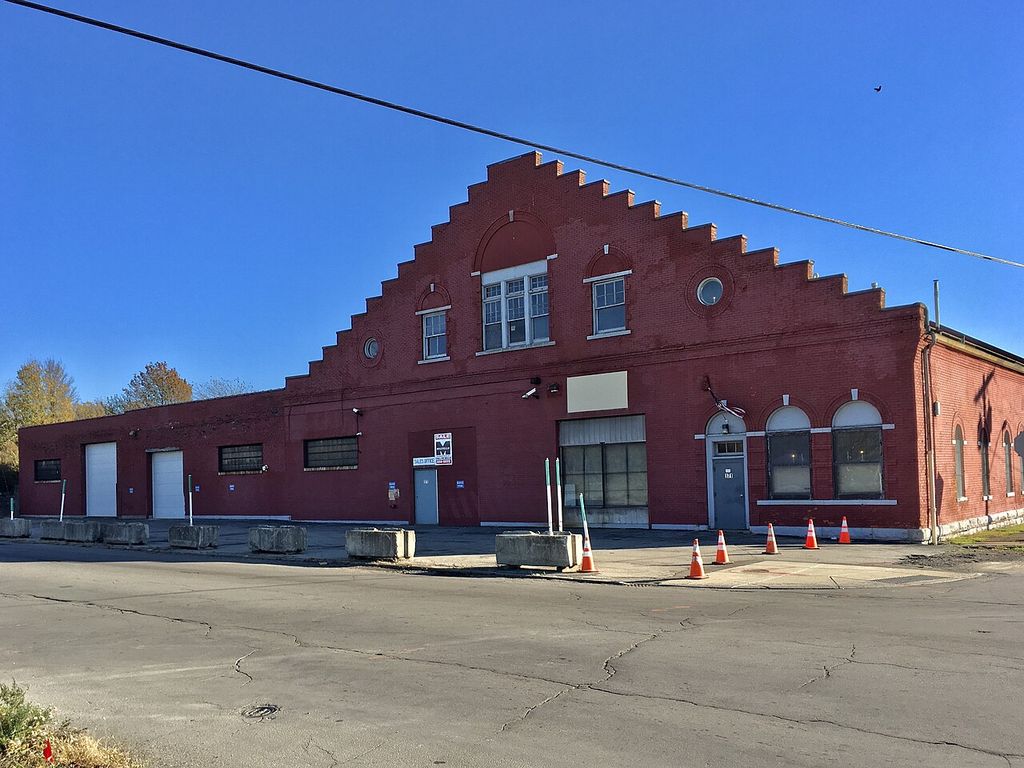
Former Buffalo Traction Company (later International Railway Company) garage, Buffalo, New York - 20201104. As seen in November 2020: the former International Railway Company garage at 175 Walden Avenue (corner Lathrop Street) in Buffalo, New York. In “Historical development”, this view helps identify voussoirs arch masonry. Source image dated 2020; that date records the image, not the original construction. Andre Carrotflower, Former Buffalo Traction Company (later International Railway Company) garage, Buffalo, New York - 20201104; CC BY-SA 4.0. Resized proportionally; no crop, retouch or upscaling.
Terminology and common confusions
The keystone is the central voussoir, not a separate structural species, and it does not support an otherwise inert ring by itself. Applied wedge patterns may imitate voussoirs without reproducing the hidden arch construction. [1][3]
Conservation and alteration
Arch repair requires diagnosis before repointing. Cracks may record historic settlement that has stabilised, or active movement at an abutment. Replacing eroded units without adequate temporary support can change force paths. Any reconstruction should document centring, joint geometry and the extent of new fabric. Repair may involve resetting voussoirs, grouting, repointing, rebuilding spandrels or adding ties and reinforcement. These measures can redirect forces, so their date and relationship to the full arch or vault must remain legible.[3][4]
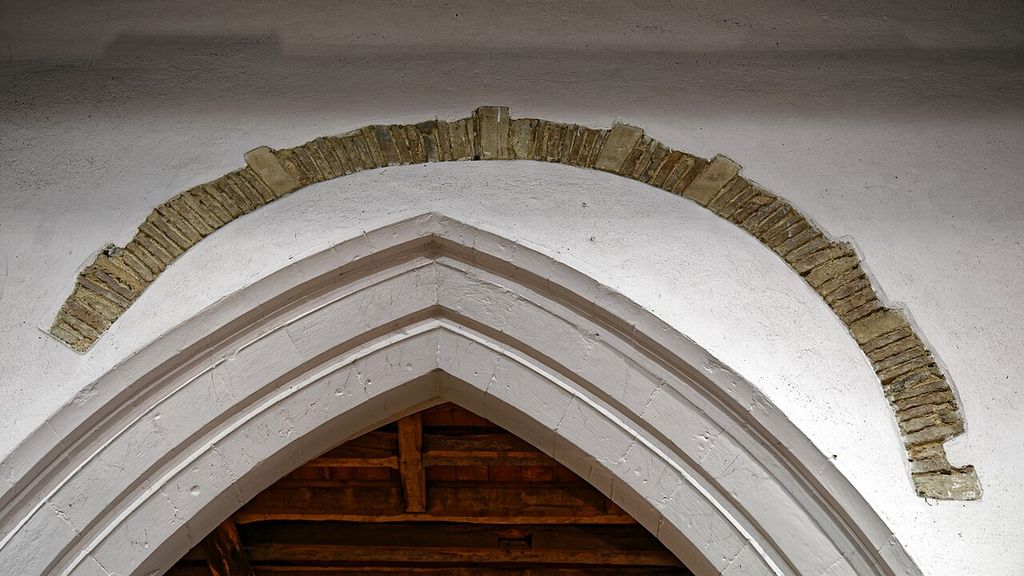
Church of St Andrew's, Boreham, Essex - tower arch voussoir remains. The nave side of the central tower arch, with voussoir remains above of a late 11th- or early 12th century round headed arch, of the Grade I listed 11th- to 15th-century Parish Church of St Andrew's, in Boreham…. In “Conservation and alteration”, this view records the form, material and setting discussed in the passage. Source image dated 2017; that date records the image, not the original construction. Acabashi, Church of St Andrew's, Boreham, Essex - tower arch voussoir remains; CC BY-SA 4.0. Resized proportionally; no crop, retouch or upscaling.
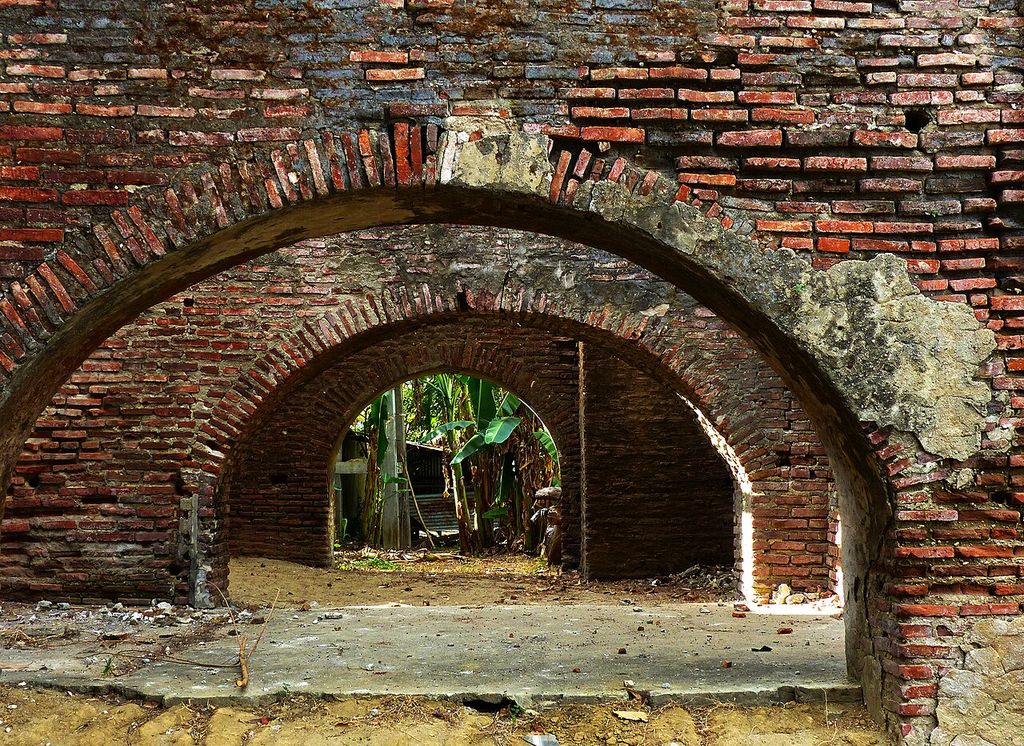
Ruined arches. (17171050176). A brick arch is the traditional and one of the most aesthetically pleasing methods of masonry support over an opening in brick or stone walling. In “Conservation and alteration”, this section drawing helps identify voussoirs arch masonry. Source image dated 2014; that date records the image, not the original construction. Bernard Spragg. NZ from Christchurch, New Zealand, Ruined arches. (17171050176); CC0. Resized proportionally; no crop, retouch or upscaling.
Mapped cracks and displacement become meaningful only when compared over time and related to arch geometry, fill, abutments and water entry; a dramatic fissure is not a diagnosis by itself. Conservation is included here as historical evidence: repair changes the object presented to readers and may reveal relationships that a supposedly pristine image conceals.
Examples for Further Study
The examples below show how the form changes across periods, materials and settings.
| Building or setting | Evidence to examine | Variant | Source |
|---|---|---|---|
| Roman bridge arches | Regular radial joints reveal the load-bearing ring above piers and abutments. Pair the elevation with a section through the ring. | plain voussoirs | Reference 5 |
| Romanesque portals | Multiple moulded orders extend the structural arch into a deep sculptural threshold. Relate the curve to springing and abutment. | rusticated voussoirs | Reference 6 |
| Striped Islamic arches | Alternating colour makes individual units legible but does not by itself reveal hidden material. Check whether the visible masonry is integral or applied. | alternating-colour voussoirs | Reference 5 |
| Rusticated Renaissance gates | Oversized wedge patterns may combine genuine masonry with representational surface treatment. Use the different spanning problem to test, rather than merely illustrate, the definition. | extrados-marked arch rings | Reference 6 |
What the voussoir reveals about the building
At Striped Islamic arches, alternating colour makes individual units legible but does not by itself reveal hidden material. At Rusticated Renaissance gates, oversized wedge patterns may combine genuine masonry with representational surface treatment. Together, these cases show that the voussoir is not a detachable motif: it participates in material, access, environmental control, structure or display according to its setting.[1][4]
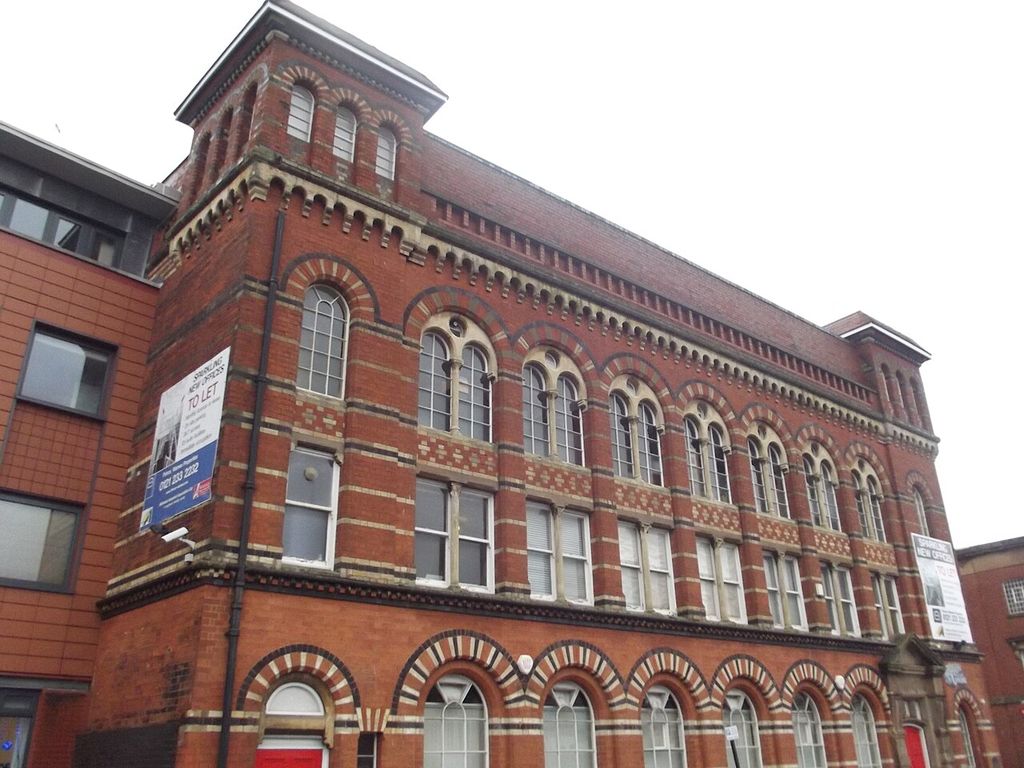
The Argent Centre - Legge Lane - Jewellery Quarter (8322082215). The Argent Centre on the corner of Legge Lane and Frederick Stret in the Jewellery Quarter. In “What the voussoir reveals about the building”, this plan helps identify polychrome voussoirs. Source image dated 2012; that date records the image, not the original construction. Elliott Brown from Birmingham, United Kingdom, The Argent Centre - Legge Lane - Jewellery Quarter (8322082215); CC BY 2.0. Resized proportionally; no crop, retouch or upscaling.
Comparing the voussoir examples
Roman bridge arches and Romanesque portals illustrate distinct settings: regular radial joints reveal the load-bearing ring above piers and abutments. By contrast, multiple moulded orders extend the structural arch into a deep sculptural threshold. Striped Islamic arches differs because alternating colour makes individual units legible but does not by itself reveal hidden material. Finally, Rusticated Renaissance gates shows that oversized wedge patterns may combine genuine masonry with representational surface treatment.[4][6]
Watch: Three Ways to Read Voussoirs in Arch Construction
Choose The Impressive Engineering of the Roman Arch, Arches: How They Do Not Fall Apart or Vault Types: Barrel, Groin and Ribbed. Together, the films connect architectural form with material, use and historical setting.
The Impressive Engineering of the Roman Arch
Animates the compression logic of an arch, making voussoirs, abutment and centring easier to distinguish.
Watch on YouTubeFrequently Asked Questions
One of the wedge-shaped masonry units that together form an arch or a masonry vault.
Read the radiating joints around the curve; the units taper toward the centre of curvature. Confirm the identification by checking depth, joints, material and position in a plan or section.
Not necessarily. Historic examples may carry load, protect an edge, manage water or organise space, while later versions can preserve the appearance as applied ornament. The surrounding assembly determines the answer.
No. Shape can narrow a comparison, but revivals, reuse and repair allow the same form to appear in different periods. Documents and material evidence are needed for a defensible date.
Record the complete assembly and diagnose water, movement, corrosion, decay and earlier intervention before replacing visible fabric. Safety-critical decisions require a qualified professional and a building-specific survey.
Discussion
Find a documented example of voussoirs in arch construction. Which joint, section or sign of alteration most changes what a façade photograph alone seems to show? Cite the source and separate observation from inference.
Reader Insights
Name the material, joint, opening or route you can observe.
Give the building, place, approximate date and a reliable source.
Separate documented history from your interpretation.
Join the Conversation
Share a concise observation or useful source below.
References
- Hastings Borough Council. “Glossary of architectural terms.” View source
- Getty Research Institute. “Art & Architecture Thesaurus.” View source
- Francis D. K. Ching. “A Visual Dictionary of Architecture, 2nd edition.” View source
- U.S. National Park Service. “Best Practices in Stone Building Preservation Management.” View source
- Nottinghamshire Historic Environment Record. “Voussoir thesaurus record.” View source
- Smarthistory. “Arch of Constantine.” View source
- Istituto Treccani. “Arco.” View source
- University of Leeds, White Rose eTheses. “Three-dimensional behaviour of brickwork masonry arch bridges.” View source
- French Ministry of Culture, POP. “Gothic choir inventory: voussoirs and vault keys.” View source
- Linnaeus University Repository. “Analysis and assessment of Swedish vaulted masonry structures using funicular methods.” View source
- French Ministry of Culture, POP. “Chapiteau et fragments de claveaux (voussoirs).” View source
Explore RELATED Architecture
Arches
further context for voussoirs in arch construction.
Vaults
further context for voussoirs in arch construction.
Arcade
further context for voussoirs in arch construction.
Round vs Pointed Arches
further context for voussoirs in arch construction.
Roman Architecture
further context for voussoirs in arch construction.
Romanesque Architecture
further context for voussoirs in arch construction.
Historic Bridges
further context for voussoirs in arch construction.
Colosseum
further context for voussoirs in arch construction.