by Tom Gurney
Tom Gurney BSc (Hons) is an art history expert with over 20 years experience
Email: tomgurney1@gmail.com / Phone: +44 7429 011000
Reading Caryatids
A caryatid is a sculpted female figure that takes the architectural place of a column, pier or related support. The definition depends on role, not subject alone: a statue of a woman standing beside a column is not automatically a caryatid. The figure must participate in the supporting order—actually, visually or through a hybrid construction—in relation to the entablature or architecture above.
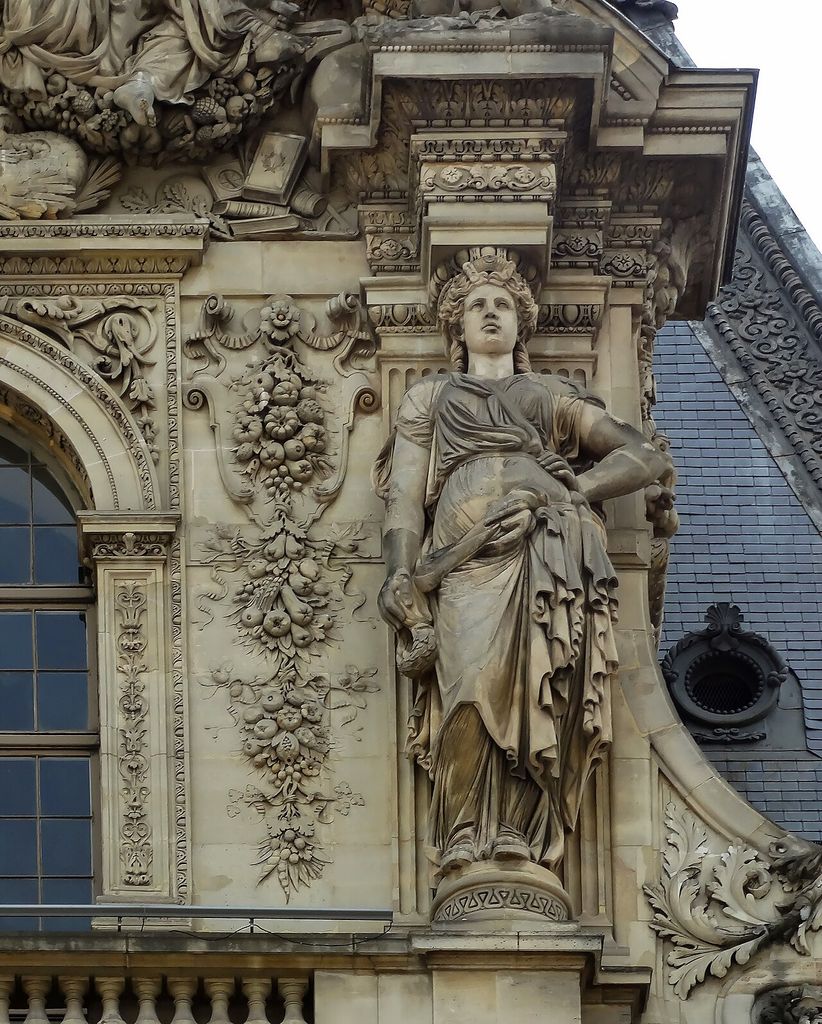
Louvre caryatid facade architecture. Created by Eugene Louis Lequesne in 1857 this is a sculpture that is part of a Caryatid - a support for the architecture above. In “Reading Caryatids”, this view records the form, material and setting discussed in the passage. Source image dated 2015; that date records the image, not the original construction. Eutouring, Louvre caryatid facade architecture; CC BY-SA 4.0. Resized proportionally; no crop, retouch or upscaling.
The six korai of the Erechtheion’s south porch on the Athenian Acropolis are the most famous ancient example, but they are neither identical nor the origin of every later figure support. Renaissance designers, printmakers and court architects transformed the type; nineteenth-century revivalists multiplied it; modern artists have used it to question gender, race, labour and the institutional idea of “bearing weight.”[1]
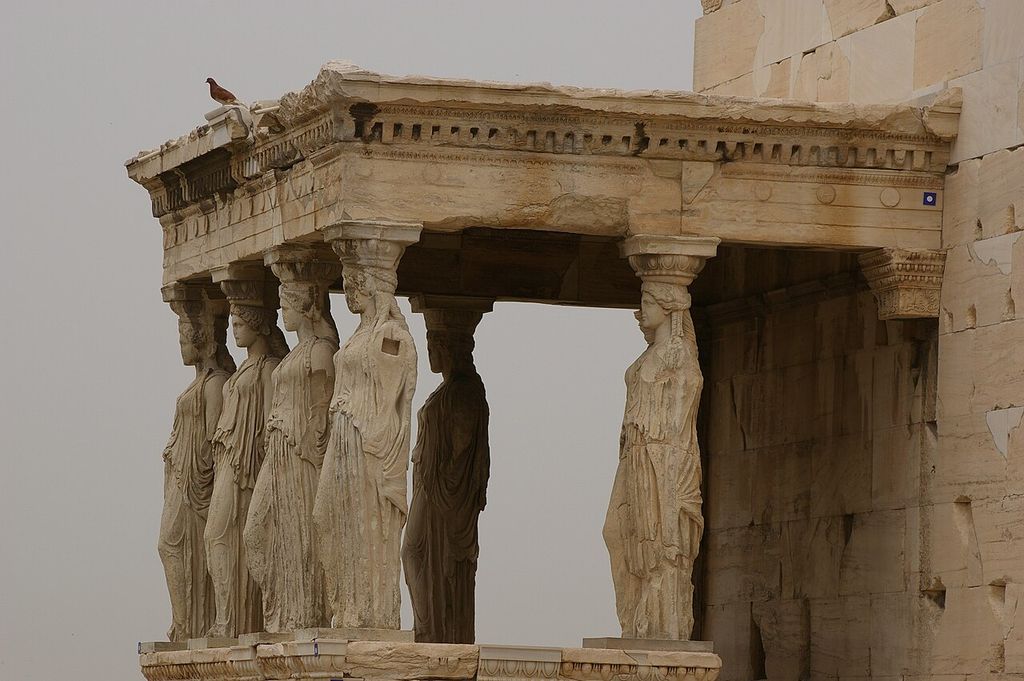
Erechtheion caryatids. The Caryatid Porch of the Erechtheion, Athens. In “Reading Caryatids”, this view records the form, material and setting discussed in the passage. Source image dated 2008; that date records the image, not the original construction. jacme31, Erechtheion caryatids; CC BY-SA 2.0. Resized proportionally; no crop, retouch or upscaling.
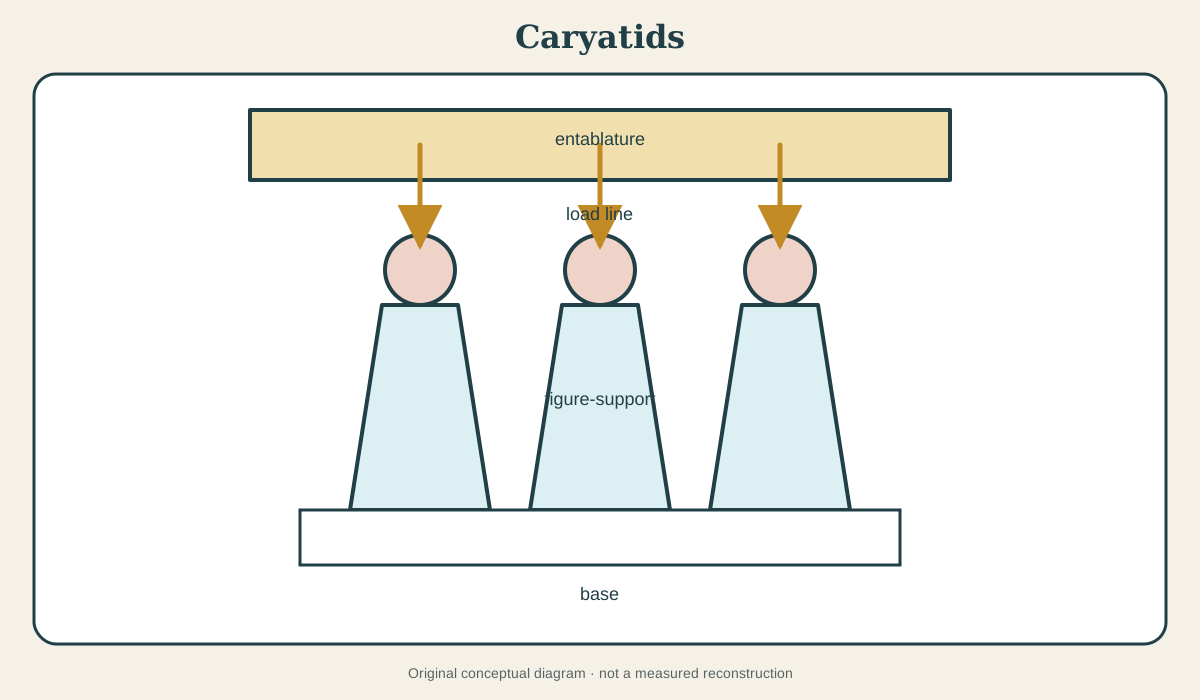
At a Glance
- Meaninga female human figure used in the place or role of an architectural support.
- How to recognise onetrace the relation among head or capital-like element, load above, body, base and supporting structure behind.
- Ancient referencethe Erechtheion’s south porch, with six coordinated but individually carved korai.
- Related termsatlas or telamon for a male supporting figure; herm and term for a head or torso merging into a tapering or pillar-like shaft.
- Essential cautionsome caryatids carry masonry directly; others encase, flank or represent a concealed support. Section and fabric decide.
Contents
- Figure as architectural order
- The Erechtheion korai
- Surface, colour and laser cleaning
- Names, myths and disputed origins
- Caryatid, atlas, telamon, herm and term
- Renaissance reception at the Louvre
- Print, façade and interior
- Gender, labour and the burdened body
- How to read a caryatid
- Conservation of body and building
Figure as architectural order
Columns organise load and proportion through base, shaft, capital and entablature. A caryatid translates that vertical sequence into a body. Feet and drapery meet the base. The torso rises where a shaft would stand. Head, basket or capital-like cushion mediates between figure and beam. The human image does not erase tectonics; it makes bearing visible through pose.
Contrapposto can solve both expressive and serial problems. One leg bears more apparent weight while the other relaxes, preventing the body from looking like an inert post. Drapery falls in long vertical folds that recall fluting and visually strengthen the lower figure. A broad arrangement of hair may reinforce the neck region, where a freestanding marble body would otherwise be vulnerable.
These observations do not prove a modern engineering calculation. They show how sculptural choices answer material and architectural position. The actual load may pass through the marble, through a core, or through structure concealed behind. A measured section and building record are necessary before declaring the body load-bearing in a technical sense.
The Erechtheion korai
The Acropolis Museum documents the Erechtheion figures individually, including Kore F.[1] That individual record matters. Popular images often turn “the Caryatids” into six interchangeable maidens, but stance, drapery, surface and condition differ. They operate as a coordinated row while retaining sculptural variation.
Their porch occupies a complex building on uneven sacred ground, conventionally dated to the late fifth century BCE. The figures carry the entablature of the south projection and face outward from an elevated base. Viewers encounter them from below and across the Acropolis, not as a circle of gallery statues.
The originals were removed to protect them from pollution and weather; one is in the British Museum, while five are displayed at the Acropolis Museum and replacement figures stand on the monument. This arrangement produces several architectural afterlives. The porch preserves the serial composition with copies. The museum enables close inspection and conservation. The absent figure makes collecting history and contested removal impossible to ignore.
Museum display can evoke spacing and entablature but cannot fully reproduce sun, wind, approach and sacred topography. Conversely, leaving all originals in place would have exposed them to continued damage. The case shows why “authentic location” and “authentic material” may pull conservation in different directions.
Surface, colour and laser cleaning
Ancient marble is often imagined as uniformly white. Weathering, pollution, burial, cleaning and lost pigment complicate that image. The Acropolis Museum’s laser-cleaning programme removed harmful dark crust with a method designed to protect the underlying surface.[2] Treatment improved legibility without returning the figures to an untouched fifth-century state.
Conservation photographs document a striking half-cleaned appearance. That image should not be simplified into “dirty versus original white.” The dark layer can include pollutants and altered material; the cleaned surface still bears age and treatment history. Any pigment traces require separate analysis.
Carving and possible colour worked together. Drapery ridges, hair and facial detail may have been differentiated by paint or attachments. Loss shifts visual emphasis towards abstract fold and pale stone. The modern caryatid is therefore both an ancient figure and a product of selective survival.
Names, myths and disputed origins
Vitruvius famously explained caryatids as images of women from Caryae condemned to bear burdens after their city’s betrayal. The story has had enormous influence on architectural interpretation. Its historical reliability is disputed, and it should be presented as an ancient Roman author’s explanatory narrative rather than the settled origin of the Greek support type.
The Greek museum’s use of kore—maiden—preserves another vocabulary for the Erechtheion figures. “Caryatid” has become the broad architectural term, but it carries centuries of reception. Naming should keep the specific object and later category in view.
Other ancient female figure supports occur at Delphi and in later Greek and Roman settings. Their costume, scale and structural relation differ. The type was available for quotation before Renaissance designers systematised it through drawing and print.
Caryatid, atlas, telamon, herm and term
An atlas or telamon is conventionally a male supporting figure. Atlantes often display effort through bent limbs or muscular strain, whereas caryatids have often been designed to appear composed. That contrast is a convention with gendered implications, not an inevitable result of structure.
A herm originally takes the form of a head—historically often Hermes—above a simple pillar-like shaft. A term is a related architectural support or ornament in which head or torso merges into a tapering pedestal. Terms can be male or female and may flank doors, furniture or garden structures. They do not necessarily stand as full-bodied substitutes for columns.
The Metropolitan Museum’s Renaissance ornament-print catalogue shows how caryatids, terms and atlantes circulated as a design vocabulary.[3] Print encouraged recombination: a designer could borrow pose, headdress or tapering support and fit it to a chimneypiece, doorway or piece of furniture. Boundaries became productive rather than fixed.
The most useful description names body, support and load. “Two female terms flank the opening” can be more exact than calling them caryatids because they look classical. Where historical records use a term differently, that usage can be retained and explained.
Renaissance reception at the Louvre
The Louvre’s Salle des Caryatides embeds figure supports in the political and architectural programme of a Renaissance palace.[4] Jean Goujon’s sculpted figures support the musicians’ gallery in a hall associated with Pierre Lescot’s transformation of the medieval fortress into a royal residence. Ancient reference is made contemporary through French court architecture.
This is not a simple copy of the Erechtheion. Scale, interior position, material setting and ceremonial function change. The figures participate in a room for royal representation and festivity. Their architectural burden becomes a metaphor for ordered support within monarchy and classicising culture.
The Louvre case also demonstrates authorship across disciplines. Architect and sculptor coordinate gallery, wall, figure and ornament. Separating sculpture from architecture would misdescribe the commission, yet treating the figures as anonymous structural units would erase Goujon’s art.
Print, façade and interior
Renaissance and early modern prints made figure supports portable. They could appear in designs for portals, chimneypieces, ephemeral festival architecture, furniture and metalwork. Printmakers exaggerated poses and invented hybrids unconstrained by a particular building. Built versions then translated paper into stone, stucco, timber or plaster.
On façades, caryatids can frame windows or support balconies. In interiors they can mark chimneypieces, galleries and doorcases. Some are carved in the round; others are high relief attached to a pier. A projecting entablature may bear behind the body, so the figure performs support visually while masonry or timber carries it.
This apparent contradiction is historically meaningful. Architecture has long represented bearing, not merely exposed it. A caryatid can establish an image of obedience, abundance, territory or courtly elegance whether or not all load passes through her body.
Gender, labour and the burdened body
The female support raises questions that cannot be answered by proportions alone. Why is the building’s burden personified as a woman? Why do male atlantes often strain while female caryatids remain graceful? How do costume, ethnicity and captivity enter particular commissions?
No one interpretation covers the entire history. Vitruvius’s punishment narrative, classical ideals of ordered femininity, court allegory and modern feminist critique belong to different contexts. The page should attribute each reading and inspect the actual figure rather than announce what “the caryatid symbolises.”
The metaphor of support can also obscure material labour. Quarry workers, sculptors, installers and maintainers made the figure; the represented woman bears the visible load. Modern artists have exposed that separation and given the caryatid new identities.
Wangechi Mutu’s four bronze figures for the Metropolitan Museum’s façade niches consciously engage the caryatid tradition while presenting powerful Afrofuturist female bodies.[5] They do not function as literal columns. Their importance lies in occupying an institutional façade historically left without sculpture and recasting who can appear to support or guard a museum.
How to read a caryatid
Begin with the building, not the face.
- Identify the architectural member above: lintel, balcony, gallery, cornice or entablature.
- Trace visible bearing through head, capital-like block, body and base.
- Look behind the figure for a pier, wall or concealed support.
- Compare repeated figures for mirrored stance, individual carving and replacement.
- Establish date, material, sculptor or workshop and restoration campaign.
- Inspect costume, attributes and adjacent imagery before interpreting identity.
- Record whether the figure remains in situ, is a copy or has been displaced to a museum.
This method allows layered conclusions. A figure can be sculpturally individual, part of a serial order, structurally engaged and symbolically burdened at the same time.
Conservation of body and building
Caryatids combine the vulnerabilities of sculpture and structure. Necks, arms and drapery edges can break; water collects at the entablature; metal fixings corrode; settlement shifts bearing. Pollution attacks exposed stone. Interior plaster or timber figures face vibration, paint loss and changes in humidity.
Treatment must establish load before cleaning. If a figure carries masonry, temporary support and structural monitoring may be essential. If a hidden pier carries the main weight, the sculptural shell still needs secure attachment. Removing a figure can protect it while changing the architecture, as at the Erechtheion.
Cleaning should preserve surface and any polychromy. The Acropolis laser project is a specific, carefully developed method, not a general instruction to use lasers on stone. Replacement figures need accurate fit and a legible date. Copies in exposed positions can preserve ensemble while originals are conserved, but interpretation should tell visitors which material they see.
Caryatids make architecture bodily. They invite viewers to feel weight, posture and endurance, then ask who is made to embody those things. Their history is richest when structure, sculpture, gender and reception remain in the same frame.
The Erechtheion porch as an architectural ensemble
The six figures of the south porch do not stand as independent statues accidentally placed beneath a roof. Their spacing, bases, vertical drapery and capitals form an order. Slight variations in stance and dress preserve individuality while repetition gives the porch coherence. The entablature makes the carried load visibly present even where the modern spectator knows that internal and surrounding masonry distribute forces more complexly.
The Acropolis Museum's Kore F record permits close object study, while the porch site preserves the architectural relation through replacements.[1] Neither location alone supplies the whole encounter. In the museum, surface and conservation can be seen; on the Acropolis, proportion, skyline and relation to the Erechtheion become legible. A complete account moves between the two and states clearly where originals and replicas stand.
The common label “Maidens” can sentimentalise the figures. Korai identifies the ancient Greek sculptural type; “caryatid” is the architectural term inherited through later writing. Names, ancient explanations and modern popular language belong to different historical moments.
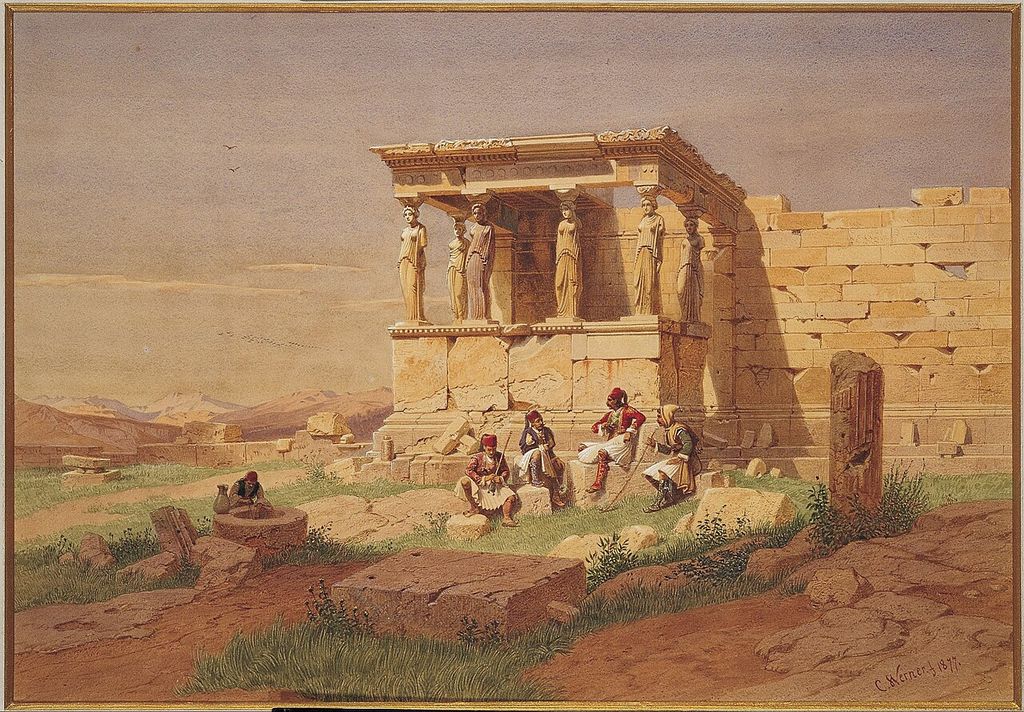
The Prostasis (portico) of the Caryatids on the Erechtheion title QS:P1476,en:"The Prostasis (portico) of the Caryatids on the Erechtheion" label…. In “The Erechtheion porch as an architectural ensemble”, this view records the form, material and setting discussed in the passage. Source image dated 1877; that date records the image, not the original construction. Werner Carl-Friedrich (1808 - 1894) Details on Google Art Project, The Prostasis (portico) of the Caryatids on the Erechtheion title QS:P1476,en:"The Prostasis (portico) of the Caryatids on the Erechtheion" label…; Public domain. Resized proportionally; no crop, retouch or upscaling.
Body, garment and apparent support
The figures turn bodily structure into architectural rhythm. A weight-bearing leg creates a firm vertical; the relaxed leg introduces counter-movement. Deep garment folds resemble fluting without making the body disappear into a column. Hair and headgear help negotiate the vulnerable junction between figure and capital.
This is not simply naturalistic sculpture under a block. The bodies are adjusted to repeated spacing and a view from below. Front, profile and back matter because the porch can be approached obliquely. The carved garment supplies both iconographic identity and visual reinforcement.
Ancient colour would have further differentiated hair, skin, textile and architectural members. Surviving traces and technical analysis undermine the habit of imagining the order as uniformly white. Any digital recolouring must mark evidential ranges rather than turn uncertain hues into spectacle.
Renaissance circulation and the Louvre
Renaissance architects encountered antique figure supports through surviving buildings, fragments, drawings and prints. At the Louvre, Jean Goujon's figures in the Salle des Caryatides translated the type into a French royal palace.[4] They belong to a new architectural, political and material context rather than functioning as replicas of the Erechtheion.
Prints made the motif available to patrons and craftsmen far from Greece. Proportions, gestures and supporting members could be recombined. The caryatid became part of an ornamental vocabulary used on façades, chimneypieces, furniture and temporary design.[3]
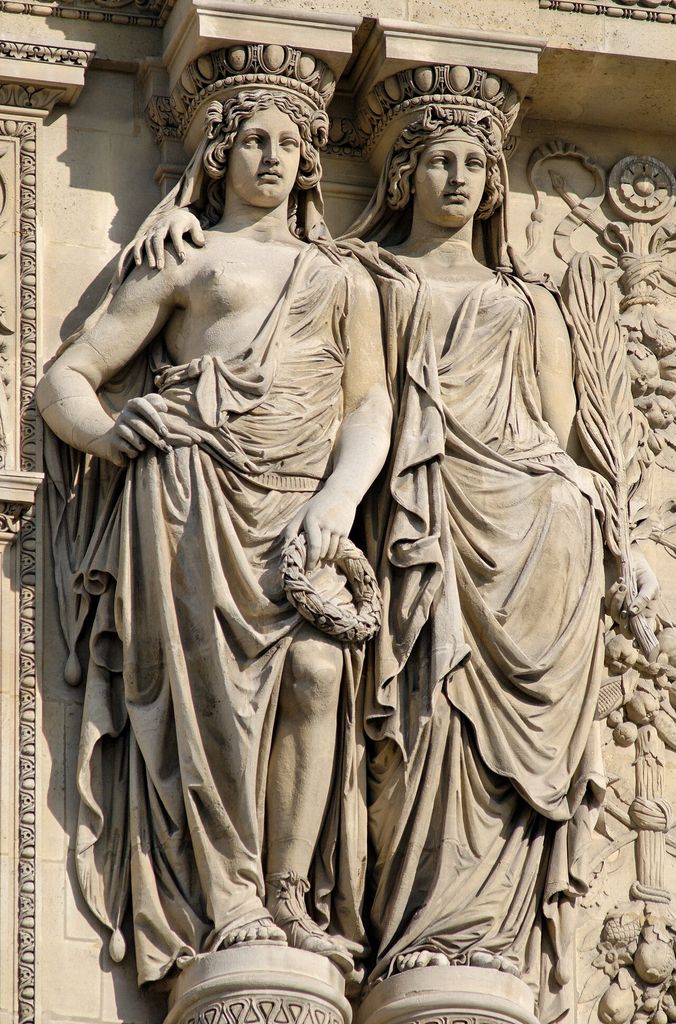
Double caryatids Pavillon Richelieu Louvre. Two assembled caryatids supporting the pediment of the Pavillon Richelieu, Louvre, Paris. In “Renaissance circulation and the Louvre”, this view records the form, material and setting discussed in the passage. Source image dated 2008; that date records the image, not the original construction. Creator not identified in the source record, Double caryatids Pavillon Richelieu Louvre; CC BY 3.0. Resized proportionally; no crop, retouch or upscaling.
This reception history explains why identifying a figure support is only the first step. One must ask which ancient or printed model was available, what building role the figure performs, and what the gendered body communicates in that commission.
Burden, gender and modern counter-images
The visual metaphor is unavoidably bodily: a human figure bears architecture. Later writers and artists have read that burden through gender, servitude, civic identity and punishment. Ancient origin stories are inconsistent and shaped by later authors, so no single myth should be treated as the form's stable meaning.
Modern works can make the metaphor explicit. Wangechi Mutu's figures for the Met façade occupied niches historically intended for sculpture and addressed absence, authority and the institution's classical architectural language.[5] They were not caryatids in the strict load-bearing sense, yet their placement productively prompts comparison with the tradition of female bodies ordered by façades.
This is where terminology protects interpretation. Calling every standing woman a caryatid weakens both works. Describing support, niche, capital, load and commission first allows a historically specific discussion of who appears to hold up the institution and who controls that image.
Conservation as a public process
The Acropolis Museum's laser-cleaning programme removed dark deposits while seeking to preserve the marble surface and surviving information.[2] The treatment was presented where visitors could see conservation as skilled investigation rather than invisible beautification.
Cleaning changes modelling because deposits occupy recesses and alter contrast. An evenly bright result is not automatically more authentic. Test areas, wavelength selection and microscopic assessment connect the desired visual change to material safety.
Outdoor exposure adds pollution, rain, thermal movement and seismic risk. Moving originals indoors protects them but changes the porch's authenticity; replicas retain composition while making substitution visible through interpretation. The case is therefore not a simple triumph of rescue. It is a negotiated division between object conservation and architectural continuity.
Replication, casts and the global classroom
Plaster casts carried caryatid forms into academies and museums, where students could draw canonical sculpture without travelling to Athens. Casts preserve a surface state at the moment of moulding, but seams, scale and monochrome presentation transform the original. They are documents of reception as well as copies.
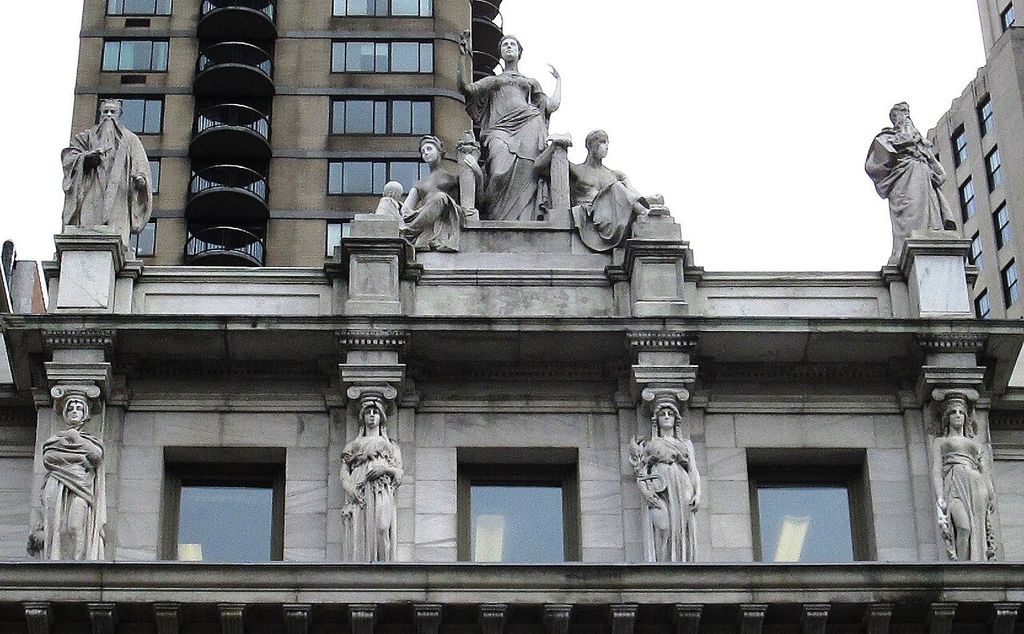
2016 Appellate courthouse west facade statuary and caryatids. Architectural sculptures and caryatids on the west facade of the Appellate Division Courthouse of the New York State Supreme Court, at 27 Madison Avenue at East 25th Street, across from Madison Square Park, in…. In “Replication, casts and the global classroom”, this view records the form, material and setting discussed in the passage. Source image dated 2016; that date records the image, not the original construction. Thomas Shields Clarke, 2016 Appellate courthouse west facade statuary and caryatids; Public domain. Resized proportionally; no crop, retouch or upscaling.
Architectural reproductions travelled further into banks, theatres, interiors and façades. Some follow antique proportion closely; others turn the figure into a narrow term beneath a mantel or balcony. The specific support condition determines whether “caryatid” is more than a decorative marketing name.
Digital models continue this history. They can compare the six korai and test missing attributes, yet a watertight mesh often fills loss automatically. Metadata should identify scan date, resolution and the difference between captured surface and reconstructed geometry.
Returning agency to the carved figure
The burden metaphor can make the body appear wholly passive. Close looking reveals stance, gaze, dress and differentiation within the ordered group. Ancient viewers may have understood ritual, civic and mythic associations now only partly recoverable.
Modern interpretation can hold uncertainty rather than select the most dramatic origin legend. It can also name the historical women, conservators and scholars involved in excavation, display and care where records allow. The architectural category has a gendered history, but its subjects are not reducible to gender alone.
This layered approach keeps a formal definition—human female figure functioning as support—while opening questions of identity, authority and afterlife. Precision enables critique rather than preventing it.
Load, appearance and modern structural support
The architectural figure may appear to carry an entablature while hidden modern reinforcement or adjacent masonry carries part of the actual load. This does not make the figure “merely decorative”; apparent support remains the organising visual idea. Technical documentation should distinguish visual and structural roles.
Cracks can follow grain, earlier iron fixings or differential loading through the capital. Monitoring needs stable points and environmental data. A repair that stiffens the neck excessively may move stress into the torso or base.
Replica installation presents a similar problem. The copy must withstand exposure and support safely while not transferring assumptions about the ancient structural system. Its date, material and reinforcement belong in the public record.
Viewing height matters as well. A museum floor can place the face closer to eye level than the porch did, revealing detail while changing the intended upward angle. Display design should acknowledge that gain and loss rather than presenting proximity as neutral.
Lighting and background colour similarly alter the relation between carved drapery and architectural shadow. A gallery view and a porch view are complementary evidence, not substitutes.
The missing Caryatid and the ethics of dispersal
One of the Erechtheion figures is in the British Museum while five are displayed in Athens. That dispersal shapes how the ensemble is discussed, reproduced and politically claimed. The architectural fact is simple: the ancient porch group is divided, and replacements mediate the site.[1][6]
Debates about return concern law, museum history, colonial power and the possibility of reuniting an architectural ensemble. A neutral-sounding object biography can conceal the conditions of removal; a purely national story can overlook later conservation histories. The page should state present locations and distinguish evidence from advocacy.
Digital reunification has educational value but cannot resolve physical custody. It can show scale and variation among all six while keeping institutional ownership visible. The model should not imply that a virtual whole cancels the material question.
Caryatids beyond women in stone
The type crossed into wood, stucco, bronze and painted illusion. In an interior, a half-length figure may merge into a term; on furniture, the burden can be purely visual. These variants belong to the reception of the architectural order, not to the ancient porch's construction history.
Male equivalents are often called atlantes or telamones, yet usage varies. The distinction may encode gendered expectations of stance and labour. A glossary should describe the form before enforcing a binary that historical objects themselves complicate.
Modern artists can deliberately refuse support, fragment the body or reverse the viewer's gaze. Those works matter because they expose assumptions embedded in the inherited type. They should be read as situated responses, not folded back into one timeless definition.
Watch: ancient figure, conservation and modern response
Choose The Acropolis Museum: Part 1, The Acropolis of Athens Explained with Reconstructions or Inside the Erechtheion: Athens’ Most Iconic Temple. Together, the films connect architectural form with material, use and historical setting.
The Acropolis Museum: Part 1
Locate the caryatids within the museum’s wider presentation of Acropolis sculpture
Watch on YouTubeDiscussion
Which building or designed landscape most clearly demonstrates Caryatids, and what physical evidence supports that reading?
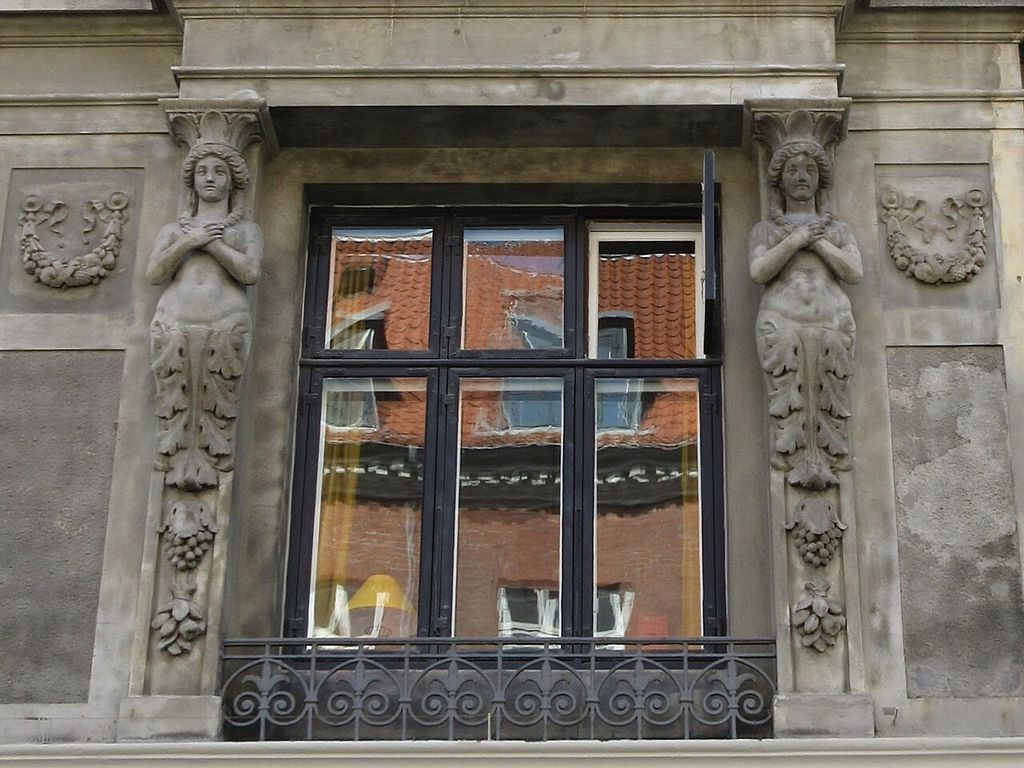
Herluf Trolles Gade 18 - caryatids. Caryatids on the facade of Herluf Trolles Gade 18 / Holbergsgade 19 in Copenhagen, Denmark. In “Caryatids beyond women in stone”, this view records the form, material and setting discussed in the passage. Source image dated 2019; that date records the image, not the original construction. Ramblersen2, Herluf Trolles Gade 18 - caryatids; CC BY-SA 4.0. Resized proportionally; no crop, retouch or upscaling.
Reader Insights
Name the material, joint, opening, route or view you can observe.
Give the place, approximate date and a reliable source.
Separate documented history from your interpretation.
Join the Conversation
Share a concise observation or useful source below.
References
- Acropolis Museum, “Erechtheion Caryatid Kore F.” View source
- Acropolis Museum, “Laser Cleaning.” View source
- Metropolitan Museum of Art, Renaissance Ornament Prints and Drawings. View source
- Musée du Louvre, “At the heart of the Renaissance palace.” View source
- Metropolitan Museum of Art, Wangechi Mutu façade commission transcript. View source
- Smarthistory, “Caryatid and Ionic column from the Erechtheion.” View source