by Tom Gurney
Tom Gurney BSc (Hons) is an art history expert with over 20 years experience
Email: tomgurney1@gmail.com / Phone: +44 7429 011000
Reading Toranas in South Asian Architecture
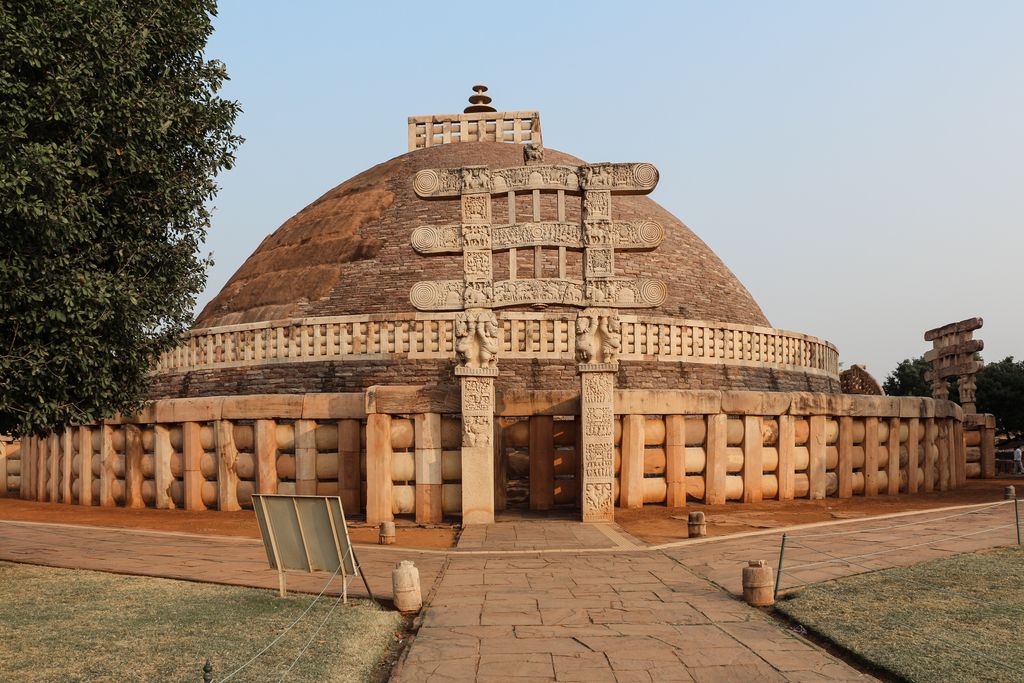
Torana—more precisely transliterated from Sanskrit as toraṇa—names an architecturally marked gateway in South Asian traditions. The best-known early examples are the four carved stone gateways around the Great Stupa at Sanchi. Each has paired uprights carrying multiple crossbars, creating both a passage and an extraordinarily dense field of narrative and auspicious carving. Their architecture is inseparable from movement: worshippers approach a cardinal side, pass the gateway and join circumambulation around the stupa.[1]
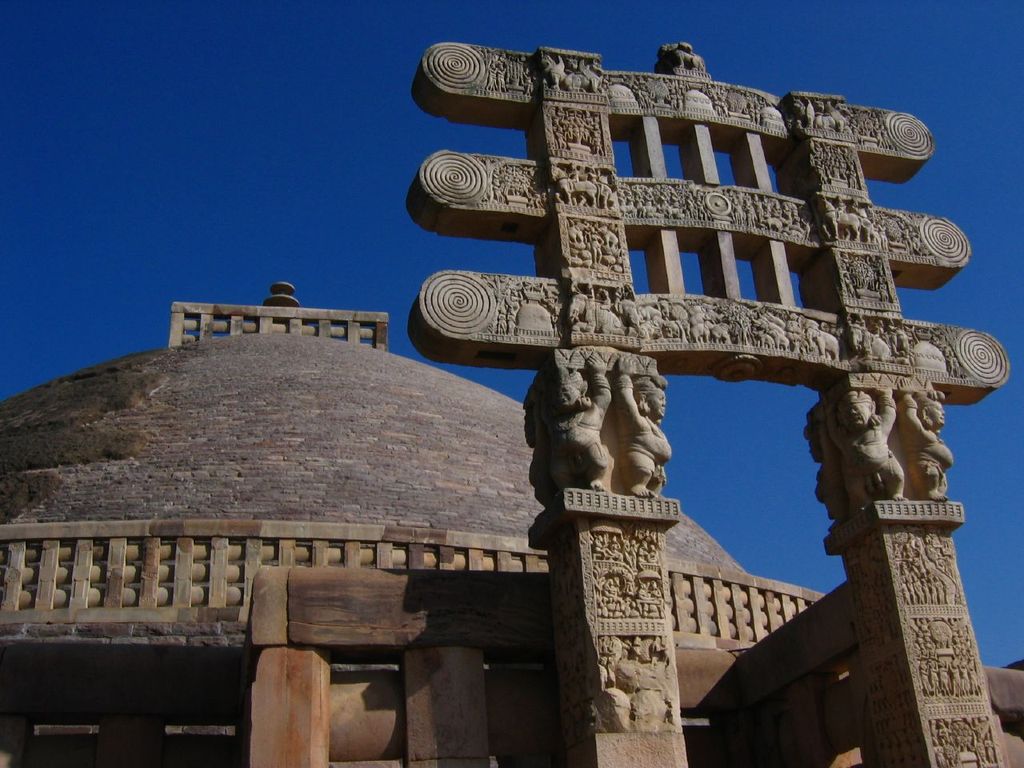
Sanchi Great Stupa Torana. torana (gateway) of the Great Stupa at Sanchi (Madhya Pradesh, India). In “Reading Toranas in South Asian Architecture”, this view records the form, material and setting discussed in the passage. Source image dated 2006; that date records the image, not the original construction. Tom Maloney from London, United Kingdom, Sanchi Great Stupa Torana; CC BY-SA 2.0. Resized proportionally; no crop, retouch or upscaling.
Later toranas appear in Buddhist, Hindu and Jain settings, sometimes free-standing, sometimes attached to enclosure, temple or ceremonial route. They vary in material and construction. The word should not be applied to every South Asian gateway, confused with the monumental tower-gate called gopura, or collapsed into the modern toran—a hanging decoration placed at a doorway.
At a Glance
- Meaninga monumental or formally marked gateway, especially in South Asian religious and ceremonial architecture.
- Early canonical examplefour stone toranas at the cardinal approaches to the Great Stupa at Sanchi.
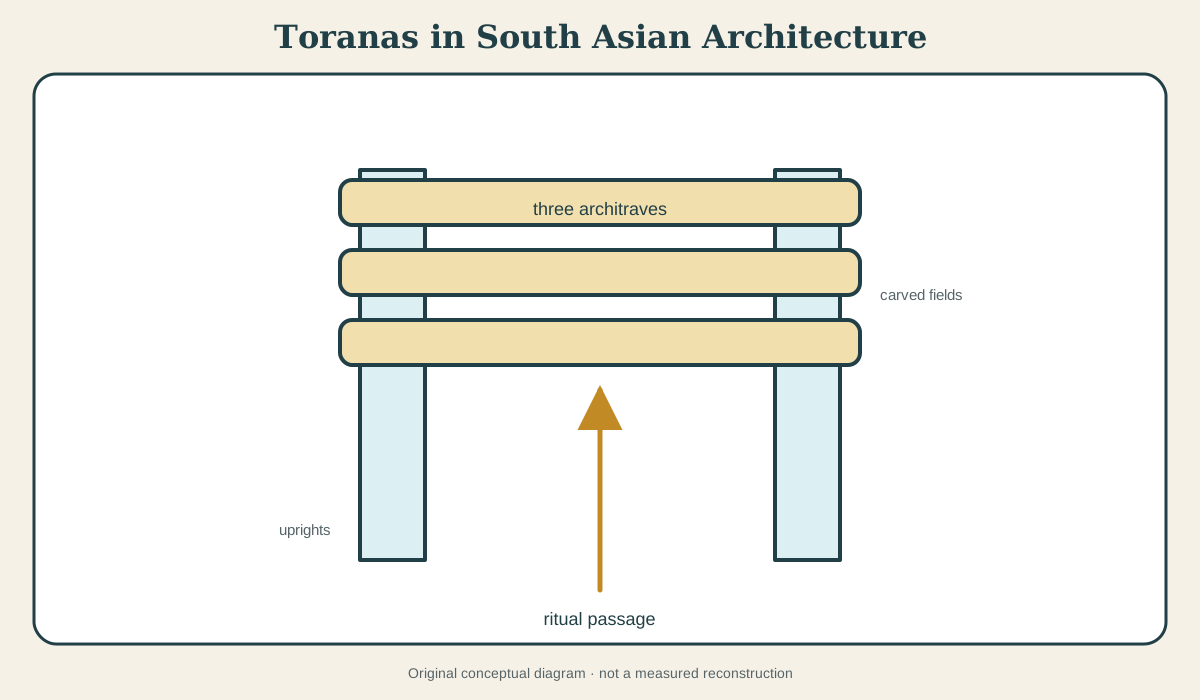
- Basic Sanchi anatomytwo upright posts supporting three curved or slightly arched crossbars, enriched with figures, symbols and narrative reliefs.
- What it doesmarks transition, orders approach and movement, and gives a threshold narrative and ritual presence.
- Essential caution“torana” is a family of historically changing gateway forms, not a synonym for every gate or decorated lintel.
Contents
Gateway as movement and image
A gate does more than make a hole in a boundary. It selects an approach, narrows passage, announces authority and changes the status of the space beyond. The Sanchi toranas make these actions visible without closing the stupa inside a massive gatehouse. Their open post-and-crossbar frames can be seen through; their carving slows and enriches approach.
The gateways align with cardinal directions around the stupa. The visitor does not simply stand in front of a sculptural screen. Passage leads to the circular path of pradakṣiṇā, keeping the sacred mound to the right. The gate therefore converts linear arrival into circumambulatory movement.[1][2]
This sequence affects imagery. Reliefs are distributed across crossbars, posts and projecting ends. Scenes become visible at different angles and heights. Repetition and framing help a viewer recognise auspicious signs, donors and episodes while moving. The architecture is not a neutral support to which narrative was later added; it determines how narrative occupies the threshold.
The Sanchi toranas
Archaeological Survey of India publications hosted by the Indira Gandhi National Centre for the Arts remain fundamental records for Sanchi’s monuments, sculpture and restoration history.[1] The IIT Kanpur SATHEE presentation of NCERT material supplies an Indian educational synthesis of post-Mauryan artistic developments and the stupa gateways.[2] Used together, they anchor the page in archaeological and locally produced scholarship rather than a generic global glossary.
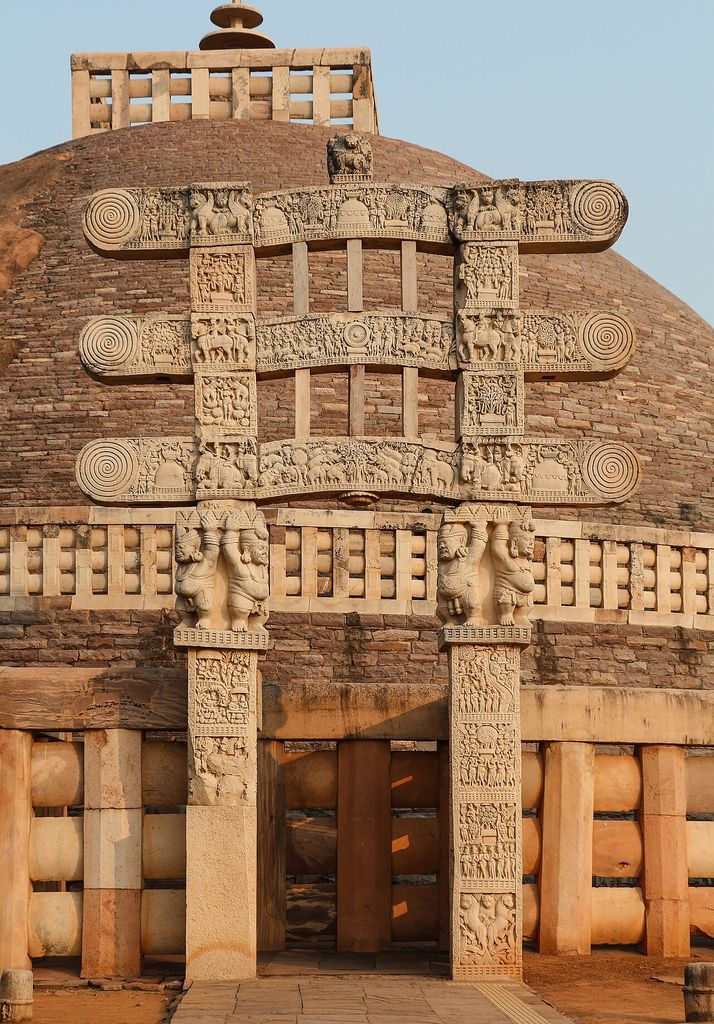
Sanchi torana gateway close detail. West torana, Stupa 1, Sanchi, India. In “The Sanchi toranas”, this view records the form, material and setting discussed in the passage. Source image dated 2013; that date records the image, not the original construction. Bernard Gagnon, Sanchi torana gateway close detail; CC BY-SA 3.0. Resized proportionally; no crop, retouch or upscaling.
The Great Stupa’s form developed over time. Its enlargement, stone railing and four gateways belong to phases rather than one instantaneous design. The toranas conventionally date around the first century BCE into the first century CE, with inscriptions, stylistic comparison and archaeological context informing finer chronology. Exact dates and sequence remain matters for specialist study.
Each gateway uses two square-section uprights capped by sculptural groups and crossed by three horizontal members. The crossbars bow or curve and extend beyond the posts, where spiral ends and figures intensify silhouette. Smaller vertical and figural elements connect the bars. The structure evokes timber assembly while exploiting stone carving and mass.
The four gates form a family, not identical copies. Narrative selection, carving style, donor inscriptions and condition differ. Later re-erection and repair also affect what stands. A responsible description names the particular cardinal gate and surface rather than treating any famous photograph as “the torana.”
Timber memory and stone construction
Scholars have long noted timber-derived forms in early Indian stone architecture: railings, beams, joints and curved profiles can appear to translate established wooden vocabularies. At Sanchi, the posts and crossbars invite that comparison. “Timber-derived,” however, should describe formal memory or a probable craft genealogy, not claim that the stone gateway behaves exactly like a wooden one.
Stone members are heavy and brittle. Crossbars require secure bearing and joints; projecting ends create leverage; upright posts need stable foundations. Carving removes material and concentrates stress. The structural assembly may imitate a lashed or joined wooden form while solving it through stone tenons, sockets, weight and later repairs.
Translation into stone can make a temporary or renewable craft monumental. It also preserves a visual language after early timber buildings have vanished. That survival tempts historians to treat stone as the origin of the form. Archaeology and material reasoning instead keep lost wooden traditions in view without pretending their exact appearance is known.
Narrative without a single viewpoint
Sanchi’s reliefs are famous for representing episodes from the Buddha’s lives and the worship of sacred sites, often through aniconic signs rather than a centrally enthroned human Buddha. Empty throne, wheel, tree, stupa and footprints can organise presence. Elephants, yakshis, riders, architecture and crowds create dense social worlds.
Interpretation requires exact location. A scene on the inner face meets a circumambulating viewer differently from one on the approach side. A figure clasping a bracket or tree may participate in both structural imagination and auspicious fertility. Donor inscriptions add another layer by connecting parts of the monument to acts of patronage.
The imagery should not be decoded through a loose symbol list. Narrative identification depends on sequence, repeated motifs and comparison with texts and other monuments. Some scenes remain debated. Responsible interpretation describes the visible evidence, attributes each reading and leaves uncertainty intact.
Scale also disciplines meaning. Fine details now enlarged in photographs were not all equally legible from the ground. Broad masses, rhythmic animals and repeated architectural forms may have carried the first visual effect. Close study and original encounter are related but different.
Patronage, donation and collective making
Monumental gateways are often narrated through dynasties, yet inscriptions and workshop evidence reveal broader communities of donation and labour. Patrons could include groups and individuals whose gifts attached them to a sacred complex. Carvers, masons, planners and installers transformed those resources into a coordinated assembly.
The gates’ stylistic variation may record different workshops and times. Attribution needs more than a distinctive figure. Tooling, stone, joints, inscriptions and relation to earlier railings all matter. “Masterpiece” language can obscure collective work and the long life of the site.
Sanchi also changed after its early flourishing. Religious use, abandonment, archaeological investigation, reconstruction and modern heritage management all shaped the monument now visited. Stone elements were reassembled; missing parts were stabilised or supplemented. The gate is an ancient object and a record of conservation history.
Toranas beyond Sanchi
Later South Asian architecture adapts the idea of a marked open gateway in many regions. Toranas can stand on ceremonial approaches to temples, frame processional routes or survive as paired pillars and lintels. Stone may become more elaborately bracketed; the gateway may relate to mandapa, enclosure, tank or urban street.
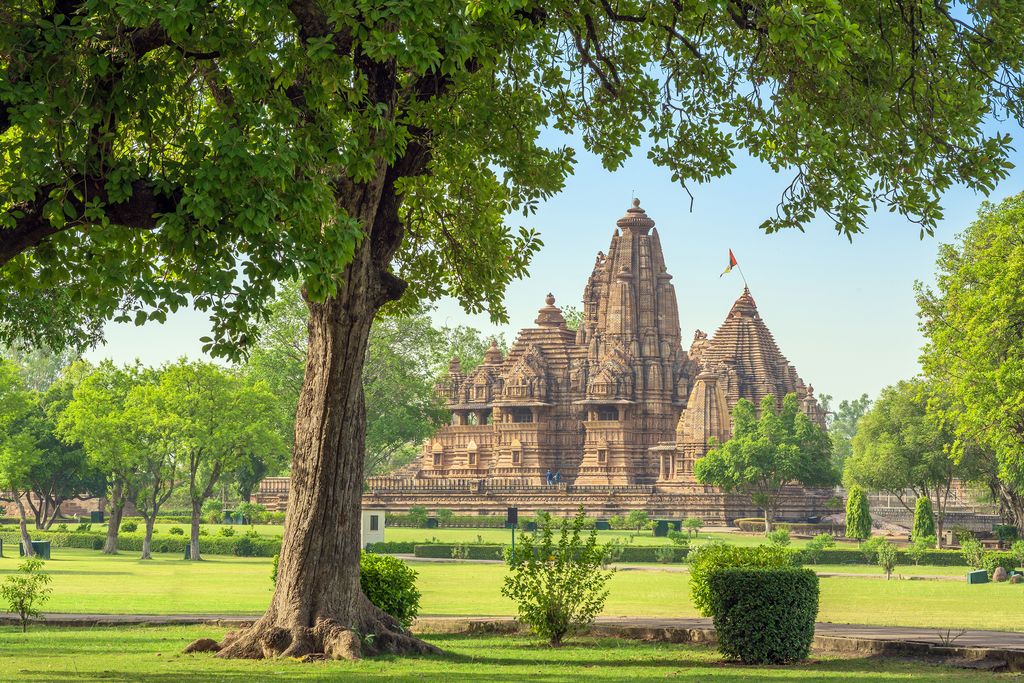
The Sun Temple at Modhera provides a useful institutional case because IGNCA presents the torana within a larger composition of temple and stepped water architecture.[3] The surviving and fragmentary elements must be read through approach, not isolated as a decorative arch. Water, stairs, axial movement and sacred building make one landscape.
Hindu and Jain toranas can use deities, auspicious creatures, foliage and complex brackets according to their particular programmes. The term’s continuity does not imply one unchanging Buddhist meaning. Regional names and monument records should take priority where more precise.
Modern and revival toranas appear in civic and diasporic contexts, sometimes as commemorative gateways. They can cite ancient Indian forms to make national, religious or community identity visible. Their historical reference should be analysed rather than treated as an unchanged survival.
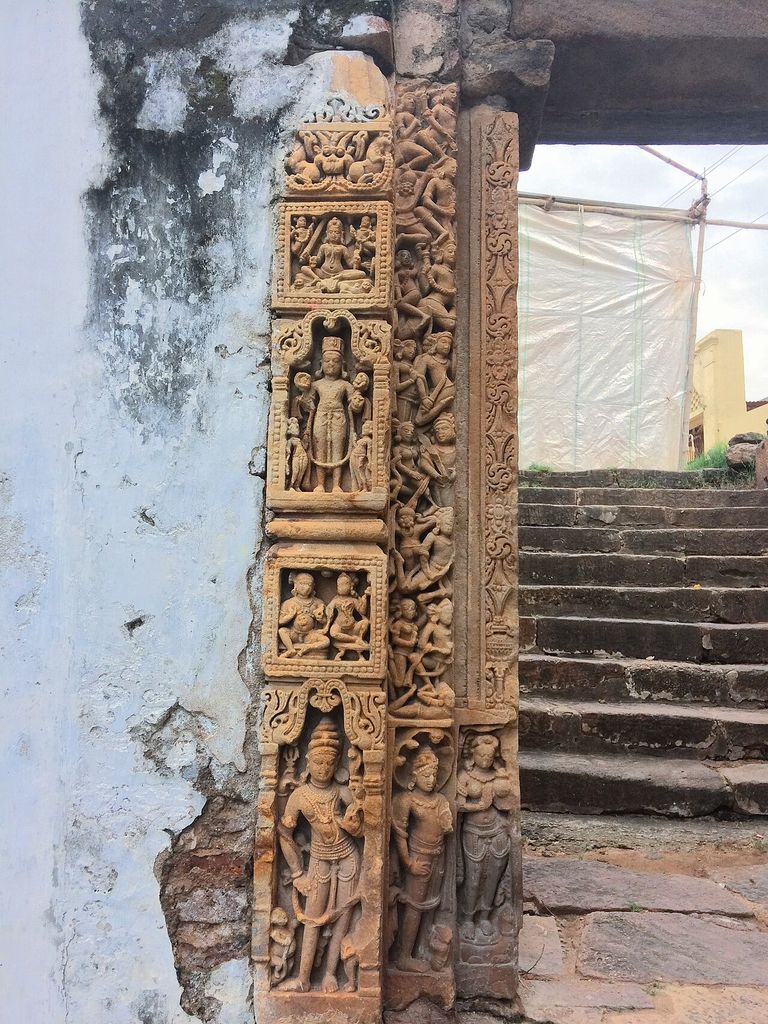
Indian temple torana gateway architecture. This is a photo of ASI monument number. In “Toranas beyond Sanchi”, this view records the form, material and setting discussed in the passage. Source image dated 2018; that date records the image, not the original construction. Mukeshtripathi5586, Indian temple torana gateway architecture; CC BY-SA 4.0. Resized proportionally; no crop, retouch or upscaling.
Torana, dvara, gopura and toran
Dvāra broadly means door or gate and appears in compound architectural terms. IGNCA’s record of a makara-dvāra—a gateway or doorway framed through the auspicious aquatic creature—shows a related threshold vocabulary without making it identical to a free-standing post-and-crossbar torana.[4]
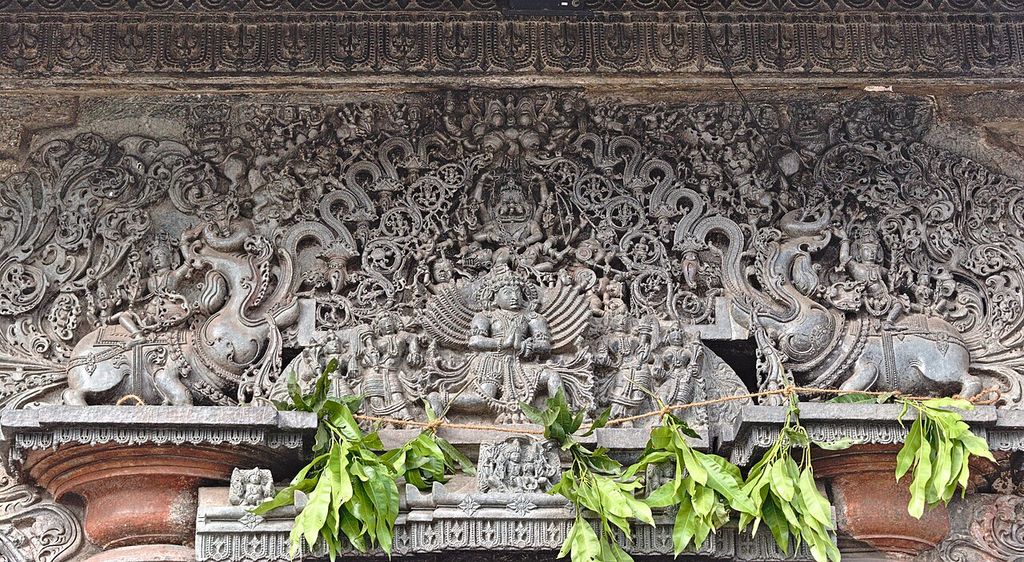
East entrance (carved Makara Torana) to Cheenakesava temple, Belur. The exquisitely carved Makara Torana above the eastern entrance showcases Narasimha killing the demon king Hiranyakashipu, surrounded by the Dashavatars of Vishnu, with Garuda in a supplicating posture below. In “Torana, dvara, gopura and toran”, this view helps identify torana Indian temple. Source image dated 2023; that date records the image, not the original construction. Rohit14400, East entrance (carved Makara Torana) to Cheenakesava temple, Belur; CC BY-SA 4.0. Resized proportionally; no crop, retouch or upscaling.
A gopura or gopuram is the monumental entrance tower especially associated with South Indian temple enclosures. Its scale, internal passage and tower construction differ fundamentally from Sanchi’s open crossbar form. Both mark sacred approach; they should not be collapsed.
The modern toran often refers to a textile, leaf, bead or other hanging decoration placed above a domestic or ceremonial doorway. It shares the idea of an auspicious threshold and related word history, but it is not automatically an architectural gateway. Context and scale make the distinction.
“Arch” is also imperfect. Many toranas do not work through a curved compression arch. Their crossbars bridge between posts. Calling every torana a “triumphal arch” imports a Roman political and structural category that may obscure the South Asian evidence.
How to read a torana
First map movement. What path reaches the gateway, and what happens after passage? Is the route axial, circumambulatory, processional or connected to water? Which face is outward?
Then record the assembly:
- number and section of uprights;
- number, curvature and bearing of crossbars;
- brackets, connecting figures and projecting ends;
- joints, sockets and replacement pieces;
- narrative fields and inscriptions by face;
- relation to railing, enclosure, temple, stupa or tank;
- archaeological reconstruction and current support.
Photograph both frontal and oblique views. A frontal view clarifies registers; an oblique view reveals depth and jointing. Do not climb or touch carved stone. Published surveys and high-resolution institutional imagery can support details inaccessible from the visitor route.
Conservation and reconstructed wholeness
Toranas concentrate risk in joints and projections. Crossbars can crack near supports; projecting ends break; upright settlement distorts alignment; biological growth and water attack carving. Earlier iron cramps may corrode. Earthquake, vandalism and repeated dismantling complicate stability.
Conservation must retain the narrative surface without treating it as separate from structure. Cleaning can erase tool marks or pigment. A replacement inserted to carry a crossbar may interrupt an image. Structural reinforcement should be designed around both load and significance.
Archaeological re-erection presents a special challenge. Fragments may be confidently placed through matching joints and relief continuities, or only approximately located. Modern supports can make the gateway safe but visually disappear. Interpretation should distinguish ancient assembly, reconstructed placement and new stabilisation.
The best account of a torana therefore follows bodies as well as images. It asks how worshippers approached, how posts and bars made passage, how narrative unfolded around them and how later hands kept the gateway standing. “Decorative gateway” is not wrong, but it is far too small for an architecture that joins route, ritual, structure and story.
Approaching Sanchi Stupa 1
The four gateways at the cardinal points turn circumambulation into a succession of thresholds. They do not open into an enclosed room. Instead, each announces entry to the railing and the ritual route around the mound. The stupa remains the spatial and devotional centre; the toranas regulate approach and present dense fields of narrative and auspicious imagery.[1][5]
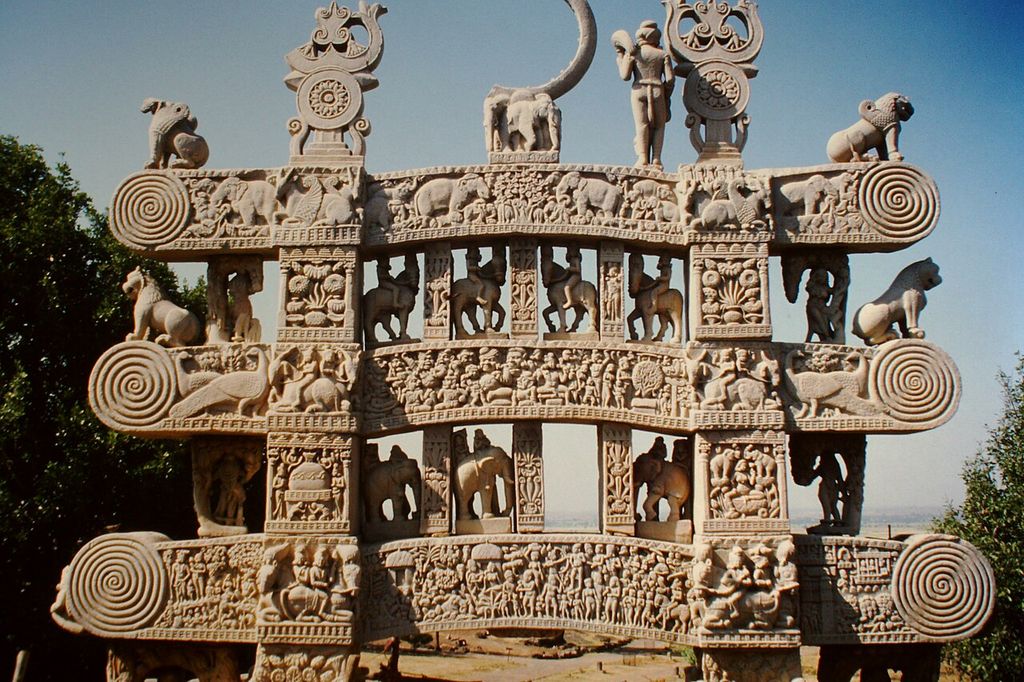
Sanchi Stupa 1 Nord-Torana (1999). Sanchi, Stupa 1 (Nord-Torana). In “Approaching Sanchi Stupa 1”, this view helps identify sanchi torana gateway. Source image dated 1999; that date records the image, not the original construction. ArnoldBetten, Sanchi Stupa 1 Nord-Torana (1999); Public domain. Resized proportionally; no crop, retouch or upscaling.
Orientation matters because the visitor meets each gateway from different paths and light conditions. Front and back are both carved. Horizontal architraves, upright posts, brackets and crowning elements distribute images across several levels, so no single face-on photograph represents the experience.
The railing and gateways were also historical additions to an earlier monument. Reading the ensemble by campaign prevents the carved stone architecture from being projected unchanged back to the stupa's foundation.
Narrative fields and aniconic strategies
Scenes at Sanchi may refer to episodes in the Buddha's lives and to worship at sacred sites without representing the historical Buddha in human form. Empty thrones, footprints, trees, wheels and stupas can make presence through signs. “Aniconic” is useful description but should not be mistaken for an absence of image or belief.
Narrative does not necessarily proceed in the left-to-right order familiar from a modern illustrated book. Figures repeat, episodes share a field, and architectural motifs orient the viewer. Identifying a scene depends on attributes, inscriptions, comparative scholarship and its place among neighbouring carvings.
The crowded surface rewards movement. As a worshipper walks, new faces and undersides come into view. Photography can isolate a panel for study, but it removes the bodily sequence that connects narration to circumambulation.
Inscriptions, donors and the distribution of patronage
Donative inscriptions complicate the idea that one ruler or master artist authored the gateways. Gifts could be associated with individuals, families, monks, nuns, guilds and communities. Patronage was distributed, even when dynastic histories remain important.[1][6]
The inscription is small relative to the monument but historically powerful. It can name social identities and places that the imagery alone does not recover. Epigraphy also requires caution: weathered scripts are read through specialist conventions, and translations may change.
Collective patronage does not imply an uncoordinated design. Workshops still organised stone, dimensions and imagery. It means that the social history of construction extends beyond a royal biography.
Stone, remembered timber and actual assembly
The gateways use forms that recall timber construction: posts, crossbars, dowel-like junctions and curved members. Describing them as “wood translated into stone” captures visual memory but can oversimplify engineering. Stone is heavier and brittle; blocks require different joints, supports and erection sequences.
Carvers exploited stone's capacity for dense relief while retaining an assembled appearance. The result is neither a literal petrified wooden prototype nor a wholly independent masonry language. It records a dialogue between established building forms and new monumental material.
Close survey should trace block boundaries, tenons, repairs and restored elements. A continuous carved scene may cross an assembly that is structurally discontinuous. Understanding that relationship is essential when cracks develop near connections.
Regional vocabulary beyond the Buddhist gateway
Related terms appear in Hindu and Jain architecture and in later ceremonial arches. At Modhera, IGNCA documentation places gateways and threshold forms within a temple complex whose ritual and architectural logic differs from Sanchi.[3] The makar dvar record identifies a doorway animated by the aquatic makara motif, again showing that formal resemblance does not make every gateway a Sanchi-type torana.[4]
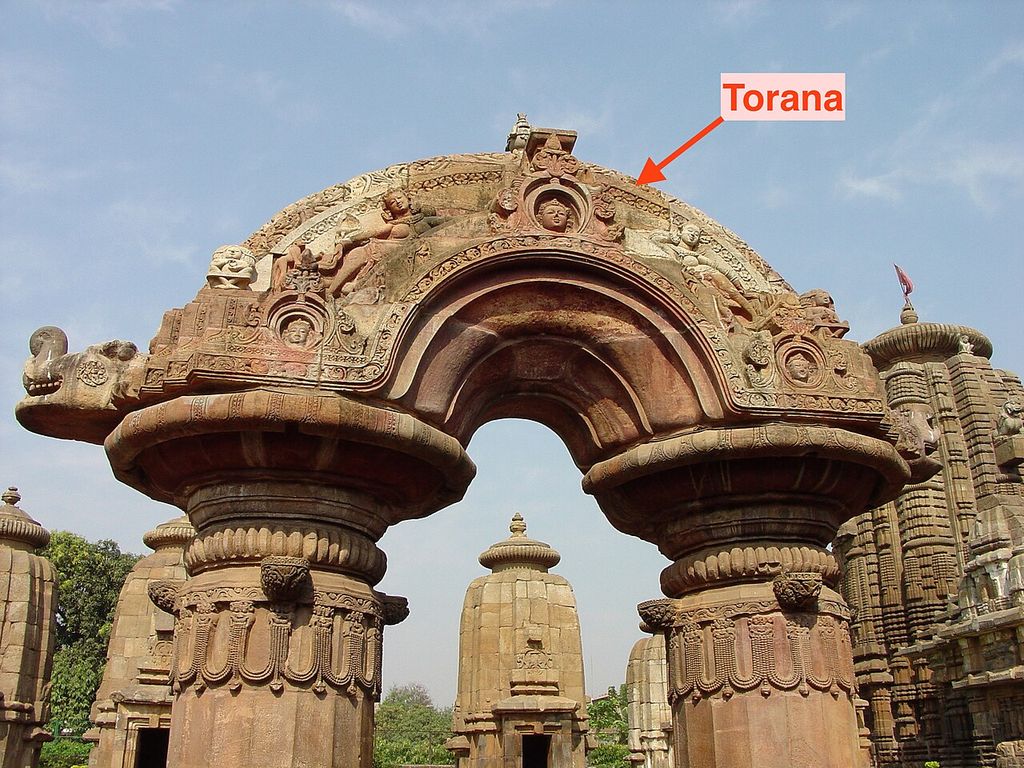
A Torana, architectural element is Indian temples, at Bhubaneshwar Odisha. Torana is an arched motif. In “Regional vocabulary beyond the Buddhist gateway”, this section drawing records the form, material and setting discussed in the passage. Source image dated 2017; that date records the image, not the original construction. Ms Sarah Welch, A Torana, architectural element is Indian temples, at Bhubaneshwar Odisha; CC BY-SA 4.0. Resized proportionally; no crop, retouch or upscaling.
Modern festive toran can refer to suspended doorway decoration. The linguistic relationship is worth noting, but object, material and duration differ. A page should not merge a permanent carved ceremonial gateway, a temple doorway and a domestic hanging into one undifferentiated category.
Local institutional naming leads. Where a monument authority calls a feature dvara, gopura or another term, that vocabulary and its architectural definition should be retained. “Torana” is most useful when it clarifies a gateway tradition, not when it replaces South Asia's richer terminological field.
Drawing movement rather than only elevation
A measured elevation records posts and architraves but not the gateway's ritual work. The documentation should add a site plan with direction of approach and circumambulation, an oblique view of carving on both faces, and a sequence showing when the stupa becomes visible. This makes the torana a threshold in motion.
Image mapping can locate scenes, inscriptions, donors and restored blocks without implying that narrative reads as a modern strip. Numbering must respect the monument authority's system so scholarship and conservation records remain interoperable.
Lighting should be recorded by face and time. Deep relief that appears legible in morning sun may flatten at noon. Weathering and biological growth also vary with orientation, giving each gateway a distinct condition history.
Sanchi after excavation
The ensemble encountered today is the result of archaeological investigation, conservation and reassembly as well as ancient construction. Early photographs and ASI documentation are therefore primary evidence for the modern history of the site.[1][6] They can show blocks before resetting and reveal how the present image of completeness was produced.
Reconstruction made the gateways understandable and stable, but every reset joint carries an interpretive decision. Labels should distinguish ancient blocks, anastylosis, new support and conjectural completion. The monument does not lose value when this work is visible; it gains an accountable biography.
Visitor circulation adds another layer. Paths and barriers protect archaeology but can alter ritual direction or viewing distance. Conservation succeeds when the gateway remains comprehensible as carved structure, donated monument and active threshold within the stupa landscape.
Architectural images within the carvings
The gateways themselves contain representations of buildings, railings, cities and sacred sites. These images are not measured elevations, but they supply evidence of how architecture participated in narrative and recognition. Their repeated forms can be compared with excavated or surviving construction cautiously.[1][2]
A carved timber-like balcony does not prove that every contemporary building used the same detail. Scale, convention and symbolic emphasis shape representation. The strongest inference identifies a family of known forms rather than reconstructing a whole building from one panel.
This reflexive relationship—the gateway showing architecture while being architecture—makes Sanchi especially valuable. It joins monument, image and ritual route in one material field.
Conservation, pilgrimage and shared authority
Sanchi is archaeological heritage, a destination for visitors and a site of Buddhist significance. These constituencies may value access, ritual, quiet, photography and fabric protection differently. Management cannot treat the monument as an unoccupied sculpture park.[5]
Wear at thresholds and congestion around gateways need route design developed with stakeholders. Barriers should not imply that contemporary devotion is a threat while casual tourism is neutral. Conservation risk comes from intensity and behaviour, not identity.
Multilingual interpretation can connect ASI scholarship, Buddhist histories and local place. It should explain reconstructed fabric and donor evidence without reducing the gateway to either national symbol or iconographic puzzle.
Copies and casts made for museums abroad belong to the reception history. They can teach relief and composition, but their display should name colonial collecting contexts and make clear that the ritual route and living significance remain at Sanchi.
Digital access can reunite dispersed documentation, inscriptions and early photographs. It should link back to Indian institutional records and avoid presenting a frictionless model as ownership of the monument.
The gateway as a frame for relic and landscape
Passing through a torana changes the relation between visitor and stupa. The mound may be partly screened by railings and gateway members, then reappears as the body turns in circumambulation. The gateway frames without functioning as a door that closes.
This distinction distinguishes it from gateways whose primary task is defence or controlled entry into an enclosed precinct. At Sanchi, ritual orientation and narrative density matter more than a lockable barrier. The architectural threshold is effective because the route continues.
The surrounding hill and other monuments extend the field. A tightly cropped view of Stupa 1 removes paths, subsidiary stupas and changing approaches that made the site a religious landscape.[5]
Copies, exhibitions and nationalist reception
Sanchi's gateways circulated through drawings, photographs, casts and displays during colonial archaeology. These media shaped international knowledge while institutions in India developed conservation and interpretation. The history of documentation should therefore name its administrative and political setting.
After independence, Sanchi also entered narratives of Indian art and national heritage. That significance coexists with Buddhist connections extending across modern borders. Neither frame alone exhausts the monument.
Present interpretation is strongest when it joins archaeological specificity, donor evidence and living religious importance. The torana is not merely an emblem reproduced from its original route; it remains part of a site whose meanings continue to be negotiated.
Watch: gateway, stupa and route
Choose Buddhist Monuments at Sanchi, The Great Sanchi Stupa or Sanchi Stupa Torana (Architrave). Together, the films connect architectural form with material, use and historical setting.
Buddhist Monuments at Sanchi
An institutional site film that places gateways, stupa and landscape together
Watch on YouTubeDiscussion
Which building or designed landscape most clearly demonstrates Toranas in South Asian Architecture, and what physical evidence supports that reading?
Reader Insights
Name the material, joint, opening, route or view you can observe.
Give the place, approximate date and a reliable source.
Separate documented history from your interpretation.
Join the Conversation
Share a concise observation or useful source below.
References
- Indira Gandhi National Centre for the Arts, Archaeological Survey of India Sanchi documentation. View source
- IIT Kanpur SATHEE / NCERT, “Post-Mauryan Trends in Indian Art and Architecture.” View source
- Indira Gandhi National Centre for the Arts, “Sun Temple at Modhera, Gujarat.” View source
- Indira Gandhi National Centre for the Arts, “Makar Dvar.” View source
- UNESCO World Heritage Centre, “Buddhist Monuments at Sanchi.” View source
- Additional ASI Sanchi volumes hosted by IGNCA. https://ignca.gov.in/Asi_data/73806.pdf and View source