by Tom Gurney
Tom Gurney BSc (Hons) is an art history expert with over 20 years experience
Email: tomgurney1@gmail.com / Phone: +44 7429 011000
Reading Gargoyles vs Grotesques
A gargoyle is a projecting water spout. A grotesque is a carved fantastic figure that does not contain that drainage function. Both may be monstrous, comic, animal, human or hybrid; both may project from the same Gothic wall; both may shed some rain from their noses or heads. The decisive distinction is not appearance. It is whether water is deliberately collected, channelled through the carving and discharged away from the masonry.[1]
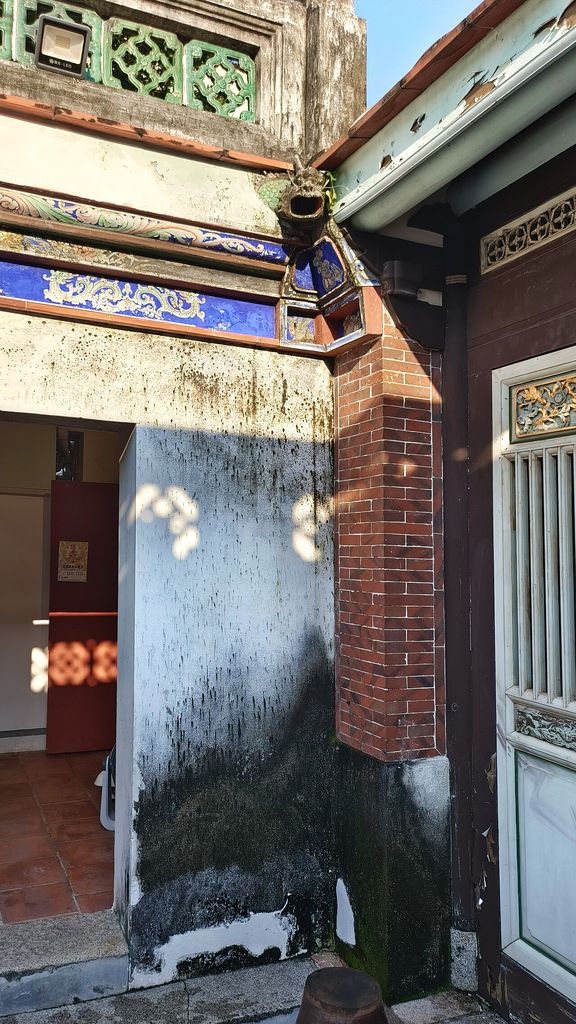
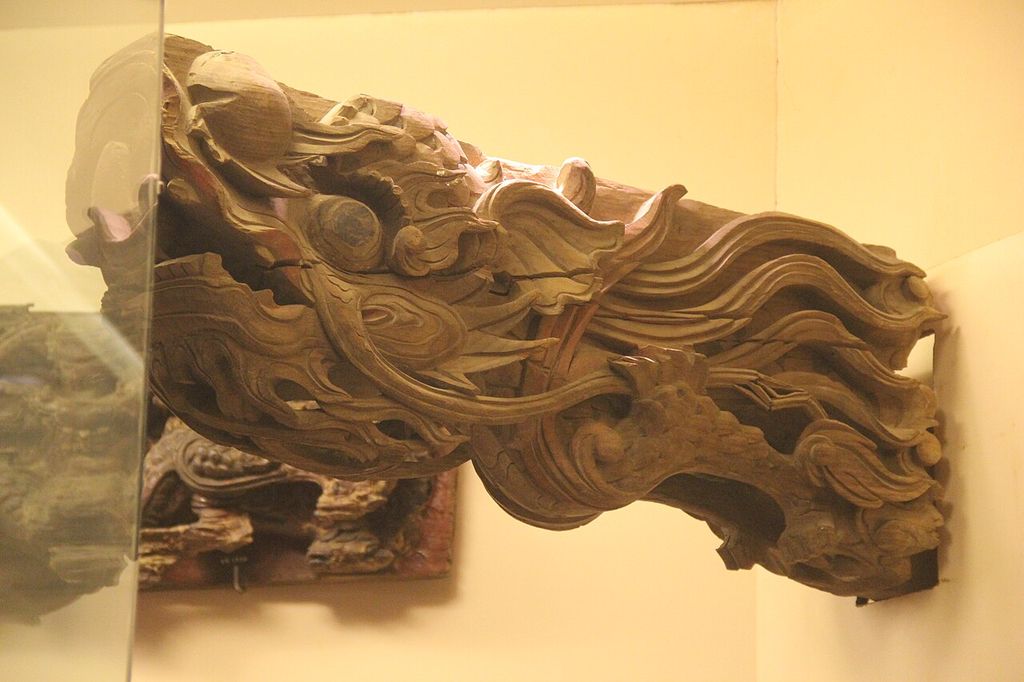
Lu Mansion, dragon-gargoyle drainage system, inner court , Anping, Tainan City (Taiwan). Lu Mansion, dragon-gargoyle drainage system, Anping, Tainan City, Taiwan. In “Reading Gargoyles vs Grotesques”, this view records the form, material and setting discussed in the passage. Source image dated 2026; that date records the image, not the original construction. Mkoo2010, Lu Mansion, dragon-gargoyle drainage system, inner court , Anping, Tainan City (Taiwan); CC BY-SA 4.0. Resized proportionally; no crop, retouch or upscaling.
That answer is easy to remember and surprisingly easy to ignore. “Gargoyle” has become a popular name for almost any strange creature on a building. Yet the functional distinction opens a richer architectural history. It connects carving to roofs, gutters, walls, weather, maintenance and urban spectators. It also prevents symbolic stories from obscuring the practical reason many projecting figures are there.
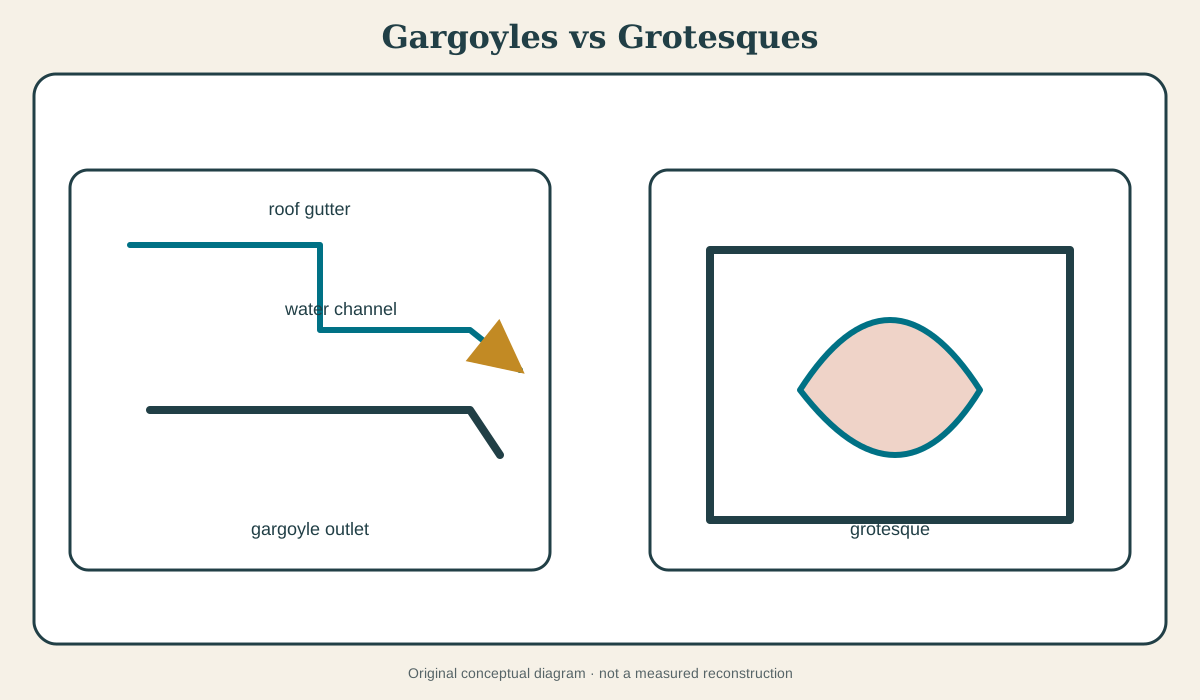
At a Glance
- Water passageHas a channel or bore
- Roof connectionReceives collected rainwater
- OutletMouth or opening discharges water
- Primary architectural roleDrainage plus carving
- Reliable identificationTrace the complete water path
Contents
Trace the water
Begin above the carving. Rain falls onto a roof, where slope directs it towards a gutter, valley or collection channel. The water enters the gargoyle’s upper opening, travels along a hollowed path and exits through a projecting mouth or throat. Projection matters because discharge needs to clear the face below. Without that clearance, water stains mortar, saturates stone and accelerates decay.
This hydraulic sequence is more informative than the creature’s face. A gargoyle can be plain, zoomorphic or human. Some long medieval spouts resemble animals because an extended neck suits the practical need to throw water outward. Others wrap a figure around an otherwise simple channel. The carver turns infrastructure into image without abolishing its work.
Washington National Cathedral gives unusually clear modern institutional evidence. Its account distinguishes 112 functioning gargoyles from more than 1,000 grotesques.[1] The numbers belong to that cathedral, not to Gothic architecture generally, but the definitions are useful: its gargoyles act as elaborate gutters; its grotesques are carved features without conventional spout channels.
A field inspection should look for an inlet, not only an outlet. A hole in a mouth could be a fixing recess or later damage. The passage should connect plausibly to the roof drainage. Conversely, a former channel may have been capped during reroofing. Dated drawings and maintenance records can establish whether an apparently dry creature once served a gutter.
What a grotesque does
Defining a grotesque by the absence of a water channel does not make it functionless. A projecting figure can animate a skyline, terminate a moulding, mark a buttress, cast a strong shadow or contribute to an iconographic programme. At Washington National Cathedral, the institution notes that rain bouncing from projecting heads and noses can help keep drops away from the wall.[1] That incidental shedding remains different from deliberately conveying roof runoff through a conduit.
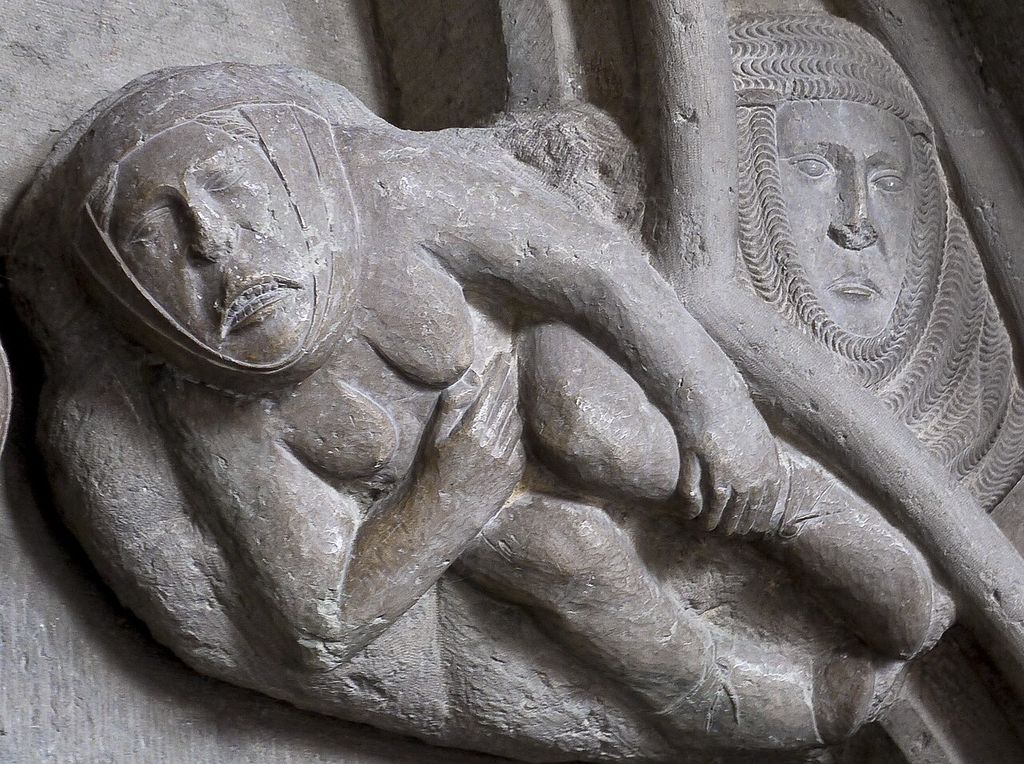
Linkoping Domkyrka GrotesqueFigures01. Linköping Cathedral, Linköping, Sweden. In “What a grotesque does”, this view helps identify grotesque cathedral sculpture. Source image dated 2009; that date records the image, not the original construction. Xauxa Håkan Svensson, Linkoping Domkyrka GrotesqueFigures01; CC BY-SA 3.0. Resized proportionally; no crop, retouch or upscaling.
Grotesques occupy a broad imaginative range. Some are unsettling hybrids; others caricature human behaviour, show musicians and craftsmen, or transform foliage into faces. Modern programmes add contemporary subjects. The Cathedral’s well-known Darth Vader grotesque, carved after a children’s design competition, is valuable precisely because its date and process are documented. It is not evidence that medieval carvers anticipated modern popular culture; it demonstrates that architectural grotesque carving remains a living practice.
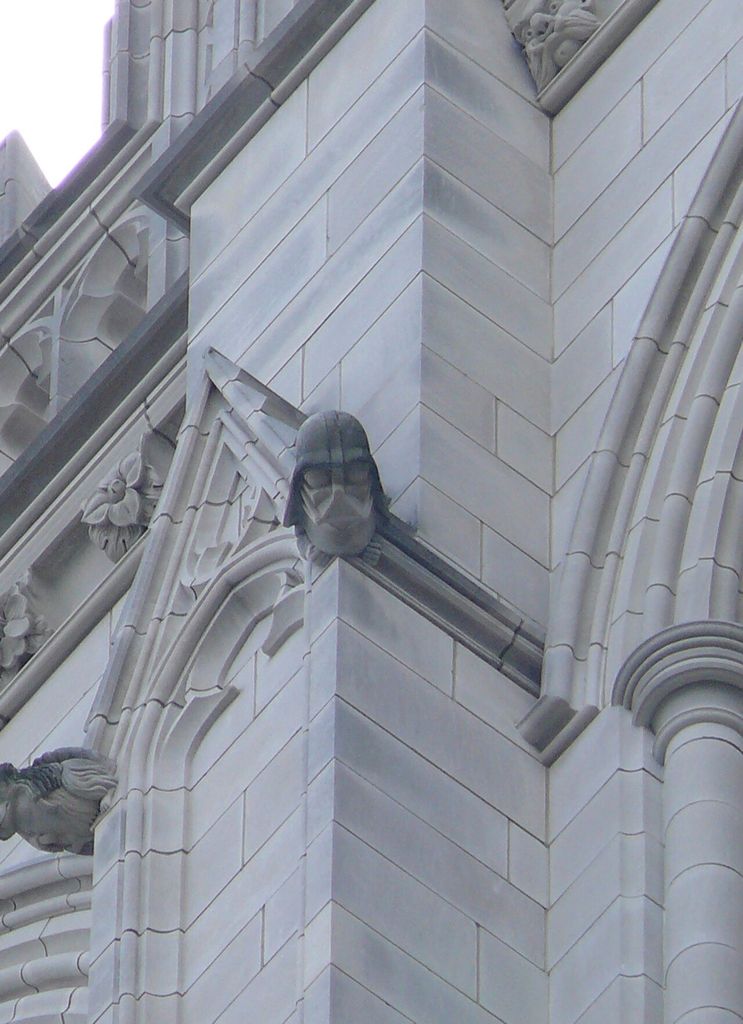
Darth vader grotesque. Darth Vader grotesque on the northwest tower of the Washington National Cathedral. In “What a grotesque does”, this view helps identify grotesque cathedral sculpture. Source image dated 2009; that date records the image, not the original construction. Cyraxote, Darth vader grotesque; Public domain. Resized proportionally; no crop, retouch or upscaling.
The category also overlaps with masks, corbels, bosses and figure sculpture. Position and construction clarify the description. A grotesque that supports a projecting member may also be a corbel. A face at the crossing of vault ribs may be a boss rather than a high exterior grotesque. Architectural terms can layer where an object performs more than one role.
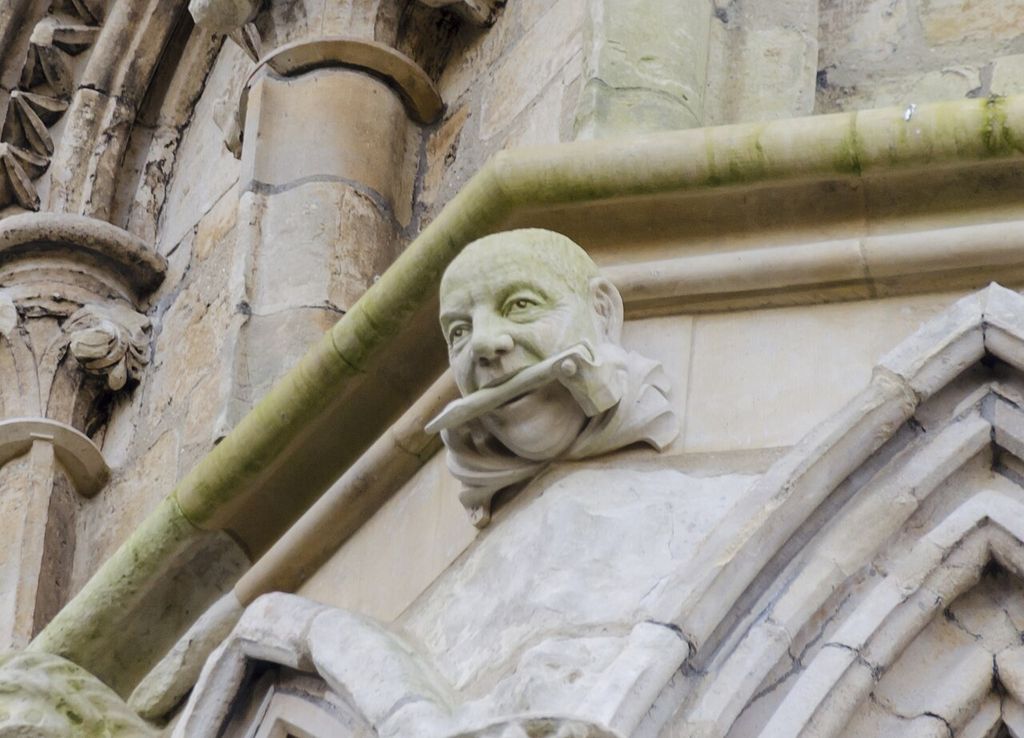
Scaffolder grotesque on Lincoln Cathedral - geograph.org.uk - 5303756. Scaffolder grotesque on Lincoln Cathedral. In “What a grotesque does”, this view helps identify grotesque cathedral sculpture. Source image dated 2017; that date records the image, not the original construction. Julian P Guffogg, Scaffolder grotesque on Lincoln Cathedral - geograph.org.uk - 5303756; CC BY-SA 2.0. Resized proportionally; no crop, retouch or upscaling.
Why carve a drain as a creature?
The practical and imaginative explanations belong together. A projecting outlet is conspicuous. Giving it an animal mouth makes the discharge visually intelligible: the building appears to spit water. Long jaws and necks can extend the throw. Repeated creatures create a population around the roofline, making a technical system part of the cathedral’s identity.
Interpretations of monstrous imagery include moral warning, humour, marginality, disorder and the containment of threatening forces at a sacred boundary. Some may be persuasive for a particular programme. None should be assigned universally. The familiar claim that gargoyles were made to frighten away evil spirits is often repeated without contemporary evidence. Even where an apotropaic reading is plausible, the carved spout still has a documented hydraulic anatomy.
Meaning also changes with audience. A creature almost invisible from the ground may have been designed for silhouette and collective effect rather than close narrative reading. A figure beside a frequently used porch can invite local recognition. Later viewers, restorers and guidebooks create new names and stories. Those afterlives are historical, but they should not be projected backwards.
Medieval systems and later campaigns
Projecting stone spouts predate Gothic cathedrals, and water outlets occur across many building traditions. The celebrated medieval gargoyle belongs to a particular expansion of stone vaults, high roofs, buttresses and sculptural façades. As churches grew taller and more articulated, disposing of water clear of walls became both more urgent and more visible.
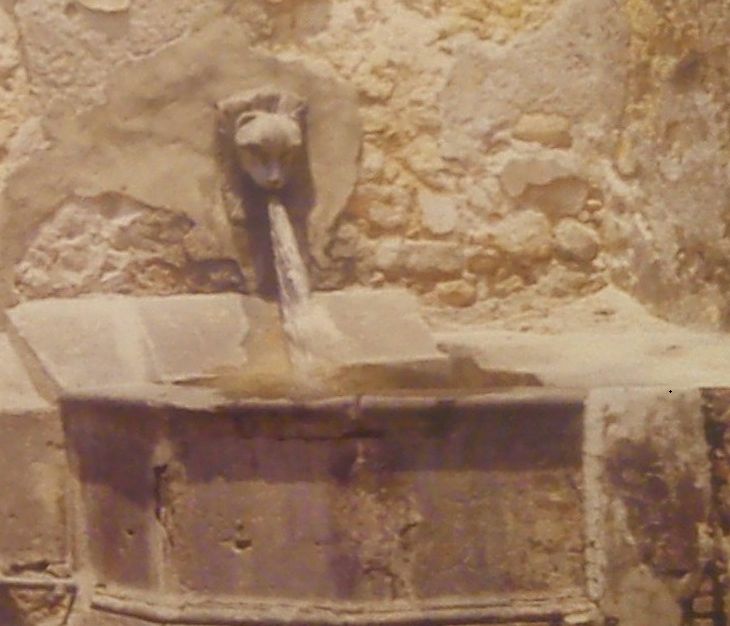
Waterspout gargoyle on the west stone wall of the Cathedral of Cuernavaca, State of Morelos, Mexico. In “Medieval systems and later campaigns”, this view records the form, material and setting discussed in the passage. Source image dated 2020; that date records the image, not the original construction. Heterotrofo, Waterspout gargoyle on the west stone wall of the Cathedral of Cuernavaca, State of Morelos, Mexico; CC BY-SA 4.0. Resized proportionally; no crop, retouch or upscaling.
The surviving skyline is rarely a single medieval campaign. Gargoyles fail because their channels carry water and their bodies project into weather. They are replaced, removed or left disconnected when gutters change. Nineteenth-century restorers often designed new creatures to replace missing work or complete an imagined ensemble. Twentieth- and twenty-first-century carvers have continued that process.
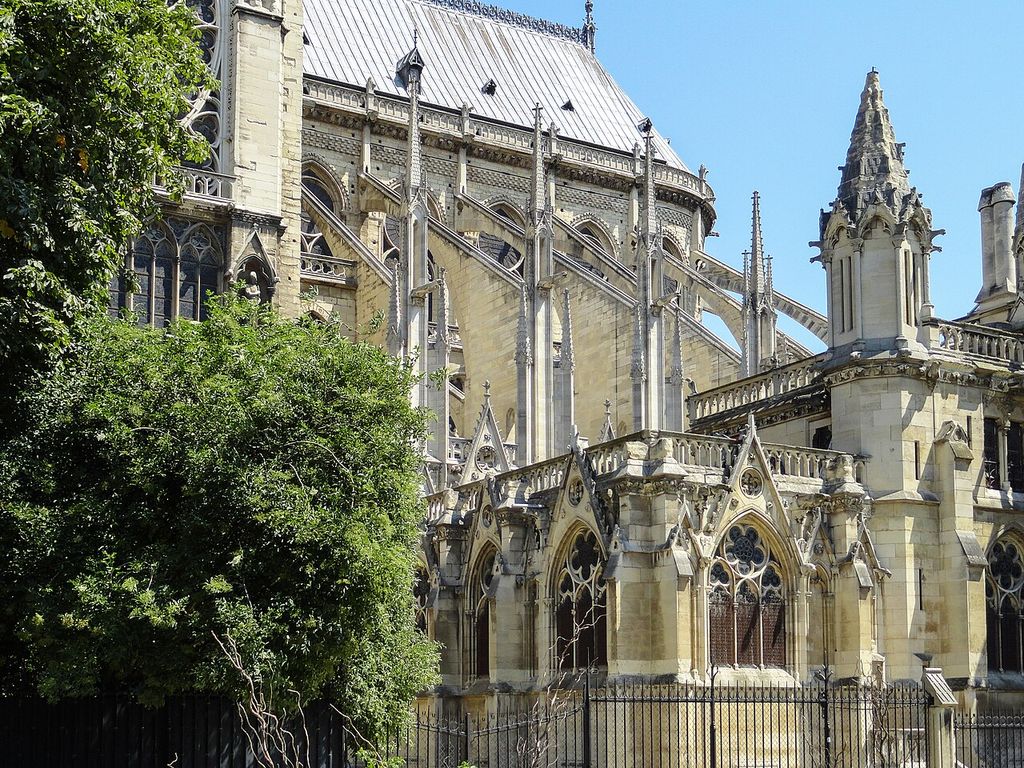
Notre-Dame de Paris exemplifies a layered public image in which medieval fabric, nineteenth-century restoration and modern conservation are easily conflated. French institutional material from the Cité de l’architecture helps place high-level sculpture within the cathedral’s architectural and restoration history.[2] The correct date for a photographed creature must come from records and fabric, not from a generic “medieval Gothic” caption.
This layered history changes interpretation. A nineteenth-century chimera may embody Romantic ideas about the medieval city. A modern replacement may portray a contemporary person or object. It can be entirely authentic as work of its own campaign while not being an original medieval survival.
How gargoyles fail
A gargoyle is deliberately exposed to moving water, which makes maintenance inseparable from design. Leaves, nests, mortar fragments and biological growth can block an inlet. Water then backs up into the roof or spills over unintended edges. Erosion deepens or perforates the channel, producing leaks before the outlet. Open joints let water enter the masonry supporting the spout.
Projection creates leverage. The stone’s weight acts beyond the wall face; wind, ice and accidental loads add stress. If the unit is anchored with iron, corrosion can expand and split its socket. Freeze–thaw cycles act most aggressively where water remains in cracks or depressions. A lost jaw is not merely an iconographic injury if it shortens the discharge throw.
Wind complicates an apparently adequate design. Water that leaves the mouth clear of the wall in calm conditions can be blown back onto masonry. Staining below an outlet is therefore evidence to investigate, not automatic proof that the original projection was foolish. Roof changes, settlement, erosion and more intense rainfall may have altered performance.
Grotesques share many exposure risks even though they do not carry water internally. Deep undercutting creates fragile ears, wings and limbs. Water concentrates behind projections. Bird deposits and plant growth retain moisture. A corroding fixing can detach a large piece above a public route.
Inspecting without guessing
From the ground, use binoculars or a long lens to identify mouths, channels and staining. Compare the carving with the roof line directly behind it. A drone survey may show inlets and upper joints but requires permission and appropriate operation. Scaffold access makes tapping, close photography and measured recording possible.
A useful record separates six observations:
- Object: material, dimensions, subject and carving style.
- Channel: inlet, bore, bed and outlet.
- Connection: gutter, chute, roof valley or evidence of a former link.
- Throw: projection and the wall or roofs beneath.
- Condition: blockage, cracks, erosion, displacement, staining and previous repair.
- Campaign: documented date, maker and relationship to neighbouring fabric.
This structure also helps with borderline cases. A stone beast may have an open mouth but no bore. A plain chute may be a gargoyle without a figure. A once-functioning outlet may now terminate inside a modern gutter. Description can acknowledge the physical form, former function and present state separately.
Conservation choices
The first duty is to restore safe water disposal, not to sharpen the creature’s expression. Clearing a blockage, repairing an upstream gutter or renewing a compatible joint can protect more fabric than recarving a damaged face. Any intervention must understand the complete rainwater system and the capacity required for current rainfall.[3]
Where a spout is badly eroded, a discreet lead lining may preserve historic stone while restoring flow, but the detail has to avoid trapping moisture or disfiguring the outlet. A dangerous projecting unit may need temporary restraint or removal. Recording its position and internal construction before dismantling is essential.
Replacement poses artistic questions. Copying a surviving neighbour can restore rhythm but falsely imply that a lost subject was identical. A new contemporary carving can continue the building’s tradition honestly if its date is recorded and the wider conservation policy supports it. The right choice depends on evidence, significance and the coherence of the ensemble.
Cleaning should be cautious. Dark crust may accelerate decay in some conditions, but it can also contain historical surface and create the visual depth by which carving is read. Abrasive treatment that makes a grotesque look “new” can erase tool marks and weaken projections.
Gargoyles, grotesques and the life of the building
The comparison ultimately reveals two ways sculpture participates in architecture. The gargoyle makes a necessary environmental system visible and memorable. The grotesque gives the building an inhabited edge, projecting bodies and imaginations into public space. Their forms overlap because both exploit the drama of projection; their definitions separate because one deliberately carries water. Reading sculpture through its original position also guards against treating a displaced carving as a self-contained museum object.[4]
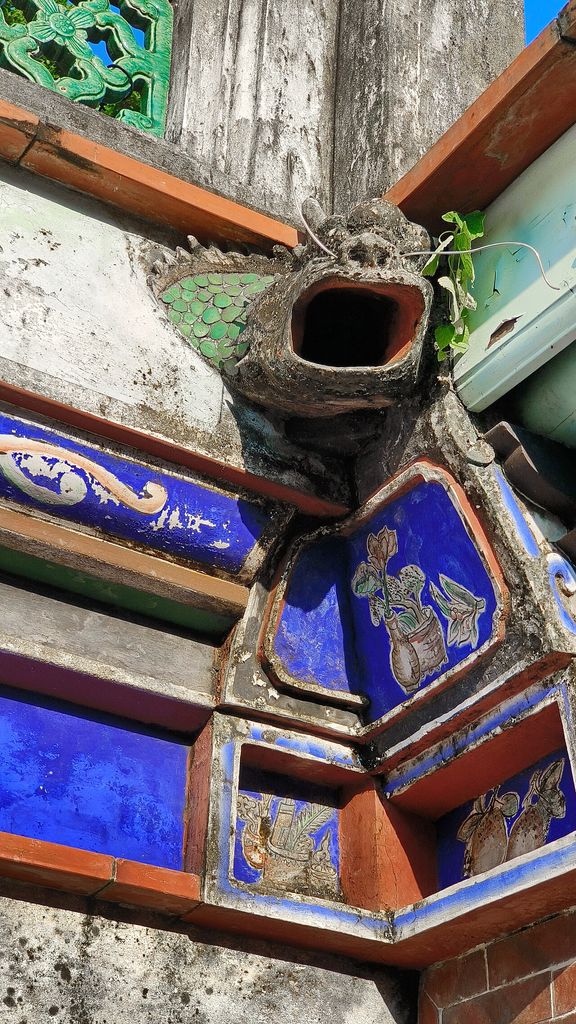
Lu Mansion, dragon-gargoyle drainage system, Anping, Tainan City (Taiwan). Lu Mansion, dragon-gargoyle drainage system, Anping, Tainan City, Taiwan. In “Gargoyles, grotesques and the life of the building”, this view records the form, material and setting discussed in the passage. Source image dated 2026; that date records the image, not the original construction. Mkoo2010, Lu Mansion, dragon-gargoyle drainage system, Anping, Tainan City (Taiwan); CC BY-SA 4.0. Resized proportionally; no crop, retouch or upscaling.
That distinction makes looking more rewarding, not less magical. Following the channel exposes roofs, craft and maintenance. Dating the carving reveals restoration and modern authorship. Testing symbolic claims produces richer, local explanations. The strange creature on the wall becomes part of a working, changing building rather than a generic medieval monster.
The whole rainwater route
A gargoyle begins far behind its carved mouth. Rain strikes a roof, runs to a valley or gutter, passes through an outlet and enters the stone channel. The projection must throw water beyond ledge, wall and foundation. If any upstream component is blocked or undersized, the creature may overflow from joints rather than discharge cleanly.
Tracing that path explains anomalies. A functional medieval gargoyle can become dry after a concealed downpipe is installed. A nineteenth-century replica may be connected to a new gutter while an older carving remains ornamental. A grotesque can acquire a drilled pipe and begin to serve drainage. Function belongs to the present fabric and historical sequence, not forever to the original sculptural type.
Performance changes with rainfall. A channel that handles ordinary showers may be overwhelmed by intense storms; wind can drive the jet back against masonry. Staining below the mouth, eroded bedding and vegetation in the gutter all provide evidence. Safe inspection should include wet-weather observation where possible, rather than inferring the water path from dry photographs.
Notre-Dame and the manufactured medieval imagination
The famous creatures on Notre-Dame de Paris do not all have the same date or function. Medieval drainage belongs to the cathedral's long fabric, but many of the chimeras that dominate modern photography arose from the nineteenth-century restoration associated with Viollet-le-Duc. Their elevated gallery and expressive silhouettes helped create a powerful modern image of the Gothic.[2]
This does not make them historically unimportant. They document restoration theory, Romantic medievalism, new urban viewpoints and the growth of photography and mass tourism. The error is chronological flattening: labelling every creature medieval, or assuming every projecting monster is a waterspout.
Close description resolves the issue. Does the back connect to a gutter? Is there an open channel through the body? Does staining follow discharge? What does the masonry joint show about insertion? Archival drawings then place the object in a campaign. The conclusion can acknowledge a nineteenth-century grotesque as a major part of the cathedral's received identity without inventing a medieval date.
Image, warning and comic excess
Animal and hybrid bodies give a practical outlet memorable form. Open jaws suit the discharge of water, elongated necks provide projection, and crouching bodies can visually anchor the object to a ledge. Carvers could exploit the view from below through large eyes, compressed torsos and dramatic contours.
Interpretations range from apotropaic protection and moral warning to satire, marginality and workshop play. Some are persuasive in particular iconographic programmes; none should be imposed on every creature. A pig, monk, dragon or grimacing human may have local resonance that depends on date, patron and neighbouring imagery.
The building itself provides context. Sacred façades often juxtapose ordered saints with unruly margins. Yet a drain's marginal position can also be the simple result of roof engineering. Functional and symbolic explanations need not exclude one another, but the physical necessity should not be romanticised away.
Repairing drainage without silencing sculpture
Emergency responses sometimes cap a leaking gargoyle or divert water into a pipe. That may protect masonry temporarily, but it changes the feature's purpose and can leave water trapped in the old channel. Repair should address roof falls, gutter capacity, joints and outlet together.
Loss at the mouth shortens the throw and can suddenly wet the wall. A small indent repair may restore hydraulic performance without replacing the entire carving. Where an object is structurally unsafe, dismantling can allow concealed cramps and fractures to be understood; numbering and three-dimensional recording preserve its assembly.
Replicas raise the familiar conservation dilemma. A copy can restore drainage and retain the original under shelter, but the building loses weathered carving and gains a new interpretation. If the original remains in situ, sacrificial repairs and regular maintenance may accept gradual change. The choice depends on significance, risk and the feasibility of inspection—not on a universal preference for either age or crispness.
Watch: function, carving and afterlife
Choose Chester Cathedral: Gargoyles and Grotesques, Gothic Architecture Explained or Gothic Architecture—When Cathedrals Reached Up to the Heavens. Together, the films connect architectural form with material, use and historical setting.
Chester Cathedral: Gargoyles and Grotesques
A close visual survey for testing outlet, projection and creature type on one cathedral
Watch on YouTubeDiscussion
Which building or designed landscape most clearly demonstrates Gargoyles vs Grotesques, and what physical evidence supports that reading?
Reader Insights
Name the material, joint, opening, route or view you can observe.
Give the place, approximate date and a reliable source.
Separate documented history from your interpretation.
Join the Conversation
Share a concise observation or useful source below.
References
- Washington National Cathedral, “Gothic Architecture 101.” View source
- Cité de l’architecture et du patrimoine, Notre-Dame architectural dossier. View source
- Historic England, technical advice on building services and rainwater disposal in historic fabric. View source
- Metropolitan Museum of Art, “Medieval European Sculpture for Buildings.” View source